The BRCA1 gene is located on which chromosome?
What is true regarding cytoplasmic messenger RNA (mRNA)?
What is an Okazaki fragment?
Lac operon transcription is induced by what substance?
Which of the following conditions is associated with hnRNA?
In DNA, the coding region reads 5'-CGT-3'. This would code in the RNA as:
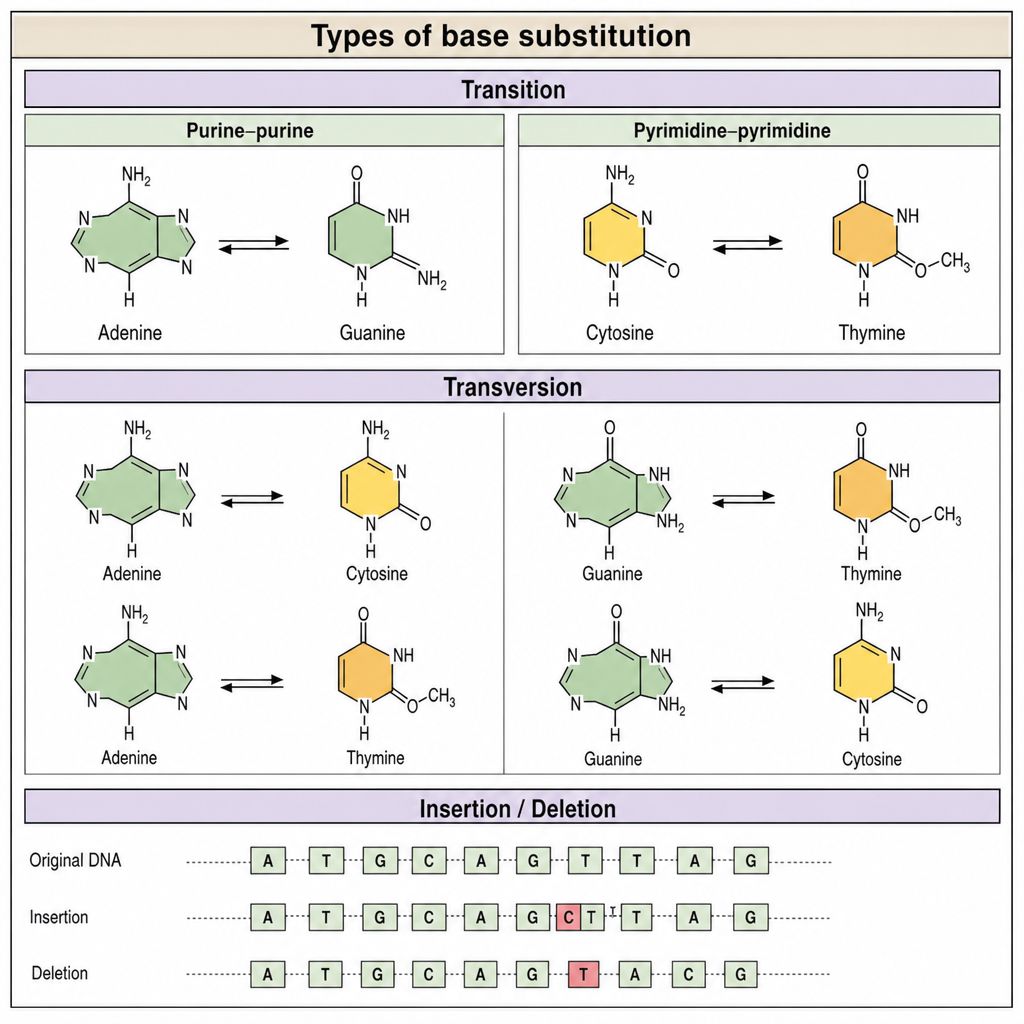
Thalassemia occurs due to which type of mutations?
In a DNA molecule, one strand contains 20 thymine (T), 25 cytosine (C), 30 guanine (G), and 22 adenine (A) residues. How many of each base pair are found in the complete double-stranded molecule?
Which statement regarding nucleotide repair mechanisms is FALSE?
A dideoxynucleotide does not contain which of the following?
Explanation: **Explanation:** The **BRCA1 (Breast Cancer 1)** gene is a tumor suppressor gene located on the **long (q) arm of Chromosome 17 (specifically 17q21)**. It plays a critical role in maintaining genomic stability by encoding a protein involved in the repair of double-stranded DNA breaks via **homologous recombination**. Mutations in this gene significantly increase the lifetime risk of breast, ovarian, and fallopian tube cancers. **Analysis of Options:** * **Option C (Correct):** BRCA1 is located on **Chromosome 17**. A helpful mnemonic is "BRCA**1** is on **17**" (both have a '7' or '1' association). * **Option A:** **Chromosome 13** is the location of the **BRCA2** gene (specifically 13q12.3). While both genes are involved in DNA repair, they are located on different chromosomes. * **Option B:** **Chromosome 11** houses several important genes like the Beta-globin gene cluster and the WT1 (Wilms tumor) gene, but not BRCA1. * **Option D:** **Chromosome 22** is associated with the NF2 gene and the "Philadelphia Chromosome" (translocation with Chromosome 9), but not BRCA1. **High-Yield Clinical Pearls for NEET-PG:** * **Inheritance:** Autosomal Dominant with variable expressivity. * **DNA Repair Mechanism:** BRCA1/2 are essential for **Homologous Recombination** (error-free repair). Deficiency leads to "BRCAness," making tumors sensitive to **PARP inhibitors** (e.g., Olaparib) via synthetic lethality. * **Cancer Risks:** BRCA1 carries a higher risk of **Ovarian Cancer** (up to 40%) compared to BRCA2 (up to 20%). BRCA2 is more strongly associated with **Male Breast Cancer**. * **Li-Fraumeni Syndrome:** Also involves Chromosome 17, but is due to a mutation in the **TP53** gene (17p13).
Explanation: ### Explanation **Correct Option: A (It is chiefly translated from nuclear DNA)** In eukaryotic cells, the genetic blueprint is stored in the nucleus as DNA. mRNA is synthesized through the process of **transcription**, where an RNA polymerase enzyme uses the nuclear DNA as a template. Once processed, this mRNA is exported to the cytoplasm to serve as a template for protein synthesis (translation). Thus, cytoplasmic mRNA is the direct transcript of nuclear genetic information. **Analysis of Incorrect Options:** * **B & C:** These options describe the characteristics of **DNA**, not RNA. mRNA contains **ribose** sugar (not deoxyribose) and the nitrogenous base **uracil** (not thymine). * **D:** mRNA is actually **smaller** than heterogeneous nuclear RNA (hnRNA). hnRNA is the primary transcript (pre-mRNA) that contains both exons (coding regions) and introns (non-coding regions). During post-transcriptional modification (splicing), introns are removed and a 5' cap and 3' poly-A tail are added, resulting in a shorter, mature mRNA molecule. **Clinical Pearls & High-Yield Facts for NEET-PG:** * **Post-transcriptional modifications:** Occur in the nucleus and include 5’ capping (7-methylguanosine), 3’ polyadenylation (Poly-A tail), and splicing. * **Splicing:** Carried out by **snRNPs** (small nuclear ribonucleoproteins). Autoantibodies against snRNPs (Anti-Smith antibodies) are highly specific for **Systemic Lupus Erythematosus (SLE)**. * **mRNA Stability:** The poly-A tail at the 3' end determines the stability and lifespan of the mRNA in the cytoplasm. * **Codons:** mRNA is read in triplets called codons; the start codon is almost always **AUG** (coding for Methionine).
Explanation: ### Explanation **Correct Option: C (A DNA fragment with an RNA primer)** **Concept:** DNA replication is **semidiscontinuous**. While the leading strand is synthesized continuously, the **lagging strand** is synthesized in short, discontinuous segments known as **Okazaki fragments**. DNA polymerase requires a free 3'-OH group to initiate synthesis, which is provided by an **RNA primer** (synthesized by the enzyme Primase). Therefore, each Okazaki fragment begins with a short RNA primer (approx. 10 nucleotides) followed by a stretch of newly synthesized DNA (approx. 100–200 nucleotides in eukaryotes). Eventually, the RNA primers are removed by DNA Polymerase I (in prokaryotes) or RNase H/FEN1 (in eukaryotes) and replaced with DNA. **Why other options are incorrect:** * **Option A & B:** These are incomplete. An Okazaki fragment is a hybrid molecule during the replication process; it is not purely DNA or purely RNA until the maturation phase. * **Option D:** This is biologically reversed. Primers are always RNA (in natural replication), and the elongation is always DNA. --- ### High-Yield Clinical Pearls for NEET-PG: * **Directionality:** Okazaki fragments are synthesized in the **5' → 3' direction**, even though the lagging strand overall grows in the 3' → 5' direction relative to the replication fork. * **DNA Ligase:** This enzyme is responsible for joining Okazaki fragments by forming phosphodiester bonds. It is the "glue" of the lagging strand. * **Clinical Correlation:** Deficiencies in enzymes involved in Okazaki fragment processing (like **DNA Ligase I**) can lead to clinical conditions like **Bloom Syndrome** (characterized by genomic instability and sister chromatid exchanges). * **Length:** Okazaki fragments are significantly shorter in eukaryotes (100–200 bp) compared to prokaryotes (1000–2000 bp).
Explanation: The **Lac Operon** is a classic model of prokaryotic gene regulation, functioning as an inducible system that ensures bacteria only expend energy to metabolize lactose when it is present and glucose is absent. ### **Why "An inducer without glucose" is correct:** Transcription of the Lac operon requires two simultaneous conditions: 1. **Presence of an Inducer (Allolactose):** The inducer binds to the **repressor protein**, causing it to detach from the operator site. This "unlocks" the gene for transcription. 2. **Absence of Glucose (Positive Control):** When glucose levels are low, **Adenylate Cyclase** is active, increasing **cAMP** levels. cAMP binds to the **Catabolite Activator Protein (CAP)**. The cAMP-CAP complex then binds to the promoter, acting as a "gas pedal" to recruit RNA polymerase for high-level transcription. ### **Why other options are incorrect:** * **A & B (Glucose present):** Glucose is the preferred energy source. If glucose is present, cAMP levels remain low. Without the cAMP-CAP complex, RNA polymerase cannot bind efficiently to the promoter (Catabolite Repression), even if an inducer is present. * **D:** Transcription is highly specific; it is inhibited by the presence of glucose and the absence of an inducer. ### **High-Yield Clinical Pearls for NEET-PG:** * **Inducer:** The natural inducer is **allolactose** (a lactose metabolite). In laboratory settings, **IPTG** (Isopropyl β-D-1-thiogalactopyranoside) is used as a "gratuitous inducer" because it isn't metabolized. * **Diauxic Growth:** If both glucose and lactose are provided, the bacteria show a biphasic growth curve—using glucose first, followed by a lag phase, then using lactose. * **Constitutive Mutations:** Mutations in the **i gene** (repressor) or the **operator** can lead to "constitutive expression," where the operon is always "on" regardless of inducer presence.
Explanation: **Explanation:** **Correct Answer: A. Spinal Muscular Atrophy (SMA)** The correct answer is **Spinal Muscular Atrophy** because it is fundamentally a disease of **hnRNA (heterogeneous nuclear RNA) processing**, specifically involving **alternative splicing**. * **Mechanism:** SMA is caused by a mutation/deletion in the *SMN1* (Survival Motor Neuron 1) gene. Humans have a nearly identical backup gene called *SMN2*. However, in *SMN2*, a single nucleotide change in an exon causes the splicing machinery to skip Exon 7 during the processing of hnRNA into mRNA. This results in a truncated, non-functional protein. * **Clinical Link:** The pathology lies in the **Spliceosome** assembly. The SMN protein is essential for the assembly of snRNPs (small nuclear ribonucleoproteins), which are the "building blocks" of the spliceosome that processes hnRNA. **Why the other options are incorrect:** * **B. Sickle Cell Disease:** This is caused by a **missense mutation** (point mutation) in the DNA (GAG → GTG), leading to a single amino acid substitution (Glutamic acid to Valine) in the beta-globin chain. It does not involve hnRNA processing. * **C. Huntington’s Chorea:** This is a **trinucleotide repeat expansion** disorder (CAG repeats) affecting protein folding and aggregation, not primary RNA splicing. * **D. Alpha-thalassemia:** This is most commonly caused by **large gene deletions** of the alpha-globin genes on Chromosome 16, leading to decreased synthesis of alpha chains. **High-Yield NEET-PG Pearls:** * **hnRNA** is the primary transcript (pre-mRNA) containing both introns and exons. * **Splicing** occurs in the nucleus; it removes introns and joins exons. * **Nusinersen (Spinraza):** A high-yield drug for SMA that acts as an antisense oligonucleotide to modify the splicing of *SMN2* hnRNA, forcing the inclusion of Exon 7. * **Other Splicing Diseases:** Systemic Lupus Erythematosus (SLE) involves antibodies against snRNPs (Anti-Smith antibodies).
Explanation: ### Explanation **1. Why Option A is Correct:** In molecular biology, DNA consists of two strands: the **coding (sense) strand** and the **template (antisense) strand**. * The **coding strand** (5' to 3') has the same sequence and polarity as the resulting mRNA, with the sole exception that **Thymine (T)** in DNA is replaced by **Uracil (U)** in RNA. * The **template strand** (3' to 5') is the one actually read by RNA polymerase to synthesize mRNA via complementary base pairing. Since the question provides the **coding region** as 5'-CGT-3', the mRNA will be identical in sequence and direction, replacing T with U. Thus, 5'-CGT-3' (DNA) becomes **5'-CGU-3' (RNA)**. **2. Why Other Options are Incorrect:** * **Option B (5'-GCA-3'):** This is the sequence of the **template strand** (complementary to the coding strand). While RNA polymerase uses this as a template, the resulting RNA is complementary to it, not identical to it. * **Option C (5'-ACG-3'):** This represents the sequence if read backward or incorrectly transcribed without maintaining polarity. * **Option D (5'-UGC-3'):** This is the **anticodon** sequence (found on tRNA) that would pair with the mRNA codon 5'-CGU-3'. **3. NEET-PG High-Yield Pearls:** * **The "Golden Rule":** mRNA sequence = Coding strand sequence (T $\rightarrow$ U). * **Directionality:** RNA synthesis always occurs in the **5' $\rightarrow$ 3' direction**. * **Template vs. Coding:** The template strand is also called the **non-coding** or **antisense** strand. The coding strand is also called the **sense** strand. * **Clinical Correlation:** Many antibiotics (like Rifampicin) and toxins (like $\alpha$-amanitin) act by inhibiting RNA polymerase, preventing this transcription process.
Explanation: **Explanation:** Thalassemia is a quantitative hemoglobinopathy characterized by the reduced or absent synthesis of alpha or beta-globin chains. While various mutations can cause Thalassemia, **Splicing mutations** are the most characteristic and high-yield mechanism associated with **$\beta$-Thalassemia**. **1. Why Splicing Mutations are correct:** In $\beta$-Thalassemia, mutations often occur at the **intron-exon junctions** (splice sites) or within introns (creating "cryptic" splice sites). These mutations interfere with the normal removal of introns during pre-mRNA processing. This leads to the production of abnormal mRNA transcripts that are either degraded or translated into non-functional proteins, significantly reducing the amount of normal globin chains produced. **2. Analysis of Incorrect Options:** * **A. Missense mutations:** These involve a single base substitution resulting in a different amino acid. This is the hallmark of **qualitative** hemoglobinopathies like **Sickle Cell Anemia** (Glutamate to Valine at position 6), rather than the quantitative deficiency seen in Thalassemia. * **C. Transition mutations:** This is a type of point mutation (purine to purine). While a transition *could* cause a splice site mutation, it is a general term for a chemical change, not the specific pathogenic mechanism defining Thalassemia. * **D. All of the above:** While rare cases of missense mutations causing Thalassemia exist, splicing mutations (along with promoter mutations and chain terminations) are the classic, textbook mechanism tested in exams. **High-Yield Clinical Pearls for NEET-PG:** * **$\beta$-Thalassemia:** Most commonly due to **Point Mutations** (specifically Splicing, Promoter, or Nonsense mutations). * **$\alpha$-Thalassemia:** Most commonly due to **Gene Deletions**. * **Hallmark finding:** Microcytic hypochromic anemia with "Target cells" on peripheral smear and increased HbA2 (>3.5%) in $\beta$-Thalassemia minor.
Explanation: ### Explanation **1. Understanding the Correct Answer (Option D)** The fundamental principle governing this question is **Chargaff’s Rule** of base pairing. In a double-stranded DNA (dsDNA) molecule, the two strands are complementary and antiparallel. This means: * Every **Adenine (A)** on Strand 1 pairs with a **Thymine (T)** on Strand 2. * Every **Guanine (G)** on Strand 1 pairs with a **Cytosine (C)** on Strand 2. To find the total count for the whole molecule, you must sum the bases from both strands: * **Total Adenine (A):** A from Strand 1 (22) + A from Strand 2 (which equals T from Strand 1, i.e., 20) = **42**. * **Total Thymine (T):** T from Strand 1 (20) + T from Strand 2 (which equals A from Strand 1, i.e., 22) = **42**. * **Total Guanine (G):** G from Strand 1 (30) + G from Strand 2 (which equals C from Strand 1, i.e., 25) = **55**. * **Total Cytosine (C):** C from Strand 1 (25) + C from Strand 2 (which equals G from Strand 1, i.e., 30) = **55**. Thus, the final composition is **A=42, T=42, G=55, C=55**. **2. Why Other Options are Incorrect** * **Option A & C:** These options violate Chargaff’s Rule (A must equal T, and G must equal C in dsDNA). In Option A, A=40 but T=44; in Option C, A=44 but T=40. * **Option B:** This simply lists the values of the single strand provided in the question but swaps some numbers. It does not account for the complementary second strand. **3. High-Yield Clinical Pearls for NEET-PG** * **Chargaff’s Rule:** States that in dsDNA, the molar ratio of A:T is 1:1 and G:C is 1:1. Therefore, **Purines (A+G) = Pyrimines (T+C)**. * **Melting Temperature (Tm):** DNA with higher G-C content has a higher Tm because G-C pairs are held by **three hydrogen bonds**, whereas A-T pairs have only **two**. * **Exception:** Chargaff’s rule does **not** apply to single-stranded DNA (ssDNA) or RNA (except in specific double-stranded viral genomes). If A ≠ T in a DNA analysis, the DNA is likely single-stranded.
Explanation: ### Explanation **1. Why Option C is the correct (False) statement:** Mismatch Repair (MMR) is a post-replicative proofreading mechanism. It identifies and corrects errors (mismatches and small insertions/deletions) that escape the proofreading activity of DNA polymerase. Because this process occurs immediately after DNA replication, it primarily takes place during the **S phase** (when DNA is being synthesized) and the **G2 phase** (to catch remaining errors before mitosis), rather than the G1 phase. **2. Analysis of other options:** * **Option A (True):** UV radiation (specifically UV-B) causes the formation of **cyclobutane pyrimidine dimers**, most commonly thymine-thymine (T-T) dimers. These are typically repaired by Nucleotide Excision Repair (NER). * **Option B (True):** **MUTYH** is a DNA glycosylase involved in **Base Excision Repair (BER)**. It specifically fixes oxidative damage (8-oxoG). Mutations in this gene lead to MUTYH-associated polyposis (MAP), an autosomal recessive colorectal cancer syndrome. * **Option D (True):** Base Excision Repair (BER) functions throughout the cell cycle but is most active during the **G1 phase** to remove damaged bases (like those caused by deamination or alkylation) before the cell enters the S phase. **3. Clinical Pearls & High-Yield Facts for NEET-PG:** * **Mismatch Repair (MMR) Deficiency:** Associated with **Lynch Syndrome** (Hereditary Non-Polyposis Colorectal Cancer - HNPCC). Look for "Microsatellite Instability" (MSI) in the question stem. * **Nucleotide Excision Repair (NER) Deficiency:** Leads to **Xeroderma Pigmentosum** (extreme UV sensitivity, skin cancers). * **Base Excision Repair (BER) Mnemonic:** "GEL P" (Glycosylase, Endonuclease, Lyase, Polymerase, Ligase) represents the sequence of enzymes involved. * **Double-Strand Break Repair:** Defective in **Ataxia-Telangiectasia** (ATM gene) and **BRCA1/2** mutations (Homologous Recombination).
Explanation: **Explanation:** The core concept here is the structure of nucleotides used in DNA synthesis versus DNA sequencing. A standard **Deoxynucleotide (dNTP)** lacks an -OH group at the 2' position but possesses a hydroxyl (-OH) group at the 3' position, which is essential for forming phosphodiester bonds. **1. Why Option A is Correct:** A **Dideoxynucleotide (ddNTP)** is a synthetic nucleotide that lacks hydroxyl groups at **both the 2' and 3' positions** (hence "di-deoxy"). In DNA synthesis, the 3' -OH group acts as a nucleophile to attack the incoming nucleotide. Without the 3' -OH group, no further nucleotides can be added to the chain. This leads to **obligatory chain termination**, a principle utilized in Sanger sequencing. **2. Analysis of Incorrect Options:** * **Options B, C, and D:** These are incorrect because all nucleotides (including ddNTPs) must retain their **5' group** (usually attached to phosphates) to initiate a bond with the previous nucleotide, and the **4' position** in the pentose sugar ring does not typically carry a free hydroxyl group in this context. The specific modification that defines a "dideoxy" nucleotide is strictly at the 2' and 3' carbons. **3. NEET-PG High-Yield Pearls:** * **Sanger Sequencing:** Also known as the "Dideoxy chain termination method." It relies on ddNTPs to stop synthesis at specific bases. * **Mechanism of Action:** Drugs like **Zidovudine (AZT)** and **Didanosine (ddI)** used in HIV treatment are nucleoside reverse transcriptase inhibitors (NRTIs). They function similarly to ddNTPs by lacking a 3' -OH group, thereby terminating the viral DNA chain. * **Structure:** Remember: Ribose (RNA) has 2' and 3' -OH; Deoxyribose (DNA) has only 3' -OH; Dideoxyribose (Sequencing/Drugs) has neither.
DNA Replication and Repair Mechanisms
Practice Questions
Transcription Factors and Gene Regulation
Practice Questions
Epigenetics and DNA Methylation
Practice Questions
RNA Processing and Splicing
Practice Questions
miRNA and RNA Interference
Practice Questions
Protein Synthesis and Post-Translational Modifications
Practice Questions
Genomics and Human Genome Project
Practice Questions
Single Nucleotide Polymorphisms
Practice Questions
Gene Therapy Approaches
Practice Questions
CRISPR-Cas9 and Genome Editing
Practice Questions
DNA Fingerprinting and Forensics
Practice Questions
Molecular Basis of Genetic Diseases
Practice Questions
Get full access to all questions, explanations, and performance tracking.
Start For Free