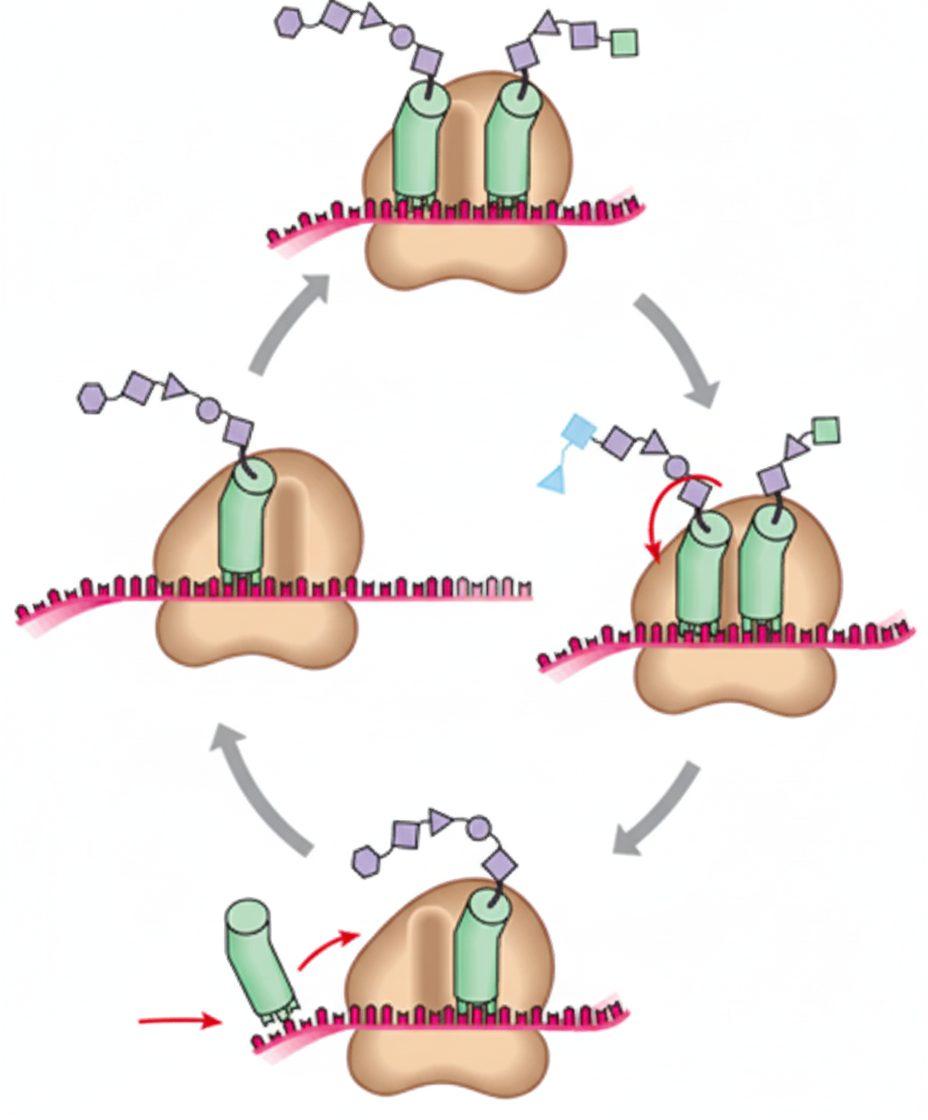
What type of molecule does mRNA represent a complementary copy of?
Which molecular technique utilizes an oligonucleotide probe with a single base pair substitution to detect DNA variations?
To which group does the X chromosome belong?
In DNA transfer, what is the order of vectors from smallest to largest?
Which of the following statements is true regarding the lac operon?
What is a palindrome in the context of DNA?
All of the following are true about DNA methylation except:
DNA repair defect is seen in which of the following conditions?
What technique is used to identify the exact location of a genetic loci?
The process underlying differences in the expression of a gene, based on which parent transmitted it, is called what?
Explanation: ### Explanation **Why the Correct Answer is Right:** The process of **transcription** involves the synthesis of RNA from a DNA template. During this process, the enzyme RNA polymerase reads the **template strand** (antisense strand) of DNA in a 3’ to 5’ direction to synthesize a complementary mRNA molecule in a 5’ to 3’ direction. Because mRNA is formed by base-pairing rules (where Uracil replaces Thymine), it represents a **complementary copy of a single strand of DNA**. Specifically, the mRNA sequence is complementary to the template strand and identical (except for U/T) to the coding (sense) strand. **Analysis of Incorrect Options:** * **A & B (tRNA & rRNA):** These are distinct types of non-coding RNA. While mRNA, tRNA, and rRNA all originate from DNA templates, they do not represent copies of each other. They work together during translation but are transcribed from different genomic loci. * **C (Ribosomal DNA):** rDNA refers to the DNA sequences that code for ribosomal RNA (rRNA). mRNA is transcribed from structural genes (protein-coding genes), not from the specific regions designated as rDNA. **NEET-PG High-Yield Pearls:** * **Directionality:** RNA synthesis always occurs in the **5’ → 3’** direction. * **Template vs. Coding:** The mRNA is complementary to the **Template (Antisense)** strand and identical to the **Coding (Sense)** strand. * **Post-transcriptional Modification:** In eukaryotes, the initial product is **hnRNA** (heterogeneous nuclear RNA), which undergoes 5’ capping, 3’ polyadenylation, and splicing to become mature mRNA. * **Enzyme:** In eukaryotes, **RNA Polymerase II** is responsible for synthesizing mRNA.
Explanation: **Explanation:** The correct answer is **Restriction Fragment Length Polymorphism (RFLP)**. **1. Why RFLP is correct:** RFLP is a technique used to detect variations in homologous DNA sequences. It relies on the fact that a **single base pair substitution** (Single Nucleotide Polymorphism or SNP) can either create or destroy a specific recognition site for a **restriction endonuclease**. When the DNA is digested with these enzymes, the resulting fragments differ in length. These fragments are then separated by electrophoresis and hybridized with a labeled **oligonucleotide probe** to visualize the specific variations. This method is classically used for genetic mapping and carrier detection in diseases like Sickle Cell Anemia (where a point mutation destroys the *MstII* restriction site). **2. Why other options are incorrect:** * **A. Polymerase Chain Reaction (PCR):** While PCR amplifies DNA, it is a tool for synthesis rather than a specific detection technique for base substitutions on its own. It requires subsequent steps (like sequencing or RFLP) to identify specific point mutations. * **C. Error-coded mutation analysis:** This is not a standard molecular biology term used in the context of probe-based DNA variation detection. It likely refers to error-correcting codes in bioinformatics or sequencing quality control, which is unrelated to the biochemical mechanism described. **3. Clinical Pearls & High-Yield Facts for NEET-PG:** * **Sickle Cell Anemia:** The gold standard for historical RFLP questions. The mutation (GAG → GTG) eliminates the *MstII* enzyme recognition site. * **VNTRs:** RFLP often utilizes Variable Number Tandem Repeats as markers for DNA fingerprinting and paternity testing. * **Southern Blotting:** RFLP is essentially a variation of Southern Blotting used to detect DNA polymorphisms. * **Limitation:** RFLP requires a large amount of high-quality DNA compared to modern PCR-based methods (like Allele-Specific PCR).
Explanation: ### Explanation Human chromosomes are classified into seven groups (**A to G**) based on the **Denver Classification System**, which categorizes them according to their size and the position of the centromere. **Why Group C is Correct:** The **X chromosome** is classified under **Group C**. This group consists of medium-sized submetacentric chromosomes (Pairs 6 to 12 and the X chromosome). Because the X chromosome is similar in size and centromere position to chromosomes 6–12, it is grouped with them. **Analysis of Incorrect Options:** * **Group A (Chromosomes 1–3):** These are the largest chromosomes and are primarily metacentric (except for chromosome 2, which is submetacentric). * **Group B (Chromosomes 4–5):** These are large chromosomes with submetacentric centromeres. * **Group D (Chromosomes 13–15):** These are medium-sized **acrocentric** chromosomes that possess satellites (important for forming nucleolus organizer regions). **High-Yield Clinical Pearls for NEET-PG:** * **The Y Chromosome:** Belongs to **Group G** (along with chromosomes 21 and 22). These are the smallest acrocentric chromosomes. * **Acrocentric Chromosomes:** Groups D (13, 14, 15) and G (21, 22) are acrocentric. These are the sites for **Robertsonian translocations**, commonly associated with Down Syndrome. * **Denver Classification Summary:** * **Group A:** 1–3 (Largest) * **Group B:** 4–5 * **Group C:** 6–12 + **X** (Medium, Submetacentric) * **Group D:** 13–15 (Medium, Acrocentric) * **Group E:** 16–18 * **Group F:** 19–20 * **Group G:** 21–22 + **Y** (Smallest, Acrocentric)
Explanation: In molecular biology, vectors are DNA molecules used as vehicles to carry foreign genetic material into another cell. The capacity of a vector to carry an insert (foreign DNA) determines its classification and utility in genomic studies. ### **Explanation of the Correct Answer** The correct order from smallest to largest carrying capacity is **Plasmids < Bacteriophage < Cosmids**. 1. **Plasmids:** These are extra-chromosomal, circular DNA found in bacteria. They have the smallest capacity, typically carrying inserts of **0.5 to 8 kb**. 2. **Bacteriophages (e.g., Lambda phage):** These are viruses that infect bacteria. They can accommodate larger fragments of DNA, usually between **8 to 25 kb**. 3. **Cosmids:** These are hybrid vectors combining properties of plasmids (ori site) and phage λ (cos sites). They are designed to carry significantly larger genomic fragments, ranging from **30 to 45 kb**. ### **Analysis of Incorrect Options** * **Options A, C, and D:** These are incorrect because they misplace the hierarchy of insert sizes. Plasmids always represent the smallest capacity, while Cosmids represent a "middle-ground" between simple phages and massive artificial chromosomes (like BACs or YACs). ### **High-Yield Clinical Pearls for NEET-PG** To master questions on genomic libraries, remember the expanded hierarchy of vector capacities: * **Plasmids:** <10 kb * **Bacteriophage (λ):** ~10–25 kb * **Cosmids:** ~30–45 kb * **Bacterial Artificial Chromosomes (BAC):** 100–300 kb (Derived from F-plasmid) * **Yeast Artificial Chromosomes (YAC):** 200–2000 kb (Largest capacity; used for Human Genome Project) **Mnemonic:** **P**lease **B**ring **C**offee **B**efore **Y**oga (**P**lasmid < **B**acteriophage < **C**osmid < **B**AC < **Y**AC).
Explanation: The **lac operon** is a classic model of prokaryotic gene regulation, ensuring that *E. coli* metabolizes lactose only when glucose is absent. ### **Explanation of the Correct Answer** **Option D** is correct because **Catabolite Repression** is the mechanism by which glucose prevents the expression of the lac operon. This process is mediated by the **CRP (cAMP Receptor Protein)**, also known as CAP (Catabolite Activator Protein). * When glucose levels are **low**, adenylate cyclase is active, and **cAMP** levels rise. * cAMP binds to **CRP**, forming a complex that binds to the promoter, enhancing RNA polymerase affinity and triggering high-level transcription. * When glucose is **high**, cAMP levels drop, the CRP cannot bind, and the operon remains "off" even if lactose is present. ### **Analysis of Incorrect Options** * **Option A:** The lac repressor is a **tetramer** (not a dimer) and acts as a **negative regulator** because its binding to the operator inhibits transcription. * **Option B:** **IPTG** (Isopropyl β-D-1-thiogalactopyranoside) is a gratuitous inducer (it induces the operon but is not metabolized). CRP is a regulatory protein, not an inducer. * **Option C:** Lactose itself is not the regulator; its isomer **allolactose** acts as the inducer. Furthermore, lactose/allolactose is an inducer that relieves negative regulation, whereas "positive regulation" specifically refers to the cAMP-CRP mechanism. ### **High-Yield Clinical Pearls for NEET-PG** * **Components:** *lacZ* (β-galactosidase), *lacY* (Permease), and *lacA* (Transacetylase). * **Dual Control:** The operon is under both **negative control** (repressor) and **positive control** (cAMP-CRP). * **Requirement for Expression:** For maximal expression, two conditions must be met: **High Lactose** (to remove the repressor) and **Low Glucose** (to allow CRP binding). * **Inducer:** Allolactose is the natural inducer; IPTG is the synthetic/gratuitous inducer used in labs.
Explanation: ### Explanation **Correct Answer: C. A sequence of DNA that reads the same forwards and backward** In molecular biology, a **palindrome** refers to a double-stranded DNA sequence where the nucleotide sequence of one strand reads the same as its complementary strand when both are read in the **5' to 3' direction**. For example: * 5'–**GAATTC**–3' * 3'–**CTTAAG**–5' These sequences exhibit **two-fold rotational symmetry**. Their primary significance in genomics is that they serve as the specific **recognition sites for Restriction Endonucleases** (Restriction Enzymes). These enzymes bind to the palindromic sequence and cleave the phosphodiester backbone, producing either "sticky ends" or "blunt ends," which are fundamental tools in Recombinant DNA Technology. --- ### Why the other options are incorrect: * **A. Synthesis of DNA:** This process is known as **Replication**, catalyzed primarily by DNA Polymerase. * **B. Extrachromosomal molecule of DNA:** This describes a **Plasmid**, which is a circular DNA molecule found in bacteria, often used as a vector in gene cloning. * **C. Small nuclear RNA (snRNA):** These are RNA molecules found within the nucleus that combine with proteins to form **snRNPs** ("snurps"), which are essential for the **splicing** of pre-mRNA. --- ### High-Yield Clinical Pearls for NEET-PG: * **Type II Restriction Endonucleases:** These are the most commonly used enzymes in labs because they cleave within or at a specific distance from their palindromic recognition site. * **EcoRI:** A classic example of a restriction enzyme (derived from *E. coli*) that recognizes the palindrome **5'-GAATTC-3'**. * **Zinc Finger Motifs:** Many DNA-binding proteins and transcription factors recognize palindromic sequences to bind as dimers. * **Hairpin/Stem-loop structures:** Single-stranded DNA or RNA with inverted repeats (palindromes) can fold back on themselves to form these secondary structures, often acting as termination signals or regulatory elements.
Explanation: **Explanation** DNA methylation is a key epigenetic mechanism that involves the addition of a methyl group (–CH₃) to DNA, typically at the 5th carbon of a cytosine ring. **Why Option D is the correct answer (The Exception):** DNA methylation plays a **critical role in carcinogenesis**. Aberrant methylation patterns are hallmarks of cancer: * **Hypermethylation** of promoter regions in tumor suppressor genes (e.g., *p16*, *BRCA1*) leads to gene silencing, allowing uncontrolled cell growth. * **Global Hypomethylation** can lead to genomic instability and the activation of oncogenes. Therefore, stating it has "no role" is factually incorrect. **Analysis of Incorrect Options:** * **Option A:** Methylation primarily occurs at **cytosine residues** within **CpG islands** (regions with a high frequency of Cytosine-guanine phosphodiester bonds). This is catalyzed by DNA methyltransferases (DNMTs). * **Option B:** It is a major regulator of **gene expression**. Generally, high levels of methylation in promoter regions correlate with **transcriptional silencing** (gene "switching off"). * **Option C:** It is the fundamental mechanism behind **genomic imprinting**, where certain genes are expressed in a parent-of-origin-specific manner (e.g., Prader-Willi and Angelman syndromes). **High-Yield Clinical Pearls for NEET-PG:** * **S-Adenosylmethionine (SAM):** The universal methyl donor for DNA methylation. * **5-Azacytidine:** A hypomethylating agent used in the treatment of Myelodysplastic Syndrome (MDS). * **Maintenance vs. De Novo:** DNMT1 maintains methylation patterns during replication, while DNMT3a/3b are responsible for new (de novo) methylation. * **Gene Silencing:** Remember: **Methylation = Mute**; **Acetylation = Active** (referring to histones).
Explanation: This question tests your knowledge of **DNA repair mechanisms** and the clinical syndromes resulting from their failure. Maintenance of genomic integrity is crucial; when specific repair pathways are defective, it leads to chromosomal instability, increased cancer risk, and multisystem disorders. ### **Explanation of the Correct Answer** The correct answer is **D (All of these)** because each of the listed conditions is a classic example of a DNA repair deficiency syndrome: 1. **Xeroderma Pigmentosum (XP):** This is caused by a defect in **Nucleotide Excision Repair (NER)**. Patients cannot repair pyrimidine dimers formed by UV radiation, leading to extreme photosensitivity and a 1000-fold increased risk of skin cancers (Basal Cell Carcinoma, Squamous Cell Carcinoma, and Melanoma). 2. **Bloom’s Syndrome:** This is caused by a mutation in the *BLM* gene, which encodes a member of the **RecQ Helicase** family. Helicases are essential for unwinding DNA during repair and replication. Defective repair leads to "sister chromatid exchanges" and high genomic instability. 3. **Ataxia Telangiectasia (AT):** This results from a mutation in the **ATM gene**, which encodes a protein kinase responsible for detecting **Double-Strand Breaks (DSBs)**. Without ATM, the cell cannot activate the p53 pathway to stop the cell cycle for repair. ### **High-Yield Clinical Pearls for NEET-PG** * **Fanconi Anemia:** Defect in repair of DNA inter-strand cross-links (hypersensitivity to cross-linking agents like Mitomycin C). * **Lynch Syndrome (HNPCC):** Defect in **Mismatch Repair (MMR)** genes (MSH2, MLH1). * **Cockayne Syndrome:** Defect in transcription-coupled DNA repair (presents with "bird-like" facies and dwarfism, but *no* increased risk of skin cancer, unlike XP). * **Hereditary Breast/Ovarian Cancer (BRCA1/2):** Defect in **Homologous Recombination** (Double-strand break repair). **Mnemonic for DNA Repair Defects:** "**ABC**" – **A**taxia Telangiectasia, **B**loom’s Syndrome, **C**ockayne Syndrome (and Fanconi/XP).
Explanation: **Explanation:** **1. Why Fluorescent In-Situ Hybridization (FISH) is correct:** FISH is a cytogenetic technique used to detect and **localize** specific DNA sequences on chromosomes. It utilizes fluorescently labeled DNA probes that are complementary to the target genetic loci. When these probes hybridize to the patient's chromosomes (which are fixed "in-situ" on a slide), they emit a signal that can be visualized under a fluorescence microscope. This allows clinicians to identify the **exact physical location** of a gene and detect numerical or structural abnormalities like microdeletions, translocations, or gene amplifications. **2. Why the other options are incorrect:** * **Polymerase Chain Reaction (PCR):** This is an amplification technique. While it can detect the *presence* or *absence* of a sequence or a mutation, it cannot provide information regarding the physical location of that sequence on a chromosome. * **Chromosome Painting:** This is actually a subset of FISH that uses a "cocktail" of probes to color an *entire* chromosome. While useful for identifying large translocations or identifying "marker" chromosomes, it is not used to pinpoint a specific, exact genetic locus. * **Comparative Genomic Hybridization (CGH):** This technique compares the patient's DNA against a control to detect **copy number variations** (gains or losses). It is excellent for detecting submicroscopic imbalances but does not visualize the specific location of the DNA on a physical chromosome map. **Clinical Pearls for NEET-PG:** * **FISH** is the gold standard for diagnosing **Prader-Willi/Angelman syndrome** (microdeletions) and monitoring **HER2/neu** amplification in breast cancer. * **Rapid Aneuploidy Testing:** FISH can be performed on interphase nuclei (non-dividing cells), allowing for faster results than traditional karyotyping. * **Mnemonic:** FISH = **F**luorescence **I**dentifies **S**pecific **H**abitat (Location) of the gene.
Explanation: **Explanation:** The correct answer is **Genomic Imprinting (Option D)**. **1. Why Genomic Imprinting is Correct:** Genomic imprinting is an epigenetic phenomenon where certain genes are expressed in a parent-of-origin-specific manner. Although an individual inherits two copies of a gene (one from each parent), imprinting causes one copy to be "silenced" (usually via **DNA methylation**), while the other remains active. Therefore, the phenotype of the offspring depends entirely on which parent transmitted the functional allele. **2. Why Other Options are Incorrect:** * **Anticipation (A):** Refers to the phenomenon where a genetic disorder (e.g., Huntington’s disease, Fragile X) becomes more severe or appears at an earlier age in successive generations, typically due to **trinucleotide repeat expansions**. * **Mosaicism (B):** Occurs when an individual has two or more genetically different cell lines derived from a single zygote, usually due to post-zygotic mutations or non-disjunction. * **Non-penetrance (C):** A situation where an individual carries a dominant disease-causing mutation but does not manifest any clinical symptoms of the disease. **3. Clinical Pearls for NEET-PG:** * **Classic Examples:** The best-known examples of imprinting involve **Chromosome 15q11-q13**. * **Prader-Willi Syndrome:** Deletion of the *paternal* allele (Maternal imprinting). * **Angelman Syndrome:** Deletion of the *maternal* allele (Paternal imprinting). * **Mechanism:** Primarily involves **DNA Methylation** (adding methyl groups to cytosine residues in CpG islands) and histone modification. * **Uniparental Disomy (UPD):** Imprinting disorders can also occur if a child inherits two copies of a chromosome from one parent and none from the other.
DNA Replication and Repair Mechanisms
Practice Questions
Transcription Factors and Gene Regulation
Practice Questions
Epigenetics and DNA Methylation
Practice Questions
RNA Processing and Splicing
Practice Questions
miRNA and RNA Interference
Practice Questions
Protein Synthesis and Post-Translational Modifications
Practice Questions
Genomics and Human Genome Project
Practice Questions
Single Nucleotide Polymorphisms
Practice Questions
Gene Therapy Approaches
Practice Questions
CRISPR-Cas9 and Genome Editing
Practice Questions
DNA Fingerprinting and Forensics
Practice Questions
Molecular Basis of Genetic Diseases
Practice Questions
Get full access to all questions, explanations, and performance tracking.
Start For Free