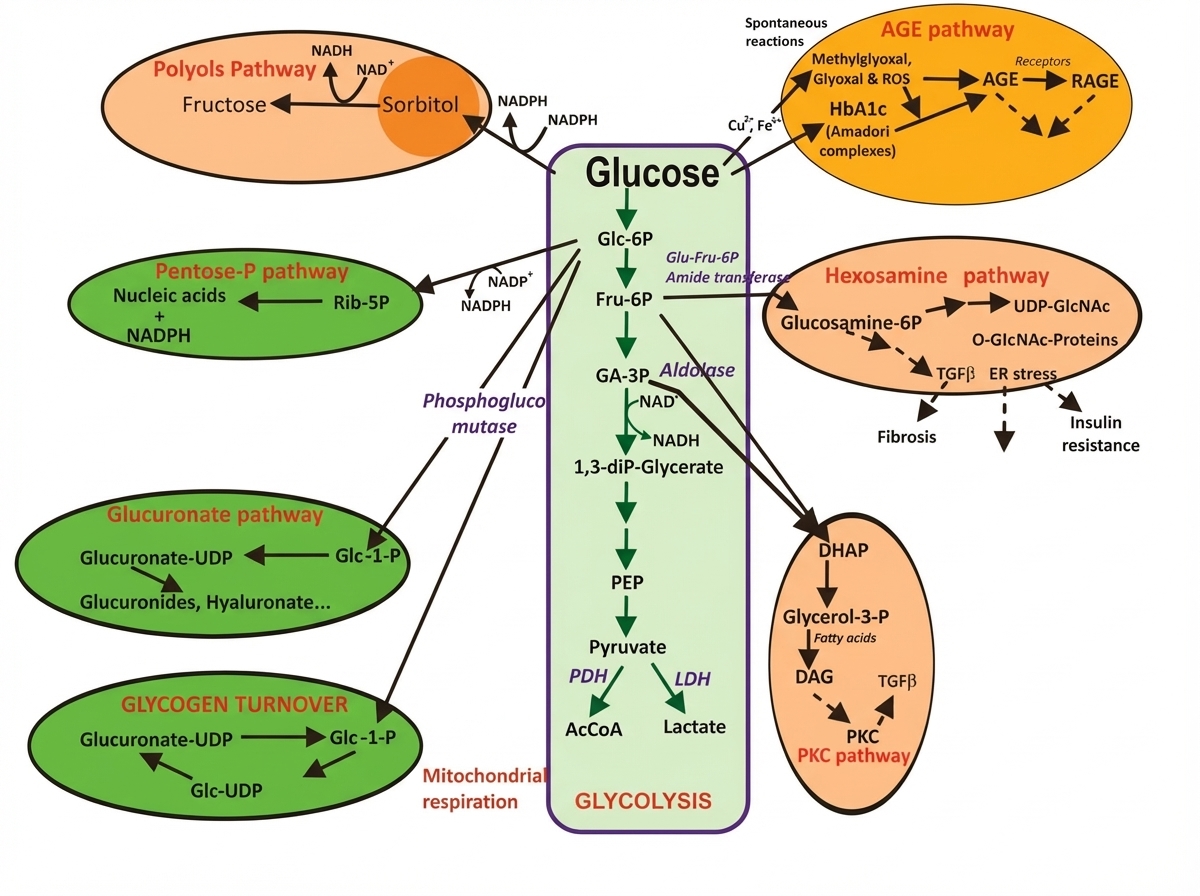
Which of the following are key glycolytic enzymes?
Which of the following carbohydrates is not digested in humans?
What is the Warburg effect?
A 7-month-old infant, recently started on top feeds, presented with diarrhea, vomiting, nausea, abdominal pain, and distension, leading to poor feeding and poor weight gain. On examination, hepatosplenomegaly was observed. Lab findings include decreased blood sugar, increased serum bilirubin, and increased uric acid. A reducing substance was found in the urine during the episode of hypoglycemia. Which of the following statements is FALSE about this condition?
What is the clinical significance of HbA1c?
Glucagon will decrease which of the following?
Enediols are formed by treating sugars with which of the following?
True regarding glucose tolerance test are all except:
What is the key enzyme in glycogenolysis?
What is the best method for measuring long-term blood glucose levels?
Explanation: **Explanation:** In glycolysis, while there are ten enzymatic steps, three specific enzymes are considered **"key"** because they catalyze **irreversible reactions** and serve as the primary regulatory points of the pathway. 1. **Hexokinase (Option B):** This is the first regulatory step. It catalyzes the phosphorylation of Glucose to Glucose-6-Phosphate, effectively "trapping" glucose inside the cell. In the liver and pancreas, its isoenzyme **Glucokinase** performs this role. 2. **Phosphofructokinase-1 (PFK-1) (Option A):** This is the **rate-limiting** and most important control point of glycolysis. It converts Fructose-6-Phosphate to Fructose-1,6-bisphosphate. It is allosterically inhibited by ATP and Citrate, and activated by AMP and Fructose-2,6-bisphosphate. 3. **Pyruvate Kinase (Option C):** This is the final irreversible step, converting Phosphoenolpyruvate (PEP) to Pyruvate, yielding one molecule of ATP via substrate-level phosphorylation. Since all three enzymes (Hexokinase, PFK-1, and Pyruvate Kinase) are the irreversible, rate-controlling catalysts of the pathway, **Option D (All of the above)** is the correct answer. **Clinical Pearls for NEET-PG:** * **PFK-1** is the "committed step" of glycolysis. * **Maturity-Onset Diabetes of the Young (MODY) Type 2** is caused by a mutation in the **Glucokinase** gene. * **Pyruvate Kinase Deficiency** is the second most common cause of enzyme-deficient **hemolytic anemia** (after G6PD deficiency), characterized by echinocytes (burr cells) on peripheral smear. * **Arsenite** poisoning inhibits enzymes requiring Lipoic acid, but **Arsenate** competes with inorganic phosphate in glycolysis, resulting in zero net ATP gain.
Explanation: **Explanation:** The correct answer is **Lactulose**. **1. Why Lactulose is the correct answer:** Lactulose is a synthetic disaccharide composed of **Galactose and Fructose**. Humans lack the specific intestinal enzyme (disaccharidase) required to hydrolyze the bond between these two sugars. Consequently, it remains undigested in the small intestine and passes into the colon. There, it is fermented by colonic bacteria into lactic acid and acetic acid, making it an effective osmotic laxative. **2. Why the other options are incorrect:** * **Maltose:** A disaccharide of Glucose + Glucose. It is digested by the enzyme **Maltase** found in the brush border of the small intestine. * **Sucrose:** Common table sugar (Glucose + Fructose). It is digested by the enzyme **Sucrase**. * **Lactose:** Milk sugar (Galactose + Glucose). It is digested by the enzyme **Lactase**. A deficiency in this enzyme leads to clinical lactose intolerance. **3. High-Yield Clinical Pearls for NEET-PG:** * **Hepatic Encephalopathy:** Lactulose is the drug of choice. It acidifies the gut lumen ($NH_3 \rightarrow NH_4^+$), trapping ammonia as non-absorbable ammonium ions (Ion Trapping), thereby reducing blood ammonia levels. * **Non-digestible Polysaccharide:** While Lactulose is a non-digestible *disaccharide*, **Cellulose** is the most common non-digestible *polysaccharide* in humans due to the absence of cellulase (which breaks $\beta$-1,4 glycosidic bonds). * **Diagnostic Use:** Lactulose is used in "Hydrogen Breath Tests" to diagnose Small Intestinal Bacterial Overgrowth (SIBO).
Explanation: ### Explanation The **Warburg Effect** refers to a unique metabolic phenomenon observed primarily in **cancer cells** and rapidly proliferating cells. **1. Why "Aerobic Glycolysis" is Correct:** In normal differentiated cells, glycolysis occurs in the cytoplasm, followed by oxidative phosphorylation in the mitochondria under aerobic conditions. However, cancer cells preferentially convert glucose to **lactate** even in the presence of **abundant oxygen**. This shift from oxidative phosphorylation to high-rate glycolysis is termed **Aerobic Glycolysis**. While less ATP-efficient per glucose molecule, it provides the carbon skeletons (metabolic intermediates) necessary for the rapid synthesis of proteins, lipids, and nucleic acids required for tumor growth. **2. Analysis of Incorrect Options:** * **A. Anaerobic glycolysis:** This is the normal physiological response to a lack of oxygen (e.g., in exercising muscle). The Warburg effect is distinct because it occurs despite oxygen availability. * **C. Inhibition of glycolysis by oxygen:** This describes the **Pasteur Effect**, where oxygen inhibits fermentation/glycolysis in yeast or normal tissues to favor more efficient ATP production. * **D. Inhibition of oxygen uptake by glycolysis:** This describes the **Crabtree Effect**, where high glucose concentrations suppress mitochondrial respiration in some tissues. **3. Clinical Pearls & High-Yield Facts for NEET-PG:** * **PET Scan (Positron Emission Tomography):** This imaging modality exploits the Warburg effect. It uses **18-Fluorodeoxyglucose (FDG)**, a glucose analog, to detect "hotspots" of high glucose uptake, identifying primary tumors and metastases. * **HIF-1α (Hypoxia-Inducible Factor):** This transcription factor often mediates the Warburg effect by upregulating glucose transporters (GLUT1, GLUT3) and glycolytic enzymes. * **Key Enzyme:** Tumor cells often express **Pyruvate Kinase M2 (PKM2)**, which promotes the diversion of glycolytic intermediates into biosynthetic pathways.
Explanation: ### **Explanation** **Diagnosis: Hereditary Fructose Intolerance (HFI)** The clinical presentation of symptoms (vomiting, hypoglycemia, hepatosplenomegaly) appearing specifically after starting **top feeds** (which contain sucrose/fructose) in a 7-month-old is classic for HFI. The biochemical hallmarks—hypoglycemia, hyperuricemia, and the presence of a **non-glucose reducing substance** (fructose) in urine—confirm this diagnosis. **1. Why Option A is the Correct (False) Statement:** The defective enzyme in HFI is **Aldolase B**. While Aldolase B *can* act on Fructose-1,6-bisphosphate (F1,6BP) in glycolysis, its primary physiological role in the liver is the cleavage of **Fructose-1-Phosphate (F1P)** into Dihydroxyacetone phosphate (DHAP) and Glyceraldehyde. * **The error in Option A:** It describes the hydrolysis of F1,6BP into triose phosphate and glyceraldehyde phosphate. While technically a function of Aldolase B, the statement is listed as the "False" option in many competitive exams because the *primary* defect causing the pathology is the inability to cleave **Fructose-1-Phosphate**. More importantly, the other options describe enzymes for entirely different conditions (Fructokinase and Galactose metabolism), making the phrasing of the question a test of specific enzyme-substrate specificity. **2. Analysis of Incorrect Options:** * **Option B:** Describes **Fructokinase**. Deficiency causes Essential Fructosuria, a benign condition without hypoglycemia or hepatomegaly. * **Option C:** Describes **GALT (Galactose-1-phosphate uridyltransferase)**. Deficiency causes Classic Galactosemia. While symptoms are similar, they appear earlier (with breastfeeding) as milk contains lactose (glucose + galactose). * **Option D:** Describes **Galactokinase**. Deficiency causes early cataracts but does not present with acute metabolic crises like hypoglycemia. **3. NEET-PG High-Yield Pearls:** * **Mechanism of Hypoglycemia:** Accumulation of F1P allosterically inhibits **Glycogen Phosphorylase** and sequesters inorganic phosphate, inhibiting ATP synthesis and gluconeogenesis. * **Reducing Substances:** Fructose, Galactose, and Lactose give a positive Benedict's test but a negative Glucose Oxidase (dipstick) test. * **Management:** Strict avoidance of Sucrose (Glucose + Fructose) and Sorbitol.
Explanation: **Explanation:** **HbA1c (Glycated Hemoglobin)** is formed by the non-enzymatic, irreversible attachment of glucose to the N-terminal valine of the beta chain of hemoglobin. This process, known as **glycation**, occurs at a rate proportional to the average blood glucose concentration. 1. **Why the correct answer is right:** Since Red Blood Cells (RBCs) have an average lifespan of **120 days**, the HbA1c level reflects the mean blood glucose concentration over the preceding **8 to 12 weeks (2–3 months)**. This makes it the gold standard for monitoring long-term glycemic control in diabetic patients, unlike fasting blood glucose, which only provides a "snapshot" of current levels. 2. **Why the incorrect options are wrong:** * **Option A & D:** Fetal lung maturity is typically assessed via the **Lecithin/Sphingomyelin (L/S) ratio** or phosphatidylglycerol levels in amniotic fluid. Fetal damage/well-being is monitored via ultrasonography or Non-Stress Tests (NST). * **Option C:** While HbA1c is a fraction of Hemoglobin A, its primary clinical utility is metabolic monitoring, not the structural assessment of hemoglobin (which is done via Hb Electrophoresis). **High-Yield Clinical Pearls for NEET-PG:** * **Diagnostic Threshold:** An HbA1c value of **≥ 6.5%** is diagnostic for Diabetes Mellitus. * **Target Goal:** For most diabetic patients, the goal is to keep HbA1c **< 7%**. * **False Lows:** Conditions that decrease RBC lifespan (e.g., Hemolytic anemia, recent blood loss, or Pregnancy) can falsely lower HbA1c levels. * **False Highs:** Iron deficiency anemia can lead to falsely elevated HbA1c levels due to changes in glycation rates.
Explanation: **Explanation:** Glucagon is a catabolic hormone secreted by the alpha cells of the pancreas in response to low blood glucose levels (hypoglycemia). Its primary goal is to increase blood glucose to maintain homeostasis. **Why Glycogenesis is the Correct Answer:** Glucagon acts via the **cAMP-Protein Kinase A (PKA) pathway**. PKA phosphorylates **Glycogen Synthase**, the rate-limiting enzyme of glycogenesis, converting it into its inactive form (*Glycogen Synthase b*). By inhibiting the synthesis of glycogen, glucagon ensures that glucose is available for release into the bloodstream rather than being stored. **Analysis of Incorrect Options:** * **A. Glycogenolysis:** Glucagon **increases** glycogenolysis. It activates *Glycogen Phosphorylase* via phosphorylation, leading to the rapid breakdown of liver glycogen into glucose. * **B. Gluconeogenesis:** Glucagon **increases** gluconeogenesis. It induces key enzymes like *PEPCK* and *Fructose-1,6-bisphosphatase* while inhibiting *Phosphofructokinase-1 (PFK-1)* via a decrease in Fructose-2,6-bisphosphate levels. * **D. Blood Glucose:** The ultimate physiological effect of glucagon is to **increase** blood glucose levels. **NEET-PG High-Yield Pearls:** * **Target Organ:** Glucagon acts primarily on the **liver**. Unlike epinephrine, glucagon has **no effect** on muscle glycogen because muscle cells lack glucagon receptors. * **Key Enzyme Regulation:** Glucagon promotes **phosphorylation** of enzymes. In carbohydrate metabolism, phosphorylation generally **activates catabolic** enzymes (e.g., Phosphorylase) and **inactivates anabolic** enzymes (e.g., Glycogen Synthase). * **I/G Ratio:** The Insulin/Glucagon ratio dictates the metabolic state; a low ratio (high glucagon) favors mobilization of fuels.
Explanation: ### Explanation **Concept: The Lobry de Bruyn-Alberda van Ekenstein Transformation** When sugars (monosaccharides) are treated with **dilute alkali** (like $Ba(OH)_2$ or $Ca(OH)_2$) at low temperatures, they undergo a process called **tautomerization** or enolization. In this reaction, the carbonyl oxygen shifts to form a double bond between the first and second carbon atoms, resulting in an intermediate known as an **enediol** (so named because it contains an 'ene' or double bond and two 'diol' or hydroxyl groups). This enediol intermediate allows for the interconversion of sugars. For example, glucose, fructose, and mannose can all be converted into one another via a common 1,2-enediol. This is why even non-reducing ketoses (like fructose) can show positive results in Benedict’s or Fehling’s tests—the dilute alkali in the reagents converts them into reducing aldoses via enediols. **Analysis of Incorrect Options:** * **Dilute Acid (A):** Sugars are generally stable in dilute mineral acids and do not undergo enolization. * **Concentrated Acid (B):** Strong acids cause **dehydration** of sugars, leading to the formation of **furfurals** (the basis for the Molisch test and Seliwanoff’s test). * **Concentrated Alkali (D):** Strong alkalis cause extensive polymerization, caramelization, and oxidative degradation of the sugar molecule (Moore’s test), breaking it down into various organic acids rather than stopping at the enediol stage. **Clinical Pearls & High-Yield Facts:** * **Reducing Property:** The formation of enediols is the prerequisite for a sugar to act as a reducing agent in alkaline copper tests (Benedict’s/Fehling’s). * **Common Intermediate:** Glucose, Fructose, and Mannose are **epimers** (or isomers) that yield the same enediol. * **Benedict's Test:** This is the most common clinical application of dilute alkali chemistry used to detect reducing sugars in urine.
Explanation: The Oral Glucose Tolerance Test (OGTT) is a standardized diagnostic tool used to assess the body's ability to metabolize glucose. **Explanation of the Correct Answer:** **Option A** is the "except" statement because an OGTT **cannot** be performed in a post-prandial state. For the test to be valid and reproducible, the patient must be in a **fasting state** (at least 8–12 hours of overnight fasting). Administering a glucose load to a patient who has already eaten would lead to inaccurate results, as baseline insulin and glucose levels would already be fluctuating. **Analysis of Other Options:** * **Option B:** In pediatric cases, the standard dose is **1.75 g/kg** of body weight (up to a maximum of 75g). In adults, while a flat 75g dose is standard, the physiological basis remains rooted in weight-based titration for specific populations. * **Option C:** The **2-hour post-load glucose level** is the diagnostic gold standard for OGTT. It measures the body's efficiency in returning blood sugar to baseline via insulin action. * **Option D:** OGTT is a definitive diagnostic test for Diabetes Mellitus and Impaired Glucose Tolerance (IGT), especially when fasting plasma glucose is inconclusive. **High-Yield Clinical Pearls for NEET-PG:** * **WHO Standard Dose:** 75 grams of anhydrous glucose dissolved in 250–300 ml of water, consumed within 5 minutes. * **Diagnostic Thresholds (2-hr value):** * Normal: <140 mg/dL * Impaired Glucose Tolerance (IGT): 140–199 mg/dL * Diabetes Mellitus: ≥200 mg/dL * **Dietary Preparation:** The patient should be on an unrestricted carbohydrate diet (at least 150g/day) for 3 days prior to the test to avoid "starvation ketosis" which can cause false-positive results. * **Cortisane-Stressed GTT:** Used to detect latent diabetes.
Explanation: **Explanation:** **Glycogen phosphorylase** is the rate-limiting and key regulatory enzyme of glycogenolysis (the breakdown of glycogen into glucose). It acts by cleaving the $\alpha(1\to4)$ glycosidic bonds between glucose residues through phosphorolysis, releasing **Glucose-1-phosphate**. This enzyme is highly regulated: it is activated by phosphorylation (via phosphorylase kinase) and allosterically activated by AMP in the muscle, ensuring glucose availability during exercise or fasting. **Analysis of Incorrect Options:** * **A. Branching enzyme:** This enzyme is involved in **glycogenesis** (glycogen synthesis). It creates $\alpha(1\to6)$ linkages to form branches, increasing the solubility of the glycogen molecule. * **B. Glycogen synthase:** This is the rate-limiting enzyme for **glycogenesis**, not glycogenolysis. It adds glucose units to the primer via $\alpha(1\to4)$ linkages. * **C. Debranching enzyme:** While involved in glycogenolysis, it is not the "key" or rate-limiting enzyme. It handles the $\alpha(1\to6)$ bonds at branch points after glycogen phosphorylase has finished its action on the linear chain. **High-Yield Clinical Pearls for NEET-PG:** * **McArdle Disease (GSD Type V):** Caused by a deficiency of **muscle** glycogen phosphorylase, leading to exercise intolerance and cramps. * **Hers Disease (GSD Type VI):** Caused by a deficiency of **liver** glycogen phosphorylase, resulting in hepatomegaly and mild fasting hypoglycemia. * **Cofactor:** Glycogen phosphorylase requires **Pyridoxal Phosphate (Vitamin B6)** as an essential cofactor. * **Hormonal Control:** Glucagon (liver) and Epinephrine (liver/muscle) stimulate glycogen phosphorylase to increase blood glucose levels.
Explanation: ### Explanation **Correct Answer: C. Glycosylated-hemoglobin method (HbA1c)** **Why it is correct:** Glycosylated hemoglobin (HbA1c) is formed by the **non-enzymatic, irreversible covalent binding** of glucose to the N-terminal valine of the beta chain of hemoglobin (Glycation). Since the average lifespan of a Red Blood Cell (RBC) is **120 days**, the HbA1c level reflects the average blood glucose concentration over the preceding **8 to 12 weeks (2–3 months)**. It is the gold standard for monitoring long-term glycemic control and assessing the risk of diabetic complications. **Why other options are incorrect:** * **A & D. Glucose Tolerance Tests (GTT/Stressed GTT):** These measure the body's immediate response to a specific glucose load. They provide a "snapshot" of glucose metabolism at a single point in time and are used primarily for diagnosing Diabetes Mellitus or Gestational Diabetes, not for long-term monitoring. * **B. Benedict's Test:** This is a semi-quantitative chemical test used to detect **reducing sugars** (like glucose, lactose, or fructose) in urine. It indicates immediate glycosuria but cannot provide information on long-term blood glucose trends. **High-Yield Clinical Pearls for NEET-PG:** * **Normal HbA1c range:** 4% – 5.6%. * **Prediabetes:** 5.7% – 6.4%; **Diabetes:** ≥ 6.5%. * **Fructosamine Test:** Measures glycated albumin and reflects glucose control over the past **2–3 weeks**. It is used when HbA1c is unreliable (e.g., in patients with hemolytic anemia or hemoglobinopathies). * **False Low HbA1c:** Seen in conditions that decrease RBC lifespan (e.g., Hemolytic anemia, acute blood loss). * **False High HbA1c:** Seen in conditions that increase RBC lifespan (e.g., Splenectomy) or Iron deficiency anemia.
Carbohydrate Chemistry and Classification
Practice Questions
Glycolysis: Reactions and Regulation
Practice Questions
Gluconeogenesis: Reactions and Regulation
Practice Questions
Glycogen Metabolism: Synthesis and Breakdown
Practice Questions
Glycogen Storage Diseases
Practice Questions
Pentose Phosphate Pathway
Practice Questions
Metabolism of Fructose and Galactose
Practice Questions
Disorders of Fructose and Galactose Metabolism
Practice Questions
Blood Glucose Regulation
Practice Questions
Diabetes Mellitus: Biochemical Aspects
Practice Questions
Glycosylation and Glycoproteins
Practice Questions
Lactose Intolerance and Galactosemia
Practice Questions
Get full access to all questions, explanations, and performance tracking.
Start For Free