What is the primary source of ribose?
GLUT-3 channels are seen in all the following tissues except?
The hydrolysis of Glucose-6-phosphate is catalyzed by a specific phosphatase which is found only in which locations?
Which ion is most important in glycolysis?
Which of the following events does not occur when the concentration of glucose in the liver decreases?
Andersen disease is due to lack of:
The gene expression of which of the following enzymes is not increased by insulin?
A newborn baby refuses breast milk from the second day of birth, vomits on force-feeding but accepts glucose-water, develops diarrhea on the third day, and by the fifth day is jaundiced with liver enlargement and shows cataracts. Urinary reducing sugar was positive, but blood glucose estimated by the glucose oxidation method was found to be low. What is the most likely cause of these symptoms?
In glycolysis, what is formed as a byproduct?
Increase in cAMP releases glycogen from the muscle due to:
Explanation: **Explanation:** The **Hexose Monophosphate (HMP) Shunt**, also known as the Pentose Phosphate Pathway (PPP), is the primary metabolic pathway responsible for generating **Ribose-5-phosphate**. This 5-carbon sugar is an essential precursor for the synthesis of nucleotides (DNA and RNA), ATP, NADH, FAD, and Coenzyme A. The pathway occurs in the cytosol and is particularly active in tissues with high rates of cell division or those requiring reductive biosynthesis. **Analysis of Options:** * **HMP Shunt (Correct):** It has two phases. The *oxidative phase* produces NADPH, while the *non-oxidative phase* (catalyzed by enzymes like Transketolase) produces Ribose-5-phosphate. * **Glycolytic Pathway:** This pathway focuses on the breakdown of glucose into pyruvate to generate ATP and NADH. It does not produce pentose sugars. * **Uronic Acid Pathway:** This pathway is responsible for the synthesis of Glucuronic acid (used for conjugation/detoxification) and Pentoses like Xylulose, but it is not the primary source of Ribose. * **Beta Oxidation:** This is the mitochondrial process of breaking down fatty acids into Acetyl-CoA for energy production; it is unrelated to carbohydrate or ribose metabolism. **NEET-PG High-Yield Pearls:** * **Rate-limiting enzyme:** Glucose-6-Phosphate Dehydrogenase (G6PD). * **Key Products:** NADPH (for fatty acid/steroid synthesis and maintaining reduced glutathione) and Ribose-5-phosphate. * **Clinical Correlation:** G6PD deficiency leads to hemolytic anemia due to the inability to regenerate reduced glutathione, making RBCs susceptible to oxidative stress (Heinz bodies). * **Transketolase:** This HMP shunt enzyme requires **Thiamine (Vitamin B1)** as a cofactor; measuring its activity is used to diagnose Thiamine deficiency.
Explanation: **Explanation:** The correct answer is **None of the above** because GLUT-3 is expressed in all the tissues listed (Brain, Placenta, and Kidney). **1. Understanding GLUT-3 Distribution:** GLUT-3 is a high-affinity glucose transporter with a low $K_m$ (Michaelis-Menten constant). This means it can transport glucose into cells even when blood glucose levels are very low. Consequently, it is primarily located in tissues with a high and constant demand for glucose, regardless of the systemic metabolic state. * **Brain:** This is the primary site of GLUT-3 expression, specifically in **neurons**. It ensures that the brain receives a steady supply of fuel. * **Placenta:** GLUT-3 is crucial here to facilitate the transport of glucose from maternal circulation to the fetus, ensuring fetal growth. * **Kidney:** It is expressed in the renal tubular cells to assist in glucose reabsorption. **2. Analysis of Options:** * **Option A (Brain):** Incorrect as an "except" choice because the brain is the most well-known site for GLUT-3. * **Option B (Placenta):** Incorrect because the placenta requires high-affinity transporters to maintain fetal glucose levels. * **Option C (Kidney):** Incorrect because GLUT-3 is present in the kidney (alongside GLUT-1 and SGLT transporters). **High-Yield Clinical Pearls for NEET-PG:** * **GLUT-1:** Present in RBCs, Blood-Brain Barrier, and Heart (Basal uptake). * **GLUT-2:** High $K_m$ (Low affinity); acts as a **glucose sensor** in Liver, Pancreatic $\beta$-cells, and Kidney. * **GLUT-4:** The only **Insulin-dependent** transporter; found in Skeletal muscle and Adipose tissue. * **GLUT-5:** Specifically transports **Fructose** (found in Small Intestine and Spermatozoa). * **Memory Aid:** "GLUT-**3** is for the **3** P's: **P**arent (Placenta), **P**erception (Brain/Neurons), and **P**ee (Kidney)."
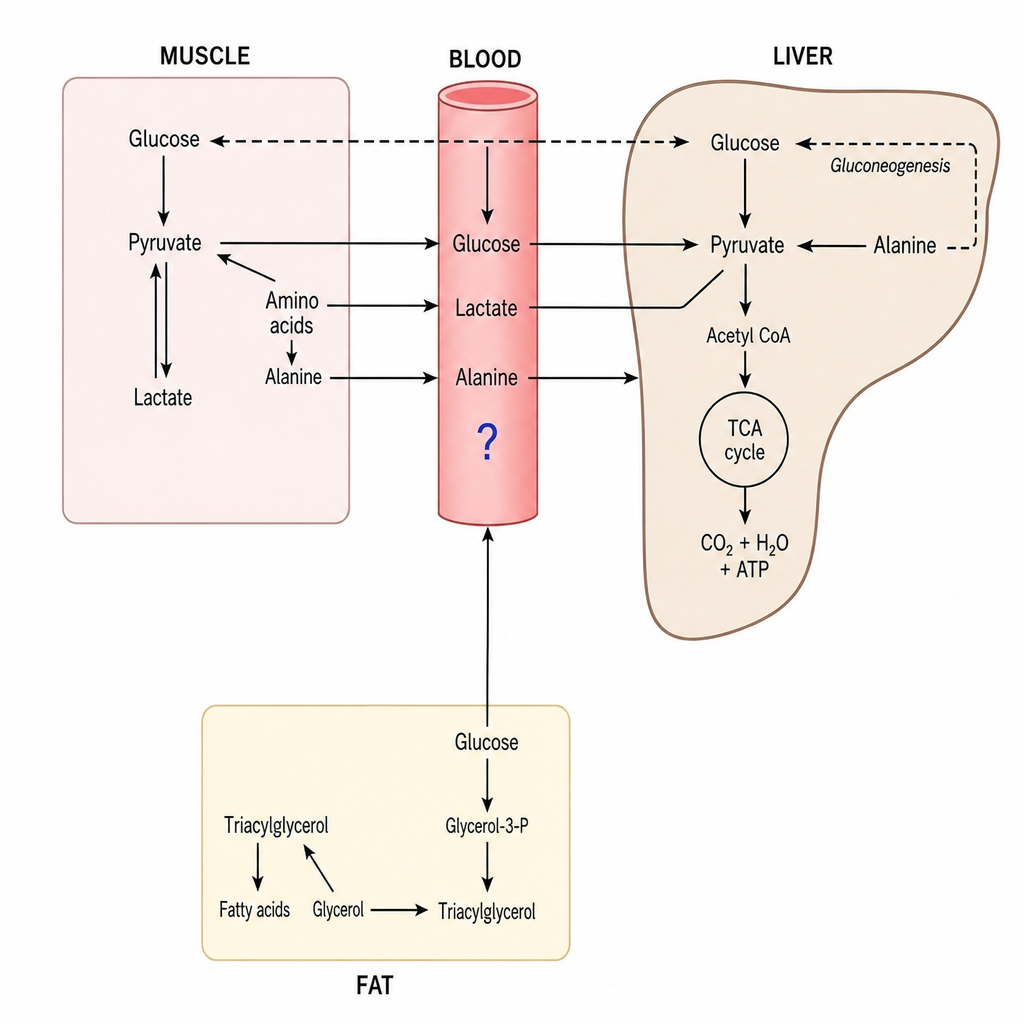
Explanation: **Explanation:** The enzyme **Glucose-6-Phosphatase (G6Pase)** is the key regulatory enzyme of the final step in both **Gluconeogenesis** and **Glycogenolysis**. It catalyzes the conversion of Glucose-6-phosphate into free glucose. **1. Why Option A is Correct:** The primary physiological role of G6Pase is to maintain blood glucose levels during fasting. This requires the release of free glucose into the systemic circulation. Therefore, the enzyme is localized specifically in the **Liver, Kidneys, and Intestinal mucosa**. These are the only tissues capable of contributing to the blood glucose pool. The enzyme is located on the luminal surface of the **Endoplasmic Reticulum (ER)**. **2. Why Other Options are Incorrect:** * **Option C (Striated Muscle):** This is a high-yield distinction. Muscle lacks G6Pase; therefore, muscle glycogen cannot be used to maintain blood glucose. Instead, G6P enters glycolysis to provide ATP for contraction. * **Option B & D:** Brain, spleen, and plasma do not perform gluconeogenesis or significant glycogen storage for systemic use. They lack the gene expression for this specific phosphatase. **Clinical Pearls for NEET-PG:** * **Von Gierke’s Disease (GSD Type Ia):** Caused by a deficiency of Glucose-6-Phosphatase. It presents with severe fasting hypoglycemia, hepatomegaly, lactic acidosis, and hyperuricemia. * **Type Ib GSD:** Caused by a deficiency of the **G6P translocase** (the transporter that moves G6P into the ER). * **Metabolic Significance:** Because muscles lack G6Pase, they export lactate (via the Cori Cycle) or alanine (via the Glucose-Alanine Cycle) to the liver to be converted into glucose.
Explanation: **Explanation:** **Why Magnesium (Mg²⁺) is the Correct Answer:** Magnesium is the essential cofactor for almost all enzymes that utilize or synthesize ATP in the glycolytic pathway. The underlying biochemical principle is that Mg²⁺ binds to the anionic phosphate groups of ATP, forming a **Mg-ATP complex**. This complex shields the negative charges of the phosphate groups, allowing the enzyme’s active site to perform a nucleophilic attack more effectively. Key Mg²⁺-dependent enzymes in glycolysis include: * **Hexokinase & Glucokinase** (First step) * **Phosphofructokinase-1 (PFK-1)** (Rate-limiting step) * **Phosphoglycerate Kinase & Pyruvate Kinase** (ATP-generating steps) * **Enolase** (Requires Mg²⁺ for stabilization; inhibited by Fluoride) **Analysis of Incorrect Options:** * **A. Zinc (Zn²⁺):** While Zn is a vital cofactor for enzymes like Carbonic Anhydrase, Alcohol Dehydrogenase, and Carboxypeptidase, it does not play a primary role in the core reactions of glycolysis. * **C. Copper (Cu²⁺):** Copper is primarily involved in redox reactions, such as in Cytochrome c Oxidase (Complex IV) of the Electron Transport Chain and Superoxide Dismutase. * **D. Calcium (Ca²⁺):** Calcium acts as a secondary messenger and is crucial for muscle contraction and blood coagulation, but it is not a cofactor for glycolytic enzymes. **High-Yield Clinical Pearls for NEET-PG:** * **Fluoride Inhibition:** In clinical practice, fluoride (grey-top tubes) is used for blood glucose estimation because it inhibits the enzyme **Enolase** by displacing Mg²⁺, thereby halting glycolysis and preserving glucose levels. * **Kinase Rule:** As a general rule for biochemistry questions, whenever a **Kinase** enzyme is involved (transfer of phosphate), **Mg²⁺** is almost always the required cofactor.
Explanation: ### Explanation **Core Concept: The Glucagon-Mediated Response to Low Glucose** When blood glucose levels decrease, the pancreas releases **glucagon**. In the liver, glucagon triggers a cAMP-mediated phosphorylation cascade via Protein Kinase A (PKA). This cascade targets the bifunctional enzyme complex **PFK-2/FBPase-2**. Phosphorylation of this complex leads to the **inactivation of PFK-2** and the **activation of FBPase-2**. The active FBPase-2 then degrades **Fructose 2,6-bisphosphate (F2,6-BP)** into Fructose-6-phosphate. Since F2,6-BP is the most potent allosteric activator of glycolysis (PFK-1) and inhibitor of gluconeogenesis (FBPase-1), its **decrease** effectively halts glycolysis and promotes gluconeogenesis to restore blood glucose. Therefore, **increased levels of F2,6-BP (Option C) do not occur**; rather, levels significantly drop. **Analysis of Other Options:** * **Option A (Inactivation of PFK-2):** This occurs because phosphorylation by PKA inhibits the kinase domain of the bifunctional enzyme. * **Option B (Activation of FBPase-2):** This occurs because phosphorylation by PKA activates the phosphatase domain of the bifunctional enzyme. * **Option D (Increased Glucagon):** This is the primary hormonal trigger released by alpha cells of the pancreas in response to hypoglycemia. **High-Yield Clinical Pearls for NEET-PG:** * **Fructose 2,6-bisphosphate** is a "signaling molecule," not a metabolic intermediate of the TCA cycle or glycolysis. * **Insulin vs. Glucagon:** Insulin dephosphorylates the bifunctional enzyme (activating PFK-2), increasing F2,6-BP and stimulating glycolysis. Glucagon phosphorylates it, decreasing F2,6-BP and stimulating gluconeogenesis. * **Mnemonic:** **P**hosphorylation by Glucagon makes the **P**hosphatase (FBPase-2) active.
Explanation: **Explanation:** **Andersen Disease (GSD Type IV)** is caused by a deficiency of the **Branching Enzyme** (amylo-1,4→1,6-transglucosidase). This enzyme is responsible for creating $\alpha$-1,6-glycosidic bonds, which introduce branches into the glycogen molecule. In its absence, the body produces an abnormal, long-chain, unbranched glycogen known as **amylopectin-like polysaccharide** (polyglucosan). These insoluble molecules trigger an immune response, leading to progressive liver cirrhosis and liver failure, often fatal in early childhood. **Analysis of Incorrect Options:** * **Option B: Debranching enzyme** deficiency causes **Cori disease (GSD Type III)**. This results in the accumulation of "limit dextrins" (short, branched glycogen chains) because the body cannot break down the $\alpha$-1,6 bonds. * **Option C: Acid maltase** (lysosomal $\alpha$-1,4-glucosidase) deficiency causes **Pompe disease (GSD Type II)**. It is unique because it is a lysosomal storage disorder, primarily affecting the heart (massive cardiomegaly). * **Option D: Myophosphorylase** deficiency causes **McArdle disease (GSD Type V)**. This is a muscle-specific disorder characterized by exercise intolerance, muscle cramps, and myoglobinuria. **High-Yield Clinical Pearls for NEET-PG:** * **Mnemonic:** "ABCD" – **A**ndersen = **B**ranching enzyme; **C**ori = **D**ebranching enzyme. * **Key Feature:** Andersen disease is the only GSD that typically presents with **early-onset liver cirrhosis**. * **Biopsy finding:** Presence of PAS-positive, diastase-resistant eosinophilic cytoplasmic inclusions (amylopectin-like bodies).
Explanation: ### Explanation **1. Why Pyruvate Carboxylase is the Correct Answer:** Insulin is an **anabolic hormone** that promotes glucose utilization (glycolysis) and storage (glycogenesis/lipogenesis). **Pyruvate Carboxylase (PC)** is a key regulatory enzyme in **gluconeogenesis**, converting pyruvate to oxaloacetate. Since insulin aims to lower blood glucose levels, it **represses** the gene expression of gluconeogenic enzymes (PC, PEPCK, Fructose-1,6-bisphosphatase, and Glucose-6-phosphatase). Therefore, its expression is decreased, not increased, by insulin. **2. Why the Other Options are Incorrect:** * **Phosphofructokinase-1 (PFK-1):** This is the rate-limiting enzyme of glycolysis. Insulin increases its expression and activity (via Fructose-2,6-bisphosphate) to enhance glucose breakdown. * **Acetyl CoA Carboxylase (ACC):** This is the rate-limiting enzyme for fatty acid synthesis. Insulin promotes lipogenesis by inducing the gene expression of ACC to store excess energy as fat. * **Pyruvate Dehydrogenase (PDH):** PDH links glycolysis to the TCA cycle. Insulin increases its activity (via dephosphorylation) and gene expression to promote the oxidative decarboxylation of pyruvate into Acetyl-CoA for energy or fat synthesis. **3. High-Yield Clinical Pearls for NEET-PG:** * **The "Insulin-Sensitive" Enzymes:** Insulin induces enzymes of **Glycolysis** (Glucokinase, PFK-1, Pyruvate Kinase) and **Lipogenesis** (ACC, Fatty Acid Synthase). * **The "Glucagon-Sensitive" Enzymes:** Glucagon and Cortisol induce enzymes of **Gluconeogenesis** (PEPCK is the primary target for transcriptional control). * **Biotin Dependency:** Pyruvate Carboxylase requires **Biotin (B7)** as a cofactor and is allosterically **activated by Acetyl-CoA**. * **Mnemonic:** Insulin "builds" (Anabolic) and "burns" (Glycolysis); it never "creates" new glucose (Gluconeogenesis).
Explanation: ### Explanation The clinical presentation describes **Classic Galactosemia**, caused by a deficiency of **Galactose 1-phosphate uridyl transferase (GALT)**. **1. Why Option A is Correct:** When the infant consumes breast milk (which contains lactose = glucose + galactose), galactose cannot be converted to glucose. This leads to an accumulation of **Galactose 1-phosphate**, which is toxic to the liver (jaundice, hepatomegaly) and kidneys. Excess galactose is diverted to the polyol pathway, where **aldose reductase** converts it to **galactitol**, causing osmotic damage and **cataracts**. * **The Diagnostic Clue:** The "Glucose Oxidase" method specifically measures glucose. In GALT deficiency, blood glucose is low (hypoglycemia), but the urine is positive for **reducing sugars** (due to galactose), creating a classic diagnostic mismatch. **2. Why Other Options are Incorrect:** * **B. Beta-galactosidase deficiency:** This causes Lactose Intolerance. It presents with diarrhea and bloating but **never** with jaundice, hepatomegaly, or cataracts, as galactose is not absorbed. * **C. G6PD deficiency:** This causes neonatal jaundice due to hemolysis, but it does not cause cataracts, reducing sugars in urine, or hepatomegaly triggered by milk. * **D. Galactokinase deficiency:** This is a milder form of galactosemia. It presents **only with cataracts**; it does not cause liver failure, jaundice, or systemic illness. **Clinical Pearls for NEET-PG:** * **Classic Galactosemia:** Deficient GALT; symptoms start as soon as milk feeding begins. * **Cataract Mechanism:** Accumulation of **Galactitol** in the lens. * **Infection Risk:** These infants are at high risk for **E. coli sepsis**. * **Treatment:** Immediate withdrawal of milk; switch to soy-based or lactose-free formula.
Explanation: **Explanation:** In glycolysis (the Embden-Meyerhof pathway), a single molecule of glucose is broken down into two molecules of pyruvate through a series of ten enzymatic reactions. While pyruvate is the primary end-product, the overall balanced equation reveals several essential byproducts. **The Net Reaction of Glycolysis:** Glucose + 2 NAD⁺ + 2 ADP + 2 Pi → **2 Pyruvate** + 2 NADH + **2 H⁺** + 2 ATP + **2 H₂O** 1. **Pyruvate (Option A):** This is the 3-carbon keto-acid produced in the final step catalyzed by Pyruvate Kinase. 2. **H₂O (Option B):** Water is released during the 9th step of glycolysis, where **Enolase** dehydrates 2-phosphoglycerate to form phosphoenolpyruvate (PEP). 3. **H⁺ (Option C):** Protons are generated during the oxidation of Glyceraldehyde 3-phosphate to 1,3-bisphosphoglycerate by **G3P Dehydrogenase**, where NAD⁺ is reduced to NADH + H⁺. Since all three components are generated during the pathway, **Option D** is the correct answer. **High-Yield Clinical Pearls for NEET-PG:** * **Rate-limiting step:** Phosphofructokinase-1 (PFK-1) is the key regulatory enzyme. * **Arsenic Poisoning:** Arsenate competes with inorganic phosphate in the G3P Dehydrogenase reaction, resulting in the bypass of ATP synthesis at the substrate level (zero net ATP). * **Fluoride Inhibition:** In blood collection tubes (grey top), fluoride inhibits **Enolase** by competing with Mg²⁺, preventing glucose breakdown for accurate measurement. * **Rapoport-Luebering Cycle:** In RBCs, 1,3-BPG can be converted to 2,3-BPG, which shifts the oxygen dissociation curve to the right, facilitating O₂ delivery to tissues.
Explanation: ### Explanation **Why Epinephrine is Correct:** The regulation of glycogenolysis in skeletal muscle is primarily driven by **Epinephrine** (Adrenaline). When epinephrine binds to **$\beta_2$-adrenergic receptors** on the muscle cell membrane, it activates the enzyme Adenylate Cyclase. This leads to an increase in intracellular **cAMP** (cyclic Adenosine Monophosphate). cAMP then activates **Protein Kinase A (PKA)**, which phosphorylates and activates **Phosphorylase Kinase**. This enzyme, in turn, converts inactive Glycogen Phosphorylase *b* into active **Glycogen Phosphorylase *a***, triggering the breakdown of glycogen into glucose-1-phosphate to provide immediate energy for muscle contraction ("Fight or Flight" response). **Why Other Options are Incorrect:** * **Glucagon:** While glucagon also increases cAMP to trigger glycogenolysis, it acts **exclusively on the liver**. Skeletal muscle lacks glucagon receptors; therefore, glucagon cannot release glycogen from muscle. * **Thyroxine (T4):** Thyroxine increases the overall metabolic rate and sensitizes cells to catecholamines, but it does not directly trigger the cAMP-mediated glycogenolytic cascade in muscle. * **Growth Hormone:** This is a counter-regulatory hormone that generally promotes gluconeogenesis and lipolysis but does not acutely stimulate muscle glycogenolysis via the cAMP pathway. **High-Yield Clinical Pearls for NEET-PG:** * **Muscle vs. Liver:** Muscle glycogen serves as a local fuel source (it lacks **Glucose-6-Phosphatase**, so it cannot release free glucose into the blood). Liver glycogen maintains blood glucose levels. * **Dual Regulation in Muscle:** Besides cAMP, muscle glycogenolysis is also triggered by **$\text{Ca}^{2+}$ ions** (via Calmodulin) during muscle contraction, bypassing the need for cAMP. * **Key Enzyme:** Glycogen Phosphorylase is the rate-limiting enzyme of glycogenolysis.
Carbohydrate Chemistry and Classification
Practice Questions
Glycolysis: Reactions and Regulation
Practice Questions
Gluconeogenesis: Reactions and Regulation
Practice Questions
Glycogen Metabolism: Synthesis and Breakdown
Practice Questions
Glycogen Storage Diseases
Practice Questions
Pentose Phosphate Pathway
Practice Questions
Metabolism of Fructose and Galactose
Practice Questions
Disorders of Fructose and Galactose Metabolism
Practice Questions
Blood Glucose Regulation
Practice Questions
Diabetes Mellitus: Biochemical Aspects
Practice Questions
Glycosylation and Glycoproteins
Practice Questions
Lactose Intolerance and Galactosemia
Practice Questions
Get full access to all questions, explanations, and performance tracking.
Start For Free