Which of the following options represents the anatomical landmark for achieving the objective signs of an inferior alveolar nerve block?
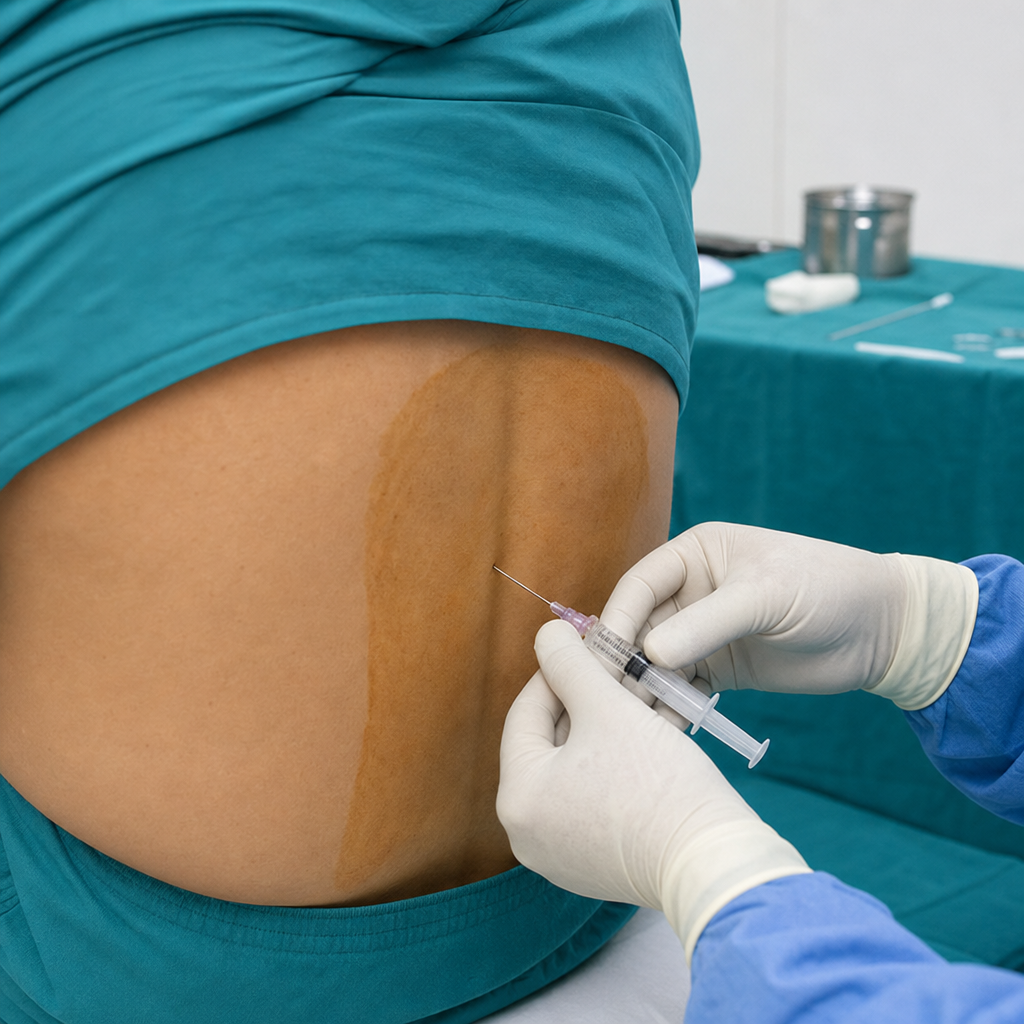
Which of the following is a contraindication for spinal anesthesia?
Which of the following is NOT an advantage of using epidural opioids over local anesthetics?
Infraorbital anesthesia involves which nerve?
Lignocaine can be used in all of the following conditions except?
Tuohy's needle is used for which of the following procedures?
Following a nerve block, what is the typical sequence of recovery of sensation?
All of the following drugs can be given intrathecally, except?
For a 78-year-old man undergoing transurethral resection of the prostate, what is the ideal anesthetic method and why?
Which of the following topical anesthetics is primarily used to anesthetize mucosa?
Explanation: The **Inferior Alveolar Nerve Block (IANB)** is the most common nerve block technique used in dentistry and oral surgery to anesthetize the mandibular teeth, lower lip, and anterior two-thirds of the tongue. ### **Explanation of the Correct Answer** The objective signs of a successful IANB are determined by the distribution of the **inferior alveolar nerve** and its terminal branch, the **mental nerve**. * **Anatomical Landmark:** A successful block results in numbness of the lower lip and chin up to the midline. This is clinically tested by checking for anesthesia in the region extending from the **mandibular first premolar to the central incisor** on the **unilateral** (injected) side. * The mental nerve exits the mental foramen (usually near the second premolar) and supplies the skin of the chin and the mucous membrane of the lower lip from the premolars to the midline. ### **Why Other Options are Incorrect** * **Options B & D (Bilateral):** An IANB is a unilateral procedure. Numbness occurs only on the side where the anesthetic was deposited. Bilateral numbness would only occur if both sides were injected (which is generally avoided to prevent difficulty in swallowing and speech). * **Options C & D (Second Molar):** While the molar teeth are anesthetized, the standard clinical "objective sign" used to confirm the block's efficacy focuses on the terminal distribution (the midline) rather than the posterior region. ### **High-Yield Clinical Pearls for NEET-PG** * **Nerves Blocked:** Inferior alveolar, incisive, mental, and often the lingual nerve. * **Target Site:** The mandibular foramen on the medial aspect of the ramus, protected by the **lingula**. * **Complication:** The most common complication is **transient facial nerve paralysis** if the anesthetic is injected too posteriorly into the parotid gland capsule. * **Aspiration:** IANB has the highest positive aspiration rate (approx. 10–15%) among dental blocks due to the proximity of the inferior alveolar artery.
Explanation: **Explanation:** **Why Clotting Disorders is the Correct Answer:** Clotting disorders (coagulopathies) are a **relative to absolute contraindication** for spinal anesthesia. The primary concern is the risk of developing a **spinal or epidural hematoma**. Because the spinal canal is a non-distensible space, even a small amount of bleeding from a punctured vessel can compress the spinal cord or cauda equina, leading to permanent neurological damage or paralysis. Therefore, patients on anticoagulants or those with low platelet counts (typically <80,000–100,000/mm³) require careful evaluation. **Analysis of Incorrect Options:** * **Hypertension (A):** Controlled hypertension is not a contraindication. While spinal anesthesia causes sympathetic blockade leading to hypotension, this is managed with pre-loading/co-loading of fluids and vasopressors. * **Renal Disease (B):** Spinal anesthesia is often preferred over general anesthesia in renal patients as it avoids the need for muscle relaxants and opioids that may have prolonged clearance. * **Diabetes (C):** Diabetes is not a contraindication. In fact, regional anesthesia is beneficial as it allows for early postoperative oral intake and minimizes the metabolic stress response, aiding glucose control. **High-Yield Clinical Pearls for NEET-PG:** * **Absolute Contraindications:** Patient refusal (most important), raised intracranial pressure (risk of herniation), infection at the injection site, and severe hypovolemia. * **Aortic Stenosis:** Severe valvular heart disease (especially AS) is a classic contraindication because the sudden drop in systemic vascular resistance (SVR) can be fatal. * **ASRA Guidelines:** Always check the most recent guidelines regarding the timing of stopping antiplatelets (e.g., Clopidogrel for 5–7 days) before performing neuraxial blocks.
Explanation: **Explanation:** The core concept tested here is the pharmacological profile of **epidural opioids** compared to **local anesthetics (LA)**. **Why "Less expensive" is the correct answer:** Epidural opioids (such as Fentanyl, Morphine, or Sufentanil) are generally **more expensive** than traditional local anesthetics (like Bupivacaine or Lignocaine). While opioids offer several clinical advantages, cost-effectiveness is not one of them. **Analysis of Incorrect Options:** * **A. Less hypotension:** Local anesthetics cause a sympathetic blockade, leading to vasodilation and hypotension. Opioids act on specific receptors in the substantia gelatinosa of the spinal cord and do not cause sympathetic denervation, resulting in superior hemodynamic stability. * **B. No motor block:** LAs block sodium channels in motor nerves, leading to muscle weakness (motor block). Opioids provide "selective analgesia" without affecting motor neurons, allowing for early ambulation (e.g., "walking epidurals" in labor). * **C. Frequent injections not required:** Hydrophilic opioids like **Morphine** have a long duration of action (up to 12–24 hours) due to their slow clearance from the CSF, reducing the need for frequent redosing compared to boluses of short-acting local anesthetics. **High-Yield Clinical Pearls for NEET-PG:** * **Site of Action:** Epidural opioids work primarily at the **Mu receptors** in the substantia gelatinosa (Rexed Lamina II). * **Side Effects:** While they avoid hypotension, opioids carry risks of **pruritus** (most common), urinary retention, nausea, and delayed **respiratory depression** (especially with Morphine). * **Synergy:** In clinical practice, a combination of low-dose LA and opioid is often used to maximize analgesia while minimizing the side effects of both.
Explanation: **Explanation:** The **infraorbital nerve** is a direct continuation of the Maxillary division of the Trigeminal nerve (V2). As it travels through the infraorbital canal, it gives off the **Anterior Superior Alveolar (ASA) nerve** before exiting through the infraorbital foramen. An infraorbital nerve block anesthetizes the ASA nerve, providing anesthesia to the maxillary incisors, canines, and the associated labial periodontium. **Analysis of Options:** * **Anterior Superior Alveolar Nerve (Correct):** This nerve branches from the infraorbital nerve within the infraorbital canal. It supplies the anterior teeth and is consistently anesthetized during an infraorbital block. * **Posterior Superior Alveolar Nerve:** This nerve branches from the Maxillary nerve (V2) in the pterygopalatine fossa *before* it enters the infraorbital canal. It supplies the maxillary molars and requires a separate block (PSA block). * **Facial Nerve (CN VII):** This is primarily a motor nerve to the muscles of facial expression. While it may be inadvertently blocked during deep injections (causing temporary facial palsy), it does not provide sensory innervation to the teeth. * **Mandibular Nerve (V3):** This is a separate division of the Trigeminal nerve. It supplies the lower jaw and teeth via the Inferior Alveolar Nerve. **Clinical Pearls for NEET-PG:** * **Area Anesthetized:** An infraorbital block affects the lower eyelid, lateral aspect of the nose, upper lip, and the teeth from the midline to the premolars (if the Middle Superior Alveolar nerve is also reached). * **Landmark:** The infraorbital foramen is located approximately 1 cm inferior to the infraorbital notch, in line with the pupil (mid-pupillary line) and the second maxillary premolar. * **High-Yield Fact:** The ASA nerve also contributes to the innervation of the anterior part of the nasal cavity floor.
Explanation: **Explanation:** The correct answer is **Convulsions**. Lignocaine (Lidocaine) is a Class Ib anti-arrhythmic and a versatile local anesthetic; however, it is contraindicated in the treatment of convulsions because it is itself a potent **pro-convulsant** at high plasma concentrations. **1. Why Convulsions is the correct answer:** Lignocaine toxicity follows a predictable pattern of Central Nervous System (CNS) effects. While it initially causes circumoral numbness and tinnitus, higher doses lead to excitatory effects, including **generalized tonic-clonic seizures**. This occurs because lignocaine selectively inhibits inhibitory cortical pathways, leading to unopposed excitatory activity. Therefore, it is never used to treat seizures; instead, benzodiazepines (like Midazolam) or Intralipid emulsion are used to treat lignocaine-induced convulsions. **2. Analysis of Incorrect Options:** * **Ventricular Fibrillation:** Lignocaine is a Class Ib anti-arrhythmic that blocks activated and inactivated sodium channels. It is indicated in the ACLS protocol for pulseless VT/VF (though Amiodarone is often preferred). * **Spinal Anesthesia:** Lignocaine (5% heavy) was historically used for spinal anesthesia due to its rapid onset. However, its use has decreased due to the risk of **Transient Neurological Symptoms (TNS)**. * **Epidural Anesthesia:** Lignocaine (1.5%–2%) is frequently used for epidural anesthesia when a rapid onset of sensory and motor block is required (e.g., emergency Cesarean section). **Clinical Pearls for NEET-PG:** * **Maximum Dose:** 4 mg/kg (plain) and 7 mg/kg (with Adrenaline). * **Metabolism:** Primarily in the liver by CYP450 enzymes. * **Drug of Choice:** Lignocaine is the drug of choice for **ventricular arrhythmias** occurring post-Myocardial Infarction. * **Toxicity Sign:** The earliest sign of systemic toxicity (LAST) is often **perioral numbness** or a metallic taste.
Explanation: **Explanation:** The **Tuohy needle** is the standard instrument used for **Epidural block (Option B)**. Its defining feature is a **curved tip (Huber tip)**, which serves two critical functions: 1. It allows the clinician to feel the "loss of resistance" more distinctly as the needle passes through the *ligamentum flavum*. 2. The directional curve helps steer the epidural catheter upward or downward into the epidural space and prevents the catheter from being sheared or passing straight through the dura (reducing the risk of accidental dural puncture). **Analysis of Incorrect Options:** * **A & C (Spinal/Saddle Block):** These procedures involve puncturing the dura to enter the subarachnoid space. They typically use smaller-gauge, straight-tipped needles to minimize post-dural puncture headaches (PDPH). Common examples include **Quincke** (cutting tip) or **Whitacre/Sprotte** (pencil-point) needles. * **D (Brachial Plexus Block):** These peripheral nerve blocks usually utilize short-bevel, insulated needles (for nerve stimulation) or high-visibility needles (for ultrasound guidance), rather than the bulky, curved Tuohy needle. **High-Yield Clinical Pearls for NEET-PG:** * **Needle Gauge:** Tuohy needles are typically **16–18 G** and have **1 cm markings** to monitor the depth of insertion. * **Loss of Resistance (LOR):** This is the most common technique to identify the epidural space. * **Combined Spinal-Epidural (CSE):** A "needle-through-needle" technique where a long spinal needle is passed through the lumen of a Tuohy needle. * **Episcleral/Eye Blocks:** Atkinson or Honan needles are used (not Tuohy).
Explanation: The sequence of nerve blockade and recovery is a high-yield topic in NEET-PG, governed by the **differential sensitivity** of nerve fibers to local anesthetics. ### 1. The Underlying Concept: Differential Blockade Local anesthetics inhibit nerve fibers based on their diameter, myelination, and firing frequency. Generally, smaller, myelinated fibers are blocked first, while larger, unmyelinated or heavily myelinated motor fibers are blocked last. **The Sequence of Blockade (Onset):** 1. **Autonomic (B-fibers)** – First to go. 2. **Pain and Temperature (A-delta and C-fibers)**. 3. **Touch and Pressure (A-beta fibers)**. 4. **Proprioception (A-gamma fibers)**. 5. **Motor/Skeletal Muscle Tone (A-alpha fibers)** – Last to go. **The Sequence of Recovery:** Recovery occurs in the **exact reverse order** of the blockade. As the concentration of the local anesthetic drug declines, the thickest fibers (Motor) regain function first, while the thinnest fibers (Pain) are the last to recover. Therefore, the correct sequence is: **SMT > Proprioception > Touch > Temperature > Pain.** ### 2. Analysis of Options * **Option A:** This describes the sequence of **blockade (onset)**, not recovery. * **Option C:** Incorrect because it swaps the order of Touch and Temperature. Temperature (A-delta) is blocked before and recovers after Touch (A-beta). * **Option D:** Recovery is a predictable physiological process based on fiber anatomy, not random. ### 3. Clinical Pearls for NEET-PG * **Fiber Size Rule:** Smaller diameter fibers are generally more sensitive than larger ones. * **Myelination:** Myelinated fibers are blocked more easily than unmyelinated fibers of the same diameter because the drug concentrates at the Nodes of Ranvier. * **Critical Length:** For a successful block, at least **3 successive Nodes of Ranvier** must be exposed to the local anesthetic. * **Order of Blockade Mnemonic:** **"ATP-TMP"** (Autonomic → Temperature → Pain → Touch → Motor → Proprioception) — *Note: Minor variations exist in textbooks regarding the exact position of Proprioception, but Motor/SMT always recovers first.*
Explanation: **Explanation:** The correct answer is **D. Etomidate**. **1. Why Etomidate is the correct answer:** Etomidate is a carboxylated imidazole derivative used exclusively for the **induction of general anesthesia** via the intravenous route. It is not formulated for neuraxial (intrathecal or epidural) administration. Its primary mechanism involves GABA-A receptor modulation in the brain. Furthermore, etomidate is dissolved in propylene glycol, which is **neurotoxic** if injected into the subarachnoid space. **2. Analysis of incorrect options:** * **Morphine (A):** Opioids are frequently used intrathecally as adjuvants to local anesthetics to provide prolonged postoperative analgesia. Morphine is highly water-soluble (hydrophilic), leading to a slow onset but a long duration of action. * **Ketamine (B):** Preservative-free ketamine can be administered intrathecally. It acts on NMDA receptors in the spinal cord to provide analgesia. However, it is rarely used in routine clinical practice due to concerns regarding potential neurotoxicity if preservatives (like benzethonium chloride) are present. * **Bupivacaine (C):** This is the **gold standard** and most commonly used local anesthetic for spinal anesthesia (intrathecal) due to its long duration and potent sensory/motor blockade. **3. High-Yield Clinical Pearls for NEET-PG:** * **Etomidate's unique feature:** It is the induction agent of choice for patients with **cardiovascular instability** (minimal effect on BP/HR). * **Side effect of Etomidate:** It causes transient **adrenocortical suppression** by inhibiting the enzyme 11-beta-hydroxylase. * **Intrathecal Morphine:** Watch for **delayed respiratory depression** (up to 24 hours) due to its hydrophilic nature and cephalad spread in the CSF. * **Chloroprocaine:** Recently regained popularity as a short-acting drug for spinal anesthesia in day-care surgeries.
Explanation: **Explanation:** The preferred anesthetic technique for Transurethral Resection of the Prostate (TURP) is **Spinal Anesthesia (Subarachnoid Block)**, typically at a sensory level of **T10**. **1. Why Option B is Correct:** The most critical complication of TURP is **TURP Syndrome**, caused by the systemic absorption of glycine irrigation fluid. This leads to hypervolemic hyponatremia and cerebral edema. Under spinal anesthesia, the patient remains conscious, allowing for early detection of neurological symptoms such as **confusion, restlessness, nausea, and headache**. Under General Anesthesia (GA), these signs are masked, and the diagnosis is often delayed until the patient fails to emerge from anesthesia. **2. Analysis of Incorrect Options:** * **Option A:** While some studies suggest regional anesthesia may reduce blood loss compared to GA due to lower venous pressure, the primary reason for choosing spinal anesthesia in TURP is safety/monitoring, not bleeding control. * **Option C:** Spinal anesthesia often **fails** to block the obturator nerve (L2–L4) sufficiently. Electrocautery stimulation of this nerve can cause sudden adduction of the thigh, potentially leading to bladder perforation. A separate obturator nerve block or neuromuscular blockers (under GA) are required to abolish this reflex. * **Option D:** While this statement is medically true (prostatic enlargement can cause renal issues), it is a clinical finding and not a justification for choosing one anesthetic method over another. **Clinical Pearls for NEET-PG:** * **Ideal Level:** T10 (umbilicus) is required to abolish the sensation of bladder distension. * **TURP Syndrome Triad:** Hypertension (early), Bradycardia, and Mental status changes. * **Bladder Perforation:** If a patient under spinal anesthesia complains of sudden **shoulder tip pain**, suspect subdiaphragmatic irritation due to intraperitoneal bladder rupture.
Explanation: **Explanation** The primary goal of topical anesthesia is to penetrate the mucous membranes or skin to block superficial nerve endings. **Why Bupivacaine is the Correct Answer (Contextual Note):** In the context of clinical practice and standard pharmacology, **Bupivacaine** is traditionally known as a long-acting injectable local anesthetic. However, in recent years, it has gained significant traction in topical applications, specifically as a **viscous or atomized solution** used to anesthetize the oral, pharyngeal, and esophageal mucosa (e.g., for painful conditions like mucositis or prior to endoscopic procedures). Its high potency and prolonged duration of action make it highly effective for sustained mucosal anesthesia compared to shorter-acting agents. **Analysis of Incorrect Options:** * **Lidocaine:** While widely used topically (as a 2% jelly or 10% spray), it is the "gold standard" versatile anesthetic used for both infiltration and topical routes. In many competitive exams, if a question seeks the most potent or specialized mucosal application, Bupivacaine or Tetracaine may be prioritized depending on the specific clinical scenario. * **Benzocaine:** This is an ester-linked anesthetic used almost exclusively topically due to its low solubility in water. However, its use is limited by the risk of **methemoglobinemia**, making it less preferred for extensive mucosal application. * **Tetracaine:** A potent ester anesthetic used primarily for **ophthalmic (corneal) anesthesia** and sometimes in topical ENT preparations, but it has a higher toxicity profile than amides like Bupivacaine. **NEET-PG High-Yield Pearls:** * **Mechanism:** Local anesthetics block voltage-gated **Na+ channels** in the inactivated state. * **Absorption:** Systemic absorption of topical anesthetics is highest in the **tracheal mucosa**, followed by the pharyngeal mucosa. * **EMLA Cream:** A eutectic mixture of 2.5% Lidocaine and 2.5% Prilocaine, used for anesthetizing **intact skin** (not just mucosa). * **Toxicity:** Always remember that Bupivacaine is the most **cardiotoxic** local anesthetic; Intralipid (20% lipid emulsion) is the antidote for systemic toxicity (LAST).
Neuraxial Anatomy
Practice Questions
Spinal Anesthesia
Practice Questions
Epidural Anesthesia
Practice Questions
Combined Spinal-Epidural Anesthesia
Practice Questions
Peripheral Nerve Blocks: Upper Extremity
Practice Questions
Peripheral Nerve Blocks: Lower Extremity
Practice Questions
Truncal Blocks
Practice Questions
Ultrasound-Guided Regional Anesthesia
Practice Questions
Complications of Regional Anesthesia
Practice Questions
Regional Anesthesia in Pediatric Patients
Practice Questions
Regional Anesthesia in Obstetrics
Practice Questions
Continuous Peripheral Nerve Catheters
Practice Questions
Get full access to all questions, explanations, and performance tracking.
Start For Free