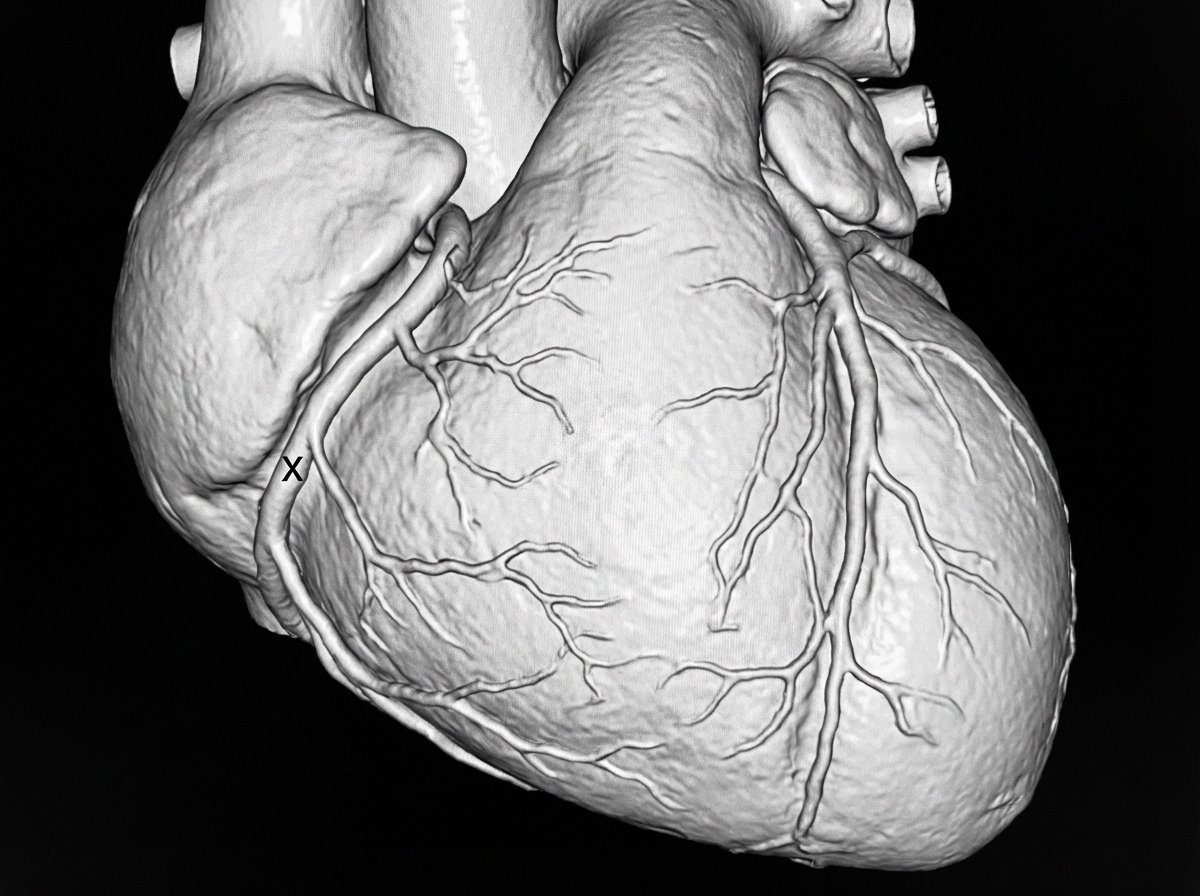
What is the true statement about the Right Coronary Artery (RCA)?
The right costophrenic angle extends up to the level of which rib in the mid-axillary line?
Which of the following statements regarding the artery of Kugel is TRUE?
The apex of the heart is formed by which chamber?
Poland Syndrome is
Which of the following is NOT an antero-superior mediastinal mass?
The region of the myocardium most prone to infarction is:
A 37-year-old man presents with severe chest pain. An angiogram reveals thrombosis of both brachiocephalic veins just before entering the superior vena cava. This condition would most likely cause dilation of which of the following veins?
The azygos lobe is an anatomical variation found in which organ?
The bifurcation of the trachea occurs most commonly at which vertebral level?
Explanation: ### Explanation **1. Why Option A is Correct:** The **Left Coronary Artery (LCA)** typically has a larger diameter (average 4–5 mm) compared to the **Right Coronary Artery (RCA)** (average 3–4 mm). This is because the LCA supplies the left ventricle, which has a significantly larger muscle mass and higher metabolic demand than the right side of the heart [1]. In approximately 60% of individuals, the LCA is the dominant vessel in terms of flow volume. **2. Analysis of Incorrect Options:** * **Option B:** While the RCA does arise from the **anterior aortic sinus** (also called the right coronary sinus), this statement is technically correct in isolation [2]. However, in the context of "All of the above" questions in NEET-PG, if multiple statements are factually true, "All of the above" becomes the intended answer. * **Option C:** The RCA supplies the majority of the right atrium and right ventricle. This is also a factually correct anatomical statement [1]. * **Option D:** Since Options A, B, and C are all anatomically accurate descriptions of the RCA, **Option D (All of the above)** is the most comprehensive "true statement." *(Note: If the question specifically asks for the "most" characteristic feature or if Option A was the only one provided in a single-choice format, it stands; however, in standard anatomy, B and C are equally true.)* **3. High-Yield Clinical Pearls for NEET-PG:** * **Artery of Sudden Death:** The LCA (specifically the LAD) is often called the "Widow Maker." * **SA Node Supply:** In 60% of individuals, the SA node is supplied by the RCA. * **AV Node Supply:** In 80% of individuals (Right Dominance), the AV node is supplied by the RCA. * **Cardiac Dominance:** Determined by which artery gives rise to the **Posterior Interventricular Artery (PIVA)** [1]. Right dominance is most common (approx. 70-80%). * **Kugel’s Artery:** An atrial anastomotic branch that connects the RCA and LCA.
Explanation: This question tests your knowledge of the **surface anatomy of the pleura**, specifically the inferior limit of the costodiaphragmatic recess (costophrenic angle). [1] ### **Explanation of the Correct Answer** The parietal pleura extends lower than the lungs to create a potential space called the costodiaphragmatic recess [1]. The inferior border of the pleura follows an "even number" rule (8-10-12) across the thoracic cage: * **Mid-clavicular line:** 8th rib * **Mid-axillary line:** **10th rib (Correct Answer)** * **Paravertebral/Scapular line:** 12th rib Therefore, at the mid-axillary line, the costophrenic angle reaches the level of the 10th rib. ### **Analysis of Incorrect Options** * **A. 6th rib:** This represents the inferior limit of the **lung** (not pleura) at the mid-clavicular line. * **B. 8th rib:** This represents the inferior limit of the **lung** at the mid-axillary line, or the **pleura** at the mid-clavicular line. * **D. 12th rib:** This is the inferior limit of the **pleura** posteriorly at the level of the spine/scapular line. ### **NEET-PG High-Yield Pearls** 1. **The "2-Rib Rule":** The lungs generally sit two ribs higher than the pleural reflections (Lungs: 6-8-10 vs. Pleura: 8-10-12). 2. **Thoracocentesis:** To avoid injuring the lung, pleural fluid is typically aspirated in the costodiaphragmatic recess [1]. The needle is usually inserted in the **8th or 9th intercostal space** in the mid-axillary line (above the 10th rib) to avoid the diaphragm and liver/spleen. 3. **Clinical Significance:** Blunting of the costophrenic angle on a Chest X-ray is the earliest radiological sign of pleural effusion.
Explanation: ### Explanation The **Artery of Kugel** (also known as the *Arteria Anastomotica Auricularis Magna*) is a rare but clinically significant atrial branch that provides a potential collateral pathway between the right and left coronary circulations. **1. Why Option C is Correct:** The artery of Kugel most commonly arises from the **circumflex branch (LCX)** of the Left Coronary Artery [3] or, less frequently, from the Right Coronary Artery (RCA) [2]. It traverses the interatrial septum, passing near the AV node, to form an anastomosis between the anterior and posterior atrial arteries. Its primary significance lies in its ability to provide collateral blood flow to the AV node if the primary nodal branches are occluded. **2. Why the Other Options are Incorrect:** * **Option A:** It is a small coronary branch, not a large vessel arising from the **Aorta** [2]. * **Option B:** The **Left Anterior Descending (LAD)** artery primarily supplies the anterior interventricular septum and the apex; it does not typically give rise to Kugel’s artery [3]. * **Option D:** The **Coronary Sinus** is a venous structure [1]. Kugel’s artery is an arterial vessel and does not connect directly to the sinus. **3. High-Yield Clinical Pearls for NEET-PG:** * **Location:** It is found in the **interatrial septum**. * **Function:** It acts as a "bypass" or collateral channel connecting the proximal segments of the coronary arteries to the distal segments (specifically the AV nodal artery). * **Clinical Significance:** In patients with severe coronary artery disease, a prominent Artery of Kugel on angiography indicates its role in maintaining blood supply to the conduction system [1]. * **Comparison:** Do not confuse it with the **Artery of Adamkiewicz**, which is the great radicular artery supplying the lower spinal cord.
Explanation: **Explanation:** The **apex of the heart** is the lowermost, blunt, conical extremity of the organ. Anatomically, it is formed **entirely by the left ventricle**. It is directed downwards, forwards, and to the left, and is located in the **left 5th intercostal space**, approximately 9 cm (or one hand-breadth) from the midsternal line, just medial to the midclavicular line [1]. **Analysis of Options:** * **Option C (Correct):** The left ventricle forms the apex and is responsible for the "Apex Beat" felt during clinical examination. * **Option A & B (Incorrect):** The **Left Atrium** primarily forms the **base** (posterior surface) of the heart [1]. It does not contribute to the apex. * **Option D (Incorrect):** While both ventricles form the diaphragmatic (inferior) surface, the **Right Ventricle** primarily forms the sternocostal (anterior) surface [1]. It does not reach the apex. **High-Yield Clinical Pearls for NEET-PG:** * **Apex Beat:** This is the lowermost and lateral-most point of maximal cardiac pulsation. In cases of **Left Ventricular Hypertrophy (LVH)**, the apex beat is shifted downwards and laterally. * **Surface Anatomy:** The apex is covered by the left lung and pleura, but a small part of it becomes superficial behind the **cardiac notch** of the left lung. * **Auscultation:** The **Mitral valve** sounds are best heard at the apex of the heart. * **Base vs. Apex:** Remember that the "Base" of the heart is its posterior aspect (formed mainly by the left atrium), while the "Apex" is the inferior-lateral tip.
Explanation: **Explanation:** **Poland Syndrome** is a rare, congenital anomaly characterized by the **underdevelopment or complete absence of the Pectoralis major muscle**, most commonly its sternocostal head. It is typically unilateral and often associated with ipsilateral hand abnormalities like symbrachydactyly (short, webbed fingers). 1. **Why the correct answer is right:** The hallmark of Poland Syndrome is the **congenital absence** of the pectoralis major. It is believed to result from a vascular disruption during embryonic development (specifically the subclavian artery or its branches), leading to hypoplasia of the musculoskeletal structures of the chest wall. 2. **Why the incorrect options are wrong:** * **Option A:** While the pectoralis minor may also be absent in severe cases, the defining and most consistent feature required for diagnosis is the absence of the **pectoralis major**. * **Options B & C:** Poland Syndrome is a **congenital** developmental defect present at birth, not an "acquired" condition resulting from weakness or disuse atrophy. Atrophy implies the muscle was once present and functional, which is not the case here. **High-Yield Clinical Pearls for NEET-PG:** * **Side Predominance:** It occurs more frequently on the **right side** of the body. * **Associated Features:** Look for absence of the pectoralis minor, rib anomalies (2nd to 4th ribs), nipple/areola hypoplasia (athelia/thelarche), and **syndactyly**. * **Functional Deficit:** Patients experience weakened adduction and medial rotation of the arm, though compensatory use of other muscles often minimizes functional loss. * **Radiology:** On a chest X-ray, it presents as unilateral hyperlucency of the lung field (mimicking a mastectomy or pneumothorax) due to the thin chest wall.
Explanation: To master mediastinal masses for NEET-PG, remember the **"4 Ts"** of the anterior mediastinum: **T**hymoma, **T**eratoma (Germ cell tumors), **T**errible Lymphoma, and Ectopic **T**hyroid [1]. ### **Why Extra-adrenal Pheochromocytoma is the Correct Answer** Extra-adrenal pheochromocytomas (Paragangliomas) are neurogenic tumors [2]. In the thorax, they arise from the para-aortic sympathetic chain or the vagus nerve. These structures are located in the **posterior mediastinum**. Therefore, while they are mediastinal masses, they are not found in the antero-superior compartment. ### **Analysis of Incorrect Options** * **Thymoma:** This is the most common primary tumor of the anterior mediastinum in adults [1]. It is classically associated with Myasthenia Gravis [3]. * **Teratoma:** As a germ cell tumor, it is a classic constituent of the "4 Ts." These are frequently found in the anterior mediastinum and may contain multiple germ layers (calcifications/teeth on imaging) [1]. * **Branchial Cyst:** While typically a neck mass, a **cervico-thoracic** branchial cyst or an ectopic thyroid/parathyroid cyst can present in the superior mediastinum due to the embryological descent of the branchial arches [1]. ### **High-Yield Clinical Pearls for NEET-PG** * **Anterior Mediastinum Boundaries:** Between the sternum anteriorly and the pericardium/great vessels posteriorly. * **Posterior Mediastinum:** The site for **Neurogenic tumors** (Schwannoma, Neurofibroma, Paraganglioma) and esophageal pathologies. * **Middle Mediastinum:** Characterized by lymphadenopathy, bronchogenic cysts, and pericardial cysts. * **Imaging Gold Standard:** Contrast-Enhanced CT (CECT) is the investigation of choice for localizing and characterizing mediastinal masses [3].
Explanation: **Explanation:** The **Left Ventricular (LV) subendocardial layer** is the most vulnerable region of the heart to ischemia and infarction due to a combination of high metabolic demand and unique vascular dynamics. **Why it is the correct answer:** 1. **Compression during Systole:** Coronary blood flow to the left ventricle occurs primarily during diastole [1]. During systole, the high intramyocardial pressure (which is highest in the subendocardium) compresses the small penetrating capillaries, virtually halting blood flow to this layer [1]. 2. **Watershed Area:** The subendocardium is the "end-of-the-line" for coronary perfusion. It is the furthest region from the epicardial coronary arteries, making it the first to suffer when perfusion pressure drops. 3. **High Oxygen Demand:** The LV subendocardium performs the most mechanical work and has the highest wall tension, resulting in the highest oxygen consumption in the entire heart. **Why the other options are incorrect:** * **Epicardial regions (A & B):** The epicardium contains the large surface coronary arteries [2]. It is the first to receive blood and is not subjected to the same compressive forces as the deeper layers; thus, it is relatively protected [1]. * **Right Ventricular (RV) regions (A & C):** The RV is a low-pressure system. The intramyocardial pressure in the RV rarely exceeds the aortic pressure, meaning RV coronary blood flow occurs during both systole and diastole. This continuous perfusion makes the RV (both epicardium and subendocardium) much more resistant to infarction than the LV. **High-Yield NEET-PG Pearls:** * **Subendocardial Infarction:** Typically presents as an **NSTEMI** (Non-ST Elevation Myocardial Infarction) on ECG, often showing ST-depression. * **Transmural Infarction:** Usually results from complete occlusion of a major coronary artery, presenting as a **STEMI**. * **The "Critical Zone":** The subendocardium is considered the "watershed" zone of the heart. In states of systemic hypotension (shock), the subendocardium is the first area to undergo necrosis.
Explanation: ### Explanation **Concept:** The **Left Superior Intercostal Vein (LSIV)** is formed by the union of the 2nd, 3rd, and 4th left posterior intercostal veins. It typically drains directly into the **left brachiocephalic vein**. If the brachiocephalic veins are thrombosed just before they join to form the Superior Vena Cava (SVC), venous return from the left upper thorax is obstructed [1]. This leads to retrograde pressure and subsequent dilation of the LSIV as it attempts to find collateral pathways. **Why Option D is Correct:** The LSIV is a direct tributary of the left brachiocephalic vein. In the event of a proximal brachiocephalic obstruction, the LSIV dilates. Notably, it may serve as a collateral channel connecting to the accessory hemiazygos vein, but its primary drainage point is the site of the blockage. **Why Other Options are Incorrect:** * **Azygos Vein:** It drains directly into the **SVC** (after the junction of the brachiocephalic veins). Since the obstruction is *before* the SVC, the azygos vein remains patent and would actually serve as a collateral to bypass the obstruction, rather than dilating due to backpressure. * **Hemiazygos Vein:** It drains into the azygos vein at the level of T8. Since the azygos system eventually reaches the SVC below the site of thrombosis, the hemiazygos is not directly congested. * **Right Superior Intercostal Vein:** This vein typically drains into the **azygos vein** (unlike its left-sided counterpart). Therefore, it remains unaffected by a brachiocephalic vein thrombosis. **High-Yield Clinical Pearls for NEET-PG:** * **"Aortic Nipple":** On a PA chest X-ray, the LSIV can sometimes be seen as a small prominence lateral to the aortic arch, known as the "aortic nipple." Its enlargement is a sign of SVC syndrome or brachiocephalic obstruction. * **Drainage Pattern:** Remember the asymmetry—Right Superior Intercostal Vein → Azygos Vein; Left Superior Intercostal Vein → Left Brachiocephalic Vein. * **SVC Formation:** Formed by the union of the right and left brachiocephalic veins at the level of the **1st right costal cartilage**.
Explanation: The azygos lobe is a normal anatomical variant found in the Right Lung (occurring in approximately 0.4% to 1% of the population). Despite its name, it is not a true independent lobe but rather an accessory lobe created by an anomalous course of the azygos vein [1]. During fetal development, if the precursor of the azygos vein fails to migrate over the apex of the lung and instead cuts through it, it carries two layers of parietal pleura and two layers of visceral pleura with it. This creates a deep fissure called the azygos fissure, which invaginates the superior lobe of the right lung, sequestering a portion of the medial apex as the "azygos lobe." On a chest X-ray, this is classically seen as a fine, curvilinear line (the fissure) ending in a teardrop shape (the vein). **Why other options are incorrect:** * **Liver:** While the liver has several accessory lobes (e.g., Riedel’s lobe), the azygos lobe is strictly a pulmonary variation. * **Spleen:** Variations in the spleen typically involve "accessory spleens" (splenunculi) near the hilum, not lobar variations related to venous migration. * **Pancreas:** Developmental variations of the pancreas include Annular Pancreas or Pancreas Divisum, which relate to ductal fusion rather than vascular invagination. **High-Yield NEET-PG Pearls:** 1. The azygos lobe is always found in the **Right Lung**. 2. The **Azygos Fissure** is unique because it consists of **four layers of pleura** (two parietal and two visceral) [1]. 3. On imaging, the **"Teardrop Sign"** represents the azygos vein at the bottom of the fissure. 4. It is a benign finding and usually asymptomatic, but it can be mistaken for a bulla, abscess, or lung mass on a radiograph.
Explanation: The trachea is a midline structure that begins at the lower border of the cricoid cartilage (C6) and terminates by bifurcating into the right and left primary bronchi. **1. Why T5 is correct:** In a cadaveric or supine position, the bifurcation of the trachea (the **carina**) occurs at the level of the **sternal angle (Angle of Louis)**, which corresponds posteriorly to the lower border of the **T4 or the T5 vertebra**. For NEET-PG purposes, T5 is the standard anatomical landmark [3]. It is important to note that in a living, standing individual, the bifurcation can descend as low as T6 or T7 due to gravity and deep inspiration. **2. Why the other options are incorrect:** * **T3:** This level is superior to the sternal angle. It corresponds to the highest point of the aortic arch [1]. * **T7:** While the trachea can reach this level during deep inspiration in a standing position, it is not the standard anatomical "resting" level described in textbooks. * **T9:** This level is far too inferior, corresponding roughly to the xiphisternal joint and the entry of the Inferior Vena Cava into the diaphragm (T8-T9). **Clinical Pearls & High-Yield Facts:** * **The Carina:** The internal cartilaginous ridge at the bifurcation. It is the most sensitive area of the tracheobronchial tree for eliciting the cough reflex [2]. * **Right vs. Left Bronchus:** The right main bronchus is wider, shorter, and more vertical than the left, making it the most common site for **foreign body aspiration**. * **Sternal Angle Landmarks:** Remember the "RAT" mnemonic for structures at T4/T5: **R**ib 2, **A**rch of aorta, **T**racheal bifurcation [3].
Thoracic Wall and Diaphragm
Practice Questions
Pleura and Lungs
Practice Questions
Mediastinum
Practice Questions
Heart and Pericardium
Practice Questions
Great Vessels and Azygos System
Practice Questions
Thoracic Duct and Lymphatics
Practice Questions
Autonomic Innervation
Practice Questions
Applied Anatomy and Clinical Correlations
Practice Questions
Thoracic Imaging and Cross-sectional Anatomy
Practice Questions
Embryological Development of Thoracic Structures
Practice Questions
Get full access to all questions, explanations, and performance tracking.
Start For Free