The thoracic duct receives tributaries from all of the following except?
Which of the following statements regarding the blood supply of different parts of the esophagus is NOT TRUE?
A 30-year-old man presents with significant nose bleeding, worsening headache over several days, and fatigue. Examination reveals markedly increased brachial artery pressure, decreased femoral pressure, and delayed femoral pulses. The patient shows no external signs of inflammation. Which of the following is the most likely diagnosis?
What is the extent of the esophagus?
Anterior cardiac veins open into:
Which of the following statements about the esophagus is FALSE?
What is the primary muscle of inspiration?
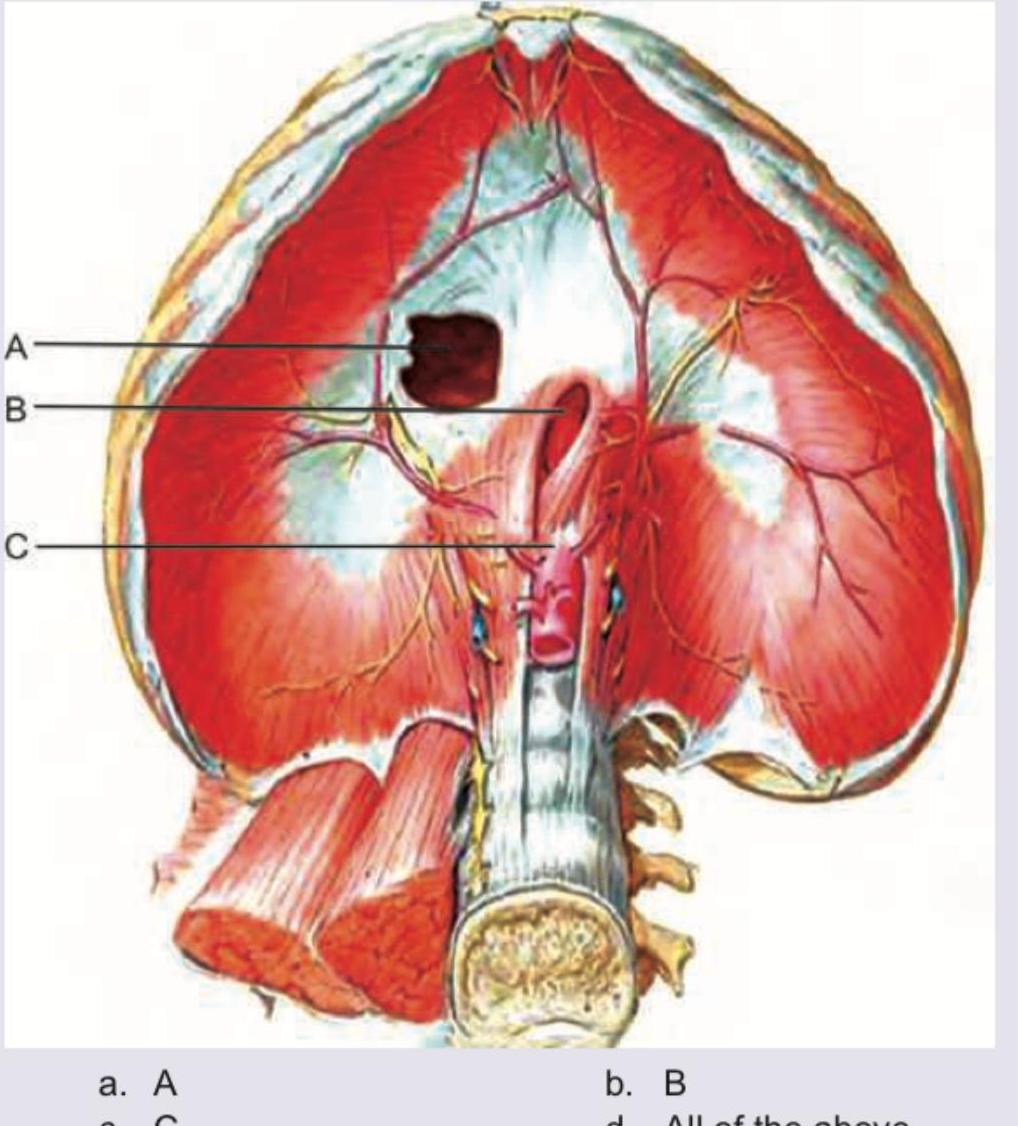
The right phrenic nerve passes through which of the following openings in the diaphragm?
The aortic hiatus contains which of the following structures?
The anterior cardiac vein empties into which cardiac structure?
Explanation: ### Explanation The **thoracic duct** is the largest lymphatic vessel in the body, responsible for draining lymph from approximately three-quarters of the body (everything except the right upper quadrant) [1]. **Why Option D is Correct:** The **Right bronchomediastinal trunk** drains lymph from the right side of the thorax (right lung, right side of the heart, and right mediastinum). It typically joins the right subclavian and right jugular trunks to form the **Right Lymphatic Duct**, which opens into the junction of the right internal jugular and right subclavian veins. Therefore, it does not contribute to the thoracic duct. **Analysis of Incorrect Options:** * **A. Bilateral ascending lumbar trunks:** The thoracic duct begins at the level of T12/L1 (often as the cisterna chyli), which is formed by the union of the right and left lumbar trunks and the intestinal trunk. * **B. Bilateral descending thoracic trunks:** These trunks drain the lower 6–7 intercostal spaces on both sides and empty into the commencement of the thoracic duct. * **C. Left upper intercostal duct:** The thoracic duct drains the left side of the thorax. The upper left intercostal spaces (usually 4th to 6th) drain into the left upper intercostal trunk, which joins the thoracic duct in the superior mediastinum. **High-Yield Clinical Pearls for NEET-PG:** * **Course:** It enters the thorax through the **aortic opening** of the diaphragm (T12), crosses from the right to the left side at the level of **T5**, and terminates at the **left venous angle** (junction of left IJV and subclavian vein). * **Beaded Appearance:** Due to the presence of numerous valves [1]. * **Chylothorax:** Injury to the thoracic duct (during esophageal surgery or due to lymphoma) leads to the accumulation of milky lymph in the pleural cavity. * **Virchow’s Node:** The duct communicates with the supraclavicular nodes; hence, gastric cancer can metastasize to the left supraclavicular fossa (Troisier’s sign).
Explanation: The esophagus is a muscular tube approximately 25 cm long, divided into three anatomical segments, each receiving its blood supply from adjacent systemic and visceral arteries. ### **Why Option C is the Correct Answer (The False Statement)** The abdominal part of the esophagus is primarily supplied by the **Left gastric artery** (a branch of the celiac trunk) and the **Left inferior phrenic artery**. * **The Error:** Option C incorrectly identifies the *Right* gastric and *Right* inferior phrenic arteries. In anatomy, laterality is crucial; the esophagus deviates to the left as it enters the abdomen through the esophageal hiatus (T10), placing it in proximity to left-sided vessels. ### **Analysis of Other Options** * **Option A (True):** The **cervical part** is supplied by the **inferior thyroid arteries**, which are branches of the thyrocervical trunk (from the subclavian artery). * **Option B (True):** The **thoracic part** receives blood from multiple sources, including the **bronchial arteries** and direct esophageal branches arising from the **descending thoracic aorta**. ### **NEET-PG High-Yield Clinical Pearls** 1. **Venous Drainage & Portal Hypertension:** The lower end of the esophagus is a site of **porto-caval anastomosis**. The esophageal branches of the left gastric vein (portal) anastomose with the esophageal branches of the azygos vein (systemic). In portal hypertension, these veins dilate, leading to **esophageal varices**. 2. **Lymphatic Drainage:** Follows the arteries. Cervical → Deep cervical nodes; Thoracic → Posterior mediastinal nodes; Abdominal → Left gastric and celiac nodes. 3. **Segmental Supply:** Unlike the stomach, the esophagus lacks a continuous longitudinal arterial arcade, making it more susceptible to ischemia during surgical mobilization.
Explanation: ### Explanation **1. Why Coarctation of the Aorta is Correct:** Coarctation of the aorta is a congenital narrowing of the aortic lumen, typically occurring near the insertion of the ductus arteriosus (post-ductal). This narrowing creates a mechanical obstruction to blood flow. * **Radio-femoral Delay:** The hallmark sign is a delay and decrease in the strength of the femoral pulse compared to the radial/brachial pulse [1]. * **Differential Blood Pressure:** Hypertension occurs in the upper extremities (proximal to the narrowing), leading to symptoms like **epistaxis (nosebleeds)** and **headaches**. Conversely, there is hypotension in the lower extremities (distal to the narrowing). * **Collateral Circulation:** To bypass the obstruction, collateral vessels develop involving the internal thoracic and intercostal arteries, often leading to "rib notching" on X-ray. **2. Why Incorrect Options are Wrong:** * **Cor Pulmonale:** This refers to right-sided heart failure due to pulmonary hypertension. It presents with peripheral edema, jugular venous distension, and hepatomegaly, not differential limb pressures [1]. * **Dissecting Aneurysm of Right Common Iliac:** While this could cause a weak right femoral pulse, it would not explain the systemic hypertension in the upper limbs or the bilateral nature of the symptoms described. * **Obstruction of the Superior Vena Cava (SVC):** This is a venous issue. It presents with facial swelling, cyanosis, and dilated veins on the chest wall (SVC syndrome), but does not affect arterial pulse timing or pressure differentials between limbs. **3. NEET-PG High-Yield Pearls:** * **Classic X-ray Sign:** "Figure of 3" sign on the aorta and **rib notching** (usually 3rd to 8th ribs) due to dilated intercostal arteries. * **Association:** Frequently associated with **Turner Syndrome** (45, XO) and **Bicuspid Aortic Valve**. * **Physical Exam:** Always look for the "Radio-femoral delay" in any young patient presenting with unexplained hypertension.
Explanation: ### Explanation The esophagus is a muscular tube approximately 25 cm long that connects the pharynx to the stomach. Its extent is defined by specific vertebral levels: **1. Why Option B is Correct:** * **Commencement:** The esophagus begins at the lower border of the **cricoid cartilage**, which corresponds to the **C6 vertebral level**. This is also the site of the pharyngoesophageal junction and the narrowest point of the esophagus (cricopharyngeal sphincter). * **Termination:** It passes through the esophageal hiatus of the diaphragm at the **T10 vertebral level** to join the cardiac end of the stomach. Note: While the anatomical junction is at T10, the esophagus ends at the T11 level after a short abdominal course. In the context of NEET-PG, T10 is the standard landmark for its diaphragmatic exit. **2. Why Other Options are Incorrect:** * **Option A & D:** The esophagus does not begin at C1 or C2. The pharynx occupies this space; the transition to the esophagus only occurs after the larynx ends at C6. * **Option C:** T2 is too low for the commencement. By T2, the esophagus is already in its superior mediastinal course. **3. High-Yield Clinical Pearls for NEET-PG:** * **Constrictions:** Remember the four anatomical constrictions (measured from upper incisors): 1. Pharyngoesophageal junction (15 cm) 2. Crossing of Aortic Arch (25 cm) 3. Crossing of Left Main Bronchus (28 cm) 4. Diaphragmatic hiatus (40 cm). * **Epithelium:** It is lined by **non-keratinized stratified squamous epithelium**, which changes to simple columnar at the gastroesophageal junction (Z-line). * **Diaphragmatic Openings:** Remember the "1-2-3" rule: Vena Cava (T8), Esophagus (T10), Aorta (T12).
Explanation: **Explanation:** The venous drainage of the heart is a high-yield topic for NEET-PG. The **Anterior Cardiac Veins** are 2 to 3 small vessels that drain the anterior surface of the right ventricle. Unlike most other cardiac veins, they do not join the coronary sinus; instead, they cross the coronary sulcus and **open directly into the Right Atrium** through its anterior wall. **Analysis of Options:** * **A. Right Atrium (Correct):** This is the primary site of drainage for the anterior cardiac veins and the *venae cordis minimae* (Thebesian veins). * **B. Great Cardiac Vein:** This vein travels in the anterior interventricular groove and drains into the left extremity of the coronary sinus. * **C. Coronary Sinus:** This is the main venous channel of the heart, receiving approximately 60-70% of cardiac venous blood (including the Great, Middle, and Small cardiac veins). However, the anterior cardiac veins are a notable exception to this rule. * **D. Marginal Vein:** The right marginal vein typically joins the small cardiac vein in the coronary sulcus or may occasionally open directly into the right atrium, but it is a tributary, not the destination for the anterior cardiac veins. **High-Yield Clinical Pearls for NEET-PG:** 1. **Thebesian Veins (Venae Cordis Minimae):** These are the smallest veins that drain directly into all four chambers of the heart, though they are most numerous in the right atrium and right ventricle. 2. **Coronary Sinus Location:** It lies in the posterior part of the atrioventricular groove (coronary sulcus) and opens into the right atrium between the IVC opening and the tricuspid orifice. 3. **The Valve of Thebesius:** This is the rudimentary valve guarding the opening of the coronary sinus in the right atrium.
Explanation: ### Explanation The esophagus is a muscular tube approximately 25 cm long, characterized by a unique transition in its muscular composition and a specific mucosal lining. [1] **Why Option D is the Correct (False) Statement:** The muscularis externa of the esophagus undergoes a transition from voluntary to involuntary muscle. * **Upper 1/3:** Composed entirely of **skeletal (striated) muscle**. * **Middle 1/3:** Contains a **mixture** of both skeletal and smooth muscle. [2] * **Lower 1/3:** Composed entirely of **smooth muscle**. [2] Therefore, the statement that the lower third contains only skeletal muscle is anatomically incorrect. **Analysis of Other Options:** * **Option A:** The esophagus is lined by **non-keratinized stratified squamous epithelium**, which provides protection against the abrasion of swallowed food boluses. * **Option B:** The esophageal mucosa is relatively **thick** compared to other parts of the GI tract to withstand mechanical stress. It also contains a prominent muscularis mucosae. [1] * **Option C:** As mentioned above, the middle third serves as the transition zone where skeletal fibers are gradually replaced by smooth muscle fibers. [2] **High-Yield NEET-PG Pearls:** * **Epithelial Transition:** At the gastroesophageal junction (Z-line), the epithelium changes abruptly from stratified squamous to simple columnar (gastric) epithelium. * **Barrett’s Esophagus:** Chronic GERD can cause metaplasia, where the squamous lining is replaced by columnar epithelium—a precursor to adenocarcinoma. * **Constrictions:** Remember the four anatomical constrictions (at 15cm, 22cm, 27cm, and 40cm from the incisors) as they are common sites for foreign body lodgment and corrosive injuries. * **Nerve Supply:** Skeletal muscle is supplied by the recurrent laryngeal nerve and vagus; smooth muscle is supplied by the esophageal plexus (autonomic).
Explanation: ### Explanation **1. Why the Diaphragm is Correct:** The **diaphragm** is the primary and most essential muscle of inspiration, responsible for approximately **75% of the air movement** into the lungs during quiet breathing. It is a dome-shaped musculofibrous sheet that separates the thoracic and abdominal cavities. When it contracts, the dome flattens, increasing the **vertical diameter** of the thoracic cavity. This creates negative intrathoracic pressure, allowing air to flow into the lungs. It is supplied by the **Phrenic nerve (C3, C4, C5)** [1]. **2. Why the Other Options are Incorrect:** * **External Intercostals:** While these are muscles of inspiration, they are secondary to the diaphragm [1]. They function primarily by elevating the ribs (bucket-handle movement), increasing the **anteroposterior and transverse diameters** of the thorax [1]. * **Pectoralis Major & Minor:** These are considered **accessory muscles** of inspiration. They are not used during quiet breathing but are recruited during forced inspiration (e.g., respiratory distress or heavy exercise) to help expand the chest wall, provided the scapula and humerus are fixed. **3. High-Yield Clinical Pearls for NEET-PG:** * **Quiet Expiration:** Unlike inspiration, quiet expiration is a **passive process** resulting from the elastic recoil of the lungs and relaxation of the diaphragm. * **Nerve Supply:** "C3, 4, 5 keep the diaphragm alive." Bilateral phrenic nerve palsy leads to respiratory failure [1]. * **Major Openings:** Remember the levels: **Vena Cava (T8)**, **Esophagus (T10)**, and **Aorta (T12)** (Mnemonic: *I Eat 10 Eggs At 12*). * **Pump-handle vs. Bucket-handle:** The diaphragm increases the vertical diameter; the intercostals increase the AP (pump-handle) and transverse (bucket-handle) diameters [1].
Explanation: The **right phrenic nerve** is unique because it is the only major structure that passes through the **vena caval opening** of the diaphragm alongside the inferior vena cava (IVC). ### **Why the Correct Answer is Right** The vena caval opening is located at the level of the **T8 vertebra** within the central tendon of the diaphragm. The right phrenic nerve passes through this opening to reach the abdominal surface of the diaphragm, where it provides motor supply and sensory innervation to the central part of the diaphragmatic peritoneum and pleura. This anatomical arrangement ensures that during inspiration (when the diaphragm contracts), the opening actually widens, preventing compression of the IVC and the nerve. ### **Explanation of Incorrect Options** * **A. Aortic opening (T12):** Transmits the Aorta, Azygos vein, and Thoracic duct (**Mnemonic: "Red, White, and Blue"**). The phrenic nerves do not pass here. * **B. Esophageal opening (T10):** Transmits the Esophagus, Vagus nerves (Left and Right gastric nerves), and esophageal branches of the left gastric vessels. * **D. Directly pierces the diaphragm:** This is the path taken by the **left phrenic nerve**. Unlike the right, the left phrenic nerve pierces the muscular part of the left dome of the diaphragm (lateral to the pericardium) to reach its inferior surface. ### **High-Yield NEET-PG Pearls** * **Mnemonic for Levels:** **I** **8** **10** **E**ggs **A**t **12** (**I**VC-T**8**; **E**sophagus-T**10**; **A**orta-T**12**). * **Phrenic Nerve Root Value:** C3, C4, C5 ("keeps the diaphragm alive"). * **Referred Pain:** Irritation of the phrenic nerve (e.g., gallbladder disease or subphrenic abscess) often causes referred pain to the **right shoulder** (C4 dermatome). * **Motor vs. Sensory:** The phrenic nerve is the **sole motor supply** to the diaphragm. Sensations from the peripheral parts of the diaphragm are carried by the lower 6–7 intercostal nerves.
Explanation: The diaphragm features three major openings (hiatuses) that allow structures to pass between the thorax and the abdomen. The **Aortic Hiatus** is the lowest and most posterior of these, located at the level of the **T12 vertebra**. ### Why Option C is Correct The aortic hiatus is not a true opening in the diaphragm but a retro-diaphragmatic space bounded by the crura and the median arcuate ligament. It transmits three primary structures, often remembered by the mnemonic **"A-T-A"**: 1. **A**orta 2. **T**horacic duct 3. **A**zygos vein ### Analysis of Incorrect Options * **Option A (Left gastric vein):** The left gastric vein (along with the esophagus and vagal trunks) passes through the **Esophageal Hiatus** at the level of **T10**. * **Option B (Hemiazygos vein):** While the azygos vein passes through the aortic hiatus (or the right crus), the hemiazygos vein typically pierces the **left crus** of the diaphragm. * **Option D (Left vagus nerve):** Both the left (anterior) and right (posterior) vagus nerves pass through the **Esophageal Hiatus (T10)** as the anterior and posterior vagal trunks [1]. ### NEET-PG High-Yield Pearls * **Levels Mnemonic:** **V**ena Cava (**8** letters) = **T8**; **E**sophagus (**10** letters) = **T10**; **A**ortic Hiatus (**12** letters) = **T12**. * **Vena Caval Opening (T8):** Transmits the Inferior Vena Cava and the Right Phrenic Nerve [1]. * **Esophageal Opening (T10):** Transmits the Esophagus, Vagal trunks, and Esophageal branches of left gastric vessels [1]. * **Clinical Fact:** The aortic hiatus is purely fibrous/retro-diaphragmatic; therefore, the aorta is **not compressed** during diaphragmatic contraction, ensuring uninterrupted blood flow to the lower body.
Explanation: ### Explanation The venous drainage of the heart is a high-yield topic for NEET-PG. The **Anterior Cardiac Veins** are unique because they do not follow the typical path of most other cardiac veins. **1. Why Option A is Correct:** The anterior cardiac veins (usually 2–3 in number) drain the anterior surface of the right ventricle. Unlike the majority of cardiac veins, they **drain directly into the right atrium** by piercing its anterior wall. They do not join the coronary sinus. **2. Why the Other Options are Incorrect:** * **Option B (Great cardiac vein):** This vein travels in the anterior interventricular sulcus and eventually drains into the coronary sinus, not directly into an atrium. * **Option C (Coronary Sinus):** While the coronary sinus is the main venous channel of the heart (receiving the Great, Middle, and Small cardiac veins), the anterior cardiac veins are a notable exception to this rule. * **Option D (Left atrium):** No major cardiac veins drain into the left atrium; it primarily receives oxygenated blood from the four pulmonary veins. **3. Clinical Pearls & High-Yield Facts:** * **The Exception Rule:** Remember that most cardiac veins drain into the **Coronary Sinus**, which then opens into the right atrium. The **Anterior Cardiac Veins** and **Thebesian Veins** (Venae Cordis Minimae) are the exceptions that drain directly into the heart chambers. * **Thebesian Veins:** These are the smallest veins that drain directly into all four chambers of the heart, though they are most numerous in the right atrium and right ventricle. * **Valve of Coronary Sinus:** Also known as the **Thebesian valve**, it guards the opening of the coronary sinus into the right atrium.
Thoracic Wall and Diaphragm
Practice Questions
Pleura and Lungs
Practice Questions
Mediastinum
Practice Questions
Heart and Pericardium
Practice Questions
Great Vessels and Azygos System
Practice Questions
Thoracic Duct and Lymphatics
Practice Questions
Autonomic Innervation
Practice Questions
Applied Anatomy and Clinical Correlations
Practice Questions
Thoracic Imaging and Cross-sectional Anatomy
Practice Questions
Embryological Development of Thoracic Structures
Practice Questions
Get full access to all questions, explanations, and performance tracking.
Start For Free