All of the following are true about the esophagus except:
The posterior surface of the heart is formed by which chamber?
All of the following are related to the mediastinal surface of the left lung except?
A 59-year-old man is admitted to the hospital with severe chest pain. During examination, a slight rhythmic pulsation on the chest wall at the left fifth intercostal space in the midclavicular line is noted. What part of the heart is responsible for this pulsation?
What is the anatomical location of the breast at the midclavicular line, in terms of rib level?
The breast is supplied by branches of all the following arteries, EXCEPT:
Herniation through the Foramen of Morgagni is seen in children. The Foramen of Morgagni refers to an opening in which anatomical structure?
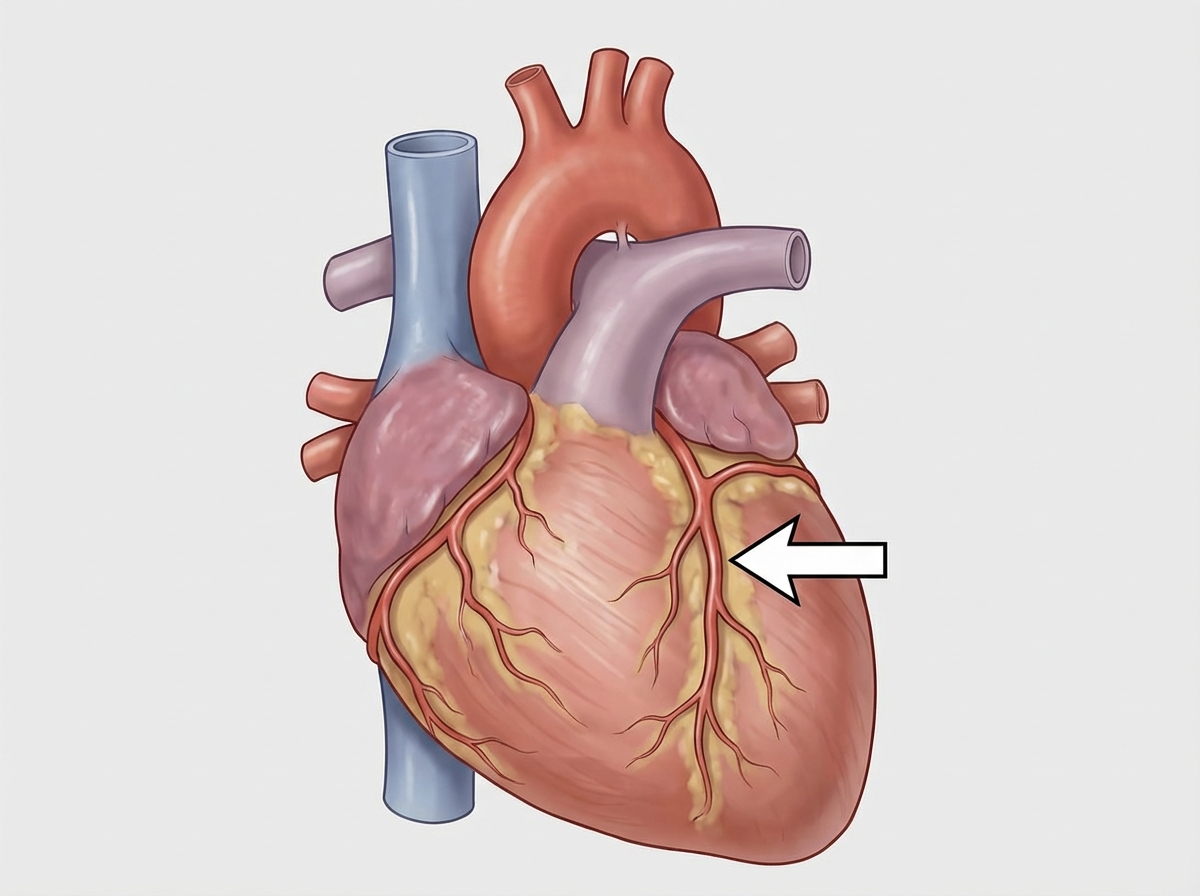
The anterior part of the atrioventricular groove contains which of the following?
What is the smallest functional unit of the lung?
What is the largest opening into the right atrium?
Explanation: **Explanation:** The esophagus is a muscular tube approximately **25 cm (10 inches)** long, extending from the cricoid cartilage (C6) to the cardiac orifice of the stomach (T11). **Why Option C is the correct answer (False statement):** The esophagus is lined by **non-keratinized stratified squamous epithelium**, which is designed to withstand the friction of swallowed food boluses. It is **not** lined by ciliated columnar epithelium (which is characteristic of the respiratory tract). A shift from squamous to simple columnar epithelium occurs at the gastroesophageal junction; if this occurs higher up due to chronic acid reflux, it is known as **Barrett’s Esophagus**, a premalignant condition. **Analysis of other options:** * **Option A:** Correct. The esophagus measures roughly 25 cm, with 4 cm in the neck, 11 cm in the thorax, and 1–2 cm in the abdomen. * **Option B:** Correct. The abdominal esophagus receives its arterial supply from the **left gastric artery** (a branch of the celiac trunk) and the left inferior phrenic artery. * **Option D:** Correct. The cervical esophagus is supplied by the **inferior thyroid arteries**, which are branches of the thyrocervical trunks. **High-Yield NEET-PG Pearls:** 1. **Constrictions:** There are four anatomical constrictions (important for endoscopy): at the pharyngoesophageal junction (15cm), crossing of the aorta (22cm), crossing of the left main bronchus (26cm), and the esophageal hiatus (40cm). 2. **Venous Drainage:** The lower end of the esophagus is a site of **porto-systemic anastomosis** (between the left gastric vein and the azygos vein). Clinical significance: **Esophageal varices** in portal hypertension. 3. **Muscle Composition:** Upper 1/3 is skeletal, middle 1/3 is mixed, and lower 1/3 is smooth muscle.
Explanation: ### Explanation The heart is oriented in the thorax such that its surfaces do not correspond directly to simple anatomical planes. The **Base of the heart** (posterior surface) is formed primarily by the **Left Atrium (LA)** [1]. **1. Why Left Atrium (LA) is correct:** The posterior surface (Base) of the heart is directed backwards and to the right. It is formed mainly by the **Left Atrium** (specifically the part receiving the four pulmonary veins) and a small portion of the Right Atrium [1]. It lies opposite the T5–T8 thoracic vertebrae (in the recumbent position) and is separated from them by the pericardium, oblique sinus, esophagus, and aorta. **2. Why the other options are incorrect:** * **Right Atrium (RA):** Primarily forms the **Right Border** of the heart. While it contributes a small portion to the base, it is not the dominant structure [1]. * **Left Ventricle (LV):** Forms the **Apex** of the heart and the majority of the **Left Border** and **Diaphragmatic (inferior) surface**. * **Right Ventricle (RV):** Forms the majority of the **Anterior (Sternocostal) surface**. It is the most anterior chamber of the heart, making it the most common chamber injured in penetrating chest trauma. **3. High-Yield NEET-PG Pearls:** * **Apex of the heart:** Formed entirely by the **Left Ventricle** (located in the left 5th intercostal space, 9cm from the midline). * **Sternocostal Surface:** Formed mainly by the **Right Ventricle** and Right Atrium. * **Diaphragmatic Surface:** Formed by the **Left Ventricle** (left 2/3) and Right Ventricle (right 1/3). * **Clinical Correlation:** Because the Left Atrium is the most posterior chamber, its enlargement (e.g., in Mitral Stenosis) can compress the esophagus, leading to **dysphagia** (Dysphagia megalatriensis), or the left recurrent laryngeal nerve, leading to hoarseness (**Ortner’s syndrome**).
Explanation: The mediastinal surface of the lungs contains impressions of structures that lie in close proximity within the mediastinum. The key to answering this question lies in understanding the **asymmetry of the mediastinum** and the **displacement of structures by the heart and great vessels.** ### Why Trachea is the Correct Answer The **Trachea** is located in the superior mediastinum, but it is shifted slightly to the right by the arch of the aorta [1]. Consequently, the trachea (and the esophagus) are related to the mediastinal surface of the **right lung**. On the left side, the trachea is separated from the lung by the massive **arch of the aorta** and the **left common carotid and subclavian arteries.** [1] ### Analysis of Incorrect Options * **Arch of Aorta:** This is a major relation of the left lung. It arches over the left bronchus, leaving a deep groove above the hilum. [1] * **Descending Aorta:** This continues from the arch and runs vertically behind the hilum of the left lung, creating a prominent longitudinal groove. [1] * **Thoracic Duct:** In the upper thorax (above T4), the thoracic duct crosses from the right side to the left side to reach the left venous angle. It lies along the left margin of the esophagus, making it a relation of the left lung. ### NEET-PG High-Yield Pearls * **Right Lung Relations:** Azygos vein (arching over the hilum), Superior Vena Cava, Right Atrium, and Trachea. [2] * **Left Lung Relations:** Arch of Aorta, Descending Aorta, Left Ventricle, and Left Subclavian Artery. [1] * **The "Rule of Aorta/Azygos":** If you see "Aorta," think Left Lung. If you see "Azygos," think Right Lung. [2] * **Esophagus:** It is related to **both** lungs but has a more extensive relationship with the right lung. On the left, it is mostly separated by the aorta.
Explanation: ### Explanation **1. Why the Correct Answer is Right:** The pulsation described is the **Apex Beat** (or Point of Maximal Impulse - PMI). The apex of the heart is formed entirely by the **left ventricle**. During ventricular systole, the heart rotates anteriorly and to the right, causing the apex to strike the anterior chest wall [1]. Anatomically, the apex is located in the **left 5th intercostal space (ICS), approximately 9 cm from the midsternal line (or within the midclavicular line)**. This rhythmic pulsation is a standard finding during a physical examination of the precordium. **2. Why the Other Options are Incorrect:** * **Right Atrium (A):** Forms the right border of the heart. It is located behind the 3rd to 6th right costal cartilages and does not reach the left 5th ICS. * **Left Atrium (B):** Forms the base (posterior surface) of the heart. It lies posteriorly, near the esophagus and thoracic vertebrae, and is not palpable on the anterior chest wall. * **Aortic Arch (C):** Located in the superior mediastinum, behind the manubrium sterni. Pulsations from the aorta are typically felt in the suprasternal notch (if aneurysmal) but not at the 5th ICS. **3. Clinical Pearls & High-Yield Facts for NEET-PG:** * **Surface Anatomy:** The **Right Ventricle** forms the majority of the anterior (sternocostal) surface of the heart. * **Displacement:** If the apex beat is shifted laterally (e.g., to the 6th ICS or axillary line), it indicates **Left Ventricular Hypertrophy (LVH)** or cardiomegaly. * **Dextrocardia:** In this congenital condition, the apex beat is found in the **right** 5th intercostal space. * **Auscultation:** The mitral valve is best heard at the apex (5th ICS, midclavicular line).
Explanation: The female breast (mammary gland) is a modified sweat gland located in the superficial fascia of the pectoral region. Its anatomical extent is a high-yield topic for NEET-PG. **1. Why Option B is Correct:** The vertical extent of the breast typically spans from the **2nd rib to the 6th rib** at the midclavicular line [1]. Horizontally, it extends from the lateral border of the sternum to the mid-axillary line [1]. The breast lies upon the pectoral fascia, covering the pectoralis major, serratus anterior, and the external oblique muscle [2]. **2. Analysis of Incorrect Options:** * **Option A (1st to 3rd rib):** This is too superior. The breast begins below the clavicle, starting at the 2nd rib level. * **Option C (5th to 8th rib):** This is too inferior. While the lower pole of the breast reaches the 6th rib, it does not extend to the 8th rib in a normal anatomical position. * **Option D (7th to 10th rib):** This area corresponds to the upper abdominal wall and lower costal margin, far below the mammary region. **3. Clinical Pearls & High-Yield Facts:** * **Axillary Tail of Spence:** A small part of the upper outer quadrant pierces the deep fascia (foramen of Langer) to enter the axilla. This is a common site for breast tumors. * **Suspensory Ligaments of Cooper:** These fibrous bands connect the skin to the pectoral fascia. Infiltration by carcinoma causes skin tethering or "dimpling." * **Retromammary Space:** A loose areolar space between the breast and pectoral fascia that allows the breast to move freely. Obliteration of this space indicates deep invasion of a tumor. * **Blood Supply:** Primarily from the Internal Thoracic Artery and Lateral Thoracic Artery.
Explanation: The breast is a highly vascular organ, receiving its blood supply from multiple sources. The question asks to identify which artery does **not** supply the breast; however, all the listed arteries contribute significantly to its vascularity, making "None of the above" the correct choice. ### **Anatomical Breakdown** 1. **Internal Thoracic Artery (Option B):** This is the primary source, providing about **60%** of the blood supply via its perforating branches (mainly the 2nd to 4th intercostal spaces). [1] 2. **Axillary Artery (Option A):** It contributes via several branches, including the **Superior thoracic**, **Thoracoacromial** (pectoral branch), and **Lateral thoracic** arteries. The lateral thoracic artery is particularly important for the lateral quadrants. [3] 3. **Intercostal Arteries (Option C):** Lateral cutaneous branches of the **posterior intercostal arteries** (2nd, 3rd, and 4th) supply the lateral aspect of the breast. [3] ### **Why "None of the above" is correct:** Since the Axillary, Internal thoracic, and Intercostal arteries all provide branches to the breast, none of them can be excluded. ### **High-Yield NEET-PG Pearls:** * **Venous Drainage:** Follows the arteries. The most important pathway for cancer metastasis to the vertebrae is via the **azygous system** and **internal vertebral venous plexus (Batson’s plexus)**. * **Lymphatic Drainage:** Approximately **75%** of lymph drains into the **axillary nodes** (primarily the pectoral/anterior group). The remaining 25% drains mainly into the **internal mammary (parasternal) nodes**. [2] * **Nerve Supply:** The breast is supplied by the anterior and lateral cutaneous branches of the **4th to 6th intercostal nerves**. The nipple is specifically supplied by the **4th intercostal nerve**. [1]
Explanation: The **Foramen of Morgagni** is a retrosternal (anterior) defect in the **diaphragm**. It is located between the sternal and costal attachments of the diaphragm, specifically behind the xiphoid process. A Morgagni hernia occurs when abdominal contents (usually omentum or liver) protrude into the thoracic cavity through this space. While less common than Bochdalek hernias, they are a high-yield topic in pediatric surgery and anatomy [1]. **Analysis of Options:** * **Option D (Correct):** The diaphragm contains several potential sites for herniation. The Foramen of Morgagni is the **anterior** defect, whereas the Foramen of Bochdalek is the **posterolateral** defect (the most common type of congenital diaphragmatic hernia) [1]. * **Option A & C:** These are incorrect. While the skull contains many foramina (e.g., Foramen Magnum, Foramen Ovale), the Foramen of Morgagni is strictly a diaphragmatic anatomical landmark. * **Option B:** The lesser omentum contains the epiploic foramen (Foramen of Winslow), which connects the greater and lesser sacs of the peritoneum, but it is not related to Morgagni hernias. **High-Yield NEET-PG Pearls:** 1. **Location:** Morgagni hernias are typically **right-sided** (90% of cases) because the heart protects the left side. 2. **Mnemonic:** **M**orgagni is **M**edial/Anterior; **B**ochdalek is **B**ack (Posterolateral). 3. **Contents:** The space of Morgagni transmits the **superior epigastric artery** (a continuation of the internal thoracic artery). 4. **Clinical Presentation:** Often asymptomatic in childhood and discovered incidentally on chest X-rays in adults as a mass in the right cardiophrenic angle.
Explanation: ### Explanation The **Atrioventricular (AV) groove**, also known as the **coronary sulcus**, separates the atria from the ventricles. It is divided into anterior and posterior segments. **Why Option D is Correct:** The **Right Coronary Artery (RCA)** originates from the anterior aortic sinus and runs forward between the pulmonary trunk and the right auricle [1]. It then descends in the **anterior part of the right atrioventricular groove** [1]. This is a high-yield anatomical landmark as the RCA supplies the right atrium and right ventricle before winding around the inferior border to the posterior surface. **Analysis of Incorrect Options:** * **A. Left Anterior Descending (LAD) Artery:** This artery travels in the **Anterior Interventricular Groove**, not the AV groove. It is the most common site of coronary occlusion. * **B. Coronary Sinus:** This is the largest vein of the heart. It is located in the **posterior part of the left atrioventricular groove**, opening into the right atrium. * **C. Great Cardiac Vein:** While it begins at the apex and ascends in the anterior interventricular groove (alongside the LAD), it eventually enters the **left part of the AV groove** to join the coronary sinus. It is not found in the anterior part of the *right* AV groove. **High-Yield Clinical Pearls for NEET-PG:** * **Crux of the Heart:** The junction of the posterior AV groove and the posterior interventricular groove. * **Nodal Supply:** In 60% of individuals, the RCA supplies the SA node [2]; in 90%, it supplies the AV node (Right Dominance) [2]. * **Contents of Posterior AV Groove:** Coronary sinus and the circumflex branch of the Left Coronary Artery.
Explanation: The correct answer is **C. Lobule** (specifically the Secondary Pulmonary Lobule). ### **Explanation** In anatomy and histology, the **Secondary Pulmonary Lobule** is defined as the smallest unit of the lung surrounded by connective tissue septa. It is considered the **smallest functional unit** because it contains all the components necessary for gas exchange and is the smallest portion of lung tissue that can be identified on high-resolution CT (HRCT) scans. It typically contains 3 to 5 terminal bronchioles and their associated acini. Connective fiber tracts highlight the septal fibers that define these unit boundaries [1]. ### **Why other options are incorrect:** * **A. Acinus:** This is the unit of the lung distal to a single terminal bronchiole. While it is the site of gas exchange, it lacks the distinct connective tissue encapsulation that defines the lobule as a structural/functional unit in gross anatomy. * **B. Alveolus:** This is the site of gas exchange at the microscopic level [2], but it is a single anatomical component, not a "functional unit" capable of independent physiological operation within the lung's structural framework. * **D. Bronchopulmonary Segment:** This is the **largest** functional subdivision of a lobe. It is clinically significant because it is surgically resectable (each has its own tertiary bronchus and artery), but it is far from the "smallest" unit. ### **High-Yield Clinical Pearls for NEET-PG:** * **Miller’s Secondary Lobule:** It is polyhedral in shape, measuring 1–2.5 cm in diameter. * **Surgical Anatomy:** The **Bronchopulmonary Segment** is the smallest unit that can be removed surgically without affecting the function of adjacent segments. * **Radiology:** The "Secondary Pulmonary Lobule" is the fundamental unit of interpretation in **HRCT Thorax**; diseases like centrilobular emphysema or panacinar emphysema are classified based on their distribution within this unit. * **Blood Supply:** Remember that pulmonary arteries follow the bronchi (centrilobular), while pulmonary veins run in the interlobular septa [1].
Explanation: ### Explanation The **right atrioventricular (AV) orifice** is the largest opening in the right atrium. It serves as the gateway between the right atrium and the right ventricle, guarded by the tricuspid valve. In an adult, this orifice typically has a circumference of about **10–12 cm** (allowing the passage of three fingers), which significantly exceeds the diameter of any venous inflow. The tricuspid valve is supported by a robust subvalvular apparatus featuring chordae tendineae that tether the leaflets and annuli to the papillary muscles [1]. **Analysis of Options:** * **A. Superior Vena Cava (SVC):** This opening is located in the upper and posterior part of the atrium. It has a diameter of approximately **2 cm** and lacks a valve. Contraction of the atrial muscle can narrow the orifices of the superior and inferior vena cava during atrial systole [3]. * **B. Inferior Vena Cava (IVC):** While the IVC is the largest vein in the body, its opening into the atrium (approx. **3 cm**) is smaller than the AV orifice. It is guarded by a rudimentary Eustachian valve. * **D. Coronary Sinus:** This is the smallest of the major openings, located between the IVC orifice and the AV orifice. It returns venous blood from the heart wall and is guarded by the Thebesian valve [2]. **High-Yield Facts for NEET-PG:** * **Crista Terminalis:** A muscular ridge separating the smooth posterior part (*sinus venarum*) from the rough anterior part (*atrium proper*). * **Fossa Ovalis:** Located on the interatrial septum; its floor represents the embryonic *septum primum* [2]. * **Triangle of Koch:** An important surgical landmark containing the **AV node**. Its boundaries are the Tendon of Todaro, the base of the septal leaflet of the tricuspid valve, and the opening of the coronary sinus [2].
Thoracic Wall and Diaphragm
Practice Questions
Pleura and Lungs
Practice Questions
Mediastinum
Practice Questions
Heart and Pericardium
Practice Questions
Great Vessels and Azygos System
Practice Questions
Thoracic Duct and Lymphatics
Practice Questions
Autonomic Innervation
Practice Questions
Applied Anatomy and Clinical Correlations
Practice Questions
Thoracic Imaging and Cross-sectional Anatomy
Practice Questions
Embryological Development of Thoracic Structures
Practice Questions
Get full access to all questions, explanations, and performance tracking.
Start For Free