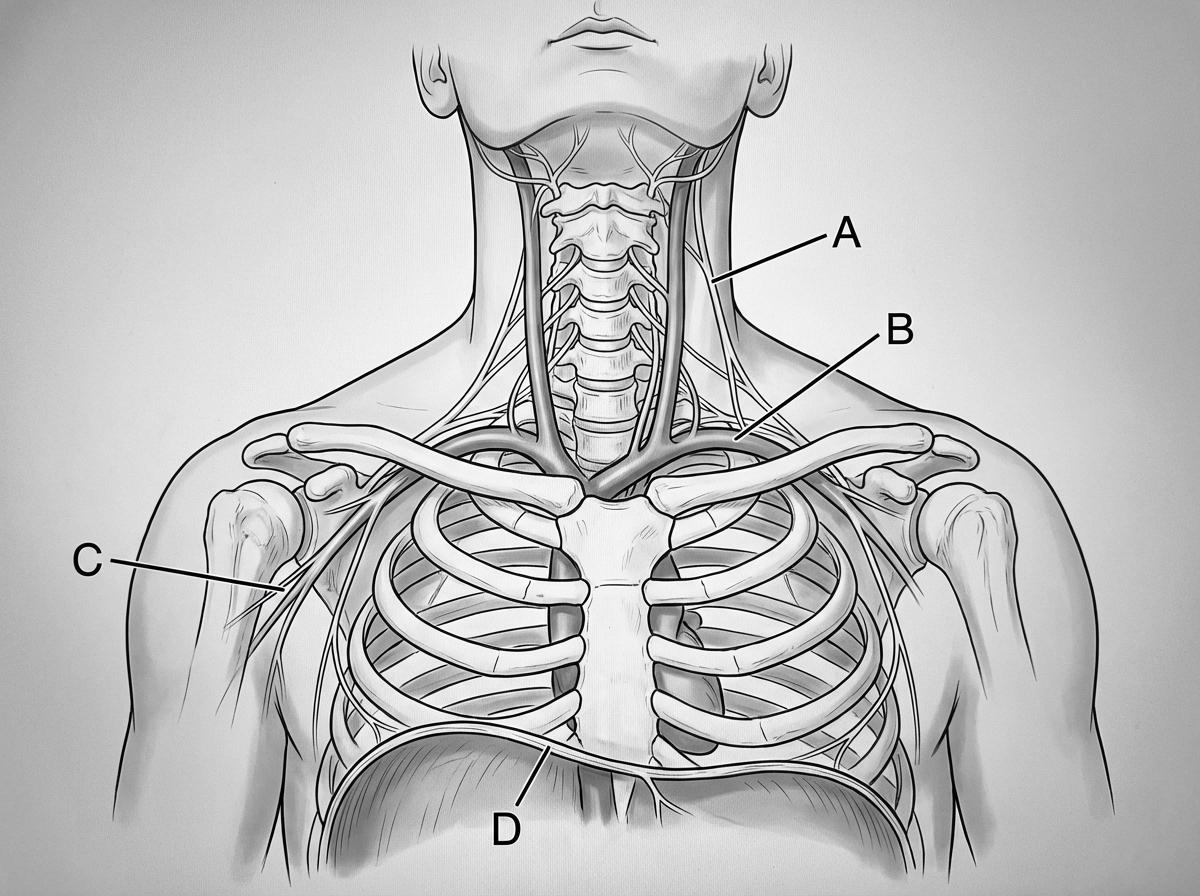
Which of the following structures does NOT pass posterior to the diaphragm?
Which of the following is NOT considered an atypical rib?
What is the anatomical arrangement of vein, artery, and nerve within the intercostal space?
Which segments comprise the middle lobe of the lung?
Where is a 'B' type esophageal ring found?
The cervical esophagus corresponds to which vertebral levels?
Imaging reveals a major blockage of the right coronary artery near the crux of the heart, just proximal to the origin of the posterior interventricular artery. Which part of the heart would be affected by the ischemia that results from this blockage?
Which of the following arteries supply the pectoralis major muscle?
A 55-year-old male presents with myocardial infarction due to a blockage in the right coronary artery. Which of the following cardiac structures is most likely to experience oxygen deficiency?
A 43-year-old house painter fell from a ladder and fractured his left third rib and structures with which it articulated. Which of the following structures would most likely be damaged?
Explanation: The diaphragm features three major openings and several smaller apertures for the passage of structures between the thorax and abdomen. [1] **Explanation of the Correct Answer:** The **Greater splanchnic nerve** (along with the lesser and least splanchnic nerves) does not pass posterior to the diaphragm. Instead, it **pierces the crus of the diaphragm** (specifically the medial aspect of the crus) to enter the abdominal cavity and synapse in the celiac ganglion. **Analysis of Incorrect Options:** The structures passing **posterior** to the diaphragm do so via the **Aortic Hiatus** (at the level of T12), which is technically an osseo-aponeurotic opening behind the median arcuate ligament, not a hole in the muscle itself. [1] * **A. Aorta:** Passes posterior to the diaphragm through the aortic hiatus. * **B. Azygos vein:** Typically ascends through the aortic hiatus (or occasionally through the right crus) to enter the thorax. * **C. Thoracic duct:** Ascends from the cisterna chyli through the aortic hiatus, positioned between the aorta and the遊 azygos vein. **NEET-PG High-Yield Pearls:** * **Mnemonic for Aortic Hiatus (T12):** **"T-A-N"** (Thoracic duct, Azygos vein, Narrowing of Aorta). * **Esophageal Opening (T10):** Transmits the Esophagus, Vagus nerves (Left anterior, Right posterior), and esophageal branches of left gastric vessels. * **Vena Caval Opening (T8):** Transmits the IVC and branches of the Right Phrenic nerve. * **Sympathetic Chain:** Passes posterior to the **medial arcuate ligament**. * **Left Phrenic Nerve:** Pierces the muscular part of the left dome of the diaphragm.
Explanation: To master rib anatomy for NEET-PG, it is essential to distinguish between **typical** and **atypical** ribs based on their morphological features. ### **Explanation** **Typical ribs (3rd to 9th)** possess a head with two facets (for articulation with two vertebrae), a neck, a tubercle, and a shaft with a distinct costal groove and an angle. **Rib IX** is a **typical rib**. It possesses all the standard features mentioned above, including two articular facets on its head to articulate with the bodies of T8 and T9 vertebrae. Therefore, it is not considered atypical. ### **Analysis of Incorrect Options** * **Rib I (Atypical):** It is the shortest, broadest, and most curved. It has only one articular facet on its head and features the **scalene tubercle** on its superior surface. It has no costal groove or angle. * **Rib II (Atypical):** Although it has two facets on its head, it is considered atypical due to the **tuberosity for serratus anterior** on its upper surface and its lack of a twisted shaft. * **Rib X (Atypical):** It typically has only **one articular facet** on its head to articulate with the T10 vertebra alone, unlike the two facets found on typical ribs. ### **High-Yield NEET-PG Pearls** * **Atypical Ribs:** 1, 2, 10, 11, and 12. * **Floating Ribs:** 11 and 12 (no anterior attachment). * **Shortest Rib:** Rib 1; **Longest Rib:** Rib 7. * **Rib 1 Relations:** The subclavian vein passes anterior to the scalene tubercle, while the subclavian artery and lower trunk of the brachial plexus pass posterior to it. * **Clinical:** The 1st rib is rarely fractured due to its protected position; if fractured, suspect severe trauma to the brachial plexus or subclavian vessels.
Explanation: ### Explanation **1. Why Option C is Correct:** The neurovascular bundle of the intercostal space consists of the **Intercostal Vein, Artery, and Nerve (VAN)**. These structures are located in the **costal groove**, which is situated along the **lower (inferior) border** of the superior rib of the space [1]. Within this groove, the structures are protected by the overhanging edge of the rib and are arranged in a specific superior-to-inferior order: **V**ein, **A**rtery, **N**erve (Mnemonic: **VAN**). They lie between the internal intercostal and the innermost intercostal muscle layers. **2. Why Other Options are Incorrect:** * **Option A:** The upper border of the rib contains the **collateral branches** of the neurovascular bundle. These are smaller and arranged in reverse order (NAV). * **Option B:** The middle of the intercostal space is occupied primarily by the intercostal muscles and membranes; the main neurovascular bundle is tucked safely under the rib margin. * **Option D:** While the bundle is in the intercostal space, "lower portion" is less precise than "along the lower border of the rib," which specifically refers to the anatomical protection of the costal groove. **3. Clinical Pearls for NEET-PG:** * **Thoracocentesis (Pleural Tap):** To avoid damaging the main neurovascular bundle (VAN), the needle is always inserted **just above the upper border of the lower rib** (the "safe zone") [1]. * **Order of structures:** From superior to inferior, it is **V-A-N**. The vein is the most protected (highest), and the nerve is the least protected (lowest). * **Intercostal Nerve Block:** The needle is directed toward the lower border of the rib to reach the nerve as it exits the costal groove.
Explanation: The right lung is divided into three lobes (superior, middle, and inferior) by the horizontal and oblique fissures. The **middle lobe** is a wedge-shaped segment located anteriorly, bounded superiorly by the horizontal fissure and inferiorly by the oblique fissure. [1] ### Why "Medial and Lateral" is Correct: The right middle lobe bronchus divides into two tertiary (segmental) bronchi, which supply the two bronchopulmonary segments of the middle lobe: 1. **Lateral segment (S4)** 2. **Medial segment (S5)** These segments are positioned side-by-side when viewed from the front, forming the portion of the lung that sits adjacent to the right atrium of the heart. ### Why Other Options are Incorrect: * **A. Superior and inferior:** These are the segments of the **Lingula** (the anatomical equivalent of the middle lobe in the left lung). * **B. Anterior and posterior:** These are segments of the **Upper Lobe** (along with the apical segment). * **C. Apical and basal:** "Apical" refers to the top of the upper lobe or the superior segment of the lower lobe. "Basal" segments (medial, lateral, anterior, posterior) comprise the bulk of the **Lower Lobes**. [1] ### High-Yield Clinical Pearls for NEET-PG: * **Silhouette Sign:** On a PA chest X-ray, opacity in the right middle lobe obscures the right heart border. * **Auscultation:** The middle lobe is best auscultated on the **anterior chest wall**, below the 4th rib. * **Foreign Body Aspiration:** While foreign bodies most commonly enter the right main bronchus due to its vertical orientation, they typically lodge in the **lower lobe** (posterior basal segment) rather than the middle lobe. * **Eponym:** The middle lobe is sometimes involved in "Right Middle Lobe Syndrome," a form of chronic atelectasis often due to compression by lymph nodes.
Explanation: ### Explanation The **'B' ring** (also known as a **Schatzki ring**) is a smooth, thin, mucosal ring located at the **squamocolumnar junction** (the Z-line), which marks the anatomical **gastro-esophageal junction** [2][3]. #### Why the Correct Answer is Right: * **Anatomy:** The 'B' ring is a mucosal fold consisting of squamous epithelium on its superior surface and columnar epithelium on its inferior surface. It is located at the distal end of the esophagus, precisely at the gastro-esophageal junction [2]. * **Clinical Significance:** It is often associated with a hiatal hernia [2]. When the luminal diameter of this ring is less than 13 mm, it can cause intermittent dysphagia (solid food bolus obstruction), a condition colloquially known as "Steakhouse Syndrome." #### Why the Other Options are Wrong: * **Option A & D:** The junction of the cervical esophagus and cricopharyngeus is the site of the **'A' ring** (a contractile muscular ring) or **Plummer-Vinson webs**. These are located in the upper esophagus, not the gastro-esophageal junction. * **Option C:** The junction of the upper and middle thirds is a common site for esophageal webs or traction diverticula [1], but not for Schatzki rings, which are strictly distal structures. #### High-Yield Facts for NEET-PG: * **A-Ring:** Located ~2 cm above the GE junction; it is a **muscular** ring covered by squamous epithelium. * **B-Ring (Schatzki):** Located at the GE junction; it is a **mucosal** ring (Squamocolumnar junction) [3]. * **C-Ring:** A rare anatomical indentation caused by the diaphragmatic crus (rarely clinically significant) [3]. * **Radiology:** Best visualized on a **Barium Swallow** during a full inspiration or Valsalva maneuver.
Explanation: **Explanation:** The esophagus is a muscular tube approximately 25 cm long, divided into cervical, thoracic, and abdominal parts. Understanding its vertebral levels is a high-yield topic for NEET-PG. **1. Why C5-C6-C7 is Correct:** The esophagus begins at the lower border of the **cricoid cartilage**, which corresponds to the **C6 vertebral level**. The cervical part of the esophagus extends from this origin (C6) down to the thoracic inlet (suprasternal notch), which corresponds to the level of **T1**. Therefore, the cervical esophagus spans the levels of **C6 and C7** (often described in textbooks as starting at the C5-C6 junction and continuing through C7). **2. Why Incorrect Options are Wrong:** * **A & B (C2 to C5):** These levels correspond to the **pharynx** (specifically the oropharynx and laryngopharynx). The esophagus has not yet begun at these levels, as the transition from the pharynx to the esophagus occurs strictly at the C6 level. * **D (C7-C8):** While the esophagus passes through C7, there is no C8 vertebra (only a C8 spinal nerve). The esophagus enters the thorax at the T1 level. **Clinical Pearls for NEET-PG:** * **Constrictions:** The first and narrowest constriction of the esophagus is at its commencement (**Cricopharyngeal junction**) at the level of **C6**, approximately 15 cm from the upper incisor teeth. * **Killian’s Dehiscence:** This is a weak muscular area between the thyropharyngeus and cricopharyngeus muscles at the C6 level, which is the site for **Zenker’s diverticulum**. * **Vertebral Landmarks:** * **Start of Esophagus:** C6 * **Bifurcation of Trachea:** T4/T5 (Lower border of T4) * **Esophageal Opening in Diaphragm:** T10
Explanation: The **crux of the heart** is the junction where the coronary sulcus and the posterior interventricular groove meet. In approximately 80–90% of individuals (Right Dominance), the **Right Coronary Artery (RCA)** gives off the **Atrioventricular (AV) nodal artery** at this location, just before it continues as the posterior interventricular artery. Therefore, a blockage proximal to the origin of the posterior interventricular artery at the crux directly compromises the blood supply to the **AV node**. **Analysis of Options:** * **B. AV Node (Correct):** As explained, the AV nodal artery typically arises from the RCA at the crux. Ischemia here can lead to AV blocks [1]. * **A. SA Node:** The SA nodal artery arises from the RCA in only 60% of cases, but it originates much earlier (proximal part of the RCA), not at the crux. * **C. Anterior 2/3 of the Interventricular Septum:** This area is supplied by the **Anterior Interventricular Artery** (Left Anterior Descending - LAD), a branch of the Left Coronary Artery. The RCA (via the posterior interventricular artery) supplies the *posterior* 1/3 of the septum. * **D. Right Ventricle:** While the RCA does supply the right ventricle, the question specifies a blockage at the **crux** (the very end of the RCA's course). The major branches to the right ventricular free wall (like the marginal artery) arise much earlier. **NEET-PG High-Yield Pearls:** * **Coronary Dominance:** Determined by which artery gives rise to the Posterior Interventricular Artery (PIVA). Right dominance is most common (85%). * **Blood Supply to Conducting System:** * **SA Node:** 60% RCA, 40% LCA. * **AV Node:** 80-90% RCA (at the crux). * **Bundle of His:** Primarily LAD (LCA). * **Clinical Correlation:** Inferior wall MI (often involving the RCA) is frequently associated with bradycardia and heart blocks due to AV node ischemia [1].
Explanation: The **Pectoralis Major** is a large, fan-shaped muscle forming the bulk of the anterior chest wall. Its blood supply is **multisource**, which is a common pattern for large superficial muscles of the trunk. ### **Explanation of the Correct Answer** The pectoralis major receives its arterial supply from three primary sources, making **Option D** the correct choice: 1. **Pectoral branches of the Thoracoacromial Artery:** This is the **primary** and largest blood supply. The thoracoacromial artery is a branch of the second part of the axillary artery. Its pectoral branch descends between the pectoralis major and minor. 2. **Lateral Thoracic Artery:** Another branch of the second part of the axillary artery, it provides significant supply to the lateral aspect of the muscle. 3. **Intercostal Arteries:** Specifically, the **anterior perforating branches** of the internal thoracic artery (mammary artery) and the anterior intercostal arteries supply the medial and deep surfaces of the muscle. ### **Why other options are part of the whole** * **Option A, B, and C** are all correct individually, but since the muscle is highly vascularized by all these vessels, "All of the above" is the most accurate anatomical description. ### **High-Yield Clinical Pearls for NEET-PG** * **Nerve Supply:** It has a dual nerve supply—the **Medial and Lateral Pectoral Nerves** [1]. (Mnemonic: *ML* - Medial supplies both Pectoralis Major and Minor; Lateral supplies only Pectoralis Major). * **Surgical Significance:** In **Modified Radical Mastectomy (MRM)** or breast reconstruction, the pectoral branches of the thoracoacromial artery must be identified. * **Pectoralis Major Myocutaneous (PMMC) Flap:** This is a "workhorse" flap in reconstructive surgery. It is a **Type V muscle flap** based primarily on the pectoral branch of the thoracoacromial artery. * **Poland Syndrome:** A congenital condition characterized by the unilateral absence of the pectoralis major muscle.
Explanation: ### Explanation The **Right Coronary Artery (RCA)** is the primary source of blood supply to the conducting system of the heart and the diaphragmatic (inferior) surface of the ventricles [1]. **Why the AV Node is the Correct Answer:** In approximately **80-85% of individuals (Right Dominance)**, the RCA gives off the **AV nodal artery** at the crux of the heart. While the SA node is also supplied by the RCA in 60% of cases, the AV node is classically associated with RCA occlusion in NEET-PG contexts, particularly when discussing inferior wall myocardial infarction. Blockage of the RCA often leads to AV blocks due to ischemia of this node. **Analysis of Incorrect Options:** * **A. Right Atrium:** While the RCA does supply the right atrium, the question asks which structure is *most likely* or most clinically significant to experience deficiency leading to complications. The AV node is a high-yield physiological target. * **B. Sinoatrial (SA) Node:** The SA node is supplied by the RCA in 60% of people and the Left Circumflex Artery (LCx) in 40%. Because the AV node has a higher dependency on the RCA (85%), it is the more definitive answer for RCA-specific questions. * **D. Apex of the Heart:** The apex is primarily supplied by the **Left Anterior Descending (LAD)** artery [1]. Occlusion of the LAD (the "widow-maker") typically leads to apical and anterior wall MI. **NEET-PG High-Yield Pearls:** * **Coronary Dominance:** Determined by which artery gives rise to the **Posterior Interventricular Artery (PIV)**. Right dominance (85%) = RCA; Left dominance (8%) = LCx; Codominance (7%). * **Inferior Wall MI:** Usually involves the RCA. Look for ECG changes in leads **II, III, and aVF**. * **Conducting System Supply:** * SA Node: 60% RCA, 40% LCx. * AV Node: 85-90% RCA. * Bundle of His/Bundle Branches: Primarily LAD (Septal branches).
Explanation: ### Explanation The correct answer is **B. Body of the second thoracic vertebra**. #### 1. Why the Correct Answer is Right The ribs articulate with the vertebral column at two points: the **costovertebral joint** and the **costotransverse joint**. A typical rib (ribs 2–9) articulates with the **body of its own vertebra** and the **body of the vertebra above it**. Therefore, the head of the **3rd rib** has two articular facets: * One for the body of the **3rd thoracic vertebra (T3)**. * One for the body of the **2nd thoracic vertebra (T2)**. Since the question asks which structure it articulates with, the body of T2 is a direct site of articulation and would likely be damaged in a fracture involving these joints. #### 2. Why Other Options are Wrong * **A. Manubrium of the sternum:** The 1st and 2nd ribs articulate with the manubrium. The 3rd rib articulates with the **body of the sternum** at the level of the third costal notch. * **C. Body of the fourth thoracic vertebra:** The 3rd rib does not descend to articulate with T4. It only articulates with its numerical match (T3) and the one superior to it (T2). * **D. Spinous process of the third thoracic vertebra:** Ribs articulate with the **transverse processes** (at the costotransverse joint) and the **vertebral bodies**, never the spinous processes. #### 3. NEET-PG Clinical Pearls * **Atypical Ribs:** Ribs 1, 10, 11, and 12 are "atypical" because they articulate with only **one** vertebral body (their own). * **Rib 2:** Articulates at the **Sternal Angle (Angle of Louis)**, which is a key landmark for counting ribs clinically. * **Floating Ribs:** Ribs 11 and 12 have no neck or tubercle and do not articulate with transverse processes. * **Neurovascular Bundle:** Always remember that the intercostal nerves and vessels run in the **costal groove** at the **inferior border** of the rib. Clinical procedures (like chest tube insertion) are performed at the superior border of the rib to avoid damage.
Thoracic Wall and Diaphragm
Practice Questions
Pleura and Lungs
Practice Questions
Mediastinum
Practice Questions
Heart and Pericardium
Practice Questions
Great Vessels and Azygos System
Practice Questions
Thoracic Duct and Lymphatics
Practice Questions
Autonomic Innervation
Practice Questions
Applied Anatomy and Clinical Correlations
Practice Questions
Thoracic Imaging and Cross-sectional Anatomy
Practice Questions
Embryological Development of Thoracic Structures
Practice Questions
Get full access to all questions, explanations, and performance tracking.
Start For Free