Which of the following statements is true about the right atrium?
A patient underwent sentinel node biopsy for treatment of breast carcinoma. Which of the following nerves is likely to be injured during this procedure?
What artery supplies the SA node?
The thoracic duct terminates by emptying into which structure?
The nipple is supplied by which of the following intercostal nerves?
In which intercostal space is the typical arrangement of vein, artery, and nerve (VAN) absent?
Anastomosis around the shoulder is between branches of which parts of the subclavian and axillary arteries?
Which of the following structures form the bulge marked X?

Which of the following statements is NOT true?
Which chamber forms the base of the heart?
Explanation: ### Explanation The right atrium is a high-yield topic in NEET-PG anatomy, focusing on its internal features and relations. **Why Option C is Correct:** The **coronary sinus** (the primary venous drainage of the heart) opens into the right atrium between the opening of the **inferior vena cava (IVC)** and the **tricuspid orifice**. Specifically, it lies in the posterior-inferior part of the interatrial septum, situated between the **fossa ovalis** and the IVC opening. This area is clinically significant as it forms part of the **Triangle of Koch**, which contains the AV node. **Analysis of Incorrect Options:** * **Option A:** The right auricle is a small, conical muscular pouch that projects from the atrium to cover the root of the ascending aorta. It lies **anteromedially** (not superolaterally) in relation to the root of the aorta. * **Option B:** The right atrium rests on the central tendon of the diaphragm, but the level of the IVC opening (where the atrium meets the diaphragm) is at the **T8 level**, not T10. * **Option C:** The **Superior Vena Cava (SVC) has no valve**. In contrast, the IVC is guarded by the *Eustachian valve* and the coronary sinus is guarded by the *Thebesian valve* (both are rudimentary in adults). **High-Yield NEET-PG Pearls:** 1. **Triangle of Koch Boundaries:** Guarded by the Tendon of Todaro, the septal leaflet of the tricuspid valve, and the opening of the coronary sinus [1]. **Apex:** Contains the AV node. 2. **Crista Terminalis:** A vertical ridge separating the smooth posterior part (*sinus venarum*) from the rough anterior part (*pectinate muscles*). The SA node is located at its upper end. 3. **Musculi Pectinati:** These originate from the crista terminalis and run anteriorly toward the auricle [1].
Explanation: ### Explanation **Correct Option: A. Intercostobrachial nerve** The **intercostobrachial nerve** is the lateral cutaneous branch of the second intercostal nerve (T2). It traverses the axilla to provide sensory innervation to the skin of the axilla and the upper medial aspect of the arm [1]. During a sentinel node biopsy or axillary lymph node dissection (ALND), this nerve is the most frequently injured structure because it passes directly through the central and apical groups of axillary lymph nodes [1]. Injury typically results in postoperative numbness or paresthesia in the axilla and medial arm. **Analysis of Incorrect Options:** * **B. Nerve to latissimus dorsi (Thoracodorsal nerve):** This nerve arises from the posterior cord of the brachial plexus and runs along the posterior wall of the axilla [1]. While it is at risk during radical mastectomies, it is deeper and more posterior than the superficial path of the intercostobrachial nerve. * **C. Nerve to serratus anterior (Long thoracic nerve of Bell):** This nerve descends on the medial wall of the axilla (on the surface of the serratus anterior). Injury leads to "winging of the scapula." It is usually protected by the fascia of the muscle during superficial biopsies. * **D. Lateral pectoral nerve:** This nerve supplies the pectoralis major and is located superior and medial to the axillary lymph node clusters [1]. It is rarely involved in sentinel node procedures. **High-Yield Clinical Pearls for NEET-PG:** * **Most common nerve injured in Axillary Surgery:** Intercostobrachial nerve [1]. * **Winging of Scapula:** Caused by injury to the Long Thoracic Nerve (C5, C6, C7). * **Sentinel Node:** The first lymph node(s) to receive lymphatic drainage from a tumor; in breast cancer, these are usually found in the **Level I (Lateral/Pectoral)** axillary group [2]. * **Nerve to Latissimus Dorsi:** Injury results in weakness of adduction, extension, and internal rotation of the arm (the "climbing" muscle).
Explanation: **Explanation:** The blood supply to the conducting system of the heart is a high-yield topic in anatomy. The **Sinoatrial (SA) node**, known as the natural pacemaker of the heart, is located at the junction of the superior vena cava and the right atrium [1]. **Why the Right Coronary Artery (RCA) is correct:** In approximately **60% of individuals**, the SA nodal artery arises from the **Right Coronary Artery (RCA)**. It typically originates from the proximal part of the RCA and courses posteriorly between the right auricle and the ascending aorta to reach the node. In the remaining 40%, it arises from the left circumflex artery. For examination purposes, the RCA is considered the primary source. **Analysis of Incorrect Options:** * **Left Anterior Descending (LAD):** This artery primarily supplies the anterior 2/3 of the interventricular septum and the anterior wall of both ventricles [2]. It does not supply the SA node. * **Posterior Interventricular Artery (PDA):** This artery (usually a branch of the RCA) supplies the **Atrioventricular (AV) node** in 80% of people (Right Dominance), but it is not the primary supply for the SA node. * **Left Coronary Artery (LCA):** While the LCA (via the circumflex branch) supplies the SA node in 40% of cases, the RCA is the statistically more common and "textbook" answer for the primary supply. **Clinical Pearls for NEET-PG:** 1. **AV Node Supply:** Supplied by the RCA in 80% of cases (via the AV nodal artery arising at the crux). 2. **Bundle of His:** Receives a dual supply from both the RCA and the LAD. 3. **Right Bundle Branch:** Primarily supplied by the LAD. 4. **Clinical Correlation:** An inferior wall MI (often involving the RCA) is frequently associated with sinus bradycardia or heart blocks due to ischemia of the SA and AV nodes.
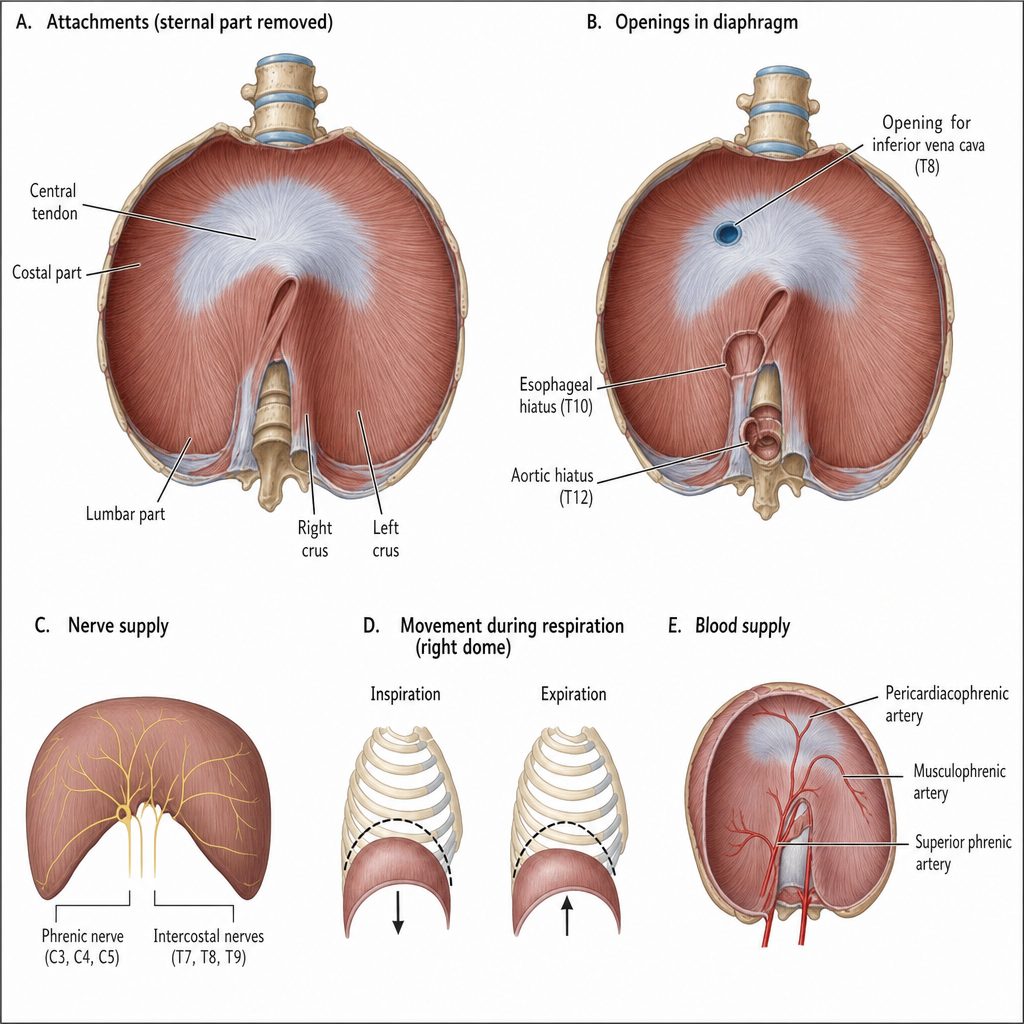
Explanation: **Explanation:** The **thoracic duct** is the largest lymphatic vessel in the body. It originates in the abdomen at the level of the L1-L2 vertebrae as a dilated sac called the **cisterna chyli**. Therefore, the thoracic duct is anatomically the superior **continuation of the cisterna chyli**. It enters the thorax through the aortic opening of the diaphragm and ascends to eventually drain into the venous system [1] at the junction of the left internal jugular and left subclavian veins. **Analysis of Options:** * **Option A (Correct):** As described, the duct begins at the upper end of the cisterna chyli; thus, it is its direct continuation. * **Option B (Incorrect):** The right lymphatic duct is a separate structure that drains the upper right quadrant of the body into the right venous angle. It does not terminate into the thoracic duct. * **Option C (Incorrect):** The thoracic duct terminates in the **venous system** (left brachiocephalic vein area), not the azygos or inferior vena cava. The azygos vein actually runs to the right of the thoracic duct in the posterior mediastinum. **High-Yield NEET-PG Pearls:** * **Course:** It crosses from the right side to the left side of the vertebral column at the level of the **T5 vertebra**. * **Drainage:** It drains lymph from the entire body **except** the right upper limb, right side of the head, neck, and thorax (which are drained by the right lymphatic duct). * **Clinical Correlation:** Injury to the duct during thoracic surgery leads to **Chylothorax** (accumulation of milky lymph in the pleural cavity). * **Relations:** In the posterior mediastinum, it lies between the **Azygos vein** (right) and the **Descending Thoracic Aorta** (left). Remember the mnemonic: *"The duck (duct) between two gooses (Azy-goos and Esopha-goos/Aorta)."*
Explanation: **Explanation:** The sensory innervation of the thoracic wall is provided by the anterior rami of thoracic spinal nerves (T1–T11), known as intercostal nerves. These nerves follow a dermatomal distribution, which is a high-yield topic for NEET-PG. **1. Why T4 is Correct:** The **T4 intercostal nerve** is responsible for the sensory supply to the skin at the level of the **nipple** in both males and females. Its lateral and anterior cutaneous branches carry fibers that provide sensation to this specific horizontal strip of the thoracic wall. **2. Analysis of Incorrect Options:** * **T3:** This nerve supplies the skin of the upper thorax, generally the area above the nipple line and the third intercostal space. * **T5:** This nerve supplies the skin immediately below the nipple line, covering the fifth intercostal space. * **None of the above:** Incorrect, as T4 is the established dermatomal landmark for the nipple. **3. Clinical Pearls & High-Yield Facts:** * **T10 Dermatome:** Another "must-know" landmark; it supplies the skin at the level of the **umbilicus**. * **T12 (Subcostal Nerve):** Supplies the skin of the suprapubic region. * **Herpes Zoster:** This viral infection often presents along these specific dermatomes; a rash at the nipple line indicates involvement of the T4 ganglion. * **Referred Pain:** Pain from the gallbladder (cholecystitis) can sometimes be referred to the T5-T9 distribution, while cardiac pain typically involves T1-T4 (left side).
Explanation: The standard anatomical arrangement of the neurovascular bundle in a typical intercostal space follows the **VAN** mnemonic (Vein, Artery, Nerve) from superior to inferior, situated within the costal groove at the lower border of the rib. **Why Option A is Correct:** The **First Intercostal Space** is considered atypical. In this space, the arrangement is reversed or disorganized. Specifically, the **first intercostal nerve** (which is the large ventral ramus of T1) passes superior to the first posterior intercostal artery to join the brachial plexus. Consequently, the relationship of structures does not follow the standard VAN pattern found in the typical (3rd–6th) or even most atypical lower spaces. **Why Other Options are Incorrect:** * **Options B & C (Second and Third Spaces):** These spaces generally follow the standard VAN arrangement. While the 2nd space is sometimes considered "atypical" due to the contribution of the intercostobrachial nerve, the fundamental superior-to-inferior relationship of the primary neurovascular bundle remains consistent with the VAN pattern. * **Option D (Eleventh Space):** Although the 11th rib is short and the space is "atypical," the neurovascular bundle still maintains a relatively consistent relationship compared to the unique reversal seen in the first space. **High-Yield NEET-PG Pearls:** * **Safe Zone for Thoracocentesis:** To avoid damaging the VAN bundle, needles are always inserted at the **upper border of the rib below** (the floor of the intercostal space). * **Collateral Bundles:** Small collateral branches of the VAN bundle run along the upper border of the rib below; however, the main bundle at the costal groove is much larger and more vulnerable. * **First Rib Anatomy:** The first rib has no costal groove, which further explains the lack of a protected, typical VAN arrangement.
Explanation: **Explanation:** The **scapular anastomosis** is a vital collateral circulation that ensures blood flow to the upper limb if the distal subclavian or proximal axillary artery is obstructed. It primarily involves a connection between branches of the **1st part of the subclavian artery** and the **3rd part of the axillary artery**. **Why Option B is Correct:** The anastomosis occurs on the dorsal and costal surfaces of the scapula involving three main arteries: 1. **Suprascapular Artery:** From the Thyrocervical trunk (**1st part of Subclavian artery**). 2. **Deep branch of Transverse Cervical Artery** (Dorsal Scapular Artery): Also from the Thyrocervical trunk or directly from the **1st/2nd part of Subclavian artery**. 3. **Circumflex Scapular Artery:** A branch of the Subscapular artery, which arises from the **3rd part of the Axillary artery**. **Why Other Options are Incorrect:** * **Option A & C:** The 1st and 2nd parts of the axillary artery give off the Superior Thoracic, Thoracoacromial, and Lateral Thoracic arteries. While these contribute to the chest wall, they are not the primary components of the scapular anastomosis. * **Option D:** While the 3rd part of the axillary artery provides the "distal" end of the shunt, the "proximal" supply must come from the subclavian artery to bypass potential blocks in the axillary artery's origin. **NEET-PG High-Yield Pearls:** * **Direction of Flow:** If the axillary artery is ligated between the 1st and 3rd parts, blood flow in the circumflex scapular artery **reverses** to reach the 3rd part of the axillary artery, maintaining limb viability. * **Acromial Anastomosis:** A separate network involves the Acromial branches of the Thoracoacromial (2nd part axillary), Suprascapular, and Posterior Circumflex Humeral arteries. * **Clinical Significance:** This anastomosis is the anatomical basis for why the upper limb survives ligation of the subclavian or axillary artery, provided the ligation is proximal to the subscapular artery.
Explanation: ***Right posterior aortic sinus*** - The **right posterior aortic sinus** (also called **non-coronary sinus**) is located posteriorly and to the right, forming a prominent bulge in lateral chest radiographs. - This sinus does **not give rise to coronary arteries** and is positioned between the **right** and **left coronary sinuses**. *Anterior aortic sinus* - This is **not a correct anatomical term** as the aortic sinuses are named based on their relationship to coronary arteries. - The three aortic sinuses are the **right coronary**, **left coronary**, and **non-coronary (right posterior)** sinuses. *Left posterior aortic sinus* - This is **not anatomically accurate** terminology for the aortic valve sinuses. - The **left coronary sinus** is positioned anteriorly and to the left, giving rise to the **left main coronary artery**. *Pulmonary trunk* - The **pulmonary trunk** is located **anterior** and **superior** to the aortic root, not forming the described bulge. - It arises from the **right ventricle** and bifurcates into **right and left pulmonary arteries**.
Explanation: ### Explanation The correct answer is **Option A** because it contains a factual error regarding the anatomy of the intercostal spaces. **1. Analysis of the Correct Answer (Option A):** The internal thoracic artery divides at the level of the 6th intercostal space into the superior epigastric and musculophrenic arteries. The **musculophrenic artery** provides anterior intercostal arteries for the **7th, 8th, and 9th spaces only**. The 10th and 11th intercostal spaces do not have anterior intercostal arteries; these spaces are supplied solely by posterior intercostal arteries. **2. Analysis of Other Options:** * **Option B:** The superior epigastric artery (a terminal branch of the internal thoracic) enters the abdominal wall by passing through the **larrey’s space (foramen of Morgagni)**, located between the sternal and costal slips of the diaphragm, to enter the rectus sheath [1]. * **Option C:** The first two posterior intercostal arteries arise from the **superior intercostal artery**, which is a branch of the **costocervical trunk** (from the 2nd part of the subclavian artery). The remaining nine pairs arise directly from the descending thoracic aorta. * **Option D:** The **intercostobrachial nerve** is the lateral cutaneous branch of the **second intercostal nerve (T2)**. It is clinically significant as it communicates with the medial cutaneous nerve of the arm. **High-Yield NEET-PG Pearls:** * **Internal Thoracic Artery:** Often used as a graft in CABG (Coronary Artery Bypass Grafting). * **Cardiac Referred Pain:** Pain from myocardial infarction is referred to the inner aspect of the left arm via the **intercostobrachial nerve (T2)**. * **Coarctation of the Aorta:** In post-ductal coarctation, the anastomosis between the anterior and posterior intercostal arteries provides collateral circulation, leading to "rib notching" on X-ray.
Explanation: The **base of the heart** (posterior surface) is a high-yield anatomical concept in NEET-PG, often confused with the "bottom" of the heart. [1] ### 1. Why the Left Atrium is Correct The base of the heart is its **posterior aspect**, directed backwards and to the right. It is formed mainly (**two-thirds**) by the **left atrium** and a small part (one-third) by the right atrium [1]. It lies opposite the apex and is separated from the vertebral column (T5–T8) by the esophagus and the descending thoracic aorta. The four pulmonary veins enter the heart at this base. ### 2. Why Other Options are Incorrect * **Right Atrium (A):** While it contributes to a small portion of the base, its primary contribution is to the **right border** and the **sternocostal (anterior) surface**. * **Right Ventricle (B):** This chamber forms the majority of the **sternocostal (anterior) surface** and the inferior border. It does not contribute to the base. * **Left Ventricle (D):** This chamber forms the **apex** of the heart (at the 5th intercostal space) and the majority of the **diaphragmatic (inferior) surface** and the left border. [1] ### 3. Clinical Pearls & High-Yield Facts * **The Apex:** Formed entirely by the **left ventricle**. * **Esophageal Relation:** Because the left atrium forms the base and lies directly anterior to the esophagus, a **Transesophageal Echocardiogram (TEE)** provides the clearest images of the left atrium and mitral valve. * **Mitral Stenosis:** In cases of mitral stenosis, the left atrium can enlarge significantly, compressing the esophagus (causing dysphagia) or the left recurrent laryngeal nerve (causing hoarseness, known as **Ortner’s Syndrome**). * **Crux of the Heart:** The point where the coronary sulcus meets the posterior interventricular groove.
Thoracic Wall and Diaphragm
Practice Questions
Pleura and Lungs
Practice Questions
Mediastinum
Practice Questions
Heart and Pericardium
Practice Questions
Great Vessels and Azygos System
Practice Questions
Thoracic Duct and Lymphatics
Practice Questions
Autonomic Innervation
Practice Questions
Applied Anatomy and Clinical Correlations
Practice Questions
Thoracic Imaging and Cross-sectional Anatomy
Practice Questions
Embryological Development of Thoracic Structures
Practice Questions
Get full access to all questions, explanations, and performance tracking.
Start For Free