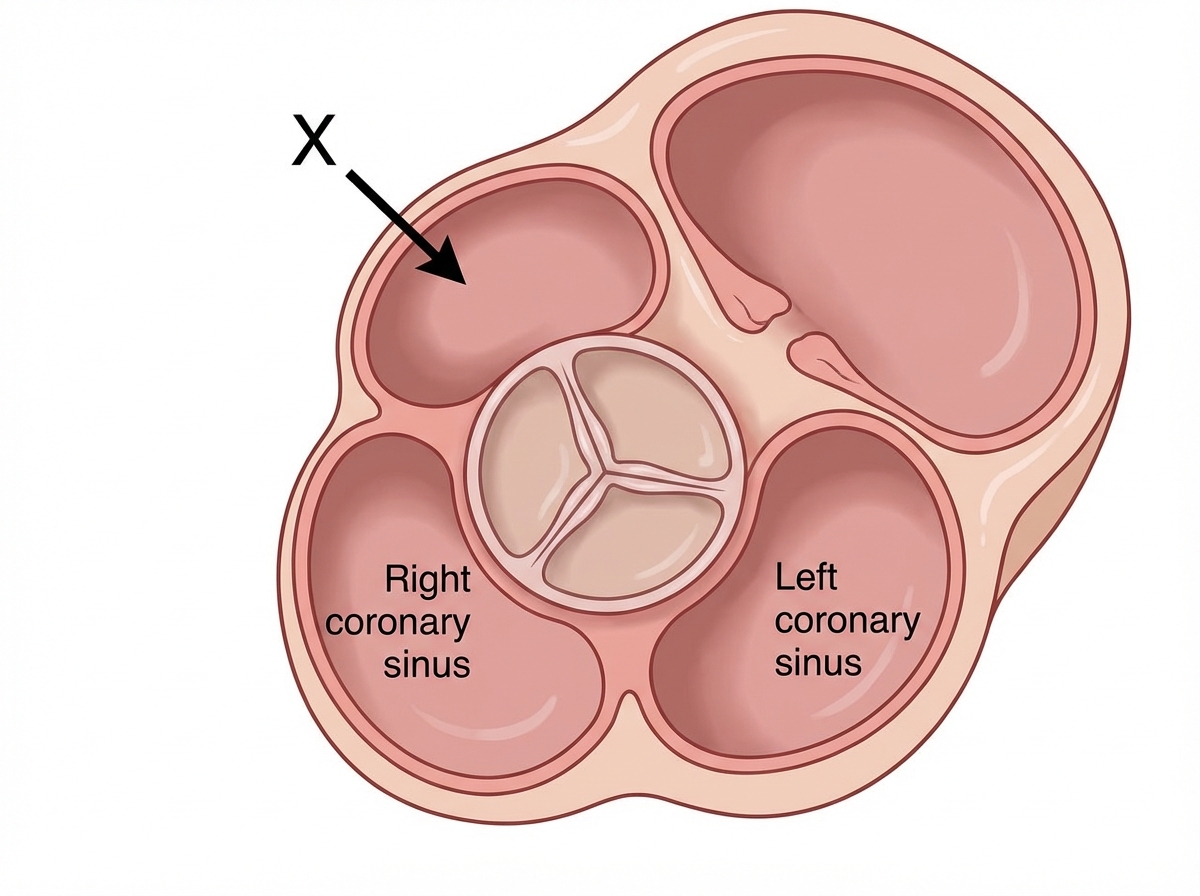
What determines cardiac dominance?
What type of joint is the manubriosternal joint?
The deep cardiac plexus is located at which anatomical landmark?
The thoracic duct is formed by?
What is the most common age group affected in thoracic outlet obstruction syndrome?
All of the following statements regarding the heart are true EXCEPT?
When performing pleural tapping in the mid-axillary line, which muscle is NOT pierced?
Symptoms of thoracic outlet syndrome are produced due to compression of which nerve roots?
Which is the first branch of the subclavian artery?
What is the approximate length of the esophagus in an adult?
Explanation: ### Explanation **1. Why "None of the above" is correct:** Cardiac dominance is determined by the **origin** of the **Posterior Interventricular Artery (PIVA)**, not the artery itself. [1] * **Right Dominance (~70-85%):** PIVA arises from the Right Coronary Artery (RCA). [1] * **Left Dominance (~8-15%):** PIVA arises from the Left Circumflex Artery (LCX). [1] * **Co-dominance (~7-10%):** PIVA is formed by branches from both the RCA and LCX. [1] Since the question asks what *determines* dominance, the answer is the **source/origin** of the PIVA. The options provided list specific arteries rather than the anatomical relationship or origin, making "None of the above" the most accurate choice in a strictly technical sense. **2. Why other options are incorrect:** * **Option A (Anterior Interventricular Artery):** Also known as the Left Anterior Descending (LAD), it almost always arises from the Left Coronary Artery and does not determine dominance. [1] * **Option B (Posterior Interventricular Artery):** While the PIVA runs in the posterior interventricular groove, its *presence* doesn't define dominance; its *parent vessel* does. * **Option C (Circumflex Artery):** This is a branch of the Left Coronary Artery. It only determines dominance if it gives rise to the PIVA (Left Dominance). [1] **3. Clinical Pearls for NEET-PG:** * **Most Common:** Right dominance is the most frequent pattern in the general population. * **SA Node Supply:** In 60% of individuals, the SA node is supplied by the RCA. * **AV Node Supply:** The artery to the AV node usually arises from the "dominant" artery at the crux of the heart. * **Crux of the Heart:** The junction of the coronary sulcus and the posterior interventricular groove; this is where the dominant artery gives off the PIVA.
Explanation: ### Explanation The **manubriosternal joint** (Sternal Angle of Louis) is a **secondary cartilaginous joint** (Symphysis). **Why it is correct:** Secondary cartilaginous joints are characterized by a fibrocartilaginous disc sandwiched between thin layers of hyaline cartilage covering the bone ends. These joints are typically located in the **midline** of the body. The manubriosternal joint allows for slight hinge-like movements during respiration, facilitating the "pump-handle" movement of the thoracic cage. Notably, in about 10% of individuals, this joint may ossify in old age (synostosis). **Analysis of Incorrect Options:** * **A. Primary cartilaginous (Synchondrosis):** These joints involve bone united by hyaline cartilage only and usually ossify with age (e.g., the 1st costosternal joint or epiphyseal plates). The manubriosternal joint contains fibrocartilage, excluding it from this category. * **C. Synovial:** These are freely movable joints with a fluid-filled cavity. While the 2nd to 7th sternocostal joints are synovial, the manubriosternal joint is not. * **D. Ellipsoid:** This is a subtype of synovial joint (e.g., wrist joint) allowing movement in two planes; it is structurally unrelated to the sternum. **High-Yield Clinical Pearls for NEET-PG:** * **Sternal Angle (Angle of Louis):** Located at the level of the **T4-T5 intervertebral disc**. * **Key Landmarks at this level:** Bifurcation of the trachea, beginning and end of the aortic arch, and where the azygos vein drains into the SVC. * **Xiphisternal Joint:** Also a secondary cartilaginous joint, though it commonly ossifies by age 40. * **1st Costosternal Joint:** A rare exception—it is a **primary cartilaginous joint**, unlike the 2nd–7th joints which are synovial.
Explanation: **Explanation:** The **cardiac plexus** is an autonomic nerve network responsible for the innervation of the heart. It is divided into two parts: superficial and deep. **1. Why the Correct Answer is Right:** The **deep cardiac plexus** is the larger of the two and is situated anterior to the **tracheal bifurcation** (carina) and posterior to the arch of the aorta. It is formed by cardiac branches from all cervical and upper thoracic sympathetic ganglia, as well as cardiac branches of the vagus and recurrent laryngeal nerves (except the superior cervical sympathetic and inferior cervical vagal branches of the left side, which form the superficial plexus). [1] **2. Analysis of Incorrect Options:** * **The Myometrium (B):** This is the middle muscular layer of the uterus; it has no anatomical relationship with the thoracic cavity or cardiac innervation. * **The end of the superior vena cava (C):** While the SVC enters the right atrium in the thorax, the cardiac plexus is located more medially and posteriorly, related to the great vessels and the trachea. * **The right bronchus (D):** The plexus lies specifically at the bifurcation (where the trachea splits), not along the course of the individual right or left main bronchi. **3. High-Yield Clinical Pearls for NEET-PG:** * **Superficial Cardiac Plexus:** Located in the concavity of the **aortic arch**, just above the pulmonary trunk. [1] * **Key Landmark:** The superficial plexus lies to the left of the ligamentum arteriosum. [1] * **Function:** Sympathetic stimulation increases heart rate and force of contraction (tachycardia), while parasympathetic (vagal) stimulation decreases them (bradycardia). * **Referred Pain:** Cardiac pain (angina) is carried via sympathetic fibers to the T1–T4/5 dermatomes, explaining pain radiation to the inner arm and chest.
Explanation: The **thoracic_duct** is the largest lymphatic vessel in the body, responsible for draining lymph from approximately three-quarters of the body (everything except the right upper quadrant). [1] **1. Why Option C is Correct:** The thoracic duct begins in the abdomen at the level of the **T12 vertebra**. It originates as the direct upward continuation of the **cisterna chyli**, a saccular dilatation located in front of the bodies of L1 and L2 vertebrae. It enters the thorax through the **aortic opening** of the diaphragm and ascends in the posterior mediastinum. **2. Why Other Options are Incorrect:** * **Options A & B:** These describe the **termination** of the thoracic duct rather than its formation. The thoracic duct ends by opening into the junction of the **left internal jugular and left subclavian veins** (the left venous angle). [1] It does not form from these veins; rather, it empties its lymphatic load into the venous circulation at this point. **3. High-Yield Clinical Pearls for NEET-PG:** * **Course:** It starts on the right side of the midline, crosses to the left side at the level of the **T5 vertebra**, and arches over the apex of the left lung to reach the venous angle. * **Relations:** In the posterior mediastinum, it lies between the **Azygos vein** (on the right) and the **Descending Thoracic Aorta** (on the left). * **Chylothorax:** Injury to the thoracic duct (during esophageal surgery or due to trauma) leads to the accumulation of milky lymphatic fluid in the pleural cavity. * **Virchow’s Node:** Enlargement of the left supraclavicular lymph node (Troisier’s sign) occurs in gastric malignancies because the thoracic duct carries malignant cells to this site.
Explanation: **Explanation:** Thoracic Outlet Syndrome (TOS) refers to the compression of the neurovascular bundle (brachial plexus, subclavian artery, or subclavian vein) as it passes through the superior thoracic aperture [1]. **Why 25–45 years is correct:** The peak incidence of TOS occurs in the **third to fourth decades of life (25–45 years)**. This age predilection is due to several factors: 1. **Muscular Development:** This is the period of peak physical activity and occupational strain. Repetitive overhead activities or poor posture lead to hypertrophy or fibrosis of the scalene muscles. 2. **Anatomical Changes:** In women (who are affected 3–4 times more than men), the gradual drooping of the shoulder girdle that occurs in early adulthood increases the traction on the brachial plexus. 3. **Neurogenic Predominance:** Over 95% of cases are Neurogenic TOS, which typically manifests during the most productive working years [1]. **Analysis of Incorrect Options:** * **10–25 years:** While congenital causes like a cervical rib are present from birth, they rarely cause symptoms until the body reaches full skeletal and muscular maturity. * **45–65 years & >65 years:** TOS is less common in the elderly. Symptoms in these age groups are more likely to be caused by cervical spondylosis or degenerative disc disease rather than outlet compression. **High-Yield Clinical Pearls for NEET-PG:** * **Most common type:** Neurogenic TOS (95%), involving the lower trunk of the brachial plexus (C8-T1) [1]. * **Most common site of compression:** The **interscalene triangle** (between anterior and middle scalene) [1]. * **Adson’s Test:** A classic clinical sign where the radial pulse disappears when the patient deep breaths and turns the head toward the affected side. * **Cervical Rib:** The most famous anatomical predisposition, though most people with a cervical rib remain asymptomatic.
Explanation: **Explanation:** **1. Why Option B is the Correct Answer (The Exception):** While the Sinoatrial (SA) node is the "pacemaker" of the heart and possesses **intrinsic automaticity** (the ability to initiate an impulse without external stimuli), it is **not** devoid of a nerve supply. The SA node is richly innervated by both sympathetic and parasympathetic (vagus nerve) fibers [2]. These autonomic nerves modulate the heart rate (chronotropy) but do not initiate the beat itself. Therefore, the statement that it "does not receive a nerve supply" is false. **2. Analysis of Incorrect Options:** * **Option A:** Cardiac pain (angina) resulting from ischemia is carried by **visceral afferent fibers** that follow the sympathetic pathways back to the T1–T4/T5 spinal segments. This explains the referred pain to the chest and left arm. * **Option C:** The Atrioventricular (AV) node is located in the **interatrial septum**, specifically within the **Triangle of Koch** (bounded by the Tendon of Todaro, the tricuspid valve annulus, and the coronary sinus orifice) [1]. * **Option D:** The diaphragmatic (inferior) surface of the heart rests on the central tendon of the diaphragm. It is formed by both ventricles, but primarily by the **left ventricle** (approx. 2/3) and the right ventricle (approx. 1/3). **3. High-Yield Clinical Pearls for NEET-PG:** * **Blood Supply:** The SA node is most commonly supplied by the **Right Coronary Artery (RCA)** (60% of cases). * **Triangle of Koch:** A frequent anatomy question; remember its boundaries to locate the AV node during electrophysiology studies. * **Dominance:** Coronary dominance is determined by which artery gives off the **Posterior Interventricular Artery**, which supplies the diaphragmatic surface. In 85% of people, it is the RCA (Right Dominant).
Explanation: To perform pleural tapping (thoracocentesis) in the **mid-axillary line**, the needle must pass through the chest wall layers to reach the pleural cavity. The anatomical layers pierced, from superficial to deep, are: Skin → Superficial fascia → Serratus anterior → **External intercostal** [2] → **Internal intercostal** → **Innermost intercostal** → Endothoracic fascia → Parietal pleura [1]. **Why Transversus Thoracis is the correct answer:** The **Transversus thoracis** (also known as the sternocostalis) is a thin muscular plane located only on the **anterior** aspect of the inner thoracic wall. It originates from the posterior surface of the lower sternum and xiphoid process and inserts into the costal cartilages of ribs 2–6. Because it is confined to the anterior chest wall (parasternal region), it is **not encountered** when inserting a needle at the mid-axillary line. **Analysis of Incorrect Options:** * **External Intercostal:** This is the outermost layer of the intercostal muscles and is present throughout the mid-axillary line [2]. * **Internal Intercostal:** This middle layer is present from the sternum to the angle of the ribs, thus it is pierced in the mid-axillary line. * **Innermost Intercostal:** This is the deepest layer, separated from the internal intercostal by the neurovascular bundle. It is well-developed in the mid-axillary region. **NEET-PG High-Yield Pearls:** * **Safe Zone:** Pleural tapping is typically performed in the 6th–8th intercostal space in the mid-axillary line or 8th–10th in the scapular line. * **Needle Position:** Always insert the needle at the **upper border of the lower rib** to avoid damaging the intercostal neurovascular bundle (VAN), which runs in the costal groove at the lower border of the upper rib. * **Neurovascular Plane:** The intercostal nerves and vessels lie between the **internal** and **innermost** intercostal muscles.
Explanation: **Explanation:** **Thoracic Outlet Syndrome (TOS)** occurs due to the compression of neurovascular structures as they pass through the superior thoracic aperture (thoracic outlet) toward the axilla [1]. **1. Why C8 and T1 are correct:** The brachial plexus and subclavian vessels pass through the **interscalene triangle** (between the anterior and middle scalene muscles) [1]. The **lower trunk** of the brachial plexus, formed by the **C8 and T1 nerve roots**, lies most inferiorly and rests directly on the first rib. Consequently, any structural abnormality—such as a **cervical rib** (an accessory rib arising from C7) or a fibrous band—exerts upward pressure specifically on these roots. This leads to neurological symptoms in the ulnar distribution, including wasting of the intrinsic hand muscles (T1) and sensory loss along the medial forearm and hand (C8). **2. Why other options are incorrect:** * **C5, C6, and C7 (Options A, B, and C):** These roots form the upper and middle trunks of the brachial plexus. They are positioned higher in the neck and are not in direct contact with the first rib or the common sites of compression in the thoracic outlet. Compression of these roots usually occurs in the cervical spine (e.g., disc herniation) rather than the thoracic outlet. **3. Clinical Pearls for NEET-PG:** * **Adson’s Test:** A classic clinical test where the radial pulse disappears when the patient extends their neck and turns the head toward the affected side while taking a deep breath. * **Most common cause:** A cervical rib or an elongated C7 transverse process. * **Structures involved:** The **Subclavian artery** is frequently compressed (leading to ischemic symptoms), but the **Subclavian vein** is usually spared as it passes anterior to the anterior scalene muscle [1]. * **Gilliatt-Sumner Hand:** The characteristic wasting of the thenar eminence and intrinsic hand muscles seen in neurogenic TOS.
Explanation: The subclavian artery is divided into three parts by the **scalenus anterior muscle**. The first part (medial to the muscle) gives off three major branches, and their order of origin is a frequent high-yield topic in anatomy. ### Why the Correct Answer is Right The **Vertebral artery** is the **first and most medial branch** arising from the superior aspect of the first part of the subclavian artery. It ascends through the foramina transversaria of the C1–C6 vertebrae to enter the cranial cavity, forming the posterior circulation of the brain. ### Analysis of Incorrect Options * **Internal thoracic artery (Option A):** This also arises from the first part of the subclavian artery but originates from the **inferior aspect**, usually slightly lateral or opposite to the origin of the vertebral artery. * **Thyrocervical trunk (Option B):** This is the third branch of the first part, located just medial to the scalenus anterior. It further divides into the inferior thyroid, suprascapular, and transverse cervical arteries. * **Costocervical trunk (Option D):** On the **right side**, this arises from the **second part** (behind the scalenus anterior), whereas on the **left side**, it usually arises from the **first part**. Regardless of the side, it is always lateral to the vertebral artery. ### NEET-PG High-Yield Pearls * **Mnemonic for branches:** **VIT C** (**V**ertebral, **I**nternal thoracic, **T**hyrocervical trunk — from the 1st part; **C**ostocervical trunk — from the 2nd part). * **Dorsal Scapular Artery:** This is typically the only branch of the **third part** of the subclavian artery. * **Clinical Correlation:** The subclavian artery becomes the **axillary artery** at the outer border of the first rib. * **Subclavian Steal Syndrome:** Occurs due to proximal stenosis of the subclavian artery, leading to retrograde flow in the vertebral artery to supply the arm.
Explanation: **Explanation:** The **esophagus** is a muscular tube that connects the pharynx to the stomach. In an average adult, its total length is approximately **25 cm (10 inches)**. It begins at the lower border of the cricoid cartilage (C6 level) and terminates at the cardiac orifice of the stomach (T11 level). **Why Option C is correct:** The 25 cm length is the standard anatomical measurement for the esophagus itself. It is divided into three parts: * **Cervical:** ~4 cm * **Thoracic:** ~20 cm * **Abdominal:** ~1–2 cm **Analysis of Incorrect Options:** * **Option A (10 cm):** This is too short for the esophagus; however, it is the approximate length of the **trachea** (10–12 cm). * **Option B (15 cm):** This represents the distance from the **incisor teeth to the commencement** of the esophagus (the cricopharyngeal sphincter). * **Option D (40 cm):** This is the distance from the **incisor teeth to the gastroesophageal junction** (15 cm to start + 25 cm of esophagus). This measurement is clinically vital for endoscopic procedures. **High-Yield Clinical Pearls for NEET-PG:** 1. **Constrictions:** The esophagus has four anatomical constrictions (measured from the incisors): * 6 inches (15 cm): Pharyngoesophageal junction (narrowest part). * 9 inches (22.5 cm): Crossing of the Aortic arch. * 11 inches (27.5 cm): Crossing of the Left main bronchus. * 15 inches (40 cm): Diaphragmatic hiatus. 2. **Epithelium:** Lined by non-keratinized stratified squamous epithelium (changes to columnar at the Z-line). 3. **Muscle Composition:** Upper 1/3 is skeletal, middle 1/3 is mixed, and lower 1/3 is smooth muscle.
Thoracic Wall and Diaphragm
Practice Questions
Pleura and Lungs
Practice Questions
Mediastinum
Practice Questions
Heart and Pericardium
Practice Questions
Great Vessels and Azygos System
Practice Questions
Thoracic Duct and Lymphatics
Practice Questions
Autonomic Innervation
Practice Questions
Applied Anatomy and Clinical Correlations
Practice Questions
Thoracic Imaging and Cross-sectional Anatomy
Practice Questions
Embryological Development of Thoracic Structures
Practice Questions
Get full access to all questions, explanations, and performance tracking.
Start For Free