Which of the following structures lies at the level of the arch of the aorta?
A patient develops a form of lung cancer that spreads to occlude the thoracic duct. Edema involving which of the following sites might be expected as a potential complication?
All of the following are arteries that supply the marked part of the specimen, except:

The right coronary artery supplies all of the following parts of the conducting system in the heart except?
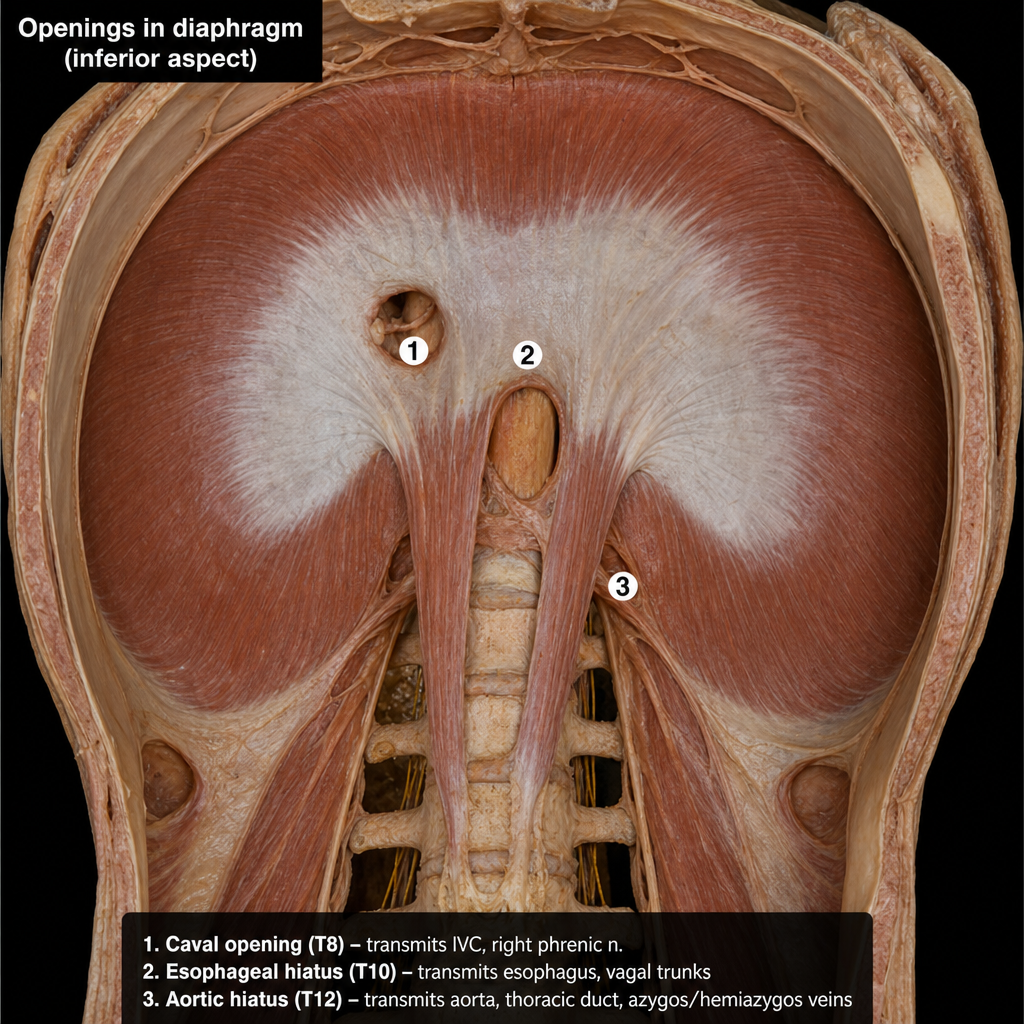
Which structure does not pass through the esophageal hiatus?
Torus aorticus is present in which chamber of the heart?
All of the following vessels end directly in the right atrium except?
The membranous part of the interventricular septum is located between which chambers?
Chylothorax is defined as the presence of chyle within the pleural cavity. What substance does chyle primarily consist of?
During cardiac surgery, the transverse pericardial sinus allows easy placement of a vascular clamp upon which of the following vessels?
Explanation: The arch of the aorta is a critical landmark in thoracic anatomy, situated entirely within the superior mediastinum. Its lower border corresponds to the level of the Sternal Angle (Angle of Louis) and the T4-T5 intervertebral disc. The tracheal bifurcation (carina) occurs at the level of the sternal angle (T4/T5). Since the arch of the aorta begins and ends at this same level, it "arches" over the left main bronchus and the bifurcation point. In a standing position, the bifurcation may descend slightly, but for anatomical examinations, T4/T5 is the standard landmark. While the arch of the aorta passes over the left bronchus, the bronchus itself extends inferiorly into the hila of the lung (T5-T7). The bifurcation occurs at the level of the T5 vertebra, just below the level of the aortic arch. The arch of the aorta specifically hooks over the bifurcation of the pulmonary trunk and the left main bronchus [2]. Connects the undersurface of the aortic arch to the root of the left pulmonary artery. The left recurrent laryngeal nerve hooks around it [1].
Explanation: ### Explanation **1. Why the correct answer is right:** The **thoracic duct** is the largest lymphatic vessel in the body. To understand its drainage pattern, remember the "3/4th rule." It begins at the *cisterna chyli* (L2 level) and ascends through the thorax to drain into the junction of the left internal jugular and left subclavian veins [2]. It drains lymph from: * **Both lower limbs** (via the cisterna chyli). * **The abdomen and pelvis.** * **The left half of the thorax.** * **The left upper limb.** * **The left half of the head and neck.** Therefore, an occlusion of the thoracic duct leads to lymphedema in the **entire left side of the body and both legs** (including the right leg). Option A is the only choice that correctly identifies this asymmetrical drainage pattern. Neoplasia involving central lymphatic drainage must often be excluded when such edema occurs [1]. **2. Why the incorrect options are wrong:** * **Option B:** This reverses the anatomy. The right side of the head, neck, and thorax, along with the right arm, are drained by the **Right Lymphatic Duct**, not the thoracic duct. * **Option C:** This is incomplete. While the left arm is drained by the thoracic duct, the obstruction would also affect the lower limbs and the left side of the head. * **Option D:** This describes the territory of the **Right Lymphatic Duct**. Occlusion of the thoracic duct would spare these areas. **3. NEET-PG High-Yield Pearls:** * **Course:** It enters the thorax through the **aortic opening** of the diaphragm (T12). * **Relations:** In the posterior mediastinum, it lies between the **Azygos vein** (right) and the **Descending Thoracic Aorta** (left)—remember the mnemonic "**Goose between two ducks**" (Azy-goose between Aorta and Thoracic duct). * **Clinical Sign:** **Virchow’s Node** (Troisier’s sign) is an enlarged left supraclavicular lymph node, often the first sign of gastric cancer metastasis via the thoracic duct. * **Chylothorax:** Injury to the duct during thoracic surgery leads to the accumulation of milky lymph in the pleural cavity.
Explanation: ***Diagonal artery*** - The **diagonal artery** is a branch of the **left anterior descending (LAD)** artery that supplies the **anterolateral wall of the left ventricle**, not the right ventricle. - It runs diagonally across the **anterior surface of the left ventricle** and does not contribute to the **right ventricular blood supply**. *Marginal artery* - The **acute marginal artery** is a branch of the **right coronary artery** that supplies the **lateral wall of the right ventricle**. - It runs along the **acute margin** of the heart and is a key arterial supply to the right ventricle. *Anterior interventricular artery* - Also known as the **left anterior descending (LAD)** artery, it gives **septal branches** that supply the **anterior portion of the interventricular septum**. - The **interventricular septum** forms part of both ventricles, including the **septal wall of the right ventricle**. *Right coronary artery* - The **RCA** is the primary arterial supply to the **right ventricle**, providing branches like the **acute marginal arteries**. - It also gives rise to the **posterior descending artery** in right-dominant systems, further contributing to right ventricular perfusion.
Explanation: The blood supply to the conducting system of the heart is a high-yield topic in NEET-PG Anatomy. The **Right Coronary Artery (RCA)** is typically the dominant vessel supplying the primary pacemakers, while the **Left Coronary Artery (LCA)** handles the distal conduction system [1]. ### **Explanation of the Correct Answer** **D. Right bundle branch:** This is the correct answer because the Right Bundle Branch (RBB) is primarily supplied by the **Left Anterior Descending (LAD) artery**, a branch of the Left Coronary Artery [2]. Specifically, the septal branches of the LAD supply the anterior two-thirds of the interventricular septum where the RBB is located. ### **Analysis of Incorrect Options** * **A. SA node:** In approximately 60% of individuals, the SA nodal artery arises from the **RCA**. (In the remaining 40%, it arises from the Left Circumflex artery). * **B. AV node:** In 80–90% of individuals (right-dominant hearts), the AV nodal artery arises from the **RCA** at the crux of the heart [3]. * **C. AV bundle (Bundle of His):** The proximal part of the AV bundle is supplied by the AV nodal artery, which is a branch of the **RCA** [1]. ### **Clinical Pearls for NEET-PG** 1. **Dominance:** Cardiac dominance is determined by which artery gives off the **Posterior Descending Artery (PDA)**. In 90% of people, it is the RCA (Right Dominant) [2]. 2. **Inferior Wall MI:** Occlusion of the RCA often leads to an Inferior Wall MI, which is frequently associated with **bradycardia or heart blocks** due to ischemia of the SA and AV nodes. 3. **Bundle Branches:** * **RBB:** Supplied by LAD. * **LBB:** Supplied by both LAD and PDA (dual supply), making it more resilient to single-vessel ischemia.
Explanation: The **esophageal hiatus** is located at the level of the **T10 vertebra** within the muscular part of the diaphragm. Understanding the specific structures that traverse this opening is a frequent high-yield topic for NEET-PG. ### Why the Left Phrenic Nerve is the Correct Answer: The **left phrenic nerve** does not pass through the esophageal hiatus. Instead, it pierces the muscular part of the diaphragm independently, usually near the apex of the heart or the left dome. In contrast, the **right phrenic nerve** typically passes through the **Vena Caval opening (T8)** along with the inferior vena cava. The phrenic and vagus nerves enter the thorax through the inlet and traverse the middle mediastinum [1]. ### Analysis of Incorrect Options: * **Left and Right Vagus Nerves (Options B & C):** These nerves descend alongside the esophagus [1]. At the hiatus, they form the **Anterior Vagal Trunk** (primarily left vagus) and the **Posterior Vagal Trunk** (primarily right vagus), both of which pass through the T10 opening. * **Left Gastric Artery (Option D):** Specifically, the **esophageal branches** of the left gastric artery (and accompanying veins) pass through the esophageal hiatus to supply the lower end of the esophagus. ### High-Yield NEET-PG Pearls: * **Mnemonic for Diaphragmatic Openings:** * **T8 (Vena Caval):** IVC, Right Phrenic Nerve. * **T10 (Esophageal):** Esophagus, Vagus nerves, Esophageal branches of left gastric vessels. * **T12 (Aortic):** Aorta, Thoracic duct, Azygos vein (**"ATA"**). * **Clinical Correlation:** The esophageal hiatus acts as a physiological sphincter. Weakness in this opening can lead to a **Hiatal Hernia**, where the stomach protrudes into the thoracic cavity [2]. * **Note:** The left phrenic nerve is unique because it is the only phrenic nerve that pierces the diaphragm alone, away from the major openings.
Explanation: **Explanation:** The **Torus aorticus** is a distinct bulge or prominence found on the **septal wall of the Right Atrium**. It is produced by the proximity of the **non-coronary (and sometimes the right coronary) sinus of the ascending aorta** as it lies adjacent to the interatrial septum [1]. **Why Right Atrium is correct:** The ascending aorta is positioned immediately posterior and medial to the right atrium [1]. The expansion of the aortic root creates a localized elevation (torus) on the postero-superior aspect of the atrial septum, just above the limbus of the fossa ovalis. **Why other options are incorrect:** * **Right Ventricle:** While the aorta arises near the ventricles, the specific anatomical landmark known as the Torus aorticus is restricted to the atrial septal surface. * **Left Ventricle:** The aorta originates from the left ventricle (Aortic Vestibule), but the "torus" refers to the external impression made by the aorta on an adjacent chamber, not its point of origin. * **Left Atrium:** Although the left atrium is posterior to the aorta, the specific bulging landmark described in classical anatomy textbooks is identified within the right atrium. **High-Yield Clinical Pearls for NEET-PG:** * **Location:** It lies superior to the **Fossa Ovalis**. * **Clinical Significance:** During transseptal catheterization or electrophysiological studies, the Torus aorticus serves as an important anatomical landmark to avoid accidental puncture of the aorta. * **Related Landmark:** Do not confuse this with the **Crista Terminalis**, which is a muscular ridge separating the sinus venarum from the atrium proper in the right atrium.
Explanation: The right atrium receives deoxygenated blood from the systemic circulation and the heart itself [2]. To answer this question, one must distinguish between veins that drain **directly** into the right atrium and those that drain into the **coronary sinus** first. ### **Explanation of the Correct Answer** **B. Oblique vein of left atrium (Vein of Marshall):** This is the correct answer because it does **not** open into the right atrium. Instead, it descends on the posterior surface of the left atrium to terminate in the **great cardiac vein**, which then forms the **coronary sinus**. Embryologically, it represents the remnant of the left common cardinal vein (left duct of Cuvier). ### **Why the Other Options are Incorrect** * **A. Coronary Sinus:** This is the largest vein of the heart. It lies in the posterior part of the atrioventricular groove and opens directly into the right atrium between the opening of the IVC and the tricuspid orifice [1]. * **C. Anterior Cardiac Veins:** These are 3–4 small vessels that drain the anterior surface of the right ventricle. They cross the coronary sulcus and open **directly** into the right atrium. * **D. Venae Cordis Minimae (Thebesian veins):** These are numerous tiny veins located in the muscular walls of all four chambers. While they exist in all chambers, they are most numerous in the right atrium and right ventricle, where they drain **directly** into the cavity. ### **High-Yield NEET-PG Pearls** * **Openings in the Right Atrium:** SVC, IVC, Coronary Sinus, Anterior Cardiac Veins, and Venae Cordis Minimae. * **The "Exception":** The **Smallest Cardiac Vein** (Venae Cordis Minimae) is the only vessel that opens into all four chambers of the heart. * **The Valve:** The opening of the coronary sinus is guarded by an endocardial fold called the **Thebesian valve**. * **The Great Cardiac Vein** is the main tributary of the coronary sinus and accompanies the Anterior Interventricular Artery (LAD).
Explanation: **Explanation:** The interventricular septum (IVS) is divided into a thick muscular part and a thin **membranous part**. The membranous part is located superiorly and is further divided into two portions by the attachment of the **septal leaflet of the tricuspid valve**: 1. **Interventricular portion:** Located below the valve attachment, separating the two ventricles. 2. **Atrioventricular portion:** Located above the valve attachment. Because the tricuspid valve is attached more apically (lower) than the mitral valve, a portion of the membranous septum actually separates the **Right Atrium (RA)** from the **Left Ventricle (LV)**. This is known as the **Atrioventricular Septum**. **Analysis of Options:** * **Option A (Correct):** Due to the differential levels of the AV valve attachments, the upper membranous septum lies between the RA and the LV (specifically the LV outflow tract). * **Option B:** The Left Atrium and Right Ventricle are separated by the bulk of the heart and do not share a direct septal boundary. * **Options C & D:** These describe the right and left atrioventricular orifices, which are guarded by the tricuspid and mitral valves, respectively, rather than a septal wall. **Clinical Pearls for NEET-PG:** * **VSD Location:** The membranous part is the **most common site** for congenital Ventricular Septal Defects (VSDs). * **Gerbode Defect:** A rare congenital or acquired shunt directly between the LV and RA through this membranous septum. * **Development:** The membranous septum is formed by the downward growth of the **bulbar ridges** and the **endocardial cushions**. Failure of fusion here leads to a membranous VSD. Note: No references provided met the relevance threshold for medical accuracy regarding cardiac anatomy.
Explanation: **Explanation:** **Correct Answer: A. Lymph** Chylothorax occurs when **chyle**, a milky bodily fluid consisting of **lymph and emulsified fats (chylomicrons)**, leaks into the pleural space. This typically results from damage to or obstruction of the **thoracic duct** [2]. The thoracic duct is the largest lymphatic vessel in the body, transporting lymph from the cisterna chyli (at the level of L2) to the junction of the left internal jugular and subclavian veins [2], [3]. Because chyle is rich in triglycerides and fat-soluble vitamins, its presence in the pleural cavity is a significant clinical finding. **Incorrect Options:** * **B. Blood:** The presence of blood in the pleural cavity is termed **Hemothorax**, usually resulting from trauma or malignancy. * **C. Air:** The presence of air in the pleural cavity is termed **Pneumothorax**, which leads to lung collapse. * **D. Pus:** The presence of pus in the pleural cavity is termed **Empyema**, typically secondary to bacterial pneumonia [1]. **High-Yield Clinical Pearls for NEET-PG:** * **Anatomical Course:** The thoracic duct enters the thorax through the **aortic opening** of the diaphragm (T12) [2]. * **Site of Injury:** Injury to the thoracic duct **below T5** usually results in a **right-sided** chylothorax, while injury **above T5** results in a **left-sided** chylothorax. * **Diagnosis:** A pleural fluid triglyceride level **>110 mg/dL** is diagnostic of chylothorax [2]. * **Appearance:** Chyle has a characteristic "milky" appearance due to high fat content [2].
Explanation: ### Explanation The **transverse pericardial sinus** is a horizontal passage within the pericardial cavity, located posterior to the arterial outflow tract and anterior to the venous inflow tract. **Why Option D is correct:** During embryonic development, the **bulbus cordis** and **truncus arteriosus** are enclosed within a common sheath of serous visceral pericardium. This results in the formation of the transverse sinus, which specifically separates the **arterial vessels** (Ascending Aorta and Pulmonary Trunk) from the **venous vessels** (SVC and Pulmonary Veins). In cardiac surgery (e.g., CABG or valve replacement), a surgeon can pass a finger or a clamp through this sinus to isolate the aorta and pulmonary trunk [1], [2], allowing for the diversion of blood to a cardiopulmonary bypass machine. **Why other options are incorrect:** * **Option A & B:** These represent the venous inflow of the heart. The **oblique pericardial sinus** (a blind-ending cul-de-sac) is located posterior to the left atrium, bounded by the pulmonary veins and the IVC. The transverse sinus lies *superior* and *anterior* to these structures. * **Option C:** The coronary arteries arise from the base of the ascending aorta and run within the subepicardial space [1]. While they are near the sinus, the sinus is specifically used to clamp the large outflow trunks, not the individual coronary arteries. **High-Yield Clinical Pearls for NEET-PG:** * **Boundaries of Transverse Sinus:** * **Anterior:** Ascending aorta and Pulmonary trunk. * **Posterior:** Superior Vena Cava (SVC) and Left Atrium. * **Superior:** Right pulmonary artery. * **Inferior:** Left atrium. * **The Oblique Sinus** is formed by the reflection of the pericardium onto the pulmonary veins and is primarily a "dead space" behind the heart. * **Clinical Use:** The transverse sinus is the landmark used to pass a **ligature** for performing a cardiac bypass [2].
Thoracic Wall and Diaphragm
Practice Questions
Pleura and Lungs
Practice Questions
Mediastinum
Practice Questions
Heart and Pericardium
Practice Questions
Great Vessels and Azygos System
Practice Questions
Thoracic Duct and Lymphatics
Practice Questions
Autonomic Innervation
Practice Questions
Applied Anatomy and Clinical Correlations
Practice Questions
Thoracic Imaging and Cross-sectional Anatomy
Practice Questions
Embryological Development of Thoracic Structures
Practice Questions
Get full access to all questions, explanations, and performance tracking.
Start For Free