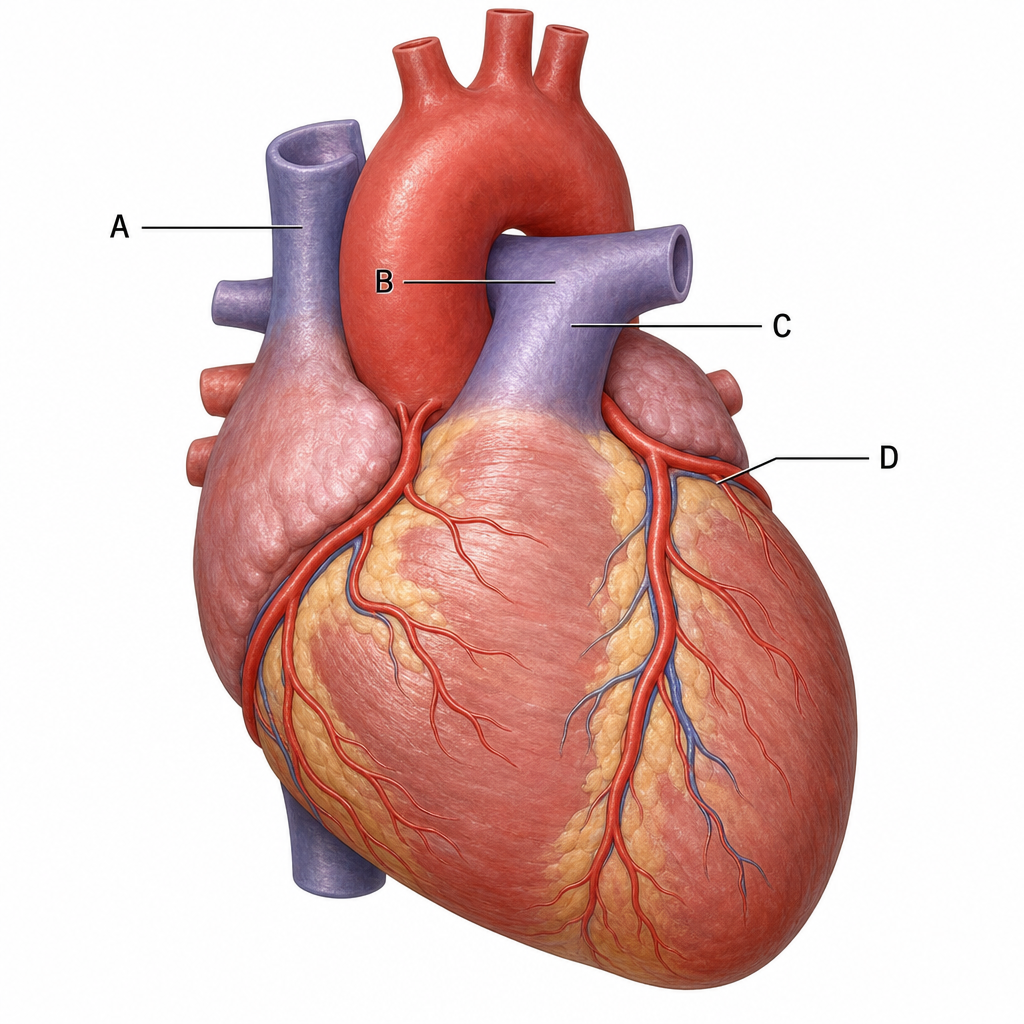
Tietze's syndrome usually develops at the costal cartilage of which ribs?
What are the blood vessels supplying the lungs?
Which of the following statements about the venous drainage of the heart is incorrect?
Which structures pass through the aortic hiatus of the diaphragm?
What is the approximate weight of the thymus gland at puberty?
The first posterior intercostal artery is a branch of which of the following?
What anatomical structure lies anterior to the transverse sinus?
A 39-year-old man presents with odynophagia. Imaging reveals an esophageal constriction at the level of the diaphragm, and biopsy confirms esophageal cancer. Which of the following lymph nodes will most likely be affected first?
What is the approximate length of the esophagus in an adult?
A 17-year-old female presents with high fever. After receiving intravenous antibiotics, a routine CT scan revealed thoracic outlet syndrome. Which symptom would most likely result from this syndrome?
Explanation: **Explanation:** **Tietze’s Syndrome** is a benign, inflammatory condition characterized by painful swelling of the costochondral or costosternal joints. It is often confused with costochondritis, but the distinguishing feature of Tietze’s is the presence of **palpable localized swelling**. 1. **Why Option B is Correct:** The syndrome most commonly affects the **second to fifth costal cartilages**. The second costal cartilage is the most frequent site of involvement. The inflammation leads to localized edema and tenderness at these specific junctions where the ribs meet the sternum. 2. **Why Other Options are Incorrect:** * **Option A:** While the first rib can occasionally be involved, it is rarely the primary or sole site compared to the 2nd–5th range. * **Option C:** The lower ribs (6th–8th) are less frequently involved because they lack the same degree of mechanical stress and mobility seen at the upper costosternal junctions. * **Option D:** It is rare for all seven true ribs to be involved simultaneously; the condition is typically localized to one or two levels. **High-Yield Clinical Pearls for NEET-PG:** * **Differential Diagnosis:** It is a crucial differential for **acute chest pain**. Unlike a myocardial infarction, the pain in Tietze’s syndrome is reproducible by palpation (localized tenderness). * **Tietze’s vs. Costochondritis:** Tietze’s syndrome presents with **swelling**, whereas costochondritis presents with pain **without** swelling. * **Demographics:** It usually affects young adults (under 40 years) and is often self-limiting. * **Radiology:** X-rays are usually normal, but an MRI or Ultrasound may show thickening of the affected cartilage.
Explanation: The blood supply to the lungs is unique because it involves two distinct systems: the **Functional Circulation** and the **Nutritional Circulation**. **1. Functional Circulation (Pulmonary Vessels):** The **Pulmonary Arteries** carry deoxygenated blood from the right ventricle to the alveolar capillaries for gas exchange [1]. The **Pulmonary Veins** then carry oxygenated blood back to the left atrium [1]. While these vessels do not "nourish" the lung tissue itself, they are the primary vessels supplying the lung parenchyma for its physiological function. **2. Nutritional Circulation (Bronchial Vessels):** The **Bronchial Arteries** (typically one on the right and two on the left) provide high-pressure, oxygenated blood to the conducting airways (bronchi), connective tissue, and visceral pleura [1]. This is the "true" systemic blood supply that keeps the lung tissue alive. **Why "All of the above" is correct:** In anatomy, "blood supply" encompasses all vessels entering or leaving the organ. Since the lungs require both the pulmonary system for gas exchange and the bronchial system for metabolic needs, all three options are integral components of the lung's vascular architecture. **High-Yield NEET-PG Pearls:** * **Origin of Bronchial Arteries:** The left bronchial arteries arise directly from the **Descending Thoracic Aorta**. The right bronchial artery usually arises from the **3rd posterior intercostal artery** or a common trunk with the left upper bronchial artery. * **Venous Drainage:** Most blood from the bronchial arteries (approx. 60-70%) drains into the **Pulmonary Veins**, creating a physiological right-to-left shunt [1]. The remainder drains into the **Azygos** (right) and **Hemiazygos** (left) veins [1]. * **Clinical Correlation:** In cases of chronic pulmonary thromboembolism, the bronchial arteries often undergo massive hypertrophy to compensate for lost pulmonary flow.
Explanation: The venous drainage of the heart is a high-yield topic in NEET-PG Anatomy. Here is the breakdown of the question: ### **Why Option B is Incorrect (The Correct Answer)** The **middle cardiac vein** does not lie in the atrioventricular groove; instead, it travels in the **posterior interventricular groove** alongside the posterior interventricular artery. The vein that occupies the posterior part of the atrioventricular (coronary) groove is the **coronary sinus** itself. ### **Analysis of Other Options** * **Option A:** The **Thebesian valve** (valve of the coronary sinus) is a semicircular fold of endocardium that guards the opening of the coronary sinus into the right atrium. * **Option C:** The **great cardiac vein** begins at the apex and ascends in the **anterior interventricular groove** alongside the Left Anterior Descending (LAD) artery. * **Option D:** **Venae cordis minimi** (Thebesian veins) are smallest cardiac veins that drain directly into the heart chambers. While they open into all four chambers, they are most numerous in the **right atrium and right ventricle**. ### **High-Yield NEET-PG Pearls** * **Coronary Sinus:** It is the largest vein of the heart, approximately 2-3 cm long, and accounts for ~60% of venous drainage. It lacks a muscular coat. * **Anterior Cardiac Veins:** These drain the anterior surface of the right ventricle and open **directly into the right atrium**, bypassing the coronary sinus. * **Crux of the Heart:** The point where the coronary sulcus meets the posterior interventricular sulcus. The middle cardiac vein and coronary sinus meet near this junction. * **Left Marginal Vein:** Accompanies the marginal branch of the circumflex artery.
Explanation: The **aortic hiatus** is the lowest and most posterior of the three major openings in the diaphragm, located at the level of the **T12 vertebra**. Unlike the caval or esophageal openings, it is not a true hole in the muscular part of the diaphragm but an osseo-aponeurotic opening formed behind the median arcuate ligament. [1] ### **Explanation of the Correct Answer** The aortic hiatus serves as a conduit for three major structures passing between the thorax and the abdomen. A useful mnemonic to remember these is **"A-T-A"**: 1. **A**orta (specifically the descending thoracic aorta becomes the abdominal aorta). 2. **T**horacic duct. 3. **A**zygos vein. Since all three structures listed in options A, B, and C pass through this opening, **Option D** is the correct answer. ### **Why other options are considered in this context** In multiple-choice questions, if all individual components (Aorta, Azygos vein, Thoracic duct) are known to pass through the same anatomical landmark, the "All of the above" option must be selected to be comprehensive. ### **NEET-PG High-Yield Pearls** * **Level:** T12 (Aortic), T10 (Esophageal), T8 (Vena Caval). * **Nature of Opening:** Because it is behind the diaphragm (not through the muscle), the aortic hiatus **does not constrict** during inspiration, ensuring uninterrupted blood flow to the abdomen. * **Hemiazygos Vein:** Note that the hemiazygos vein does *not* pass through the aortic hiatus; it usually pierces the left crus of the diaphragm. * **Clinical Significance:** The median arcuate ligament can sometimes compress the celiac trunk (a branch of the aorta just below the hiatus), leading to **Median Arcuate Ligament Syndrome (MALS)**, characterized by postprandial abdominal pain.
Explanation: ### Explanation The thymus is a primary lymphoid organ located in the superior and anterior mediastinum [2]. Its size and weight are highly dynamic, changing significantly throughout a person's lifespan due to a process known as **age-associated involution**. **Why Option B (35 gms) is Correct:** The thymus reaches its **maximum absolute weight** during **puberty**, typically ranging between **30 to 40 grams** (average 35 gms). After puberty, the functional lymphatic tissue undergoes "atrophy of transition," where it is progressively replaced by adipose and connective tissue. By old age, the gland may weigh as little as 5–10 grams. **Analysis of Incorrect Options:** * **Option A (15 gms):** This is the approximate weight of the thymus at **birth**. While the gland is most active and largest relative to total body weight in infancy, its absolute weight continues to increase until puberty. * **Option C (25 gms):** This represents the weight during late childhood (pre-pubescence). It is an intermediate stage before reaching the peak weight at puberty. * **Option D (55 gms):** This is significantly higher than the physiological peak. A thymus of this weight in an adult would suggest pathology, such as thymic hyperplasia or a thymoma [1]. **High-Yield Clinical Pearls for NEET-PG:** * **Derivation:** The thymus develops from the **3rd pharyngeal pouch** (along with the inferior parathyroid glands). * **Blood Supply:** Primarily from the **Internal Thoracic Artery** (Internal Mammary Artery). * **Hassall’s Corpuscles:** These are characteristic acidophilic structures found in the **medulla** of the thymus; they are a key histological marker. * **Clinical Correlation:** **Myasthenia Gravis** is frequently associated with thymic abnormalities (hyperplasia in 70% of cases, thymoma in 15%). * **DiGeorge Syndrome:** Results from the failure of the 3rd and 4th pharyngeal pouches to develop, leading to thymic aplasia and T-cell deficiency [2].
Explanation: The posterior intercostal arteries supply the intercostal spaces, but their origins differ based on the level of the space. **1. Why the Correct Answer is Right:** The **Superior (Supreme) intercostal artery** is a branch of the **costocervical trunk**, which arises from the second part of the subclavian artery. It descends into the thorax and divides to give rise to the **1st and 2nd posterior intercostal arteries**. Therefore, the first posterior intercostal artery is a direct branch of the superior intercostal artery, not the aorta. **2. Why the Incorrect Options are Wrong:** * **A. Aorta:** The descending thoracic aorta gives rise to the **3rd through 11th** posterior intercostal arteries and the subcostal artery. It does not supply the first two spaces directly. * **C. Internal mammary (Internal thoracic) artery:** This artery gives rise to the **anterior** intercostal arteries for the upper six spaces, not the posterior ones. [1] * **D. Bronchial artery:** These are visceral branches of the thoracic aorta (or 3rd intercostal artery) that supply the lungs and bronchi, not the thoracic wall. **High-Yield Clinical Pearls for NEET-PG:** * **Origin Summary:** 1st & 2nd Posterior Intercostals → Superior Intercostal Artery; 3rd–11th Posterior Intercostals → Thoracic Aorta. * **Anastomosis:** The posterior intercostal arteries anastomose with the anterior intercostal arteries. In **Coarctation of the Aorta**, these vessels enlarge significantly to provide collateral circulation, leading to the classic radiological sign of **"Rib Notching"** (usually seen on the lower borders of the 3rd to 8th ribs). * **Neurovascular Bundle:** In the costal groove, the order of structures from superior to inferior is **V-A-N** (Vein, Artery, Nerve).
Explanation: The **transverse pericardial sinus** is a short, horizontal passage within the pericardial cavity. It is formed during embryonic development due to the folding of the heart tube and the subsequent breakdown of the dorsal mesocardium. **Why Aorta is Correct:** The transverse sinus is located posterior to the **outflow tract** of the heart. Specifically, its anterior boundary is formed by the **ascending aorta** and the **pulmonary trunk** [1]. Since the aorta is the more prominent structure in this relationship and is listed in the options, it is the correct anatomical landmark. Its posterior boundary is the superior vena cava (SVC) and the left atrium. **Analysis of Incorrect Options:** * **B. Pulmonary Artery:** While the pulmonary *trunk* is anterior to the sinus, the term "pulmonary artery" usually refers to the left and right branches. The right pulmonary artery actually lies **posterior** to the sinus. * **C. Inferior Vena Cava (IVC):** The IVC is located inferiorly and enters the right atrium far below the level of the transverse sinus. * **D. Superior Vena Cava (SVC):** The SVC forms the **posterior** (and slightly lateral) boundary of the transverse sinus, not the anterior [1]. **High-Yield Clinical Pearls for NEET-PG:** * **Surgical Significance:** During cardiac surgery (e.g., CABG or valve replacement), a surgeon can pass a finger or a ligature through the transverse sinus to clamp the aorta and pulmonary trunk together to divert blood to a bypass machine [1]. * **Boundaries Summary:** * **Anterior:** Ascending Aorta & Pulmonary Trunk. * **Posterior:** Superior Vena Cava. * **Inferior:** Left Atrium. * **Oblique Sinus:** Do not confuse this with the *oblique sinus*, which is a blind-ending cul-de-sac located posterior to the left atrium, bounded by the pulmonary veins.
Explanation: The lymphatic drainage of the esophagus is unique because it follows a longitudinal pattern within the submucosa before draining into regional nodes [1]. The drainage is generally divided into thirds, corresponding to the esophageal segments: 1. **Correct Answer (A):** The **lower third of the esophagus** (including the diaphragmatic level) drains primarily into the **posterior mediastinal lymph nodes** (in the thorax) and the **left gastric lymph nodes** (in the abdomen). Since the esophagus pierces the diaphragm at the T10 level to join the stomach, malignancies in this region frequently metastasize to the celiac group via the left gastric artery pathway [1]. 2. **Incorrect Options (B, C, D):** * **Bronchopulmonary (Hilar) nodes:** These primarily drain the lungs and visceral pleura. * **Tracheobronchial (Superior and Inferior/Carinal) nodes:** These are the primary drainage sites for the **middle third** of the esophagus and the lungs [1]. While the middle esophagus shares these nodes with the respiratory tree, they are not the primary site for the distal (diaphragmatic) segment. **NEET-PG High-Yield Pearls:** * **Upper 1/3 (Cervical):** Drains to Deep Cervical nodes. * **Middle 1/3 (Thoracic):** Drains to Posterior Mediastinal and Tracheobronchial nodes [1]. * **Lower 1/3 (Abdominal):** Drains to Left Gastric and Celiac nodes. * **Clinical Correlation:** Esophageal cancer spreads early due to the **absence of a serosal layer** and a rich submucosal lymphatic plexus that allows longitudinal spread far from the primary tumor. * **Anatomical Level:** The esophagus passes through the diaphragm at **T10** along with the Vagus nerves.
Explanation: **Explanation:** The esophagus is a muscular tube that facilitates the passage of food from the pharynx to the stomach. In an adult, its average length is **25 cm (10 inches)**. It begins at the lower border of the cricoid cartilage (C6 level) and terminates at the cardiac orifice of the stomach (T11 level). **Why Option D is Correct:** The standard anatomical measurement for the adult esophagus is 25 cm. This is divided into three parts: * **Cervical:** 4 cm * **Thoracic:** 20 cm (the longest segment) * **Abdominal:** 1–2 cm **Analysis of Incorrect Options:** * **Option A (10 cm):** This is too short for the esophagus; however, it is the approximate length of the **trachea** (10–12 cm). * **Option B (15 cm):** This represents the distance from the **incisor teeth to the commencement** of the esophagus (cricopharyngeus). * **Option C (20 cm):** This is the approximate length of the **male urethra**. **High-Yield Clinical Pearls for NEET-PG:** 1. **Constrictions:** For endoscopy, distances are measured from the **upper incisor teeth**: * At the start (Cricopharyngeus): **15 cm** * Aortic arch/Left bronchus crossing: **25 cm** * Diaphragmatic opening: **40 cm** 2. **Epithelium:** The esophagus is lined by **non-keratinized stratified squamous epithelium**, which changes to simple columnar at the gastroesophageal junction (Z-line). 3. **Muscle Composition:** The upper 1/3 is skeletal muscle, the middle 1/3 is mixed, and the lower 1/3 is smooth muscle. 4. **Portosystemic Anastomosis:** The lower end of the esophagus is a vital site for portosystemic shunt (Esophageal varices).
Explanation: **Explanation:** **Thoracic Outlet Syndrome (TOS)** occurs due to the compression of neurovascular structures as they pass through the **superior thoracic aperture** (anatomical thoracic inlet). The structures most commonly involved are the **brachial plexus (C5-T1)** and the **subclavian vessels** [1]. 1. **Why Option D is Correct:** The most common type of TOS is **Neurogenic TOS** (95% of cases), caused by compression of the lower trunk of the brachial plexus [1]. This typically results from a cervical rib or a tight scalene muscle. Compression leads to paresthesia (numbness/tingling) and pain along the ulnar distribution (medial aspect) of the forearm and hand, and may progress to wasting of the intrinsic hand muscles (Gilliatt-Sumner hand). 2. **Why Incorrect Options are Wrong:** * **Option A:** While the phrenic nerve passes through the thoracic inlet, it is rarely involved in TOS. Respiratory distress is not a characteristic feature of this syndrome. * **Option B:** The thoracic wall is primarily supplied by the intercostal arteries arising from the aorta and internal thoracic arteries. TOS affects the subclavian artery, which supplies the **upper limb**, not the thoracic wall [1]. * **Option C:** Venous return from the head and neck is via the jugular veins. TOS involves the **subclavian vein**, leading to symptoms in the upper limb (Paget-Schroetter syndrome), such as edema and cyanosis of the arm [1], rather than the head and neck. **High-Yield Clinical Pearls for NEET-PG:** * **Boundaries of Thoracic Outlet:** T1 vertebra (posterior), 1st rib (lateral), and manubrium sterni (anterior). * **Adson’s Test:** A clinical exam where the radial pulse disappears when the patient turns their head toward the symptomatic side and inhales; indicates subclavian artery compression. * **Cervical Rib:** An accessory rib articulating with C7; the most common anatomical cause of neurogenic TOS.
Thoracic Wall and Diaphragm
Practice Questions
Pleura and Lungs
Practice Questions
Mediastinum
Practice Questions
Heart and Pericardium
Practice Questions
Great Vessels and Azygos System
Practice Questions
Thoracic Duct and Lymphatics
Practice Questions
Autonomic Innervation
Practice Questions
Applied Anatomy and Clinical Correlations
Practice Questions
Thoracic Imaging and Cross-sectional Anatomy
Practice Questions
Embryological Development of Thoracic Structures
Practice Questions
Get full access to all questions, explanations, and performance tracking.
Start For Free