The foramen of Morgagni refers to an opening in which anatomical structure?
A 17-year-old girl is admitted to the hospital with severe dyspnea. Physical examination reveals that the patient is suffering from an asthma attack, with associated bronchospasm. Which of the following nerves is responsible for the innervation of the bronchial smooth muscle cells?
The central tendon of the diaphragm is derived from which embryonic structure?
A 62-year-old male patient expresses concern that his voice has changed over the preceding months. Imaging reveals a growth located within the aortic arch, adjacent to the left pulmonary artery. Which neural structure is most likely being compressed to cause the changes in the patient's voice?
A 27-year-old male billiards player received a small-caliber bullet wound to the chest in the region of the third intercostal space, several centimeters to the left of the sternum. The patient is admitted to the emergency department and a preliminary notation of "Beck's triad" is entered on the patient's chart. Which of the following are features of this triad?
All of the following are branches of the subclavian artery except:
In mitral stenosis, a double atrial shadow is typically due to which chamber?
Sappey's plexus drains what structure?
A 55-year-old male presented with angina. Coronary angiography revealed a blockage in the right coronary artery. Which of the following blood vessels is LEAST likely to experience a decrease in blood supply due to this condition?
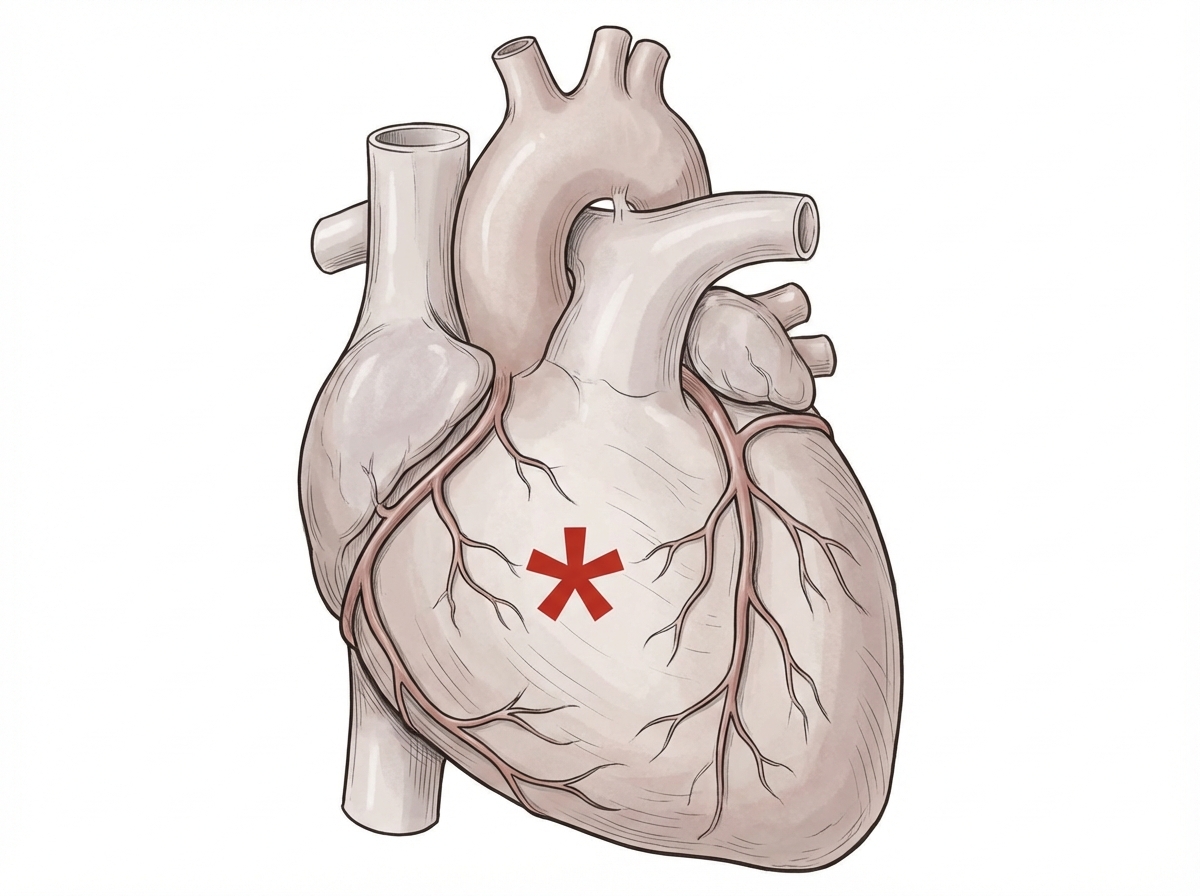
Which chamber of the heart primarily forms the sternocostal surface?
Explanation: **Explanation:** The **Foramen of Morgagni** is a small, paired anatomical space located in the **diaphragm**. It is situated anteriorly between the sternal and costal attachments of the diaphragm, specifically behind the xiphoid process [1]. It allows for the passage of the superior epigastric artery (a continuation of the internal thoracic artery) and associated lymphatics [1]. **Why the other options are incorrect:** * **The brain:** The "Foramen of Magendie" and "Foramina of Luschka" are openings in the fourth ventricle of the brain for CSF drainage. * **The lesser omentum:** The opening here is the "Foramen of Winslow" (epiploic foramen), which connects the greater and lesser sacs of the peritoneal cavity. * **The skull:** The skull contains numerous foramina (e.g., Foramen Magnum, Foramen Ovale), but none are named after Morgagni. **High-Yield Clinical Pearls for NEET-PG:** 1. **Morgagni Hernia:** A congenital diaphragmatic hernia occurring through this foramen. It is more common on the **right side** (as the heart protects the left) and is usually asymptomatic until adulthood. 2. **Bochdalek Hernia:** Contrast this with the more common "Bochdalek" hernia, which occurs **posterolaterally** (mnemonic: *Bochdalek is Back and Big*). 3. **Contents:** The Foramen of Morgagni typically contains the **superior epigastric vessels** [1]. 4. **Radiology:** On a chest X-ray, a Morgagni hernia often presents as a mass in the **right cardiophrenic angle**.
Explanation: The innervation of the bronchial tree is managed by the **Pulmonary Plexus**, which contains both sympathetic and parasympathetic fibers. **1. Why Vagus Nerve is Correct:** The **Vagus nerve (CN X)** provides the **parasympathetic** (cholinergic) supply to the lungs. In the bronchial smooth muscles, parasympathetic stimulation causes **bronchoconstriction** and increased glandular secretion. In an asthma attack, excessive vagal activity or hypersensitivity leads to the bronchospasm described in the clinical scenario. **2. Why the Other Options are Incorrect:** * **Greater thoracic splanchnic nerve:** This carries sympathetic fibers (T5–T9). Sympathetic stimulation causes **bronchodilation** (via $\beta_2$ receptors) and vasoconstriction. It opposes the action described in the question. * **Phrenic nerve:** This is a somatic nerve (C3–C5) that provides motor innervation to the **diaphragm** and sensory innervation to the mediastinal pleura and pericardium [2]. It has no role in bronchial smooth muscle tone. * **Intercostal nerve:** These are somatic nerves that supply the intercostal muscles, overlying skin, and the peripheral part of the costal pleura [2]. They do not innervate visceral structures like the bronchi. ### Clinical Pearls for NEET-PG: * **Pharmacological Correlation:** Anticholinergic drugs (e.g., **Ipratropium bromide**) are used in asthma/COPD to block the Vagus nerve's bronchoconstrictor effect. * **Sensory Component:** The Vagus nerve also carries afferent fibers for the **cough reflex** and stretch receptors in the lungs [1]. * **Plexus Location:** The pulmonary plexus is divided into anterior and posterior parts, with the **posterior pulmonary plexus** (located behind the lung root) being the larger and more significant of the two.
Explanation: The diaphragm is a composite structure formed by the fusion of four embryonic components. Understanding its development is a high-yield topic for NEET-PG. ### **1. Why Septum Transversum is Correct** The **septum transversum** is a thick plate of mesodermal tissue that initially lies between the primitive heart and the liver [1]. During development, it migrates caudally, carrying the phrenic nerve with it. It forms the **central tendon** of the diaphragm, which serves as the non-contractile structural foundation of the muscle [1]. ### **2. Explanation of Incorrect Options** * **B. Pleuroperitoneal membrane:** These membranes close the pericardioperitoneal canals. They contribute to the **small peripheral portions** of the diaphragm. Failure of these to fuse results in Congenital Diaphragmatic Hernia (Bochdalek). * **C. Dorsal mesogastrium:** This forms the **crura** of the diaphragm (the muscular pillars surrounding the esophagus). * **D. Ventral mesogastrium:** This does not contribute to the diaphragm; it gives rise to the lesser omentum and the falciform ligament [1]. ### **3. High-Yield Clinical Pearls for NEET-PG** * **Mnemonic for Diaphragm Development:** "**S**everal **P**arts **B**uild **D**iaphragm" (**S**eptum transversum, **P**leuroperitoneal membranes, **B**ody wall (muscular ingrowth), **D**orsal mesentery of esophagus). * **Nerve Supply:** The diaphragm is supplied by the **Phrenic Nerve (C3, C4, C5)**. The "C3, 4, 5 keep the diaphragm alive" rule exists because the septum transversum originates at the cervical level before descending. * **Bochdalek Hernia:** The most common congenital diaphragmatic hernia; occurs posterolaterally (usually on the **left**) due to failure of the pleuroperitoneal membrane to close. * **Morgagni Hernia:** Occurs anteriorly through the space between the xiphoid and costal origins.
Explanation: ### Explanation **Correct Option: C. Left recurrent laryngeal nerve** The patient is presenting with hoarseness of voice (dysphonia) due to compression of the **left recurrent laryngeal nerve (RLN)** [1]. This is a classic clinical scenario known as **Ortner’s Syndrome** (cardiovocal syndrome). * **Anatomical Basis:** The left vagus nerve descends into the thorax and gives off the left RLN as it crosses the aortic arch [1]. The left RLN then loops **underneath the arch of the aorta**, posterior to the **ligamentum arteriosum** (the remnant of the ductus arteriosus located between the aortic arch and the left pulmonary artery) [1]. * **Mechanism:** Any pathology in this specific "aortopulmonary window"—such as an aortic aneurysm, hilar lymphadenopathy, or a mediastinal tumor—can compress the nerve. Since the RLN supplies all intrinsic muscles of the larynx (except the cricothyroid), compression leads to vocal cord paralysis and voice changes [3]. **Why Other Options are Incorrect:** * **A. Left phrenic nerve:** Passes anterior to the lung root. Compression typically causes diaphragm paralysis (hiccups or dyspnea), not voice changes. * **B. Esophageal plexus:** Formed by the vagus nerves around the esophagus; compression leads to dysphagia (difficulty swallowing). * **D. Left vagus nerve:** While the RLN is a branch of the vagus, the specific location (under the aortic arch) and the specific symptom (isolated voice change) point directly to the recurrent laryngeal branch [1]. **High-Yield Clinical Pearls for NEET-PG:** * **Right vs. Left RLN:** The **Right RLN** loops around the **Right Subclavian Artery** in the neck; it does not enter the thorax. Therefore, thoracic tumors cause *left-sided* vocal cord palsy [2]. * **Ortner’s Syndrome:** Originally described as hoarseness due to **left atrial enlargement** (mitral stenosis) compressing the left RLN against the aorta. * **Muscle Supply:** The RLN supplies all intrinsic laryngeal muscles except the **cricothyroid** (supplied by the external laryngeal nerve) [3].
Explanation: ### Explanation **1. Understanding the Correct Answer (Option C)** The clinical scenario describes a penetrating injury to the **left 3rd intercostal space**, which is the anatomical projection of the **pericardial sac**. The mention of **Beck’s triad** confirms a diagnosis of **Cardiac Tamponade**. Cardiac tamponade occurs when fluid (blood) accumulates in the pericardial cavity, increasing intrapericardial pressure. This prevents the heart from expanding during diastole, leading to: * **Small, quiet heart:** Muffled heart sounds due to the insulating effect of the fluid. * **Decreased pulse pressure (Hypotension):** Reduced stroke volume leads to a drop in systolic blood pressure. * **Increased Central Venous Pressure (CVP):** Backlog of blood into the systemic veins (manifesting as Jugular Venous Distension) because the right atrium cannot fill properly. **2. Analysis of Incorrect Options** * **Option A:** Describes a "hilar injury." While these structures are in the thorax, they do not constitute Beck's triad. * **Option B:** Describes a **Tension Pneumothorax** or Hemothorax. While life-threatening, the triad for this includes absent breath sounds and tracheal deviation, not Beck’s triad. * **Option D:** These are features more consistent with aortic regurgitation or aneurysm, not acute tamponade. **3. NEET-PG High-Yield Pearls** * **Anatomical Vulnerability:** The right ventricle is the most common chamber injured in penetrating chest trauma because it forms the majority of the heart's anterior surface. * **Pulsus Paradoxus:** A classic sign of tamponade where systolic BP drops >10 mmHg during inspiration. * **Kussmaul’s Sign:** Paradoxical rise in JVP on inspiration (more common in constrictive pericarditis but can be seen in tamponade). * **Management:** The immediate life-saving procedure is **Pericardiocentesis** (typically via the subxiphoid approach).
Explanation: **Explanation:** The **subclavian artery** is divided into three parts by the scalenus anterior muscle. To identify the correct answer, one must distinguish between the branches of the subclavian artery and those of the axillary artery. 1. **Why Subscapular Artery is the Correct Answer:** The **subscapular artery** is the largest branch of the **third part of the axillary artery**, not the subclavian artery. It supplies the muscles of the posterior wall of the axilla and participates in the scapular anastomosis. 2. **Analysis of Incorrect Options:** * **Vertebral Artery (A):** This is the first and largest branch arising from the **first part** of the subclavian artery. It ascends through the foramina transversaria of the cervical vertebrae to supply the brain. * **Thyrocervical Trunk (B):** Arises from the **first part** of the subclavian artery. It further divides into the inferior thyroid, suprascapular, and transverse cervical arteries. * **Internal Thoracic Artery (D):** Also known as the internal mammary artery, it arises from the **first part** of the subclavian artery (opposite the vertebral artery) and descends behind the costal cartilages. **High-Yield NEET-PG Pearls:** * **Mnemonic for Subclavian Branches:** **VIT C & D** * **V**ertebral Artery (1st part) * **I**nternal Thoracic Artery (1st part) * **T**hyrocervical Trunk (1st part) * **C**ostocervical Trunk (2nd part) * **D**orsal Scapular Artery (3rd part - inconsistent) * **Clinical Note:** The internal thoracic artery is frequently used as a graft for Coronary Artery Bypass Grafting (CABG). * **Anatomical Landmark:** The **Scalenus Anterior** muscle is the key landmark; branches arise medial to it (1st part), posterior to it (2nd part), and lateral to it (3rd part).
Explanation: Explanation: In Mitral Stenosis (MS), the narrowing of the mitral valve orifice leads to increased pressure and volume overload in the Left Atrium (LA). This results in significant left atrial enlargement [1]. On a Chest X-ray (PA view), the enlarged left atrium expands towards the right side, overlapping the right atrium. This creates a "double density" or "double atrial shadow," where the right border of the left atrium is seen as a distinct line within the shadow of the right atrium. Analysis of Options: * Left Atrium (Correct): The double shadow is specifically caused by the right lateral wall of the dilated left atrium projecting behind the right atrium. * Right Atrium: While the right atrium forms the right heart border, it does not cause the "double" shadow effect; it is the background against which the enlarged LA is seen. * Both Atria: While both may be visible, the pathology and the specific radiological sign are defined by the enlargement of the left atrium. * Left Auricle: Enlargement of the left auricle contributes to the "straightening of the left heart border" (filling of the pulmonary bay), but not the double shadow on the right side. High-Yield Clinical Pearls for NEET-PG: * Other X-ray signs of LA enlargement: Straightening of the left heart border, splaying of the carina (widening of the subcarinal angle >90°), and the "Walking Cane" sign (elevation of the left main bronchus). * Ortner’s Syndrome: Hoarseness of voice in MS due to compression of the left recurrent laryngeal nerve by an enlarged LA. * Kerley B lines: Horizontal lines at the lung bases indicating pulmonary venous hypertension/interstitial edema.
Explanation: **Explanation:** **Sappey’s Plexus** (also known as the subareolar plexus) is a dense network of lymphatic vessels located in the subcutaneous tissue [3] beneath the areola and nipple of the **breast** [1]. It receives lymph from the nipple, the areola, and the underlying glandular parenchyma. From this plexus, the majority of the lymph (approximately 75%) drains laterally into the **axillary lymph nodes**, primarily the anterior (pectoral) group [2]. **Why other options are incorrect:** * **Thyroid:** Lymphatic drainage of the thyroid is primarily to the prelaryngeal, pretracheal, and paratracheal nodes, eventually reaching the deep cervical lymph nodes. * **Adrenal:** The adrenal glands drain into the lateral aortic (para-aortic) nodes. * **Porta hepatis:** This is a fissure in the liver where lymphatics drain into the hepatic nodes and then to the celiac nodes. **High-Yield Clinical Pearls for NEET-PG:** * **Direction of Flow:** While older theories suggested all breast lymph passed through Sappey’s plexus, modern studies show that lymph from the deep parts of the breast can bypass it to reach the axillary or internal mammary nodes directly [3]. * **Sentinel Node:** The first node to receive drainage from a tumor site (usually in the axilla) is the "Sentinel Node," identified using blue dye or radiocolloids [2]. * **Internal mammary Nodes:** About 20-25% of lymph, especially from the medial quadrants, drains to the internal mammary (parasternal) chain. * **Clinical Sign:** Obstruction of the superficial lymphatics (including Sappey’s plexus) by cancer cells leads to lymphedema of the skin, resulting in the characteristic **"Peau d'orange"** appearance.
Explanation: **Explanation:** The correct answer is **D. Circumflex artery**. This question tests your knowledge of the branching patterns and distribution of the coronary arteries. The **Right Coronary Artery (RCA)** typically arises from the anterior aortic sinus and supplies the right atrium, right ventricle, and parts of the conducting system [1]. **Why the Circumflex artery is the correct answer:** The **Circumflex artery** is a major branch of the **Left Coronary Artery (LCA)** [1]. It travels in the left atrioventricular groove to supply the left atrium and the left ventricle's posterior and lateral surfaces. Since it originates from the LCA, its blood flow remains independent of any blockage in the RCA. **Analysis of incorrect options:** * **A. Acute Marginal artery:** This is a direct branch of the RCA that supplies the anterior surface of the right ventricle [1]. * **B. Posterior interventricular artery (PDA):** In approximately 70-85% of individuals (Right Dominance), the PDA arises from the RCA [1]. It supplies the posterior 1/3 of the interventricular septum. * **C. Artery to SA node:** In about 60% of the population, the SA nodal artery is a branch of the RCA (in the remaining 40%, it arises from the LCA). Given the high frequency of RCA origin, it is highly likely to be affected. **High-Yield Clinical Pearls for NEET-PG:** * **Coronary Dominance:** Determined by which artery gives rise to the **PDA**. Most people are Right Dominant (RCA). * **AV Node Supply:** The AV nodal artery arises from the "dominant" artery (usually RCA). * **Crux of the Heart:** The junction of the posterior interventricular and atrioventricular grooves; the RCA typically reaches this point to give off the PDA. * **Most common site of occlusion:** Anterior Interventricular Artery (LAD), followed by the RCA.
Explanation: **Explanation:** The **sternocostal (anterior) surface** of the heart is the portion directed forward and upward, situated immediately behind the sternum and costal cartilages. 1. **Why "All of the above" is correct:** The sternocostal surface is formed by multiple chambers, though in unequal proportions. It is primarily formed by the **Right Ventricle (2/3rd)** and the **Right Atrium/Auricle**. A small strip of the **Left Ventricle** (the remaining 1/3rd) also contributes to the left border of this surface. Therefore, while the right ventricle is the dominant component, all three structures listed contribute to the anatomical formation of the sternocostal surface. 2. **Analysis of Options:** * **Right Ventricle:** This is the major contributor (approx. two-thirds). If the question asked for the "major" or "primary" contributor alone, this would be the best single choice. * **Right Auricle/Atrium:** Forms the right portion of the sternocostal surface, situated between the superior and inferior vena cava. * **Left Ventricle:** Forms a narrow strip on the left extremity of this surface. **High-Yield NEET-PG Clinical Pearls:** * **Diaphragmatic (Inferior) Surface:** Formed mainly by the **Left Ventricle (2/3rd)** and partly by the Right Ventricle (1/3rd). * **Base (Posterior Surface):** Formed mainly by the **Left Atrium** (and a small part of the right atrium). It lies opposite the T5–T8 vertebrae. * **Apex:** Formed entirely by the **Left Ventricle**. * **Clinical Correlation:** In a penetrating chest injury (e.g., a stab wound to the sternum), the **Right Ventricle** is the most commonly injured chamber due to its dominant position on the sternocostal surface.
Thoracic Wall and Diaphragm
Practice Questions
Pleura and Lungs
Practice Questions
Mediastinum
Practice Questions
Heart and Pericardium
Practice Questions
Great Vessels and Azygos System
Practice Questions
Thoracic Duct and Lymphatics
Practice Questions
Autonomic Innervation
Practice Questions
Applied Anatomy and Clinical Correlations
Practice Questions
Thoracic Imaging and Cross-sectional Anatomy
Practice Questions
Embryological Development of Thoracic Structures
Practice Questions
Get full access to all questions, explanations, and performance tracking.
Start For Free