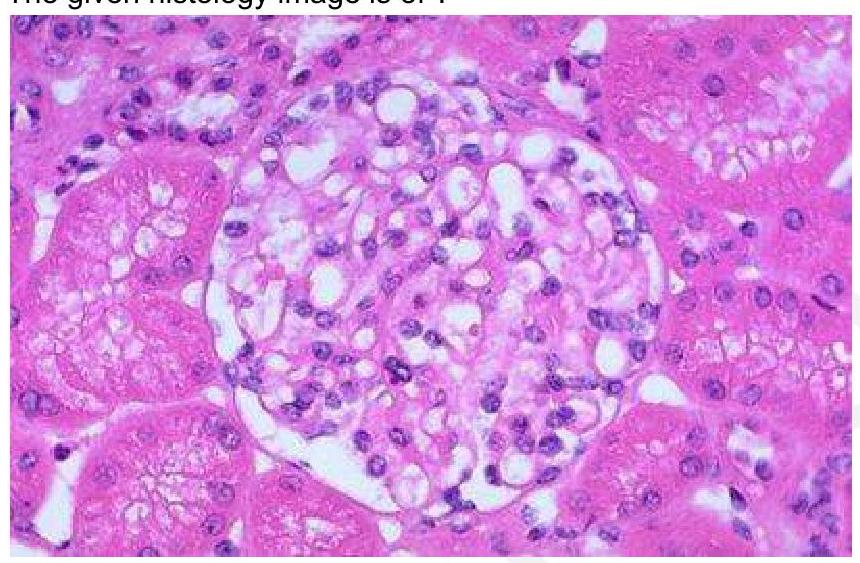
Pseudounipolar neurons are seen in which of the following structures?
Which of the following best describes pericytes found in the capillary bed?
What is the typical ratio of fat cells to blood cells in the bone marrow?
What are the cells responsible for bone resorption?
Transitional epithelium is seen in which of the following organs?
Which of the following tissues normally has the highest percentage of mucus-secreting cells?
Which of the following statements regarding the cerebral cortex is NOT true?
Which of the following statements about Brown adipose tissue is FALSE?
Which of the following microscope types not only reveals cell organelles but also allows for quantitative measurement of the chemical constituents of a cell?
Panniculus adiposus is seen in which of the following structures?
Explanation: Neurons are classified based on the number of processes extending from the cell body [1]. **Pseudounipolar neurons** are unique because they begin as bipolar neurons during embryonic development, but their two processes later fuse to form a single short process that divides into a T-shape (one peripheral branch to the receptor and one central branch to the CNS) [1]. **Why the Correct Answer is Right:** * **Spinal Dorsal Root Ganglion (DRG):** These contain the cell bodies of sensory neurons. They are the classic example of pseudounipolar neurons, responsible for transmitting touch, pain, and temperature sensations from the periphery to the spinal cord [1]. The **Mesencephalic nucleus of the Trigeminal nerve** is the only other major site where these are found within the CNS. **Analysis of Incorrect Options:** * **Olfactory Epithelium (A):** Contains **Bipolar neurons**. These are specialized sensory neurons for smell. * **Celiac Ganglion (B):** This is an autonomic (sympathetic) ganglion. All autonomic ganglia contain **Multipolar neurons**. * **Cochlea (D):** The spiral ganglion of the cochlea (and the vestibular ganglion) contains **Bipolar neurons**, which are characteristic of the special senses of hearing and balance [1]. **High-Yield NEET-PG Pearls:** 1. **Bipolar Neurons:** Found in the Retina (inner nuclear layer), Olfactory epithelium, and Vestibulocochlear nerve (CN VIII) ganglia [1]. 2. **Multipolar Neurons:** The most common type; includes motor neurons, pyramidal cells of the cortex, and Purkinje cells of the cerebellum [1]. 3. **Anaxonic Neurons:** Found in the Amacrine cells of the retina; they do not produce action potentials but regulate local electrical changes. 4. **Embryology:** Pseudounipolar neurons are derived from the **Neural Crest Cells**.
Explanation: ### Explanation **Pericytes** (also known as Rouget cells) are specialized, contractile cells found at intervals along the walls of capillaries and post-capillary venules. They are embedded within the **basal lamina** of the endothelial cells. #### Why Option C is Correct: Pericytes are derived from the mesenchyme and are considered **pluripotent (multipotent) stem cells**. They possess the remarkable ability to differentiate into various cell types, including fibroblasts, smooth muscle cells, and even osteoblasts or adipocytes during tissue repair and angiogenesis. Their primary functions include regulating capillary blood flow (via actin and myosin filaments), maintaining the blood-brain barrier, and supporting vascular stability. #### Why Other Options are Incorrect: * **Option A (Modified endothelial cells):** Pericytes are distinct from endothelial cells. While they communicate via gap junctions, they are located on the *abluminal* surface (outside) of the endothelium and have a different embryological lineage [1]. * **Option B (Phagocytes):** Although pericytes can exhibit some endocytic activity, they are not classified as professional phagocytes. The primary phagocytic cells in the reticuloendothelial system are macrophages (e.g., Kupffer cells in the liver). #### High-Yield Facts for NEET-PG: * **Location:** They are most numerous in the capillaries of the **Central Nervous System (CNS)** and the **retina**, where they are crucial for the integrity of the blood-brain barrier. * **Clinical Correlation (Diabetic Retinopathy):** One of the earliest histological changes in diabetic retinopathy is the **selective loss of pericytes**, leading to capillary weakening, microaneurysms, and hemorrhage. * **Contractility:** They contain **tropomyosin, isomyosin, and protein kinase**, which allow them to contract and regulate the diameter of the capillary lumen [1].
Explanation: **Explanation:** The cellularity of bone marrow is defined by the ratio of hematopoietic (blood-forming) cells to adipocytes (fat cells). In a healthy adult, the standard ratio in the red marrow of the axial skeleton is approximately **1:1 (50% cells and 50% fat)**. **Why Option C is Correct:** As a person ages, active red marrow is gradually replaced by yellow (fatty) marrow—a process known as marrow involution. By adulthood, the marrow space reaches a steady state where hematopoietic tissue and adipose tissue are present in roughly equal proportions. This 1:1 ratio serves as the baseline for pathologists when evaluating bone marrow trephine biopsies. **Why Other Options are Incorrect:** * **Option A (1:4) and B (1:2):** These ratios represent "Hypercellular" marrow. This is typically seen in children (where marrow is nearly 100% cellular) or in pathological states like Myeloproliferative Disorders or Leukemias. * **Option D (2:1):** This represents "Hypocellular" marrow. A predominance of fat over blood cells is a hallmark of Aplastic Anemia or marrow suppression following chemotherapy. **High-Yield Clinical Pearls for NEET-PG:** * **The Age Rule:** A quick clinical formula to estimate expected cellularity is **100 minus Age**. For example, a 70-year-old should have roughly 30% cellularity (70% fat). * **Biopsy Site:** The **Posterior Superior Iliac Spine (PSIS)** is the most common site for marrow aspiration and biopsy in adults. * **Yellow vs. Red Marrow:** Yellow marrow is rich in adipocytes and can revert to red marrow during periods of severe chronic anemia.
Explanation: **Explanation:** The correct answer is **B. Osteoclasts**. **1. Why Osteoclasts are correct:** Osteoclasts are large, multinucleated giant cells derived from the **monocyte-macrophage lineage** (hematopoietic stem cells) [1]. Their primary function is **bone resorption** [1, 3]. They achieve this by adhering to the bone surface and creating a sealed "Howship’s lacuna." They secrete hydrogen ions (via proton pumps) to dissolve hydroxyapatite crystals and lysosomal enzymes (like Cathepsin K) to digest the organic collagen matrix [1]. **2. Why other options are incorrect:** * **A. Osteoblasts:** These are bone-forming cells derived from mesenchymal stem cells [1, 3]. They synthesize the organic matrix (osteoid) and regulate mineralization [2]. * **C. Stem cells:** While osteoblasts arise from Mesenchymal Stem Cells (MSCs) and osteoclasts from Hematopoietic Stem Cells (HSCs), "stem cells" is a generic term and not the functional cell responsible for resorption [1]. * **D. Cytotoxic T cells:** These are immune cells involved in destroying virus-infected or tumor cells; they do not play a direct physiological role in bone remodeling. **3. High-Yield Facts for NEET-PG:** * **Origin:** Osteoblasts = Mesenchymal; Osteoclasts = Monocyte-Macrophage lineage (HSC) [1]. * **Markers:** Osteoclasts are characterized by **TRAP** (Tartrate-Resistant Acid Phosphatase) positivity. * **Regulation:** **Parathyroid Hormone (PTH)** stimulates bone resorption indirectly by acting on Osteoblasts, which then release **RANK-L**. RANK-L binds to receptors on Osteoclasts to activate them. * **Calcitonin:** Directly inhibits osteoclast activity, decreasing bone resorption. * **Howship’s Lacunae:** The microscopic pits on the bone surface where active resorption occurs [1].
Explanation: **Explanation:** **Transitional epithelium (Urothelium)** is a specialized type of stratified epithelium characterized by its remarkable ability to stretch and withstand the toxicity of urine. It is the hallmark of the urinary tract, lining the renal pelvis, ureters, **urinary bladder**, and the proximal part of the urethra [1]. * **Why Urinary Bladder is Correct:** The cells of the transitional epithelium (specifically the superficial **"Umbrella cells"**) can change shape from cuboidal/columnar when the bladder is empty to flattened/squamous when it is distended [1]. This allows the bladder to expand significantly without the lining tearing or leaking. **Analysis of Incorrect Options:** * **A. Esophagus:** Lined by **Non-keratinized stratified squamous epithelium**, which provides protection against mechanical abrasion during swallowing. * **B. Vagina:** Also lined by **Non-keratinized stratified squamous epithelium**, adapted to withstand friction and maintain a protective barrier. * **C. Trachea:** Lined by **Pseudostratified ciliated columnar epithelium** (Respiratory epithelium) containing goblet cells for mucus production and clearance. **High-Yield Clinical Pearls for NEET-PG:** * **Umbrella Cells:** The most superficial layer of urothelium; they often contain two nuclei and possess "plaques" (uroplakins) that act as a permeability barrier. * **Schistosomiasis Link:** Chronic infection with *Schistosoma haematobium* in the bladder can cause squamous metaplasia, leading to **Squamous Cell Carcinoma** rather than the more common Transitional Cell Carcinoma (TCC). * **Location Summary:** Remember the "Urinary" rule—if it carries urine (from calyces to urethra), it is likely transitional epithelium [1].
Explanation: ### Explanation **Correct Option: D. Sublingual gland** The **sublingual gland** is a major salivary gland characterized as a **mixed gland**, but it is **predominantly mucous** in nature. In histology, it consists mainly of mucous acini with only a few serous demilunes (Giannuzzi's demilunes). Among the options provided, it contains the highest density of mucus-secreting cells to ensure the production of thick, viscid saliva that aids in the lubrication of the oral cavity. **Analysis of Incorrect Options:** * **A. Esophageal mucosa:** The lining of the esophagus is **non-keratinized stratified squamous epithelium**. While it contains submucosal mucous glands (esophageal glands proper) to provide lubrication, the bulk of the tissue consists of protective squamous cells, not secretory cells. * **B. Oral mucosa:** Similar to the esophagus, the oral mucosa is primarily **stratified squamous epithelium** (keratinized or non-keratinized depending on the site). While minor salivary glands are scattered throughout, they do not constitute the majority of the tissue volume. * **C. Parotid gland:** This is a **purely serous** gland (in adults). It contains watery secretory granules and lacks mucus-secreting cells entirely, making it the histological opposite of the sublingual gland. **High-Yield NEET-PG Pearls:** * **Salivary Gland Rule of Three:** 1. **Parotid:** Purely Serous (Stensen’s duct). 2. **Submandibular:** Mixed, but Predominantly Serous (Wharton’s duct). 3. **Sublingual:** Mixed, but Predominantly Mucous (Ducts of Rivinus/Bartholin). * **Serous Demilunes:** These are crescent-shaped caps of serous cells found on mucous acini, most characteristically seen in the **submandibular gland** (and to a lesser extent, the sublingual). * **Staining:** Mucus-secreting cells appear "empty" or pale on H&E stain because mucin is washed out during processing; they stain positively with **PAS (Periodic Acid-Schiff)**.
Explanation: The cerebral cortex is organized into six distinct histological layers (Neocortex). Understanding the distribution of cells and fibers within these layers is a high-yield topic for NEET-PG. ### **Explanation of the Correct Answer (Option C)** The statement in Option C is **incorrect** because the **Outer Band of Baillarger** is located in the **Internal Granular Layer (Layer IV)**, not the outer granular layer. * **The Concept:** The bands of Baillarger are thick horizontal bundles of nerve fibers. The outer band is particularly prominent in the visual cortex (V1), where it is known as the **Stria of Gennari**, visible to the naked eye [1]. ### **Analysis of Other Options** * **Option A:** True. The neocortex (90% of the human cortex) consists of six layers: (I) Molecular, (II) External Granular, (III) External Pyramidal, (IV) Internal Granular, (V) Internal Pyramidal, and (VI) Multiform. * **Option B:** True. Granule cells (stellate cells) are primarily sensory in function. Therefore, the granular layers (II and IV) are highly developed in sensory areas like the postcentral gyrus. * **Option D:** True. The **Inner Band of Baillarger** is located within the **Internal Pyramidal Layer (Layer V)**. This layer also contains the giant cells of Betz in the motor cortex [2]. ### **NEET-PG High-Yield Pearls** * **Agranular Cortex:** Found in motor areas (e.g., Precentral gyrus); dominated by pyramidal cells with poorly defined granular layers. * **Granular Cortex (Koniocortex):** Found in sensory areas (e.g., Visual cortex); dominated by stellate cells. * **Betz Cells:** Largest pyramidal cells, found in Layer V of the primary motor cortex; their axons form the corticospinal tract [2]. * **Allocortex:** Older parts of the cortex (e.g., Hippocampus) that have only three layers.
Explanation: ### Explanation **Concept:** Adipose tissue is classified into two types: White (Unilocular) and Brown (Multilocular). The distinction lies in their morphology and physiological function. **Why Option B is the Correct Answer (The False Statement):** Brown adipocytes are **multilocular**, meaning they contain **numerous small lipid droplets** dispersed throughout the cytoplasm. In contrast, white adipocytes are unilocular, containing a single, large fat droplet that occupies most of the cell volume. Therefore, the statement that brown adipocytes contain one large fat droplet is incorrect. **Analysis of Other Options:** * **Option A:** Because the lipid droplets in brown fat are small and scattered, they do not exert enough pressure to displace the nucleus. Thus, the nucleus remains **central or eccentric**, unlike the flattened, peripheral "signet-ring" nucleus seen in white fat. * **Option C:** Brown fat is highly metabolic and packed with **numerous large mitochondria**. These mitochondria contain the protein **UCP-1 (Thermogenin)**. * **Option D:** The primary function of brown fat is **non-shivering thermogenesis**. It generates heat by uncoupling the electron transport chain from ATP synthesis, which is vital for neonates and hibernating animals [1]. **High-Yield Clinical Pearls for NEET-PG:** * **Color:** The characteristic brown color is due to the high concentration of **cytochrome oxidase** enzymes in the mitochondria and a rich capillary network. * **Distribution:** In newborns, brown fat makes up about 5% of body mass (found in the interscapular region, axilla, and mediastinum). In adults, it is significantly reduced but persists in areas like the **supraclavicular fossa** and around the kidneys/adrenals. * **Thermogenin (UCP-1):** Located on the inner mitochondrial membrane; it allows protons to leak back into the matrix, releasing energy as heat instead of ATP [1].
Explanation: ### Explanation **1. Why the Correct Answer is Right (Interference Microscope)** The **Interference microscope** is a sophisticated modification of phase-contrast microscopy. It utilizes the principle of light interference, where a beam of light is split into two: one passing through the specimen and the other through a reference path. When these beams recombine, they create an image with high contrast and a 3D-like appearance. The defining feature of this microscope is its ability to perform **quantitative histochemistry**. Because the phase delay of light is directly proportional to the refractive index and thickness of the object, it allows researchers to calculate the **dry mass** of cell components (like proteins and nucleic acids) and measure the thickness of the specimen. Although modern biophysical and biochemical techniques [1] have expanded our knowledge, interference microscopy remains a foundational tool for these specific measurements. **2. Why the Other Options are Incorrect** * **A. Light Microscope:** This is the standard bright-field microscope. While it reveals general cell structure [1], it has low contrast for living, unstained cells and cannot provide quantitative chemical data. * **B. Phase Contrast Microscope:** This is excellent for viewing living, unstained cells by converting small differences in refractive index into variations in light intensity. However, it is primarily **qualitative** and does not allow for the precise measurement of chemical constituents. * **C. Dark Field Microscope:** This uses a special condenser so that only light reflected/refracted by the specimen enters the objective. It is used to visualize very thin objects (like *Treponema pallidum*) against a dark background but provides no quantitative chemical information. **3. Clinical Pearls & High-Yield Facts for NEET-PG** * **Gold Standard for Syphilis:** Dark-field microscopy is the classic method for identifying *Treponema pallidum* from primary chancre fluid. * **Living Cells:** Both Phase Contrast and Interference microscopy are used to study **living cells** (e.g., during mitosis) without the need for fixing or staining, which would kill the cell. * **Polarizing Microscope:** Used specifically for identifying **birefringent** structures like collagen fibers, muscle striations, and gout crystals (monosodium urate). * **Fluorescence Microscope:** Uses UV light to detect naturally fluorescent substances or those tagged with fluorescent dyes (e.g., in ANA testing for SLE).
Explanation: **Explanation:** **Panniculus adiposus** refers to the fatty layer of the subcutaneous tissue (superficial fascia). While this layer is distributed throughout most of the body, it is notably absent in specific regions where skin mobility or thinness is essential. **Why Orbit is the Correct Answer:** The **Orbit** contains a significant amount of retrobulbar fat (orbital fat), which acts as a cushion for the eyeball and facilitates its smooth movement [1]. This fatty tissue is a specialized form of panniculus adiposus [1]. **Why the Other Options are Incorrect:** The superficial fascia is devoid of fat (panniculus adiposus) in the following regions to prevent bulkiness and allow for specific physiological functions: * **Eyelid:** To ensure the eyelids remain light and mobile for rapid blinking [1]. * **Scrotum:** The fat is replaced by smooth muscle fibers called the **Dartos muscle**, which helps in thermoregulation for spermatogenesis. * **Penis:** The absence of fat allows for skin mobility and prevents interference with erectile function. * **Note:** It is also absent in the **Pinna of the ear**. **High-Yield Clinical Pearls for NEET-PG:** * **Dartos Muscle:** In the scrotum, the panniculus adiposus is replaced by smooth muscle (Dartos), which is responsible for the wrinkled appearance of the scrotal skin. * **Colles' Fascia:** In the perineum, the membranous layer of the superficial fascia is known as Colles' fascia. * **Scarpa’s Fascia:** The deep membranous layer of the superficial fascia of the abdomen. * **Clinical Significance:** The absence of fat in the eyelids explains why systemic edema (e.g., in nephrotic syndrome) often manifests first as **periorbital puffiness**, as there is no fatty resistance to fluid accumulation [1].
Cellular Ultrastructure
Practice Questions
Microscopic Anatomy of Epithelial Tissues
Practice Questions
Microscopic Anatomy of Connective Tissues
Practice Questions
Microscopic Anatomy of Muscle Tissues
Practice Questions
Microscopic Anatomy of Nervous Tissues
Practice Questions
Microscopic Anatomy of Blood and Immune System
Practice Questions
Microscopic Anatomy of Endocrine Glands
Practice Questions
Microscopic Anatomy of Digestive System
Practice Questions
Microscopic Anatomy of Respiratory System
Practice Questions
Microscopic Anatomy of Urinary System
Practice Questions
Microscopic Anatomy of Reproductive System
Practice Questions
Techniques in Microscopic Anatomy
Practice Questions
Get full access to all questions, explanations, and performance tracking.
Start For Free