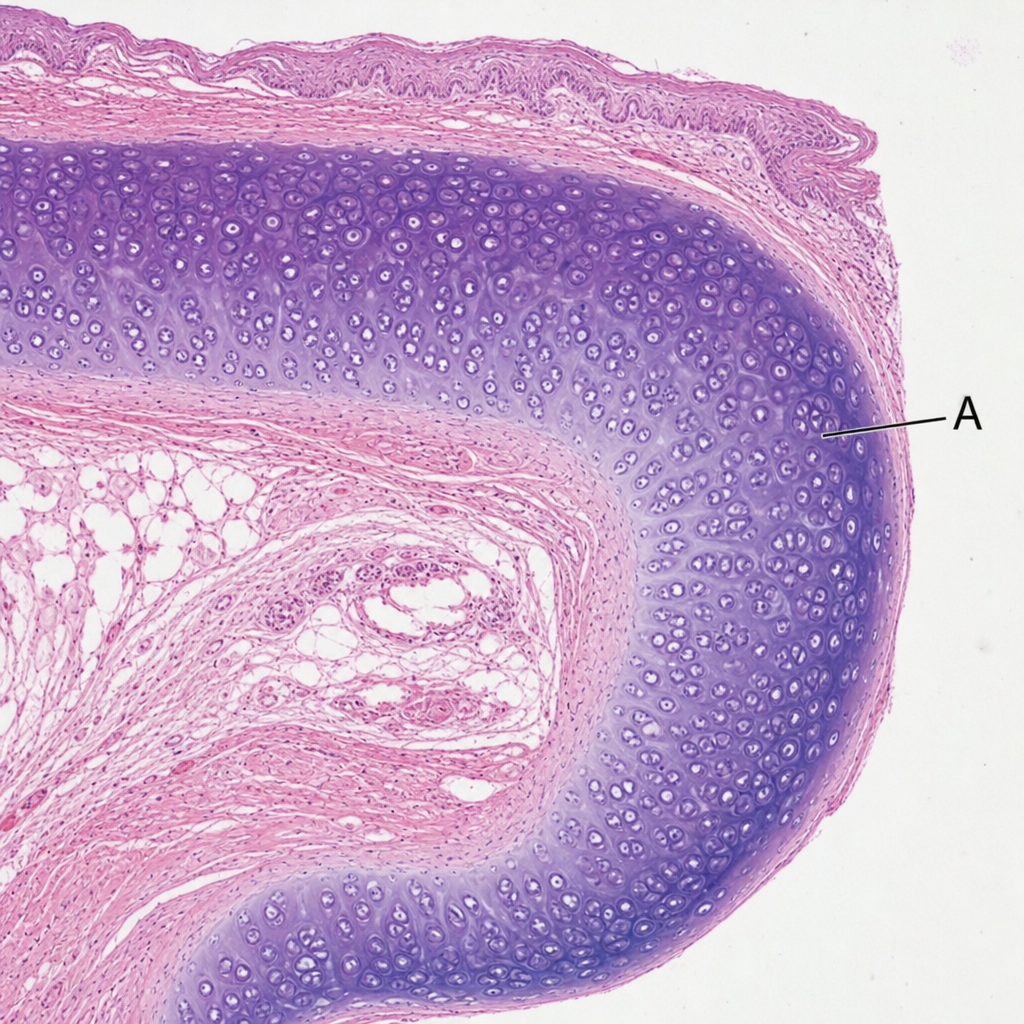
The Haversian system is found in:
What type of epithelium is present in the thin segment of the Loop of Henle?
Exchange of substances between blood cells and hepatocytes occurs in which of the following sites?
The blood-testis barrier is located between which of the following cell types?
Which among the following is the most superficial layer of the skin?
Posterior pituitary bodies are known as which of the following?
Amelogenesis imperfecta is also known as?
Which of the following epithelia is seen in all locations EXCEPT:
Oncocytes are found in all of the following organs, EXCEPT:
Acid phosphatase is specific to which of the following cells?
Explanation: The **Haversian system**, also known as an **Osteon**, is the fundamental functional unit of **compact (cortical) bone** [1]. It consists of a central Haversian canal containing blood vessels and nerves, surrounded by concentric layers of mineralized matrix called lamellae [1]. 1. **Why Option A is correct:** The **diaphysis** (shaft) of long bones is primarily composed of thick compact bone [2]. To provide structural strength while allowing for nutrient delivery to deeply embedded osteocytes, the bone is organized into these cylindrical Haversian systems [1]. 2. **Why Options B, C, and D are incorrect:** * **Cancellous bone** (also known as **Spongy** or **Trabecular bone**) does not contain Haversian systems [1]. Instead, it is organized into a lattice-work of *trabeculae*. Because trabeculae are thin and surrounded by marrow spaces, osteocytes receive nutrients via diffusion, making a complex canal system unnecessary [1]. * The **Epiphysis** (ends of long bones) consists mainly of spongy bone covered by a thin shell of compact bone; therefore, it is not the primary site for Haversian systems compared to the dense diaphysis [2]. **High-Yield Clinical Pearls for NEET-PG:** * **Volkmann’s Canals:** These are horizontal channels that connect Haversian canals to each other and to the periosteum. Unlike Haversian canals, they are *not* surrounded by concentric lamellae. * **Interstitial Lamellae:** These are remnants of old osteons left behind during bone remodeling. * **Sharpey’s Fibers:** These are collagenous fibers that anchor the periosteum to the underlying compact bone of the diaphysis. * **Osteoblasts vs. Osteoclasts:** Osteoblasts "build" bone (found on surfaces), while Osteoclasts (derived from monocytes) resorb bone.
Explanation: ### Explanation **Correct Answer: D. Simple Squamous Epithelium** The **thin segment of the Loop of Henle** is characterized by a **simple squamous epithelium**. This structural adaptation is crucial for its physiological function. The extremely thin, flattened cells provide a minimal barrier, allowing for the passive diffusion of water (in the descending limb) and solutes like sodium and chloride (in the ascending limb) along osmotic gradients [2]. Under a microscope, these cells appear as flattened nuclei bulging slightly into the lumen, similar to vascular endothelial cells. **Analysis of Incorrect Options:** * **A. Simple Cuboidal Epithelium:** This is found in the **Proximal Convoluted Tubule (PCT)** and **Distal Convoluted Tubule (DCT)** [1]. These areas require more metabolic machinery (mitochondria and organelles) for active transport, necessitating a thicker cell profile. * **B. Simple Columnar Epithelium:** This type is typically found in the **Collecting Ducts** (specifically the larger ducts of Bellini) and the gastrointestinal tract. It is too thick for the rapid passive exchange required in the thin loop [3]. * **C. Stratified Columnar Epithelium:** This is a rare epithelium in the human body, found only in parts of the conjunctiva and large excretory ducts of glands. It is never found in the functional units of the kidney (nephrons). **High-Yield Clinical Pearls for NEET-PG:** * **PCT vs. Loop of Henle:** The PCT is lined by simple cuboidal epithelium with a **prominent brush border** (microvilli) to increase surface area for reabsorption [1]. The thin loop lacks this brush border. * **Vasa Recta:** The thin segment of the Loop of Henle is often confused with the **Vasa Recta** (capillaries) in histological sections, as both are lined by simple squamous cells [2]. * **Countercurrent Multiplier:** The permeability differences between the descending thin limb (permeable to water) and ascending thin limb (permeable to NaCl) are the basis for the renal medullary osmotic gradient [2].
Explanation: The **Space of Disse** (also known as the perisinusoidal space) is the narrow anatomical gap located between the fenestrated endothelial cells of the liver sinusoids and the microvilli-covered surface of the hepatocytes [1]. **Why Option C is Correct:** The sinusoids in the liver are lined by a discontinuous (fenestrated) endothelium that lacks a basement membrane. This allows plasma to filter freely into the Space of Disse [2]. Here, the plasma comes into direct contact with the microvilli of **hepatocytes**, facilitating the efficient exchange of nutrients, proteins, and metabolites between the blood and the liver cells [1]. **Analysis of Incorrect Options:** * **A. Kupffer cells:** These are specialized fixed macrophages located within the sinusoidal lumen. Their primary role is phagocytosis of debris and pathogens, not the metabolic exchange of substances. * **B. Space of Mall:** This is a small space located at the periphery of the hepatic lobule, between the outermost hepatocytes and the connective tissue of the portal tract. It is the site where **lymph originates** in the liver. * **D. Lumen of Sinusoids:** While blood flows through the lumen, the actual exchange occurs across the endothelial barrier within the perisinusoidal space, not within the central flow of the lumen itself [1]. **High-Yield NEET-PG Pearls:** * **Ito Cells (Stellate Cells):** Located within the Space of Disse; they store **Vitamin A** and are responsible for hepatic fibrosis when activated. * **Lymph Formation:** Approximately 25-50% of the body's lymph is formed in the Space of Disse, which then drains into the Space of Mall. * **Fenestrations:** The absence of a basement membrane in sinusoids is a unique feature that allows large molecules (like albumin) to enter the Space of Disse [1], [2].
Explanation: **Explanation:** The **Blood-Testis Barrier (BTB)** is a physical barrier formed by specialized **tight junctions (Zonula occludens)** [2] between the basolateral membranes of adjacent **Sertoli cells** [1]. **Why Option A is Correct:** The BTB divides the seminiferous epithelium into two compartments: the **basal compartment** (containing spermatogonia) and the **adluminal compartment** (containing meiotic and post-meiotic cells) [1]. By linking Sertoli cell to Sertoli cell, the barrier prevents the passage of large molecules and immune cells from the blood into the lumen [1]. This creates an "immunologically privileged" site, protecting developing haploid sperm—which express foreign antigens—from being attacked by the host's immune system. **Why Other Options are Incorrect:** * **Option B:** Leydig cells are located in the interstitium (outside the tubules) and produce testosterone; they do not form structural barriers. Myoid cells surround the tubules and provide contractile support. * **Options C & D:** While Sertoli cells physically support and nourish germ cells and spermatids via gap junctions and desmosomes, these attachments do not constitute the "barrier." The barrier exists *between* the Sertoli cells to isolate the germ cells from the systemic circulation. **High-Yield Clinical Pearls for NEET-PG:** * **Location:** The BTB is located near the basement membrane of the seminiferous tubule [1]. * **Function:** It prevents the formation of **anti-sperm antibodies**, a potential cause of male infertility. * **Dynamics:** The barrier is not static; it temporarily unzips to allow primary spermatocytes to move from the basal to the adluminal compartment. * **Composition:** Tight junctions are the primary component [2], but gap junctions and adherens junctions also contribute to the complex.
Explanation: **Explanation:** The skin (epidermis) is composed of keratinized stratified squamous epithelium organized into distinct layers. The correct answer is **Stratum corneum** because it is the outermost (most superficial) layer of the skin [1]. **1. Why Stratum corneum is correct:** The Stratum corneum consists of 15–30 layers of dead, flattened, keratin-filled cells called corneocytes [1]. These cells lack nuclei and organelles. This layer serves as the primary barrier against environmental hazards, pathogens, and prevents transepidermal water loss. **2. Analysis of Incorrect Options:** * **Stratum basale:** This is the **deepest** (basal) layer [1]. It consists of a single layer of cuboidal or columnar stem cells attached to the basement membrane. It is the site of active mitosis. * **Stratum spinosum:** Located just above the stratum basale, it is known as the "prickly layer" due to the desmosomal connections between keratinocytes. * **Stratum granulosum:** This layer sits above the spinosum and below the corneum (or lucidum in thick skin). It is characterized by cells containing keratohyalin granules [2]. **3. NEET-PG High-Yield Pearls:** * **Mnemonic for layers (Superficial to Deep):** "**C**ome **L**et's **G**et **S**un **B**urnt" (**C**orneum, **L**ucidum, **G**ranulosum, **S**pinosum, **B**asale). * **Stratum Lucidum:** This is an additional layer found **only in thick skin** (palms and soles), located between the stratum corneum and granulosum. * **Clinical Correlation:** In **Psoriasis**, there is accelerated cell turnover leading to *parakeratosis* (retention of nuclei in the stratum corneum). * **Bullous Pemphigoid** involves antibodies against hemidesmosomes at the stratum basale/basement membrane junction.
Explanation: ### Explanation **Correct Answer: A. Herring Bodies** Herring bodies are histological landmarks found in the **neurohypophysis (posterior pituitary)** [2]. They represent the terminal ends of the axons originating from the supraoptic and paraventricular nuclei of the hypothalamus. These structures serve as temporary storage sites for neurosecretory products—specifically **Oxytocin and Vasopressin (ADH)**—bound to carrier proteins called **neurophysins** [1]. Under a light microscope, they appear as eosinophilic, dilated structures near fenestrated capillaries. **Analysis of Incorrect Options:** * **B. Brain sand (Corpora Arenacea):** These are calcified structures (calcium phosphate and carbonate) found in the **pineal gland**. They increase with age and serve as useful radiological markers for the midline of the brain. * **C. Golgi bodies:** These are universal intracellular organelles involved in protein packaging and modification; they are not specific to the posterior pituitary. * **D. Amyloid bodies (Corpora Amylacea):** These are small hyaline masses found in the **prostate gland** (within the acini) and sometimes in the aging brain or lungs. They are not associated with pituitary neurosecretion. **NEET-PG High-Yield Pearls:** * **Origin:** The posterior pituitary is derived from **neuroectoderm** (down-growth of the diencephalon), unlike the anterior pituitary, which arises from **Rathke’s pouch** (oral ectoderm). * **Pituicytes:** These are the specialized glial cells (supporting cells) of the posterior pituitary. * **Hormone Synthesis:** Remember that the posterior pituitary **does not synthesize** hormones; it only stores and releases those produced in the hypothalamus [3]. * **Staining:** Herring bodies stain positive with Chrome-alum hematoxylin phloxine.
Explanation: **Explanation:** **Amelogenesis Imperfecta (AI)** is a group of hereditary disorders that primarily affect the development of dental enamel in both deciduous and permanent dentitions, without involving systemic manifestations. **Why "All of the above" is correct:** The terminology for AI has evolved, and it is known by several descriptive synonyms based on its clinical presentation: * **Hereditary Enamel Dysplasia:** This is a broad term reflecting the abnormal development (dysplasia) of the enamel layer due to genetic mutations affecting proteins like amelogenin. * **Hereditary Brown Enamel:** This refers to the clinical appearance often seen in the **hypocalcified type** of AI. Because the enamel is poorly mineralized, it is soft and rapidly absorbs extrinsic stains, resulting in a characteristic dark brown or orange-brown discoloration. * **Hereditary Opalescent Teeth:** While this term is more classically associated with *Dentinogenesis Imperfecta*, historical literature and certain classifications have used it to describe the translucent, "opalescent" appearance of teeth in specific subtypes of Amelogenesis Imperfecta where the enamel is thin but the underlying dentin is normal. **Clinical Pearls for NEET-PG:** * **Inheritance:** Can be Autosomal Dominant, Autosomal Recessive, or X-linked. * **Classification:** The most common classification is **Witkop’s Classification**, which divides AI into four types: 1. Hypoplastic, 2. Hypomaturation, 3. Hypocalcified, and 4. Hypomaturation-hypoplastic with taurodontism. * **Radiographic Feature:** In the hypocalcified type, the enamel may have the same radiodensity as dentin, making it difficult to distinguish the two layers on an X-ray. * **Distinction:** Unlike Dentinogenesis Imperfecta, AI typically shows **normal pulp chambers and root morphology** on radiographs [1].
Explanation: ### Explanation The question tests your knowledge of the distribution of **Transitional Epithelium (Urothelium)**. **1. Why "Membranous Urethra" is the correct answer:** The transitional epithelium is a specialized stratified epithelium designed to withstand stretch and protect underlying tissues from the toxicity of urine. It lines the urinary tract from the **renal pelvis down to the proximal part of the prostatic urethra**. The **membranous urethra**, which is the shortest and least dilatable part of the male urethra (passing through the urogenital diaphragm), is lined by **pseudostratified or stratified columnar epithelium**, not transitional epithelium. **2. Analysis of Incorrect Options:** * **Minor Calyx:** This is the beginning of the "excretory" part of the renal system. Transitional epithelium starts here and continues through the major calyces and renal pelvis. * **Ureters:** These tubes are lined entirely by transitional epithelium to accommodate the bolus of urine moving via peristalsis. The ureter receives protection from surrounding connective tissue and fascia [1]. * **Urinary Bladder:** This is the classic site for transitional epithelium. The cells (umbrella cells) flatten out when the bladder is distended and become cuboidal/globular when the bladder is empty. **3. High-Yield Clinical Pearls for NEET-PG:** * **Umbrella Cells:** The superficial layer of the urothelium contains large, dome-shaped "umbrella cells" which often contain two nuclei and have a specialized thickened apical membrane (plaques) to prevent urine reabsorption. * **Urethral Lining Summary:** * *Prostatic Urethra:* Transitional epithelium. * *Membranous & Bulbar Urethra:* Pseudostratified/Stratified columnar. * *Distal Urethra (Navicular fossa):* Non-keratinized stratified squamous epithelium. * **Schistosomiasis Link:** Chronic irritation (e.g., Schistosoma haematobium) can cause squamous metaplasia of the bladder's transitional epithelium, leading to Squamous Cell Carcinoma.
Explanation: **Explanation:** **Oncocytes** (also known as oxyphil cells or Askanazy cells) are large, epithelial cells characterized by an abundant, granular, acidophilic cytoplasm. This distinct appearance is due to the presence of a massive accumulation of **mitochondria**. They are typically associated with aging or certain pathological states (oncocytomas). **Why Pineal Body is the Correct Answer:** Oncocytes are found in various endocrine and exocrine glands, but they are **not** a feature of the **Pineal body**. The pineal gland primarily consists of pinealocytes and interstitial glial cells [1]. As the pineal gland ages, it typically undergoes calcification (forming *corpora amylacea* or "brain sand"), rather than oncocytic transformation. **Analysis of Other Options:** * **Thyroid:** Oncocytes are very common here and are specifically called **Hürthle cells** or Askanazy cells. they are seen in Hashimoto’s thyroiditis and Hürthle cell tumors. * **Pancreas:** Oncocytes can be found in the epithelial lining of the pancreatic ducts and are associated with rare oncocytic variants of pancreatic neoplasms. * **Pituitary:** Oncocytes are found in the anterior pituitary (adenohypophysis), especially in the elderly, and can give rise to oncocytic adenomas. **High-Yield Clinical Pearls for NEET-PG:** * **Most common site:** The **Parotid gland** is the most frequent site for oncocytes (e.g., Warthin’s tumor or Oncocytoma). * **Staining:** Due to high mitochondrial content, they stain intensely with **Phosphotungstic Acid Hematoxylin (PTAH)**. * **Other locations:** They are also found in the Parathyroid glands (Oxyphil cells), Kidneys (Renal oncocytoma), and Lacrimal glands [2]. * **Key Ultrastructural Feature:** The hallmark of an oncocyte is the cytoplasm packed with **mitochondria** of varying sizes and shapes [2].
Explanation: **Explanation:** **Acid Phosphatase (AP)** is a lysosomal enzyme used as a cytochemical marker to identify specific cell lineages in hematology. **Why Monocytes are correct:** Monocytes and macrophages are part of the Mononuclear Phagocyte System. These cells are characterized by a high concentration of lysosomes required for phagocytosis and intracellular digestion. Consequently, they show **strong, diffuse positivity** for Acid Phosphatase. In clinical pathology, the **Tartrate-Resistant Acid Phosphatase (TRAP)** stain—a subtype of AP—is a classic diagnostic marker for Hairy Cell Leukemia (a B-cell neoplasm with "monocytoid" features). **Why the other options are incorrect:** * **T and B Lymphocytes:** While some T-lymphocytes may show focal "dot-like" positivity for acid phosphatase, they are generally considered AP-negative or weak compared to monocytes. B-lymphocytes are typically negative. * **Myelocytes:** These cells belong to the granulocytic series. They are primarily characterized by **Myeloperoxidase (MPO)** and Alkaline Phosphatase (in mature neutrophils/LAP score), rather than Acid Phosphatase. **High-Yield NEET-PG Pearls:** 1. **MPO (Myeloperoxidase):** Most sensitive marker for the Myeloid lineage (AML). 2. **Sudan Black B:** Stains phospholipids; mimics MPO patterns. 3. **Non-Specific Esterase (NSE):** Highly specific for **Monocytic** differentiation (AML-M4 and M5). 4. **PAS (Periodic Acid-Schiff):** Shows "block positivity" in Lymphoblasts (ALL) and intense staining in Erythroleukemia (M6). 5. **LAP Score:** Used to differentiate Leukemoid Reaction (High) from Chronic Myeloid Leukemia (Low).
Cellular Ultrastructure
Practice Questions
Microscopic Anatomy of Epithelial Tissues
Practice Questions
Microscopic Anatomy of Connective Tissues
Practice Questions
Microscopic Anatomy of Muscle Tissues
Practice Questions
Microscopic Anatomy of Nervous Tissues
Practice Questions
Microscopic Anatomy of Blood and Immune System
Practice Questions
Microscopic Anatomy of Endocrine Glands
Practice Questions
Microscopic Anatomy of Digestive System
Practice Questions
Microscopic Anatomy of Respiratory System
Practice Questions
Microscopic Anatomy of Urinary System
Practice Questions
Microscopic Anatomy of Reproductive System
Practice Questions
Techniques in Microscopic Anatomy
Practice Questions
Get full access to all questions, explanations, and performance tracking.
Start For Free