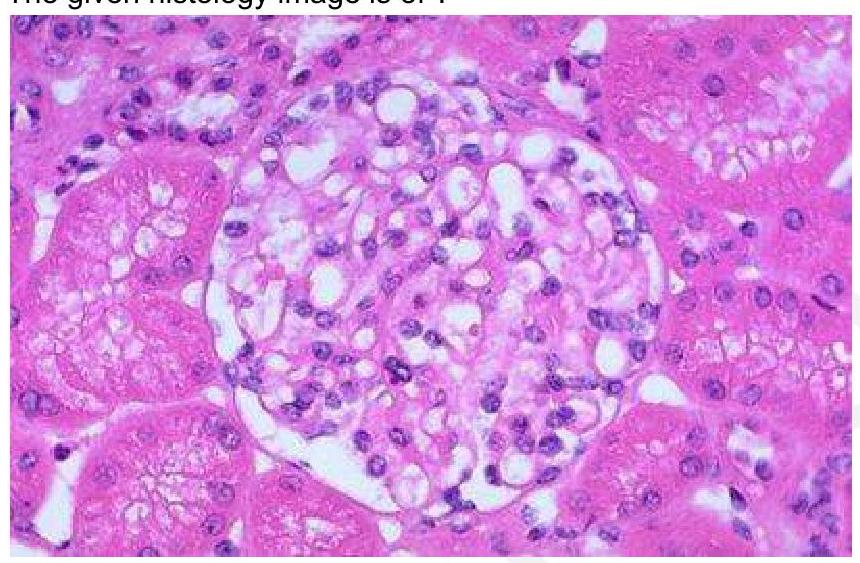
The given histology image is of which structure?
Which of the following statements about the papillae of the tongue is false?
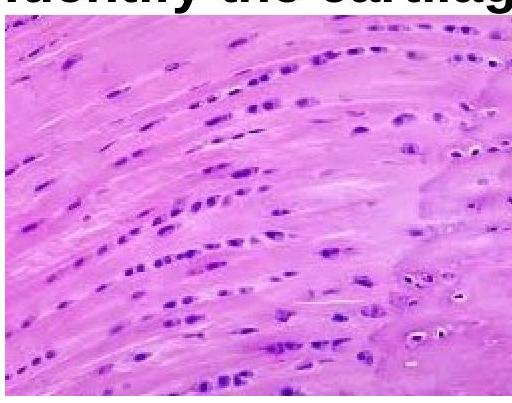
Identify the type of cartilage shown in the image.
Which of the following accurately describes the anatomical structure of the hard palate?
Which type of collagen is the most abundant in the human skin?
Ceruminous glands present in the ear are:
What is the type of epithelium of the adenoid?
Which area in the spleen is considered *primarily* thymus-dependent?
B cells are located in which region of lymph nodes?
Blood testis barrier in testis is formed by?
Explanation: ***Glomerulus*** - The glomerulus is characterized by a **tuft of capillaries** surrounded by Bowman's capsule, responsible for filtration in the kidney [1]. - Histological examination typically shows a **dense network of capillaries** and **mesangial cells**, which are distinct features of the glomeruli [1]. *Hassall's corpuscles* - Found in the **thymus**, they are round structures composed of epithelial cells, crucial in T-cell maturation. - Histologically, they present as concentric layers of **epithelial cells** and are not found in the kidney. *Leydig cells of testis* - Located in the **interstitial tissue** of the testes, these cells produce testosterone and are typically larger than glomerular cells. - They are characterized by their **eosinophilic cytoplasm** and round nuclei, differing markedly from the structures found in the glomerulus. *Pancreatic islet cells* - Islet cells are involved in **hormone production**, predominantly insulin and glucagon, and are located in the pancreas. - Histologically, they appear as small clusters dispersed among **exocrine pancreas**, which is different from the highly organized structure of the glomerulus. **References:** [1] Cross SS. Underwood's Pathology: A Clinical Approach. 6th ed. Common Clinical Problems From Diseases Of The Urinary And Male Genital Tracts, pp. 522-523.
Explanation: ***Foliate papillae are located at the tip of the tongue.*** - This statement is **false** because **foliate papillae** are typically found on the **lateral margins** (sides) of the posterior part of the tongue, not the tip [1]. - They are responsible for a small number of taste buds and are more prominent in early childhood. *Fungiform papillae at tip* - This statement is **true**. **Fungiform papillae** are mushroom-shaped and are scattered across the dorsal surface of the tongue, being more numerous at the **tip** and sides [1]. - They contain **taste buds** on their superior surface and are involved in taste perception (especially for sweet and sour tastes) [1]. - An increased number of fungiform papillae may be associated with heightened sensitivity to taste [1]. *Circumvallate papillae at base* - This statement is **true**. **Circumvallate papillae** are large, dome-shaped papillae arranged in a **V-shape** at the posterior **base** of the tongue [1]. - They contain numerous **taste buds** (up to half of all taste buds) and are primarily involved in the perception of bitter tastes. *Filiform papillae do not have taste buds at their tips.* - This statement is **true**. **Filiform papillae** are the most numerous type of papillae and are responsible for the **rough texture** of the tongue, aiding in manipulating food. - Unlike other papillae, they **do not contain taste buds** but provide a mechanical function.
Explanation: ***Fibrocartilage*** - The image displays **chondrocytes** arranged in rows between bundles of **collagen fibers**, characteristic of fibrocartilage. This structure provides high tensile strength and shock absorption. - Unlike other cartilage types, fibrocartilage lacks a distinct perichondrium and is found in structures requiring extreme strength, such as intervertebral discs and menisci. *Hyaline cartilage* - Hyaline cartilage has an amorphous, **glassy matrix** with chondrocytes typically arranged in small groups (isogenous groups) within lacunae, without prominent collagen bundles. - It is found in articular surfaces, tracheal rings, and the costal cartilages, providing smooth, low-friction surfaces. *Elastic cartilage* - Elastic cartilage is characterized by a high concentration of **elastic fibers** within its matrix, giving it flexibility and resilience. - Chondrocytes are typically scattered and the matrix stains darker due to the elastic fibers, which are not apparent in the image. *Dense connective tissue* - While dense connective tissue contains abundant **collagen fibers**, it lacks chondrocytes in lacunae, instead containing fibroblasts. - The presence of chondrocytes in the image confirms this is cartilage, not dense connective tissue.
Explanation: ***Keratinised mucosa with a submucosal layer and minor salivary glands.*** - The hard palate is covered by **keratinised stratified squamous epithelium** to withstand the forces of chewing and mastication. - It contains a **submucosal layer** in its posterolateral region (near the molar teeth) and anteriorly (near the incisor teeth) where **minor salivary glands** (palatine glands) are present. *Non-keratinised mucosa with a submucosal layer and minor salivary glands.* - The hard palate is primarily covered by **keratinised epithelium**, not non-keratinised, due to its role in food processing. - While it does have a submucosal layer and minor salivary glands in specific regions, the mucosal type is incorrect. *Non-keratinised mucosa without a submucosal layer and minor salivary glands.* - This option incorrectly states that the hard palate has **non-keratinised mucosa** and no submucosal layer, which is false for several regions. - The presence of minor salivary glands is also incorrect for this description. *Keratinised mucosa without a submucosal layer and minor salivary glands.* - While the hard palate is indeed covered by **keratinised mucosa**, it is incorrect to state that it entirely lacks a submucosal layer or minor salivary glands. - These structures are present in the posterolateral and anterior regions of the hard palate.
Explanation: ***Type I collagen*** - **Type I collagen** is the **most abundant type** of collagen in the human body, accounting for about 90% of the collagen, and is particularly prevalent in the **dermis** of the skin, where it provides tensile strength and elasticity [1]. - It forms **thick, striated fibrils** and is critical for the structural integrity of skin, bones, tendons, and ligaments [1]. *Type II collagen* - **Type II collagen** is primarily found in **cartilage**, especially **hyaline and elastic cartilage**, where it provides resistance to pressure. - It is not a major component of the skin's dermal structure. *Type III collagen* - **Type III collagen** is found alongside Type I collagen in the skin but is prominent in **reticular fibers** and plays a role in the elasticity and suppleness of the skin, particularly in rapidly growing tissues and blood vessels. - While present in the skin, it is less abundant than Type I collagen and its primary role is in supporting organ structure, not tensile strength. *Type IV collagen* - **Type IV collagen** is a major component of **basement membranes**, forming a mesh-like network that provides structural support and acts as a filter in tissues. - It is not found in the interstitial connective tissue of the dermis but rather underlies the epidermis, forming part of the dermoepidermal junction.
Explanation: ***Modified apocrine glands*** - **Ceruminous glands** in the ear canal are specialized **apocrine glands** responsible for producing cerumen (earwax). - Like other apocrine glands, they secrete their product via **apical budding** of the cell, releasing fragments of the cell along with the secretion [1]. *Modified eccrine glands* - **Eccrine sweat glands** are distributed throughout the skin and produce a watery sweat for thermoregulation [1]. - They secrete their product directly onto the skin surface via **exocytosis**, without loss of cellular material. *Mucous gland* - **Mucous glands** (e.g., salivary glands, respiratory tract glands) produce **mucus**, a viscous secretion primarily for lubrication and protection. - Their secretions are rich in **mucin glycoproteins**, which is distinct from the lipid-rich cerumen. *Modified holocrine glands* - **Holocrine glands** (e.g., sebaceous glands) release their entire cell contents, including lipids and cellular debris, upon cell lysis. - While sebaceous glands contribute to earwax, ceruminous glands themselves operate via an **apocrine mechanism**, not holocrine [1].
Explanation: ***Pseudostratified ciliated columnar epithelium*** - The adenoid (pharyngeal tonsil) is located in the nasopharynx, which is part of the upper respiratory tract and is lined with **pseudostratified ciliated columnar epithelium** with goblet cells [1]. - This type of epithelium is also known as **respiratory epithelium**, and its cilia and mucus-producing goblet cells help to trap and clear inhaled particles and pathogens [1]. *Non-keratinized squamous epithelium* - This type of epithelium is found in areas subject to friction and abrasion, such as the oral cavity, oro- and laryngopharynx, and esophagus, not typically in the nasopharynx. - It provides protection but lacks the ciliated and mucus-producing cells necessary for clearing respiratory passages. *Cuboidal epithelium* - This epithelium is typically found in glands and ducts, secretory and absorptive surfaces, such as renal tubules and thyroid follicles. - It does not have the specialized functions (cilia, mucus production) required for the respiratory system's protective lining. *Columnar epithelium with goblet cells* - While the adenoid epithelium does contain **goblet cells** for mucus production, specifically stating "columnar epithelium" is not as precise as "pseudostratified ciliated columnar epithelium." - The key feature of being **pseudostratified** and **ciliated** is crucial for its function in the nasopharynx [1].
Explanation: ***Periarteriolar lymphoid sheath (PALS)*** - PALS is the **T-cell zone** of splenic white pulp, containing predominantly **T-lymphocytes** arranged around central arterioles. [2] - This area is **thymus-dependent** as it houses mature T cells that have undergone thymic selection and education, making it the primary thymus-dependent area of the spleen. [1] *Mantle layer* - The mantle layer consists of **naïve B lymphocytes** that surround the germinal center within splenic follicles. - This area is **thymus-independent** and primarily involved in **B-cell responses** to antigens. *Malpighian corpuscle* - Also known as **splenic follicles** or white pulp, this area primarily functions as **B-cell aggregation zones**. - While containing both B and T cell areas, it's predominantly **thymus-independent** with its main role being B-cell activation and antibody production. *None of the options* - This option is incorrect because PALS clearly represents the primary **thymus-dependent area** in the spleen. - The spleen definitively contains thymus-dependent zones where **T-cell activation** and proliferation occur, specifically the PALS. [1]
Explanation: ***Cortical follicles*** - **B cells** are predominantly found within the **cortical follicles** of lymph nodes, where they mature and become activated upon encountering antigens [2]. - These follicles can be primary (inactive) or secondary (active, containing **germinal centers** for B cell proliferation and differentiation). *Paracortical region* - The **paracortical region** is primarily occupied by **T cells** and is the site where T cells interact with antigen-presenting cells [1]. - While it's adjacent to B cell areas, it's not the primary location for B cells. *Medullary sinuses* - **Medullary sinuses** are channels in the medulla of the lymph node, containing macrophages and plasma cells, which are *differentiated B cells*. - They are not the primary residence for undifferentiated B cells. *Subcapsular region* - **Subcapsular region** is the space immediately beneath the capsule of the lymph node where lymph initially enters. - It contains macrophages and dendritic cells that sample antigens but is not a primary B cell zone.
Explanation: ***Sertoli cells*** - **Sertoli cells** form tight junctions with each other, creating the **blood-testis barrier** [1] - This barrier divides the seminiferous epithelium into **basal and adluminal compartments** [1] - Essential for protecting developing **germ cells** from immune attack and maintaining a specialized microenvironment for **spermatogenesis** [1] - The tight junctions between Sertoli cells are among the tightest in the human body *Granulosa cells* - **Granulosa cells** are found in the **ovary**, not the testis - They surround the oocyte in ovarian follicles and produce **estrogen** - Completely unrelated to testicular structure or function *Germ cells* - **Germ cells** (spermatogonia, spermatocytes, spermatids, spermatozoa) are the developing sperm cells [1] - They are **protected by** the blood-testis barrier, not forming it [1] - Located within the seminiferous tubules but do not create barrier structures [1] *Leydig cells* - **Leydig cells** are interstitial cells located in the connective tissue **between seminiferous tubules** - Their primary function is production of **testosterone**, not forming barriers [2] - They are outside the seminiferous tubules and not involved in barrier formation [2]
Cellular Ultrastructure
Practice Questions
Microscopic Anatomy of Epithelial Tissues
Practice Questions
Microscopic Anatomy of Connective Tissues
Practice Questions
Microscopic Anatomy of Muscle Tissues
Practice Questions
Microscopic Anatomy of Nervous Tissues
Practice Questions
Microscopic Anatomy of Blood and Immune System
Practice Questions
Microscopic Anatomy of Endocrine Glands
Practice Questions
Microscopic Anatomy of Digestive System
Practice Questions
Microscopic Anatomy of Respiratory System
Practice Questions
Microscopic Anatomy of Urinary System
Practice Questions
Microscopic Anatomy of Reproductive System
Practice Questions
Techniques in Microscopic Anatomy
Practice Questions
Get full access to all questions, explanations, and performance tracking.
Start For Free