Community Medicine
8 questionsThe "risk of a disease" is measured by the
The "Relative Risk" of 0.25 indicates
Which of the following constitutes "Secondary Prevention"?
The installation and usage of sanitary latrines by general public constitutes which level of prevention?
"Sampling error" occurs due to the variation in results
Match List-I with List-II and select the correct answer using the code given below the Lists:
Which one of the following indicators includes the value of a person's height squared in its formula?
Which of the following is covered under spiritual dimension of health?
UPSC-CMS 2023 - Community Medicine UPSC-CMS Practice Questions and MCQs
Question 81: The "risk of a disease" is measured by the
- A. Prevalence Rate
- B. Incidence Rate (Correct Answer)
- C. Case Fatality Rate
- D. Communicability Rate
Explanation: ***Incidence Rate*** - The **incidence rate** directly measures the frequency of **new cases** of a disease in a population over a specified period. - It is used to estimate the **risk** or probability of developing a disease, as it quantifies how quickly people are contracting the disease within the at-risk population. - **Formula:** (Number of new cases during time period / Population at risk) × multiplier - This is the epidemiologically correct measure of disease risk. *Prevalence Rate* - The **prevalence rate** measures the **total number of existing cases** (both new and old) of a disease in a population at a specific point in time or over a period. - It reflects the **burden** of a disease, not the risk of acquiring it, as it includes individuals who may have developed the disease much earlier. - Prevalence = Incidence × Duration of disease. *Case Fatality Rate* - The **case fatality rate** (CFR) measures the **proportion of individuals diagnosed with a disease who die from that disease** within a specified period. - It reflects the **severity** or lethality of a disease among those affected, not the risk of developing the disease in the first place. - CFR is a measure of disease outcome, not disease occurrence. *Communicability Rate* - There is no standard epidemiological term exactly defined as "communicability rate"; however, related concepts include the **basic reproduction number (R₀)** and **secondary attack rate**. - These concepts describe the **spread or transmissibility of an infectious disease**, not the risk of contracting a disease from a general population perspective. - This measures transmission dynamics rather than individual risk.
Question 82: The "Relative Risk" of 0.25 indicates
- A. 2.5 times higher risk in the exposed individuals compared with the unexposed
- B. 25% increase in the incidence rate in the exposed individuals compared with the unexposed
- C. 75% reduction in the incidence rate in the exposed individuals compared with the unexposed (Correct Answer)
- D. 75% risk increase in the exposed individuals compared with the unexposed
Explanation: ***75% reduction in the incidence rate in the exposed individuals compared with the unexposed*** - A **Relative Risk (RR)** of 0.25 means the risk in the exposed group is 25% of the risk in the unexposed group. - This indicates a **reduction** in risk calculated as (1 - RR) * 100%, so (1 - 0.25) * 100% = 75% reduction. *2.5 times higher risk in the exposed individuals compared with the unexposed* - This would be indicated by an RR of 2.5, meaning the risk is **2.5 times greater** in the exposed group. - An RR of 0.25 signifies a risk that is **less than** that of the unexposed group, not higher. *25% increase in the incidence rate in the exposed individuals compared with the unexposed* - A 25% increase would mean the RR is 1.25 (1 + 0.25), indicating a **higher risk** in the exposed group. - An RR of 0.25 represents a **decrease** in risk, not an increase. *75% risk increase in the exposed individuals compared with the unexposed* - A 75% risk increase would correspond to an RR of 1.75 (1 + 0.75), suggesting a **greater risk**. - With an RR of 0.25, the risk in the exposed group is **lower**, representing a reduction rather than an increase.
Question 83: Which of the following constitutes "Secondary Prevention"?
- A. Health Education Programme
- B. Using Limb Callipers
- C. Wearing Safety Helmets
- D. Screening Tests (Correct Answer)
Explanation: ***Screening Tests (Correct)*** - **Screening tests** constitute the core of **secondary prevention**, designed to detect disease in its **early, asymptomatic stages** before clinical symptoms appear. - By identifying disease early, screening enables **prompt intervention** to prevent progression, reduce morbidity, and improve prognosis. - Examples include mammography for breast cancer, PAP smear for cervical cancer, and blood pressure screening for hypertension. *Health Education Programme* - Health education programmes are examples of **primary prevention**, which aims to **prevent disease occurrence** by promoting healthy behaviors and reducing risk factors. - These interventions target healthy individuals to maintain health and prevent disease onset, not to detect existing disease. *Using Limb Callipers* - **Limb callipers** are used for anthropometric measurements or as assistive devices for mobility in patients with disabilities. - As a measurement tool, it's used for **assessment and monitoring**, not for disease prevention. - As an assistive device, it falls under **tertiary prevention** (rehabilitation), helping patients manage existing disability. *Wearing Safety Helmets* - Wearing safety helmets is a classic example of **primary prevention**, as it aims to **prevent injuries** (head trauma) from occurring in the first place. - It is a protective measure implemented before any health event occurs, not for early disease detection.
Question 84: The installation and usage of sanitary latrines by general public constitutes which level of prevention?
- A. Disability limitation and rehabilitation
- B. Early diagnosis and treatment
- C. Health promotion
- D. Specific protection (Correct Answer)
Explanation: ***Specific protection*** - Installation and usage of sanitary latrines is a **specific protective measure** against fecal-oral disease transmission. - This intervention specifically targets diseases like **cholera, typhoid, hepatitis A, amoebiasis, and helminthic infections** by preventing contamination of water and food sources. - Specific protection includes measures like **immunization, water purification, proper excreta disposal, food sanitation, and use of personal protective equipment** - all aimed at protecting against specific disease agents. - Proper sanitation facilities create a **physical barrier** between human excreta and the environment, preventing the spread of specific pathogens. *Health promotion* - This involves **general measures** to improve overall health without targeting specific diseases, such as health education, nutritional counseling, promotion of physical activity, and stress management. - While educating people about the importance of sanitation falls under health promotion, the actual **installation and use of latrines** is a specific protective measure. - Health promotion strengthens host defenses through lifestyle modifications and healthy behaviors. *Early diagnosis and treatment* - This is **secondary prevention** that focuses on early detection of disease through screening programs and prompt treatment to prevent progression. - Examples include mammography for breast cancer, cervical cytology for cervical cancer, and blood pressure screening for hypertension. - Not applicable to sanitary latrine installation, which prevents disease occurrence rather than detecting existing disease. *Disability limitation and rehabilitation* - This is **tertiary prevention** aimed at reducing complications from established disease and restoring function after illness or injury. - Examples include physiotherapy after stroke, cardiac rehabilitation after myocardial infarction, and limb prostheses after amputation. - Not relevant to preventive sanitation measures.
Question 85: "Sampling error" occurs due to the variation in results
- A. due to the use of many instruments in the study
- B. due to the multiple readings taken on the same instrument
- C. between one sample and another (Correct Answer)
- D. between the observations of two individuals
Explanation: ***between one sample and another*** - **Sampling error** arises because a sample is not a perfect representation of the entire population from which it is drawn. - This error quantifies the natural **variability** that occurs when different subgroups (samples) are selected from the same population. *due to the use of many instruments in the study* - This scenario describes **inter-instrument variability** or **measurement error**, which is related to the precision and calibration of different tools. - While it can introduce error, it is distinct from sampling error, which arises from the representativeness of the chosen study subjects. *due to the multiple readings taken on the same instrument* - Multiple readings on the same instrument assess **intra-instrument variability** or **repeatability**, indicating how consistent a single instrument is over time. - This relates to the precision of the measurement device, not the representativeness of the sample itself. *between the observations of two individuals* - Differences in observations between two individuals indicate **inter-rater variability** or **observer bias**. - This type of error is related to subjective interpretation or measurement technique by different observers, rather than the intrinsic variability between selected samples.
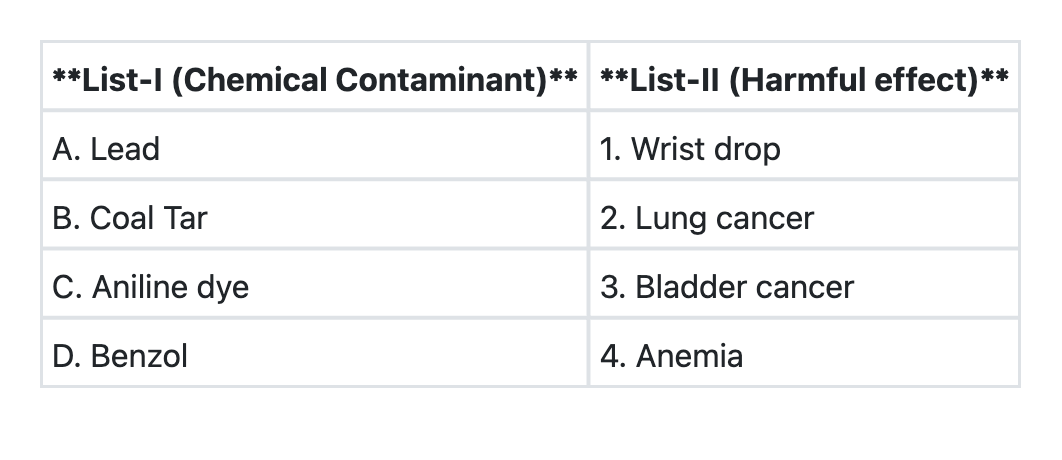
Question 86: Match List-I with List-II and select the correct answer using the code given below the Lists:
- A. A→3 B→2 C→1 D→4
- B. A→3 B→1 C→4 D→2
- C. A→1 B→3 C→2 D→4 (Correct Answer)
- D. A→4 B→2 C→3 D→1
Explanation: ***A→1 B→3 C→2 D→4*** - This option correctly matches the occupational exposures with their characteristic health effects based on the lists provided. - **Lead poisoning** classically causes **wrist drop** due to radial nerve palsy, a hallmark neurological manifestation. - **Coal tar** exposure is associated with **skin cancer** (especially scrotal cancer in historical chimney sweeps) and **lung cancer** in occupational settings. - **Aniline dye** (particularly β-naphthylamine) is a well-established cause of **bladder cancer** in dye industry workers. - **Benzol (Benzene)** is notorious for causing **hematological disorders** including aplastic anemia, pancytopenia, and leukemia. *A→3 B→2 C→1 D→4* - This option incorrectly associates the exposures with their health effects. - The matching does not align with established occupational health associations. *A→3 B→1 C→4 D→2* - This option incorrectly associates the exposures with their health effects. - The matching does not align with established occupational health associations. *A→4 B→2 C→3 D→1* - This option incorrectly associates the exposures with their health effects. - Although lead can cause anemia, its most characteristic neurological effect is **wrist drop**, which is a diagnostic hallmark. Benzol (benzene) is primarily associated with hematological disorders, not neurological manifestations like wrist drop.
Question 87: Which one of the following indicators includes the value of a person's height squared in its formula?
- A. Quetelet's index (Correct Answer)
- B. Waist-to-hip ratio
- C. Ponderal index
- D. Waist circumference
Explanation: ***Quetelet's index*** - **Quetelet's index**, also known as **Body Mass Index (BMI)**, is calculated as **weight (kg) / height (m)²**, thus directly incorporating height squared. - It is widely used to classify individuals as underweight, normal weight, overweight, or obese. - BMI is the most commonly used anthropometric indicator in clinical and public health settings. *Waist-to-hip ratio* - This ratio is calculated by dividing **waist circumference** by **hip circumference**. - It is an indicator of abdominal adiposity and does not use height in its formula. *Ponderal index* - The **Ponderal index** is calculated as **weight (kg) / height (m)³**, which uses height cubed, not squared. - It is often used to assess proportionality in infants and children. - While it includes height, the power is different from Quetelet's index. *Waist circumference* - **Waist circumference** is a direct measurement of the circumference of the abdomen. - It is an indicator of visceral fat and does not include height in its measurement or interpretation.
Question 88: Which of the following is covered under spiritual dimension of health?
- A. Harmony within individual
- B. Balance of rationality and emotionality
- C. Meaning and purpose of life (Correct Answer)
- D. Quality of interpersonal ties
Explanation: ***Meaning and purpose of life*** - The spiritual dimension of health encompasses an individual's search for **meaning, purpose, and value** in life. - It involves one's **beliefs, values, ethics**, and connection to something greater than oneself, which can provide a sense of peace and fulfillment. *Harmony within individual* - This concept aligns more closely with the **mental or psychological dimension** of health, focusing on inner peace and a balanced mind. - It relates to having a **stable emotional state** and a good self-concept. *Balance of rationality and emotionality* - This aspect primarily falls under the **mental or emotional dimension** of health. - It reflects an individual's ability to manage their emotions effectively and make rational decisions, contributing to overall **psychological well-being**. *Quality of interpersonal ties* - This pertains to the **social dimension** of health, which involves an individual's relationships and interactions with others. - Strong and positive social connections are crucial for social well-being, but they are not the primary focus of the **spiritual dimension**.
Forensic Medicine
1 questionsWhich of the following insecticides is a natural contact poison?
UPSC-CMS 2023 - Forensic Medicine UPSC-CMS Practice Questions and MCQs
Question 81: Which of the following insecticides is a natural contact poison?
- A. Propoxur
- B. Rotenone (Correct Answer)
- C. Carbaryl
- D. Lindane
Explanation: ***Rotenone*** - **Rotenone** is a naturally occurring plant-derived insecticide, traditionally used as a **contact poison** and **stomach poison**. - It is effective against a broad spectrum of insects and works by inhibiting **electron transport** in the mitochondria, disrupting cellular respiration. *Propoxur* - **Propoxur** is a **synthetic carbamate insecticide**, not a natural one. - It acts primarily as a **cholinesterase inhibitor**, interfering with nervous system function. *Carbaryl* - **Carbaryl** is a **synthetic carbamate insecticide**, derived from carbamic acid, not a natural product. - Its mechanism of action involves **reversible inhibition of acetylcholinesterase**, leading to nerve overstimulation. *Lindane* - **Lindane** is an **organochlorine insecticide**, which is a synthetic compound, not naturally occurring. - It acts as a **neurotoxin**, primarily by interfering with **GABA-gated chloride channels** in the insect's nervous system.
Pediatrics
1 questionsIn measles, when do the Koplik's spots appear?
UPSC-CMS 2023 - Pediatrics UPSC-CMS Practice Questions and MCQs
Question 81: In measles, when do the Koplik's spots appear?
- A. On the day that rashes appear
- B. 1-2 days before the rashes appear (Correct Answer)
- C. On the day that fever occurs
- D. 1-2 days before the fever occurs
Explanation: ***1-2 days before the rashes appear*** - **Koplik's spots** are considered an **enanthem**, a pathognomonic sign of **measles**. - These small, white spots with a bluish-white center on an erythematous base on the buccal mucosa typically appear 1-2 days before the generalized maculopapular rash. *On the day that rashes appear* - The generalized **maculopapular rash** of measles typically appears a few days *after* Koplik's spots. - While the rash is a hallmark of measles, it is preceded by the oral lesions. *On the day that fever occurs* - **Fever** is usually one of the initial symptoms of measles, often appearing several days before Koplik's spots. - The fever is part of the **prodromal phase**, which includes cough, coryza, and conjunctivitis. *1-2 days before the fever occurs* - Measles symptoms, including fever, are usually the first indicators of infection, making it unlikely for a specific sign like Koplik's spots to appear before the fever itself. - The incubation period precedes any symptoms, including fever.