Community Medicine
10 questionsThe ratio between incidences among exposed and non-exposed persons is called
Match List-I with List-II and select the correct answer using the code given below the Lists:
A new drug is to be evaluated for its therapeutic effect. The best study design will be.
Consider the following criteria for a "screening test" : 1. Disease should have a latent period 2. Condition (disease) should be rare 3. Disease should be amenable to treatment Which of the above must be satisfied before including a screening test into any programme?
"Risk ratio" is also known as:
Consider the following characteristics of biological agents : 1. Infectivity 2. Pathogenicity 3. Virulence 4. Communicability Among the above characteristics, which are used to measure the ability of biological agents to induce clinically apparent illness?
"Mid-year population" is not the denominator of which mortality rate?
The best indicator for the measurement of "completed family size"; that is the number of children a woman would have through her reproductive years is
Under the DOTS strategy of Revised National Tuberculosis Programme, the recommended line of management in Category I patients, if the sputum is positive after 2 months of Intensive Phase treatment with 4 drugs, is to
A 15-month-old child presents with fever and cough since the last two days, the respiratory rate is 55/min and there is no drawing of the chest. According to the National Programme for Acute Respiratory Infections, the line of management should be
UPSC-CMS 2023 - Community Medicine UPSC-CMS Practice Questions and MCQs
Question 91: The ratio between incidences among exposed and non-exposed persons is called
- A. Positive predictive value
- B. Relative risk (Correct Answer)
- C. Attributable risk
- D. Odds ratio
Explanation: ***Correct: Relative risk*** - This is the ratio of the **incidence of disease** in an **exposed group** to the incidence of disease in an **unexposed group**. - It quantifies the likelihood of developing the disease in the exposed group relative to the unexposed group. - **Formula:** RR = (Incidence in exposed) / (Incidence in unexposed) *Incorrect: Positive predictive value* - This statistical measure indicates the probability that a person with a **positive test result** actually has the disease. - It is not a measure of incidence comparison between exposed and unexposed populations. *Incorrect: Attributable risk* - This measures the **absolute difference** in incidence rates between exposed and unexposed groups. - It quantifies the amount of disease incidence that can be directly attributed to the exposure, not a ratio. - **Formula:** AR = (Incidence in exposed) - (Incidence in unexposed) *Incorrect: Odds ratio* - This is a measure of association between an **exposure and an outcome**, representing the odds that an outcome will occur given a particular exposure, compared to the odds of the outcome occurring in the absence of that exposure. - It is commonly used in **case-control studies** and is a ratio of odds, not directly incidence rates.
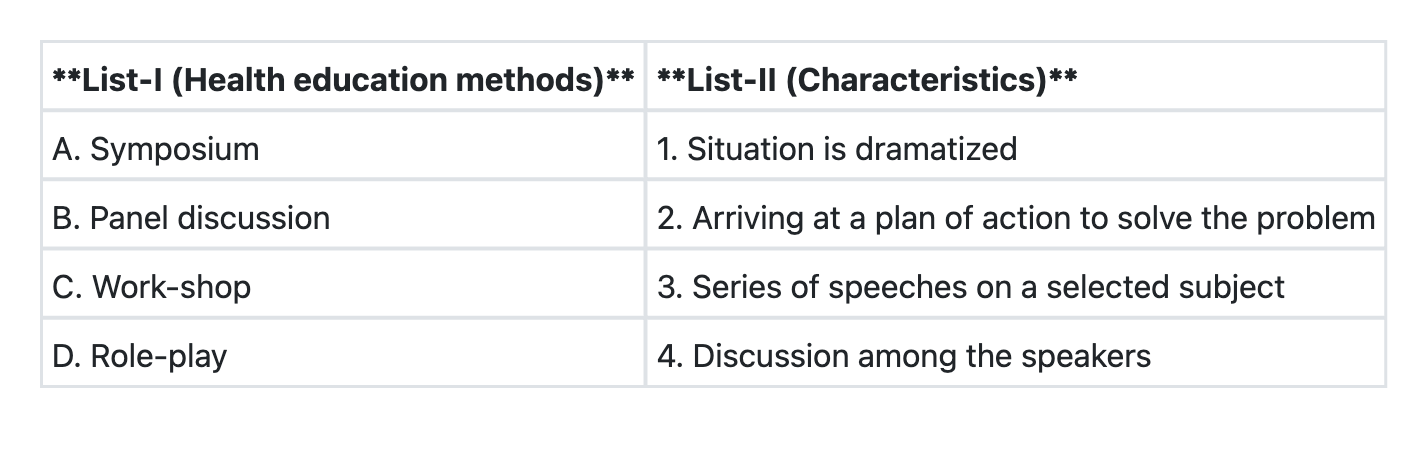
Question 92: Match List-I with List-II and select the correct answer using the code given below the Lists:
- A. A→4 B→3 C→2 D→1 (Correct Answer)
- B. A→1 B→3 C→2 D→4
- C. A→1 B→2 C→3 D→4
- D. A→4 B→2 C→3 D→1
Explanation: ***A→4 B→3 C→2 D→1*** - A **symposium** (A) is characterized by a "discussion among the speakers" (4), where experts present different aspects of a topic, followed by interaction. - A **panel discussion** (B) involves a "series of speeches on a selected subject" (3) by panel members in front of an audience, often with interaction moderated by a chairperson. - A **workshop** (C) typically focuses on "arriving at a plan of action to solve the problem" (2) through practical, hands-on activities and collaborative problem-solving. - **Role-play** (D) is a technique where a "situation is dramatized" (1) by participants acting out roles to understand different perspectives or practice new skills. *A→1 B→3 C→2 D→4* - This option incorrectly matches "Symposium" with "Situation is dramatized" and "Role-play" with "Discussion among the speakers". - Role-play is about dramatizing a situation, while a symposium involves discussion among speakers. *A→1 B→2 C→3 D→4* - This option misaligns multiple matches, particularly with "Symposium" (A) and "Workshop" (C). - A workshop is about action plans, and a symposium is about discussions among speakers, not the other way around. *A→4 B→2 C→3 D→1* - This option incorrectly matches "Panel discussion" with "Arriving at a plan of action to solve the problem" and "Workshop" with "Series of speeches on a selected subject". - Workshops focus on action plans, and panel discussions involve a series of speeches.
Question 93: A new drug is to be evaluated for its therapeutic effect. The best study design will be.
- A. Natural experiment
- B. Randomized controlled trial (Correct Answer)
- C. Cross sectional survey
- D. Case control design
Explanation: ***Randomized controlled trial*** - This design is the **gold standard** for evaluating the effectiveness of a new therapeutic intervention. - **Randomization** minimizes confounding, and a control group allows for direct comparison of outcomes, isolating the **drug's effect**. *Natural experiment* - This design involves observing the effects of an intervention that occurs naturally, without researcher manipulation. - It lacks the **control** and **randomization** necessary to definitively attribute observed effects solely to the therapeutic agent. *Cross sectional survey* - This design assesses the prevalence of a condition or exposure at a single point in time. - It cannot establish **causality** or evaluate the therapeutic effect of an intervention over time. *Case control design* - This retrospective design compares individuals with a disease (cases) to those without (controls) to identify past exposures. - It is used to investigate **risk factors** for diseases, not to evaluate the therapeutic efficacy of a new drug.
Question 94: Consider the following criteria for a "screening test" : 1. Disease should have a latent period 2. Condition (disease) should be rare 3. Disease should be amenable to treatment Which of the above must be satisfied before including a screening test into any programme?
- A. 1 only
- B. 2 only
- C. 1 and 3 (Correct Answer)
- D. 1 and 2
Explanation: ***1 and 3*** - A successful screening program requires the disease to have a detectable **latent period** (criterion 1) during which early intervention can be beneficial. - Furthermore, the disease must be **amenable to treatment** (criterion 3); if there's no effective treatment, early detection offers no clinical advantage. *1 only* - While a **latent period** is essential for effective screening, it is not the sole criterion; the availability of treatment is equally critical. - Screening for a disease with a latent period but no effective treatment would lead to early diagnosis without improved outcomes, causing unnecessary anxiety. *2 only* - The **rarity of a condition** (criterion 2) is generally not a prerequisite for screening; in fact, screening is often more cost-effective for more prevalent diseases. - Screening rare diseases can lead to a low positive predictive value and higher rates of false positives, making it inefficient without substantial public health impact. *1 and 2* - Although a **latent period** is necessary, screening is generally more useful and cost-effective for diseases that are common enough to warrant population-level intervention, not necessarily rare diseases. - Screening primarily aims for early intervention and improved outcomes, which are not solely dependent on rarity, but on the disease's burden and treatability.
Question 95: "Risk ratio" is also known as:
- A. Odds ratio
- B. Relative risk (Correct Answer)
- C. Attributable risk
- D. Population attributable risk
Explanation: ***Relative risk*** - **Risk ratio** is another term for **relative risk**, which is a measure of association between exposure to a factor and the risk of an outcome. - It compares the risk of an event in an **exposed group** to the risk of an event in an **unexposed group**. *Odds ratio* - The **odds ratio** is a measure of association that quantifies the relationship between an exposure and an outcome, often used in **case-control studies**. - It approximates the relative risk when the outcome is **rare** but is distinct in its calculation based on odds rather than risks. *Attributable risk* - **Attributable risk** (or risk difference) quantifies the **absolute difference in risk** between exposed and unexposed groups. - It represents the amount of disease incidence that can be directly attributed to the exposure. *Population attributable risk* - **Population attributable risk** is the proportion of a disease in the total population that is attributable to a specific exposure. - It considers both the **strength of the association** and the **prevalence of the exposure** in the population.
Question 96: Consider the following characteristics of biological agents : 1. Infectivity 2. Pathogenicity 3. Virulence 4. Communicability Among the above characteristics, which are used to measure the ability of biological agents to induce clinically apparent illness?
- A. 3 only
- B. 2 and 3 (Correct Answer)
- C. 2 only
- D. 1 and 2
Explanation: ***2 and 3*** - **Pathogenicity** is the ability of an infectious agent to cause disease (clinically apparent illness) in infected individuals, measured as the proportion of infected persons who develop clinical disease. - **Virulence** is the ability of an agent to produce severe disease, measured as the proportion of clinical cases that are severe or fatal. - **Both characteristics measure different aspects of the ability to induce clinically apparent illness**: pathogenicity measures whether clinical illness occurs, while virulence measures the severity of that clinical illness. - Together, they comprehensively describe an agent's capacity to produce clinically apparent disease. *2 only* - While pathogenicity does measure the ability to cause clinically apparent illness, this is incomplete. - Virulence is also a measure of the ability to induce clinically apparent illness, specifically measuring the severity spectrum of that illness. *3 only* - Virulence alone is insufficient as it only measures severity among those who are already clinically ill. - Pathogenicity is also needed to measure the ability to produce clinical illness in the first place. *1 and 2* - **Infectivity** measures the ability of an agent to enter, survive, and multiply in a host, which is a prerequisite for disease but does not measure clinical illness itself. - An agent can have high infectivity but low pathogenicity (causing mostly subclinical infections). - Only pathogenicity and virulence directly measure aspects of clinically apparent illness.
Question 97: "Mid-year population" is not the denominator of which mortality rate?
- A. Age specific death rate
- B. Proportional mortality rate (Correct Answer)
- C. Crude death rate
- D. Weekly death rate
Explanation: ***Proportional mortality rate*** - The **proportional mortality rate** uses the **total number of deaths from all causes** as its denominator, not the mid-year population. - It expresses the proportion of all deaths due to a specific cause, rather than a rate per population at risk. - Formula: PMR = (Deaths from specific cause / Total deaths) × 100 *Age specific death rate* - The **age-specific death rate** uses the **mid-year population of a specific age group** as its denominator to calculate the number of deaths within that group. - This allows for comparison of mortality across different age cohorts. *Crude death rate* - The **crude death rate** uses the **total mid-year population** of a given area as its denominator. - It represents the overall mortality experience of a population but does not account for age structure. *Weekly death rate* - Though not a standard epidemiological measure, if calculated, this would use the **mid-week or average population for that specific week** as its denominator. - This would measure mortality frequency over a shorter, defined period using a population base.
Question 98: The best indicator for the measurement of "completed family size"; that is the number of children a woman would have through her reproductive years is
- A. Net reproduction rate
- B. General fertility rate
- C. Total fertility rate (Correct Answer)
- D. Gross reproduction rate
Explanation: ***Total fertility rate*** - The **Total Fertility Rate (TFR)** estimates the average number of children a woman would have over her lifetime if she were to experience the current age-specific fertility rates. - It is considered the best indicator of "completed family size" because it projects the total number of live births a woman is expected to have by the end of her reproductive life, assuming static fertility rates. *Net reproduction rate* - The **Net Reproduction Rate (NRR)** accounts for both fertility and mortality, indicating how many daughters each woman is expected to have who will survive to reproductive age. - While it measures population replacement, it doesn't directly represent the total number of children a woman *would have* through her reproductive years, as it only counts female offspring who survive to reproductive age. *General fertility rate* - The **General Fertility Rate (GFR)** measures the number of live births per 1,000 women aged 15-49 years in a given year. - It provides an overall measure of current fertility but does not project the total number of children a woman is expected to have over her lifetime, as it is a period measure. *Gross reproduction rate* - The **Gross Reproduction Rate (GRR)** is similar to TFR but only counts female births, representing the average number of daughters a woman would have if she survived through her entire reproductive life. - It does not account for mortality among female offspring, making TFR a more comprehensive measure of overall family size, and NRR a better measure of population replacement.
Question 99: Under the DOTS strategy of Revised National Tuberculosis Programme, the recommended line of management in Category I patients, if the sputum is positive after 2 months of Intensive Phase treatment with 4 drugs, is to
- A. Add one more drug, that is, to use 5 drugs until the sputum becomes negative
- B. Continue the Intensive Phase of treatment with 4 drugs until the sputum becomes negative
- C. Continue the Intensive Phase of treatment with 4 drugs for 1 more month only, regardless of sputum positivity after that (Correct Answer)
- D. Start the continuation phase with INH and Rifampicin
Explanation: ***Continue the Intensive Phase of treatment with 4 drugs for 1 more month only, regardless of sputum positivity after that*** - In the **DOTS strategy** under earlier RNTCP guidelines, for Category I patients whose sputum remains positive after 2 months of the Intensive Phase, the recommended action was to **extend the Intensive Phase by one additional month**. - This step aimed to maximize the bactericidal effect of the four drugs (isoniazid, rifampicin, pyrazinamide, ethambutol) before transitioning to the Continuation Phase, even if sputum conversion was not achieved by the end of the third month. - **Note:** Current NTEP guidelines recommend sputum examination at 3 months, with drug susceptibility testing if positive, rather than automatic extension. *Add one more drug, that is, to use 5 drugs until the sputum becomes negative* - **Adding a fifth drug** is not the standard recommendation for a Category I patient who remains sputum positive after 2 months of the initial Intensive Phase. - This approach might be considered in cases of confirmed drug resistance after appropriate testing, which would typically involve more extensive evaluation beyond a single sputum result. *Continue the Intensive Phase of treatment with 4 drugs until the sputum becomes negative* - **Continuing the Intensive Phase indefinitely** until sputum conversion was not the standard protocol under DOTS. - Prolonged use of the intensive phase drugs beyond the specified duration can increase the risk of side effects and may not be more effective if underlying issues like drug resistance are present. *Start the continuation phase with INH and Rifampicin* - **Transitioning to the Continuation Phase** with only isoniazid (INH) and rifampicin (RMP) while sputum is still positive after 2 months of the Intensive Phase is inappropriate. - This would risk selecting for drug-resistant strains and lead to treatment failure due to insufficient bactericidal activity.
Question 100: A 15-month-old child presents with fever and cough since the last two days, the respiratory rate is 55/min and there is no drawing of the chest. According to the National Programme for Acute Respiratory Infections, the line of management should be
- A. Immediate referral of the child to hospital for urgent admission
- B. Administration of treatment for fever at home, advising the mother to return after two days for assessment of the need for an antibiotic
- C. Referral of the child to hospital for admission, after administration of first dose of antibiotic
- D. Administration of antibiotic at home along with treatment for fever, advising the mother to return for reassessment after two days (Correct Answer)
Explanation: ***Administration of antibiotic at home along with treatment for fever, advising the mother to return for reassessment after two days*** - A respiratory rate of 55/min in a 15-month-old child indicates **fast breathing**, which is a sign of pneumonia. However, the **absence of chest indrawing** means it's classified as **non-severe pneumonia**. - According to the National Programme for Acute Respiratory Infections (ARI) guidelines, **non-severe pneumonia** in children 2 months to 5 years without severe illness signs should be managed with **oral antibiotics at home** and outpatient follow-up. *Immediate referral of the child to hospital for urgent admission* - This action is indicated for **severe pneumonia** or **very severe disease**, characterized by signs such as chest indrawing, stridor, central cyanosis, or inability to drink, which are not present here. - While the child has fast breathing, the **absence of chest indrawing** suggests a less severe presentation that does not immediately warrant urgent hospital admission. *Administration of treatment for fever at home, advising the mother to return after two days for assessment of the need for an antibiotic* - This approach is inappropriate because **fast breathing** is a definitive sign of pneumonia in this age group, requiring immediate antibiotic treatment. - Delaying antibiotic administration could lead to the **progression of the infection** to a more severe form. *Referral of the child to hospital for admission, after administration of first dose of antibiotic* - Admission to the hospital is not required for **non-severe pneumonia** if the child can be managed at home and there are no signs of severe disease. - The guidelines suggest home management with oral antibiotics unless specific **danger signs** for referral are present.