Community Medicine
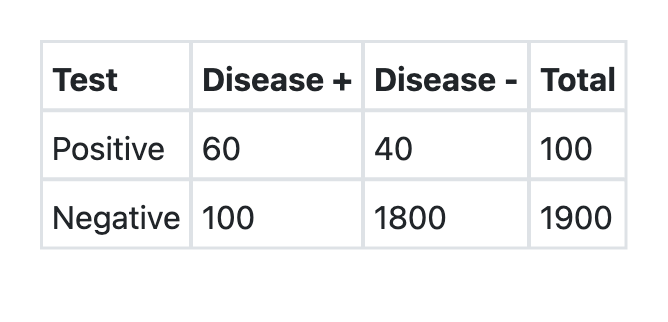
6 questionsA new test was developed for detection of COVID-19. What is the sensitivity of the test as per the information provided above?
A study was conducted to evaluate the effectiveness of a new antidiabetic drug. The fasting blood glucose levels (mg/dL) of 5 diabetic patients after 3 months of treatment were: 110, 94, 102, 98, 96. Consider the following statements about this data: 1. The range of blood glucose levels is 16 mg/dL 2. The median blood glucose level is 98 mg/dL 3. The standard deviation is √10 mg/dL
Which of the following are correct in respect of Diphtheria? 1. The incubation period is 14 to 28 days 2. Diphtheria antitoxin is used in treatment of cases 3. It is one of the diseases protected from, by the Pentavalent vaccine given in National Program
A person has presented with history of dog-bite on the uncovered surface of his right leg. There is a minor abrasion without bleeding. Consider the following statements about management : 1. The bite should be taken as a category I contact with suspect animal 2. The bite requires local treatment of the wound 3. The person requires immediate vaccination 4. The person requires immediate administration of rabies immunoglobulin Which of the above statements are correct ?
Consider the following stages of modern sewage treatment plants : 1. Use of Grit chamber 2. Use of Primary sedimentation tank 3. Screening 4. Use of Sludge digester What would be the correct sequence of the above stages ?
A vital layer, also known as "Schmutzdecke" is seen in which one of the following ?
UPSC-CMS 2021 - Community Medicine UPSC-CMS Practice Questions and MCQs
Question 81: A new test was developed for detection of COVID-19. What is the sensitivity of the test as per the information provided above?
- A. 97%
- B. 37.5% (Correct Answer)
- C. 20.5%
- D. 60%
Explanation: ***37.5%*** - **Sensitivity** is calculated as the number of **true positives** divided by the sum of true positives and false negatives (i.e., total number of individuals with the disease). - From the table, **True Positives (Test Positive and Disease +)** = 60, and **False Negatives (Test Negative and Disease +)** = 100. So, sensitivity = 60 / (60 + 100) = 60 / 160 = 0.375 or 37.5%. *97%* - This value is incorrect. It might be confused with **Negative Predictive Value (NPV)**, which is the probability that subjects with a negative test truly don't have the disease (1800/1900 ≈ 0.947 or 94.7%), but it's not 97%. - It does not correctly represent the calculation for sensitivity as described above. *20.5%* - This value is incorrect. It does not correspond to any standard epidemiological measure of test performance based on the provided data. - This percentage might arise from an incorrect division or addition of values from the table. *60%* - This value is incorrect. While 60 **true positives** are present, sensitivity requires dividing this by the total number of diseased individuals, not just any other total. - This could be confused with the ratio of true positives to total positive tests (Positive Predictive Value), which would be 60/100, resulting in 60%, but this is not sensitivity.
Question 82: A study was conducted to evaluate the effectiveness of a new antidiabetic drug. The fasting blood glucose levels (mg/dL) of 5 diabetic patients after 3 months of treatment were: 110, 94, 102, 98, 96. Consider the following statements about this data: 1. The range of blood glucose levels is 16 mg/dL 2. The median blood glucose level is 98 mg/dL 3. The standard deviation is √10 mg/dL
- A. 1, 2 and 3
- B. 1 and 3 only
- C. 1 and 2 only (Correct Answer)
- D. 2 and 3 only
Explanation: ***1 and 2 only*** - **Statement 1 is correct**: The **range** is calculated as maximum value minus minimum value. Ordering the data: 94, 96, 98, 102, 110 mg/dL. Range = 110 - 94 = **16 mg/dL** ✓ - **Statement 2 is correct**: For the ordered dataset (94, 96, 98, 102, 110), with n=5 observations, the **median** is the middle (3rd) value = **98 mg/dL** ✓ - **Statement 3 is incorrect**: To calculate standard deviation: - Mean (x̄) = (110 + 94 + 102 + 98 + 96) / 5 = **100 mg/dL** - Deviations from mean: 10, -6, 2, -2, -4 - Sum of squared deviations: 100 + 36 + 4 + 4 + 16 = **160** - Sample variance = 160 / (n-1) = 160 / 4 = **40** - Standard deviation = √40 = **2√10 ≈ 6.32 mg/dL** (NOT √10 ≈ 3.16 mg/dL) ✗ *1, 2 and 3* - This would only be correct if all three statements were true. However, **statement 3 is incorrect** as the actual standard deviation is √40 (or 2√10), not √10. *1 and 3 only* - This is incorrect because **statement 3 is false** (SD = √40, not √10), while statement 2 is actually correct. *2 and 3 only* - This is incorrect because **statement 1 is correct** (range is indeed 16 mg/dL) and **statement 3 is incorrect** (SD ≠ √10).
Question 83: Which of the following are correct in respect of Diphtheria? 1. The incubation period is 14 to 28 days 2. Diphtheria antitoxin is used in treatment of cases 3. It is one of the diseases protected from, by the Pentavalent vaccine given in National Program
- A. 1, 2 and 3
- B. 2 and 3 only (Correct Answer)
- C. 1 and 3 only
- D. 1 and 2 only
Explanation: **Correct Answer: Option B (2 and 3 only)** **Analysis of Statements:** **Statement 1: INCORRECT** - The incubation period for diphtheria is **2 to 5 days** (range: 1-10 days), NOT 14 to 28 days - The stated period of 14-28 days is inaccurate **Statement 2: CORRECT** - **Diphtheria antitoxin (DAT)** is the mainstay of treatment - It neutralizes the exotoxin produced by *Corynebacterium diphtheriae* - Must be given early to prevent irreversible toxin-mediated tissue damage **Statement 3: CORRECT** - **Pentavalent vaccine** (DPT-HepB-Hib) is given under India's Universal Immunization Programme - Protects against 5 diseases: Diphtheria, Pertussis, Tetanus, Hepatitis B, and *Haemophilus influenzae* type b - Contains diphtheria toxoid for active immunization **Why Other Options are Incorrect:** *Option A (1, 2 and 3)* - Incorrect because Statement 1 has wrong incubation period *Option C (1 and 3 only)* - Incorrect because Statement 1 has wrong incubation period - Also omits the important fact about antitoxin treatment *Option D (1 and 2 only)* - Incorrect because Statement 1 has wrong incubation period - Also omits the important fact about Pentavalent vaccine protection
Question 84: A person has presented with history of dog-bite on the uncovered surface of his right leg. There is a minor abrasion without bleeding. Consider the following statements about management : 1. The bite should be taken as a category I contact with suspect animal 2. The bite requires local treatment of the wound 3. The person requires immediate vaccination 4. The person requires immediate administration of rabies immunoglobulin Which of the above statements are correct ?
- A. 2 and 3 only (Correct Answer)
- B. 1 and 2
- C. 2, 3 and 4
- D. 3 and 4 only
Explanation: ***2 and 3 only*** - A minor abrasion without bleeding falls under **Category II exposure** per WHO guidelines, requiring **local wound treatment** and **immediate vaccination**. - **Category II exposures** are defined as nibbling of uncovered skin, minor abrasions without bleeding, or scratches without bleeding. *1 and 2* - The bite described (minor abrasion without bleeding) is classified as **Category II exposure** by WHO, not Category I. - **Category I contact** involves touching or feeding an animal, or licks on intact skin, requiring **no post-exposure prophylaxis** as there is no breach of skin integrity. *2, 3 and 4* - While local wound treatment and vaccination are correct for Category II exposure, **rabies immunoglobulin (RIG)** is not indicated for Category II. - RIG is reserved for **Category III exposures**, which involve single or multiple transdermal bites or scratches, contamination of mucous membranes with saliva, or licks on broken skin. *3 and 4 only* - Immediate vaccination is correct, but **rabies immunoglobulin** is not necessary for a minor abrasion without bleeding (Category II exposure). - Administration of RIG is only indicated after **Category III exposures** due to the higher risk of rabies transmission.
Question 85: Consider the following stages of modern sewage treatment plants : 1. Use of Grit chamber 2. Use of Primary sedimentation tank 3. Screening 4. Use of Sludge digester What would be the correct sequence of the above stages ?
- A. 2→3→4→1
- B. 3→2→1→4
- C. 3→1→2→4 (Correct Answer)
- D. 4→2→1→3
Explanation: ***3→1→2→4*** - The correct sequence for modern sewage treatment begins with **screening** (3) to remove large debris, followed by **grit chambers** (1) for sand and gravel, then **primary sedimentation tanks** (2) to settle organic solids. Finally, the collected sludge is processed in a **sludge digester** (4). - This order ensures progressive removal of contaminants, from large physical objects to settled organic matter, optimizing the efficiency of each treatment stage. *2→3→4→1* - This sequence incorrectly places the **primary sedimentation tank** (2) as the first step, which would be inefficient as large debris and grit would interfere with its operation. - It also reverses the order of screening and grit removal, which are crucial initial physical processes. *3→2→1→4* - While starting with **screening** (3) is correct, this sequence incorrectly places the **primary sedimentation tank** (2) before the **grit chamber** (1). - Grit removal should precede primary sedimentation to prevent abrasive materials from damaging equipment and accumulating in sedimentation tanks. *4→2→1→3* - This sequence is entirely incorrect, as it begins with the **sludge digester** (4), which is a final step in sludge processing, not the initial treatment of raw sewage. - It also drastically misorders the preliminary physical treatment stages.
Question 86: A vital layer, also known as "Schmutzdecke" is seen in which one of the following ?
- A. Air filter
- B. Slow sand filter (Correct Answer)
- C. Reverse osmosis filter
- D. Rapid sand filter
Explanation: ***Slow sand filter*** - A vital biological layer known as **"Schmutzdecke"** or **"filter skin"** forms on the surface of slow sand filters. - This layer, composed of **algae, bacteria, fungi**, and protozoa, is crucial for effective water purification by trapping and breaking down organic matter and pathogens. *Air filter* - Air filters primarily remove particulate matter from air, not water, and do not develop a biological layer like **Schmutzdecke**. - Their mechanism involves mechanical filtration, not biological degradation. *Reverse osmosis filter* - Reverse osmosis filters use a **semi-permeable membrane** to remove dissolved solids and contaminants from water under pressure. - They operate on a physical process and do not rely on the formation of a biological "Schmutzdecke" layer for filtration. *Rapid sand filter* - Rapid sand filters primarily rely on **physical straining** and **coagulation/flocculation** for clarification, followed by backwashing to clean the filter media. - While some biological activity may occur, they do not form a distinct, vital **"Schmutzdecke"** layer as seen in slow sand filters, and their primary mechanism is different.
Pediatrics
2 questionsHepatitis B vaccine administered at birth is
The classical triad of congenital defects in Congenital Rubella Syndrome include which of the following? 1. Hydrocephalus 2. Deafness 3. Cardiac malformations 4. Cataract
UPSC-CMS 2021 - Pediatrics UPSC-CMS Practice Questions and MCQs
Question 81: Hepatitis B vaccine administered at birth is
- A. A pentavalent vaccine
- B. A fixed combination vaccine of Hepatitis B and Hib
- C. A monovalent vaccine of Hepatitis B (Correct Answer)
- D. A combined vaccine of inactivated Polio and Hepatitis B
Explanation: ***A monovalent vaccine of Hepatitis B*** - The **initial dose** of the Hepatitis B vaccine given at birth is a **single-antigen (monovalent)** preparation. It is given as a **standalone vaccine** to ensure prompt protection against Hepatitis B virus. - This early administration is critical for preventing **perinatal transmission** of Hepatitis B from an infected mother to her newborn, and establishing immunity as soon as possible. *A pentavalent vaccine* - **Pentavalent vaccines** typically protect against five different diseases: **Diphtheria, Tetanus, Pertussis (DTP), *Haemophilus influenzae* type b (Hib), and Hepatitis B**. - While Hepatitis B is one component, the vaccine administered at birth is usually monovalent, and the pentavalent vaccine is given later in the infant's immunization schedule. *A fixed combination vaccine of Hepatitis B and Hib* - A fixed combination vaccine of Hepatitis B and **Hib (Haemophilus influenzae type b)** is available and used in some immunization schedules. - However, the **first dose** given at birth is specifically a monovalent Hepatitis B vaccine, not a combined Hib vaccine, to target immediate Hepatitis B protection. *A combined vaccine of inactivated Polio and Hepatitis B* - Combined vaccines that include **inactivated Polio vaccine (IPV)** and **Hepatitis B** do exist but are generally administered later, at 6 weeks and subsequent doses. - The **birth dose** of Hepatitis B vaccine is exclusively for Hepatitis B protection and does not typically include polio antigen.
Question 82: The classical triad of congenital defects in Congenital Rubella Syndrome include which of the following? 1. Hydrocephalus 2. Deafness 3. Cardiac malformations 4. Cataract
- A. 2, 3 and 4 (Correct Answer)
- B. 1, 2 and 3 and 4
- C. 1, 2 and 4
- D. 1, 2 and 3
Explanation: ***2, 3 and 4*** - The classical triad of congenital defects associated with **Congenital Rubella Syndrome (CRS)** typically refers to **deafness**, **cataracts**, and **cardiac malformations**. - These are the most common and prominent features that result from transplacental infection during early pregnancy. *1, 2 and 3 and 4* - This option incorrectly includes **hydrocephalus** as part of the classical triad. While other neurological manifestations can occur in CRS, hydrocephalus is not a defining feature of the classical triad. - The three most prominent and characteristic defects in CRS are **deafness, cataracts, and cardiac malformations**. *1, 2 and 4* - This option incorrectly includes **hydrocephalus** and omits **cardiac malformations**, which is a key component of the classical triad. - The classical triad specifically highlights defects in the **eyes (cataracts)**, **ears (deafness)**, and **heart (cardiac malformations)**. *1, 2 and 3* - This option incorrectly includes **hydrocephalus** and omits **cataracts**, which is a definitive feature of the classical triad of CRS. - While cardiac and auditory defects (deafness) are part of the triad, ocular defects (cataracts) are equally crucial for the classical definition.
Pharmacology
2 questionsWhich of the following drugs should be avoided in the first-line ART regimens because of its well recognized metabolic toxicities ?
The recommended dose of cotrimoxazole for treatment of pneumonia in a child weighing 16 kg is
UPSC-CMS 2021 - Pharmacology UPSC-CMS Practice Questions and MCQs
Question 81: Which of the following drugs should be avoided in the first-line ART regimens because of its well recognized metabolic toxicities ?
- A. Tenofovir (TDF)
- B. Stavudine (d4T) (Correct Answer)
- C. Zidovudine (AZT)
- D. Lamivudine (3TC)
Explanation: ***Stavudine (d4T)*** - **Stavudine** is a **nucleoside reverse transcriptase inhibitor (NRTI)** that is well-known for its significant **metabolic toxicities**, including **lipoatrophy**, peripheral neuropathy, and lactic acidosis [1]. - Due to these severe side effects, it is no longer recommended for first-line ART regimens and its use is generally avoided. *Tenofovir (TDF)* - While Tenofovir (TDF) can cause **renal toxicity** and **bone mineral density loss** [2], it is generally considered a safer option than stavudine regarding severe metabolic toxicities like lipoatrophy. - TDF is commonly used in first-line ART regimens, often in combination with other drugs. *Zidovudine (AZT)* - **Zidovudine** is associated with side effects such as **bone marrow suppression** (leading to anemia and neutropenia), myopathy, and gastrointestinal upset, but not typically the severe metabolic toxicities seen with stavudine. - It is still used in some ART regimens, particularly for prevention of mother-to-child transmission. *Lamivudine (3TC)* - **Lamivudine** is generally well-tolerated with a favorable side effect profile, primarily mild gastrointestinal symptoms, and is rarely associated with significant metabolic toxicities. - It is a cornerstone drug in many first-line ART regimens due to its efficacy and safety.
Question 82: The recommended dose of cotrimoxazole for treatment of pneumonia in a child weighing 16 kg is
- A. Four paediatric tablets twice a day
- B. Two paediatric tablets twice a day
- C. One paediatric tablet twice a day
- D. Three paediatric tablets twice a day (Correct Answer)
Explanation: ***Three paediatric tablets twice a day*** - A paediatric cotrimoxazole tablet contains **20 mg trimethoprim + 100 mg sulfamethoxazole**. - The recommended dose for pneumonia is **4 mg/kg trimethoprim + 20 mg/kg sulfamethoxazole** twice daily. - For a 16 kg child: Required dose = **64 mg trimethoprim + 320 mg sulfamethoxazole** per dose. - Three tablets provide **60 mg trimethoprim + 300 mg sulfamethoxazole**, which is the closest appropriate dose to the calculated requirement. *One paediatric tablet twice a day* - This provides only **20 mg trimethoprim + 100 mg sulfamethoxazole** per dose. - This is **grossly inadequate** for a 16 kg child, providing less than one-third of the required dose. - Such underdosing risks treatment failure and antibiotic resistance. *Two paediatric tablets twice a day* - This provides **40 mg trimethoprim + 200 mg sulfamethoxazole** per dose. - While better than one tablet, this is still **subtherapeutic** for a 16 kg child with pneumonia. - This represents only about 60% of the recommended dose. *Four paediatric tablets twice a day* - This provides **80 mg trimethoprim + 400 mg sulfamethoxazole** per dose. - This is **slightly higher** than required but would risk unnecessary adverse effects. - Three tablets is the more appropriate choice for this weight range.