Biochemistry
1 questionsAn infant is brought by his parents with complaints that his urine turns black on standing. Which of the following metabolic disorders is likely?
NEET-PG 2023 - Biochemistry NEET-PG Practice Questions and MCQs
Question 71: An infant is brought by his parents with complaints that his urine turns black on standing. Which of the following metabolic disorders is likely?
- A. Phenylketonuria
- B. Alkaptonuria (Correct Answer)
- C. Homocystinuria
- D. Maple syrup urine disease
Explanation: ***Alkaptonuria*** - **Alkaptonuria** is an autosomal recessive disorder characterized by a deficiency of **homogentisate 1,2-dioxygenase**, an enzyme involved in the metabolism of tyrosine. - The accumulation of **homogentisic acid** in tissues and urine causes the urine to turn black on standing due to oxidation. *Phenylketonuria* - **Phenylketonuria (PKU)** is caused by a deficiency of **phenylalanine hydroxylase**, leading to the accumulation of phenylalanine. - While it can manifest with intellectual disability and neurological symptoms, it does not typically cause the urine to turn black. *Homocystinuria* - **Homocystinuria** is a disorder of methionine metabolism, typically due to a deficiency of **cystathionine beta-synthase**. - It is characterized by intellectual disability, skeletal abnormalities, and lens dislocation, but not black urine. *Maple syrup urine disease* - **Maple syrup urine disease (MSUD)** results from a deficiency of **branched-chain alpha-keto acid dehydrogenase complex**, leading to the accumulation of branched-chain amino acids. - The distinguishing feature is urine that smells like maple syrup, not turning black.
Community Medicine
2 questionsWhat is the correct method for collecting water for bacteriological examination during a disease outbreak?
In a village, it is observed that several farmers have crossed gait and use a stick for support to stand up and walk. Due to poor yield from farms, they consume meals containing rice and pulses only. Supplementing their diet with which of the following vitamins could have prevented neurological symptoms associated with their condition?
NEET-PG 2023 - Community Medicine NEET-PG Practice Questions and MCQs
Question 71: What is the correct method for collecting water for bacteriological examination during a disease outbreak?
- A. Collect water from already leaking taps
- B. Collect water from a tap after letting it flow for at least 1 minute to ensure freshness (Correct Answer)
- C. Collect from a gentle stream of water to avoid splashing
- D. Before collecting, let water flow for at least 1 minute
Explanation: ***Correct: Collect water from a tap after letting it flow for at least 1 minute to ensure freshness*** - This is the **standard protocol** for bacteriological water sampling as per WHO and APHA guidelines - Flushing for **at least 1 minute** removes stagnant water from pipes and tap fixtures that may contain biofilms or non-representative bacterial contamination - This ensures the sample represents the **actual water supply** rather than water sitting in pipes - The complete statement includes both the flushing step AND the collection, making it a **complete procedure** *Incorrect: Collect water from already leaking taps* - Leaking taps contain **stagnant water** with biofilm accumulation that is not representative of the main water supply - Continuous dripping allows **external contamination** from air and surrounding surfaces - Does not follow standard water sampling protocols *Incorrect: Collect from a gentle stream of water to avoid splashing* - While avoiding splashing is important to prevent external contamination, this option **omits the critical flushing step** - Without prior flushing, the sample may contain bacteria from **stagnant water in pipes** rather than the actual supply - Incomplete methodology *Incorrect: Before collecting, let water flow for at least 1 minute* - While this describes the flushing step correctly, it is **incomplete as a method** - It states "before collecting" but doesn't describe the actual collection process - The question asks for the "correct method" which should include the complete procedure, not just a preparatory step
Question 72: In a village, it is observed that several farmers have crossed gait and use a stick for support to stand up and walk. Due to poor yield from farms, they consume meals containing rice and pulses only. Supplementing their diet with which of the following vitamins could have prevented neurological symptoms associated with their condition?
- A. Vitamin B1 (Thiamine) (Correct Answer)
- B. Vitamin A
- C. Vitamin D
- D. Vitamin C
Explanation: ***Vitamin B1 (Thiamine)*** - The symptoms described, such as **crossed gait** (ataxia) and difficulty standing and walking, are classic signs of **neurological dysfunction**. A diet primarily of **rice and pulses** is often deficient in thiamine, especially in regions where polished rice is a staple. - Deficiency in thiamine leads to **beriberi**, which can manifest as **dry beriberi** (neurological symptoms) or **wet beriberi** (cardiovascular symptoms). *Vitamin A* - Deficiency primarily affects **vision** (e.g., **night blindness**, xerophthalmia) and **immune function**, not gait or neurological coordination in this manner. - While essential for health, its deficiency does not typically present with the described neurological signs. *Vitamin D* - Deficiency primarily affects **bone health**, leading to conditions like **rickets in children** and **osteomalacia in adults**, causing bone pain and muscle weakness, but not typically a crossed gait. - It plays a role in calcium and phosphate metabolism, essential for bone mineralization. *Vitamin C* - Deficiency causes **scurvy**, characterized by **gingival bleeding**, **poor wound healing**, and **petechiae**, due to impaired collagen synthesis. - It does not directly cause the neurological symptoms or gait abnormalities described in the scenario.
Internal Medicine
2 questionsA child presents with intermittent jaundice and splenomegaly. There is a history of similar complaints in the elder brother. Peripheral smear shows the following finding. What is the most appropriate investigation for this condition?
A man presents with a history of dysuria and urethral discharge after having unprotected sexual intercourse. What is the treatment of choice for this infection?

NEET-PG 2023 - Internal Medicine NEET-PG Practice Questions and MCQs
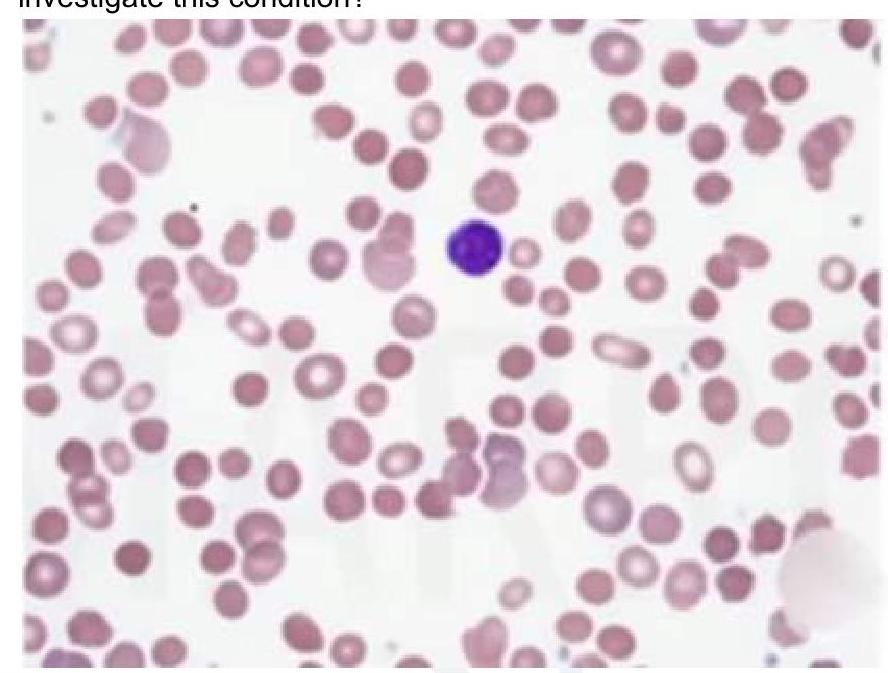
Question 71: A child presents with intermittent jaundice and splenomegaly. There is a history of similar complaints in the elder brother. Peripheral smear shows the following finding. What is the most appropriate investigation for this condition?
- A. Osmotic fragility test (Correct Answer)
- B. Coombs test
- C. G6PD deficiency testing
- D. Flow cytometry for PNH
Explanation: ***Osmotic fragility test*** - The image shows **spherocytes** (dense, small red cells lacking central pallor), a hallmark of **hereditary spherocytosis**. The clinical picture of intermittent jaundice, splenomegaly, and a family history further supports this diagnosis. - The **osmotic fragility test** measures the red blood cell's susceptibility to hemolysis in hypotonic solutions and is the most appropriate test to confirm hereditary spherocytosis. *Coombs test* - The Coombs test (direct antiglobulin test) detects **antibodies on the surface of red blood cells** or in the serum. It is primarily used to diagnose **autoimmune hemolytic anemia**. - Hereditary spherocytosis is a membrane defect, not an immune-mediated condition, so the Coombs test would typically be negative. *G6PD deficiency testing* - **Glucose-6-phosphate dehydrogenase (G6PD) deficiency** leads to episodic hemolytic anemia triggered by oxidative stress (e.g., fava beans, certain drugs, infections). - While it causes episodic hemolysis and jaundice, the peripheral smear typically shows **Heinz bodies** and **bite cells** during hemolytic episodes, not spherocytes, and without specific triggers, it doesn't fit the clinical picture as well as hereditary spherocytosis. *Flow cytometry for PNH* - **Flow cytometry** is used to diagnose **paroxysmal nocturnal hemoglobinuria (PNH)** by detecting the absence of GPI-anchored proteins (e.g., CD55, CD59) on blood cells. - PNH is characterized by dark urine (hemoglobinuria), thrombosis, and bone marrow failure, and its peripheral smear does not typically show spherocytes.
Question 72: A man presents with a history of dysuria and urethral discharge after having unprotected sexual intercourse. What is the treatment of choice for this infection?
- A. Erythromycin
- B. Azithromycin
- C. Ceftriaxone (Correct Answer)
- D. Penicillin G
Explanation: ***Ceftriaxone*** - The combination of **dysuria** and **urethral discharge** following unprotected sexual intercourse is highly suggestive of **gonorrhea**. - **Ceftriaxone** is the recommended first-line treatment for uncomplicated gonococcal infections due to increasing antibiotic resistance. *Erythromycin* - Erythromycin is primarily used for atypical bacterial infections, such as those caused by *Mycoplasma pneumoniae* or *Chlamydia trachomatis*. - While it can be used for chlamydia, it is not the preferred treatment for suspected gonorrhea. *Azithromycin* - Azithromycin is often used in combination with ceftriaxone for gonorrhea to cover potential co-infection with **Chlamydia trachomatis**. - However, **monotherapy with azithromycin is not recommended for gonorrhea** due to concerns about emerging resistance and suboptimal efficacy. *Penicillin G* - Penicillin G was historically used to treat gonorrhea, but this is no longer the case due to widespread **resistance** of *Neisseria gonorrhoeae* strains. - Its primary use now is for susceptible bacterial infections, such as syphilis and certain streptococcal infections.
Pediatrics
2 questionsAn infant presents with hepatosplenomegaly and thrombocytopenia. Neuroimaging with CT shows periventricular calcifications. What is the most likely diagnosis?
Which of the following is the best sign to indicate adequate growth in an infant with a birth weight of 2.8 kg?
NEET-PG 2023 - Pediatrics NEET-PG Practice Questions and MCQs
Question 71: An infant presents with hepatosplenomegaly and thrombocytopenia. Neuroimaging with CT shows periventricular calcifications. What is the most likely diagnosis?
- A. Congenital rubella syndrome
- B. Congenital herpes simplex virus infection
- C. Congenital toxoplasmosis
- D. Congenital cytomegalovirus infection (Correct Answer)
Explanation: ***Congenital cytomegalovirus infection*** - **Periventricular calcifications** on neuroimaging are a classic and highly suggestive finding for congenital CMV infection. - **Hepatosplenomegaly** and **thrombocytopenia** are common systemic manifestations of congenital CMV, which can be severe. *Congenital rubella syndrome* - Rubella typically causes **sensorineural hearing loss**, ocular abnormalities (e.g., cataracts), and congenital heart defects (e.g., patent ductus arteriosus), rather than periventricular calcifications. - While hepatosplenomegaly and thrombocytopenia can occur, the specific brain calcification pattern points away from rubella. *Congenital herpes simplex virus infection* - HSV infection in neonates presents with a variety of symptoms, including skin vesicles, keratoconjunctivitis, and seizures. - Brain imaging often shows **focal necrosis** or **encephalitis**, not typically periventricular calcifications unless it's a very widespread and destructive process. *Congenital toxoplasmosis* - Congenital toxoplasmosis classic triad includes **chorioretinitis**, **hydrocephalus**, and **intracranial calcifications**, but these calcifications are typically scattered or diffuse rather than strictly periventricular. - While hepatosplenomegaly and thrombocytopenia can be present, the specific location of calcifications is a key differentiating factor.
Question 72: Which of the following is the best sign to indicate adequate growth in an infant with a birth weight of 2.8 kg?
- A. Increase in length of 25 centimetres in the first year (Correct Answer)
- B. Weight gain of 300 grams per month till 1 year
- C. Anterior fontanelle closure by 6 months of age
- D. Weight under the 75th percentile and height under the 25th percentile
Explanation: ***Increase in length of 25 centimetres in the first year*** - A **25 cm increase in length during the first year** is a normal and expected growth rate for infants, indicating adequate overall growth and development since overall length growth is a sensitive indicator of good health. - This corresponds to roughly a **50% increase in birth length** (which is typically around 50 cm), demonstrating appropriate linear growth. *Weight gain of 300 grams per month till 1 year* - While weight gain is crucial, an infant typically **gains more than 300 grams per month** in the early months (e.g., 500-1000g/month for the first 3-4 months) and then the rate slows. - This value represents an **average over the entire year** and may not reflect adequate growth during periods of rapid weight gain. *Anterior fontanelle closure by 6 months of age* - The **anterior fontanelle typically closes between 10 to 18 months of age**, with closure as early as 6 months being within the normal range but not the *best* indicator of overall growth. - While fontanelle closure is an important developmental milestone, it is **not a direct measure of growth in length or weight**, which are more indicative of nutritional status. *Weight under the 75th percentile and height under the 25th percentile* - Having weight under the 75th percentile and height under the 25th percentile means the **child is growing disproportionately**, which could suggest a growth problem or underlying health issue. - **Optimal growth** is typically indicated when weight and height measurements fall within a similar percentile range, generally between the 25th and 75th percentiles.
Pharmacology
1 questionsA patient with a malignancy is undergoing chemotherapy. The platelet counts were reduced after the previous cycle of chemotherapy. Which of the following drugs can be used to treat this patient?
NEET-PG 2023 - Pharmacology NEET-PG Practice Questions and MCQs
Question 71: A patient with a malignancy is undergoing chemotherapy. The platelet counts were reduced after the previous cycle of chemotherapy. Which of the following drugs can be used to treat this patient?
- A. Oprelvekin (IL-11) - stimulates platelet production (Correct Answer)
- B. Filgrastim - stimulates white blood cell production
- C. Amifostine - protects against chemotherapy toxicity
- D. Erythropoietin - stimulates red blood cell production
Explanation: ***Oprelvekin (IL-11) - stimulates platelet production*** - **Oprelvekin** is a recombinant interleukin-11 (IL-11) that directly stimulates the proliferation and maturation of **megakaryocytes**, leading to increased platelet production. - It is specifically indicated for the prevention of **severe thrombocytopenia** and the reduction of the need for platelet transfusions following myelosuppressive chemotherapy. *Filgrastim - stimulates white blood cell production* - **Filgrastim** is a **granulocyte colony-stimulating factor (G-CSF)** that primarily acts on neutrophil precursors, promoting their proliferation and maturation. - It is used to prevent and treat **neutropenia** and reduce the incidence of febrile neutropenia, but it does not significantly affect platelet counts. *Amifostine - protects against chemotherapy toxicity* - **Amifostine** is a **cytoprotective agent** that reduces toxicities associated with chemotherapy and radiation by preferentially protecting non-malignant cells. - It does not directly stimulate blood cell production but rather acts as a **free radical scavenger** to mitigate damage from cytotoxic treatments. *Erythropoietin - stimulates red blood cell production* - **Erythropoietin** is a **hematopoietic growth factor** that specifically stimulates the production of **red blood cells** by promoting the proliferation and differentiation of erythroid progenitor cells. - It is used to treat **anemia**, particularly in patients with chronic kidney disease or those undergoing chemotherapy, but it has no role in managing thrombocytopenia.
Surgery
2 questionsA patient was brought to the ER following a road traffic accident. On examination, the patient opens his eyes to a painful stimulus, speaks inappropriately, and withdraws his limbs to a painful stimulus. What is his GCS score?
A diabetic patient presents with sudden-onset perineal pain. On examination, foul-smelling discharge and necrotic tissue are noted. Which of the following is the most characteristic feature of this condition?
NEET-PG 2023 - Surgery NEET-PG Practice Questions and MCQs
Question 71: A patient was brought to the ER following a road traffic accident. On examination, the patient opens his eyes to a painful stimulus, speaks inappropriately, and withdraws his limbs to a painful stimulus. What is his GCS score?
- A. E2V2M3
- B. E3V3M3
- C. E3V2M2
- D. E2V3M4 (Correct Answer)
Explanation: ***E2V3M4*** - Eye opening to **painful stimulus** scores 2 (E2). - Inappropriate speech scores 3 (V3). - Withdrawal from pain scores 4 (M4). *E2V2M3* - This option incorrectly assesses the **verbal response** and **motor response**. - Speaking incomprehensibly scores V2, while here the patient speaks inappropriately (V3). - Flexion to pain scores M3, but the patient exhibits withdrawal from pain (M4). *E3V3M3* - This option incorrectly assesses the **eye opening response**. - Eye opening to verbal command scores E3, but here the patient opens eyes to painful stimulus (E2). - The motor response is also incorrect, as M3 is flexion to pain, not withdrawal from pain (M4). *E3V2M2* - This option incorrectly assesses all three components of the **GCS score**. - A patient who opens eyes to a painful stimulus would score E2, not E3 (eyes opening to verbal command). - Both verbal (V3 for inappropriate speech, not V2 for incomprehensible sounds) and motor responses (M4 for withdrawal from pain, not M2 for extension to pain) are incorrectly scored.
Question 72: A diabetic patient presents with sudden-onset perineal pain. On examination, foul-smelling discharge and necrotic tissue are noted. Which of the following is the most characteristic feature of this condition?
- A. Mixed aerobic and anaerobic infection (Correct Answer)
- B. Urinary diversion may be considered in severe cases
- C. Bilateral orchidectomy is not routinely required
- D. Anti-gas gangrene serum is indicated only in specific cases
Explanation: **Mixed aerobic and anaerobic infection** - Fournier's gangrene is a polymicrobial infection typically involving a **synergistic mixture of aerobic and anaerobic bacteria**. - This mixed infection contributes to the rapid progression and tissue destruction seen in this condition, leading to the **foul-smelling discharge** due to anaerobic metabolism. *Anti-gas gangrene serum is indicated only in specific cases.* - Anti-gas gangrene serum is specifically for **Clostridium perfringens** infections, which can cause gas gangrene but is usually a distinct clinical entity from Fournier's. - While Clostridium species can be present in Fournier's gangrene, it is not the sole causative agent, and **broader antimicrobial therapy** is the mainstay of treatment, not antitoxin serum. *Urinary diversion may be considered in severe cases.* - Urinary diversion, such as a **suprapubic catheter**, may be necessary when the urethra or perineum is extensively involved or to prevent ongoing contamination of the surgical site. - However, it's not a primary treatment for the infection itself but rather an **adjunctive measure** to manage complicated cases of Fournier's gangrene. *Bilateral orchidectomy is not routinely required.* - **Testicular involvement** in Fournier's gangrene is rare due to the separate blood supply of the testes. - **Orchidectomy** is only performed if the testes themselves are affected by necrosis, which is uncommon and occurs in critically severe cases; routine removal is not indicated.