Anatomy
2 questionsDuring acute tonsillitis, referred pain from the tonsil to the middle ear occurs via which nerve?
Which of the following is true about nerve injuries?
NEET-PG 2023 - Anatomy NEET-PG Practice Questions and MCQs
Question 121: During acute tonsillitis, referred pain from the tonsil to the middle ear occurs via which nerve?
- A. Facial nerve
- B. Glossopharyngeal nerve (Correct Answer)
- C. Trigeminal nerve
- D. Vagus nerve
Explanation: ***Glossopharyngeal nerve*** - The **glossopharyngeal nerve (CN IX)** provides sensory innervation to the palatine tonsil via its tonsillar branches - CN IX also supplies the middle ear via the **tympanic nerve (Jacobson's nerve)**, which forms the tympanic plexus - This shared sensory pathway explains **referred otalgia** (ear pain) during acute tonsillitis - Inflammation of the tonsil stimulates CN IX, and the brain misinterprets this as pain from the middle ear *Facial nerve* - The **facial nerve (CN VII)** primarily provides motor innervation to muscles of facial expression and taste to the anterior two-thirds of the tongue - While it has a small sensory component (nervus intermedius) for the external auditory canal, it does not innervate the tonsil - Cannot serve as the pathway for referred pain from tonsil to middle ear *Trigeminal nerve* - The **trigeminal nerve (CN V)** provides sensory innervation to the face, anterior scalp, and oral cavity - Does not innervate the palatine tonsil or the middle ear cavity - Not involved in tonsillar referred otalgia *Vagus nerve* - The **vagus nerve (CN X)** provides sensory innervation to parts of the pharynx, larynx, and external auditory canal (via Arnold's nerve) - While it contributes to pharyngeal sensation, the **glossopharyngeal nerve is the primary pathway** for referred otalgia from tonsillar inflammation due to its direct innervation of both the tonsil and middle ear
Question 122: Which of the following is true about nerve injuries?
- A. Froment sign seen in median nerve palsy is due to Flexor pollicis longus action
- B. All lumbricals are supplied by median nerve
- C. Waenburg sign is seen in median nerve palsy
- D. Median nerve is also named as labourer's nerve (Correct Answer)
Explanation: ***Median nerve is also named as labourer's nerve*** - The median nerve is sometimes called the "laborer's nerve" because it innervates many of the muscles essential for **fine motor control** and **dexterous hand movements** predominantly used in manual labor. [1] - It supplies most of the **flexors in the forearm** and several intrinsic hand muscles, making it crucial for a strong grip and coordinated hand actions. [1] *Froment sign seen in median nerve palsy is due to Flexor pollicis longus action* - **Froment's sign** is observed in **ulnar nerve palsy**, not median nerve palsy. - It occurs when the adductor pollicis is weak, and the **flexor pollicis longus** (median nerve-innervated) compensates by hyperflexing the interphalangeal joint of the thumb to grasp an object. *All lumbricals are supplied by median nerve* - The **first two lumbricals** (from the radial side) are typically supplied by the **median nerve**. [1] - The **third and fourth lumbricals** (from the ulnar side) are supplied by the **ulnar nerve**. [1] *Waenburg sign is seen in median nerve palsy* - There is no widely recognized clinical sign called "Waenburg sign" associated with median nerve palsy. - Common signs of **median nerve palsy** include **ape hand deformity**, **hand of benediction**, and sensory loss in the radial three and a half digits. [1]
Internal Medicine
3 questionsA 29-year-old patient presents with focal seizures. MRI shows frontal and temporal enhancement. What is the most probable diagnosis?
When resuscitating a patient in shock which of the following is not an adequate parameter to predict end point of resuscitation?
All the following nerves are involved in entrapment neuropathy except -
NEET-PG 2023 - Internal Medicine NEET-PG Practice Questions and MCQs
Question 121: A 29-year-old patient presents with focal seizures. MRI shows frontal and temporal enhancement. What is the most probable diagnosis?
- A. Herpes simplex encephalitis (Correct Answer)
- B. Enterovirus encephalitis
- C. Japanese encephalitis
- D. Meningococcal meningitis
Explanation: ***Herpes simplex encephalitis*** - **Herpes simplex encephalitis (HSE)** characteristically causes inflammation and damage in the **frontal** and **temporal lobes**, leading to focal neurological deficits and seizures [1]. - MRI findings of **enhancement** in these specific brain regions are highly suggestive of HSE. *Enterovirus encephalitis* - **Enterovirus encephalitis** typically affects a broader range of brain regions and less commonly presents with the focal frontal and temporal enhancement seen in HSE. - While it can cause seizures, the MRI findings are not as specific for this diagnosis. *Japanese encephalitis* - **Japanese encephalitis** is geographically restricted to parts of Asia and is transmitted by mosquitoes. The clinical presentation typically includes diffuse encephalitic symptoms rather than focal frontal/temporal involvement and enhancement on MRI. - This diagnosis would be unlikely without a relevant travel history and exposure. *Meningococcal meningitis* - **Meningococcal meningitis** is an infection of the **meninges**, the membranes surrounding the brain and spinal cord, not primarily the brain tissue itself. - MRI would typically show inflammation and enhancement of the meninges, rather than focal parenchymal (brain tissue) enhancement in the frontal and temporal lobes.
Question 122: When resuscitating a patient in shock which of the following is not an adequate parameter to predict end point of resuscitation?
- A. Mixed venous oxygen saturation
- B. Base deficit
- C. Lactate
- D. Blood pressure (Correct Answer)
Explanation: ***Blood pressure*** - While essential for initial assessment and guiding treatment, **blood pressure** can be maintained within normal limits even in significant shock states due to compensatory mechanisms [1]. - Blood pressure alone does not reflect **tissue perfusion** or cellular oxygenation, which are the true endpoints of resuscitation [1]. *Mixed venous oxygen saturation* - **Mixed venous oxygen saturation (SvO2)** reflects the balance between oxygen delivery and consumption, providing insight into global tissue oxygenation. - A low SvO2 indicates inadequate oxygen delivery relative to demand, making it a valuable target for guiding resuscitation. *Base deficit* - **Base deficit** is a measure of metabolic acidosis and reflects the severity of tissue hypoperfusion and anaerobic metabolism. - Normalization of base deficit indicates correction of metabolic derangements and improved tissue perfusion. *Lactate* - **Lactate** is a product of anaerobic metabolism, which occurs when tissues are not adequately perfused or oxygenated. - Elevated lactate levels indicate tissue hypoperfusion, and serial measurements are crucial for monitoring the effectiveness of resuscitation and predicting outcomes.
Question 123: All the following nerves are involved in entrapment neuropathy except -
- A. Median nerve
- B. Femoral nerve (Correct Answer)
- C. Ulnar nerve
- D. Lateral cutaneous nerve of thigh
Explanation: ***Femoral nerve*** - While the femoral nerve can be injured, it is **uncommonly involved** in entrapment neuropathy compared to other nerves. - Entrapment of the femoral nerve is rare and typically occurs in the **pelvis** or **inguinal region**, often due to trauma or mass effect. *Median nerve* - The median nerve is classically involved in **carpal tunnel syndrome**, where it is compressed at the wrist [1], [2]. - Symptoms include pain, numbness, and tingling in the thumb, index, middle, and radial half of the ring finger [1]. *Ulnar nerve* - The ulnar nerve is commonly entrapped at the **cubital tunnel** (elbow) or the **Guyon's canal** (wrist) [1]. - This leads to symptoms such as numbness and weakness in the small finger and ulnar half of the ring finger [1]. *Lateral cutaneous nerve of thigh* - This nerve is frequently entrapped as it passes under the **inguinal ligament**, causing **meralgia paresthetica**. - Symptoms include burning pain and numbness on the lateral aspect of the thigh.
Microbiology
1 questionsAll of the following cause Fournier's gangrene except:
NEET-PG 2023 - Microbiology NEET-PG Practice Questions and MCQs
Question 121: All of the following cause Fournier's gangrene except:
- A. Bacteroides
- B. Clostridium (Correct Answer)
- C. Streptococcus
- D. Staphylococcus
Explanation: ***Clostridium*** - While *Clostridium* species (especially *C. perfringens*) **CAN be isolated** from Fournier's gangrene cases and contribute to gas formation and tissue necrosis, they are **less commonly identified as primary pathogens** compared to other organisms. - In the context of this question, *Clostridium* is considered the "except" option because it is **relatively less frequently implicated** in Fournier's gangrene compared to the other listed organisms, though it is NOT entirely excluded from the microbiology of this condition. - *Clostridium* species are more classically associated with **gas gangrene (clostridial myonecrosis)** in traumatic wounds and deep muscle tissue. *Bacteroides* - ***Bacteroides fragilis*** and other **anaerobic gram-negative bacilli** are among the **most commonly isolated organisms** in Fournier's gangrene. - They produce enzymes that facilitate tissue destruction and contribute significantly to the **polymicrobial synergistic necrotizing infection**. - Essential component of the typical microbial flora in perianal and genital infections. *Streptococcus* - ***Streptococcus pyogenes*** (Group A Streptococcus) and other streptococcal species are **frequently isolated** from Fournier's gangrene. - They produce toxins and enzymes causing **rapid necrotizing fasciitis** with systemic toxicity. - Major contributor to the aggressive nature and rapid progression of the infection. *Staphylococcus* - ***Staphylococcus aureus*** (including MRSA) is **commonly found** in polymicrobial Fournier's gangrene infections. - Contributes to local tissue destruction through toxin production and enzyme activity. - Often isolated from perianal and genital skin flora, facilitating its involvement in these infections.
Orthopaedics
2 questionsA swelling behind the ear suggests fracture of:
A child 10 yrs of age presents with a mass on his left thigh. The mass seems to be arising from the diaphysis of the femur and involving the soft tissue of the thigh. The child is having fever also. Give your most probable diagnosis -
NEET-PG 2023 - Orthopaedics NEET-PG Practice Questions and MCQs
Question 121: A swelling behind the ear suggests fracture of:
- A. Zygomatic complex
- B. Temporal bone
- C. Condylar fracture (Correct Answer)
- D. Orbital floor fracture
Explanation: ***Condylar fracture*** - A swelling behind the ear (known as the **Battle sign** if associated with ecchymosis) is a classic indicator of a **basilar skull fracture**, which often involves the temporal bone but can also be seen with severe condylar fractures affecting the base of the skull or mastoid area. - While a direct condylar fracture itself doesn't cause swelling *behind* the ear, **indirect condylar fractures** or those with significant associated trauma could compromise nearby structures leading to such a presentation. *Zygomatic complex* - Fractures of the **zygomatic complex** typically cause swelling, ecchymosis, and pain around the **cheekbone** and orbit, not specifically behind the ear. - These fractures can also lead to limited jaw movement due to impingement on the coronoid process, or orbital symptoms like **diplopia**. *Temporal bone* - A **temporal bone fracture** can indeed cause swelling and ecchymosis behind the ear (**Battle sign**). - However, direct temporal bone fractures are more commonly associated with **otorrhea**, **hemotympanum**, facial nerve palsy, or hearing loss. *Orbital floor fracture* - **Orbital floor fractures** are characterized by periorbital swelling, ecchymosis, **diplopia** (especially on upward gaze), and sometimes **enophthalmos** (sunken eye). - These signs are localized to the **eye region** and do not typically involve swelling behind the ear.
Question 122: A child 10 yrs of age presents with a mass on his left thigh. The mass seems to be arising from the diaphysis of the femur and involving the soft tissue of the thigh. The child is having fever also. Give your most probable diagnosis -
- A. Osteosarcoma
- B. Chondrosarcoma
- C. Ewing's sarcoma (Correct Answer)
- D. Malignant fibrous histiocytoma
Explanation: ***Ewing's sarcoma*** - **Ewing's sarcoma** commonly presents in children and adolescents, often involving the **diaphysis of long bones** like the femur. - The presence of a **soft tissue mass** and **fever** are characteristic systemic symptoms due to its aggressive nature and rapid growth. *Osteosarcoma* - While it is a common pediatric bone tumor, **osteosarcoma** typically arises in the **metaphysis** of long bones, not the diaphysis. - Systemic symptoms like fever are less common at presentation compared to Ewing's sarcoma unless there's significant metastatic disease. *Chondrosarcoma* - **Chondrosarcoma** is a malignant tumor of cartilage that usually affects older adults and rarely occurs in children. - It typically affects the **pelvis, shoulder, or long bones**, but a fever and involvement of the soft tissue with a diaphyseal origin are less classic presentation. *Malignant fibrous histiocytoma* - **Malignant fibrous histiocytoma** (now often termed undifferentiated pleomorphic sarcoma) is a tumor of adulthood, primarily affecting individuals over 40 years of age. - While it can involve deep soft tissues and bone, it is an extremely rare diagnosis in a 10-year-old child.
Pediatrics
1 questionsA 2 year child presented with low grade fever and stridor. What is the likely diagnosis?
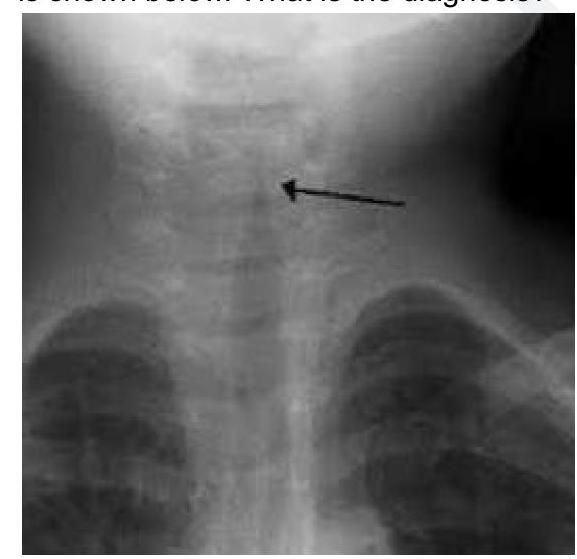
NEET-PG 2023 - Pediatrics NEET-PG Practice Questions and MCQs
Question 121: A 2 year child presented with low grade fever and stridor. What is the likely diagnosis?
- A. Acute Laryngotracheobronchitis (Correct Answer)
- B. Acute Bacterial Tracheitis
- C. Acute Epiglottitis
- D. Foreign Body aspiration
Explanation: ***Acute Laryngotracheobronchitis*** - The combination of **low-grade fever** and **stridor** in a 2-year-old child strongly suggests **croup**, which is medically known as acute laryngotracheobronchitis. - Croup is characterized by **inflammation** of the larynx, trachea, and bronchi, often presenting with a **barking cough** and inspiratory stridor. The X-ray image would show the characteristic **steeple sign**. *Acute Bacterial Tracheitis* - This is a more severe bacterial infection that can present with stridor but typically shows **higher fever**, **toxic appearance**, and rapid clinical deterioration. - Unlike croup, bacterial tracheitis patients appear **more ill** and may have **purulent secretions** requiring more aggressive management. *Acute Epiglottitis* - A serious condition characterized by **rapid onset of high fever**, **dysphagia**, drooling, and a **"tripod" position**, which are not indicated by the given symptoms. - The stridor in epiglottitis is typically quieter and may indicate more severe airway obstruction compared to the characteristic stridor of croup. *Foreign Body aspiration* - While foreign body aspiration can cause stridor, it is typically an **acute event** with a sudden onset of choking, coughing, and respiratory distress. - There is no mention of a choking episode or sudden onset, and a low-grade fever is less typical for an uncomplicated foreign body aspiration.
Surgery
1 questionsA patient presents with a gradually progressive, painless mass persisting for 10 years. The mass is firm to nodular and shows variable consistency within different areas of the swelling. What is the most probable diagnosis?
NEET-PG 2023 - Surgery NEET-PG Practice Questions and MCQs
Question 121: A patient presents with a gradually progressive, painless mass persisting for 10 years. The mass is firm to nodular and shows variable consistency within different areas of the swelling. What is the most probable diagnosis?
- A. Dermoid cyst
- B. Malignancy
- C. Sebaceous cyst
- D. Pleomorphic adenoma (Correct Answer)
Explanation: ***Pleomorphic adenoma*** - A **gradually progressive**, **painless mass** that has been present for 10 years, with a **firm to nodular** consistency and variability at different sites, is highly characteristic of a pleomorphic adenoma. - This benign tumor of salivary glands is known for its **slow growth** and **variable histological composition**, leading to its characteristic consistency. *Dermoid cyst* - Dermoid cysts are typically **present from birth** or early childhood and tend to be **soft and doughy** in consistency, rather than firm or nodular with variable consistency. - While painless, their growth pattern and texture differ from the described mass. *Malignancy* - A mass that has been present for **10 years** and is still described as **gradually progressive** but painless is less likely to be a malignancy, as most malignant tumors tend to grow more rapidly and often present with pain or other symptoms over such a long period. - Malignancies usually demonstrate a more infiltrative and aggressive growth pattern. *Sebaceous cyst* - A sebaceous cyst (epidermoid cyst) typically presents as a **smooth, movable, dome-shaped lump** and contains a cheesy, malodorous material, which is not consistent with a firm to nodular mass with varying consistency. - While they can be long-standing and painless, their characteristic feel and contents are different.