Biochemistry
1 questionsA farmer complains of a skin rash that worsens with sun exposure and redness of the tongue. Maize is the staple in his diet. Which vitamin deficiency is likely responsible for these symptoms?
NEET-PG 2021 - Biochemistry NEET-PG Practice Questions and MCQs
Question 51: A farmer complains of a skin rash that worsens with sun exposure and redness of the tongue. Maize is the staple in his diet. Which vitamin deficiency is likely responsible for these symptoms?
- A. Vitamin C deficiency
- B. Vitamin K deficiency
- C. Niacin deficiency (Correct Answer)
- D. Folic acid deficiency
- E. Riboflavin deficiency
Explanation: ***Niacin deficiency*** - The symptoms described (dermatitis that worsens with sun exposure, glossitis, and a diet high in maize) are characteristic of **pellagra**, which is caused by a **niacin (Vitamin B3) deficiency**. - **Maize** is a poor source of niacin, and the niacin it contains is largely bound and unavailable, leading to higher rates of deficiency in populations relying on it as a staple. - The classic **3 D's of pellagra** are: **Dermatitis** (photosensitive), **Diarrhea**, and **Dementia**. *Riboflavin deficiency* - **Riboflavin (Vitamin B2) deficiency** causes **angular stomatitis**, **cheilosis**, and **glossitis**, but the dermatitis is typically **seborrheic** (not photosensitive). - The **photosensitive** nature of the rash in this case is the key differentiating feature pointing to niacin deficiency. *Vitamin C deficiency* - **Vitamin C deficiency** leads to **scurvy**, characterized by **gingival bleeding**, **poor wound healing**, and **petechiae**, none of which are mentioned here. - While it can manifest with fatigue, it does not typically cause a photosensitive rash or glossitis as described. *Vitamin K deficiency* - **Vitamin K deficiency** primarily affects **blood clotting**, leading to **bleeding disorders** and **easy bruising**. - It is not associated with skin rashes or glossitis. *Folic acid deficiency* - **Folic acid deficiency** causes **macrocytic anemia**, fatigue, and potentially **glossitis**, but it does not cause a photosensitive rash. - The distinctive combination of photosensitive dermatitis and glossitis points away from folic acid deficiency.
Community Medicine
3 questionsThere is an outbreak of buboes in a community. What is the vector responsible for transmitting the causative agent?
Which of the following is not included in the Global Hunger Index?
In a 10-year-old school child under the school health program, which vaccine should be administered?
NEET-PG 2021 - Community Medicine NEET-PG Practice Questions and MCQs
Question 51: There is an outbreak of buboes in a community. What is the vector responsible for transmitting the causative agent?
- A. Human flea
- B. Sand fly
- C. Xenopsylla [Rat Flea] (Correct Answer)
- D. Tsetse fly
Explanation: ***Xenopsylla [Rat Flea]*** - The presence of **buboes** is characteristic of the **bubonic plague**, caused by *Yersinia pestis*. - *Xenopsylla cheopis*, the **rat flea**, is the primary **vector** responsible for transmitting *Yersinia pestis* from rodents to humans. *Human flea* - While human fleas (*Pulex irritans*) can bite humans, they are not the primary or most efficient vector for transmitting **bubonic plague**. - Their role in widespread outbreaks is generally considered minor compared to the **rat flea**. *Sand fly* - **Sand flies** are vectors for diseases such as **leishmaniasis** and **sandfly fever**. - They are not associated with the transmission of **bubonic plague** or the formation of **buboes**. *Tsetse fly* - The **tsetse fly** is the vector for **African trypanosomiasis** (sleeping sickness). - This disease presents with fevers, headaches, and neurological symptoms, not **buboes**.
Question 52: Which of the following is not included in the Global Hunger Index?
- A. Undernourishment
- B. Under 5 mortality rate
- C. Child undernutrition
- D. Infant Mortality Rate (IMR) (Correct Answer)
Explanation: ***Infant Mortality Rate (IMR)*** - The **Infant Mortality Rate (IMR)** measures deaths of infants under one year of age and is an indicator of overall community health and access to medical care, but it is **not directly included** in the GHI calculation. - While related to health and well-being, the GHI focuses on direct measures of **food insecurity** and its immediate consequences on children. *Undernourishment* - **Undernourishment**, defined as the proportion of the population that is consuming insufficient caloric energy, is a **direct component** of the GHI. - It reflects the overall **food supply** and access at the population level. *Under 5 mortality rate* - The **Under-5 Mortality Rate** (child mortality) is a key indicator in the GHI, reflecting the fatal consequences of a combination of **inadequate nutrition** and unhealthy environments. - It captures deaths of children before their fifth birthday, which can be heavily influenced by **nutritional status**. *Child undernutrition* - **Child undernutrition** is represented in the GHI by two indicators: **child stunting** (low height for age) and **child wasting** (low weight for height). - These are crucial measures reflecting **chronic** and **acute undernutrition** in children, respectively.
Question 53: In a 10-year-old school child under the school health program, which vaccine should be administered?
- A. DPT
- B. BCG
- C. Td (Correct Answer)
- D. MMR
Explanation: ***Td (Tetanus-Diphtheria)*** - For a 10-year-old child under the school health program in India, the recommended vaccination is a booster dose of **Td (tetanus-diphtheria)**. - This ensures continued **protection against tetanus and diphtheria**, as immunity from the primary series may wane over time. - **Td is preferred over TT** (tetanus toxoid alone) as it provides protection against both tetanus and diphtheria. - This is administered at **10 years and 16 years** as per the Indian Academy of Pediatrics immunization schedule. *DPT* - **DPT (diphtheria, pertussis, tetanus)** is administered in infancy and early childhood (at 6, 10, and 14 weeks, with boosters at 16-24 months and 4-6 years). - The **pertussis component is not given** in later childhood or adolescence due to increased reactogenicity in older children. *BCG* - **BCG (Bacille Calmette-Guérin)** vaccine protects against tuberculosis and is given **at birth** in endemic areas like India. - It is **not routinely administered** to a 10-year-old unless there are specific risk factors or documented non-vaccination status. *MMR* - **MMR (measles, mumps, rubella)** vaccine is given as **two doses**: first at 9-12 months and second at 16-24 months (or 4-6 years). - A 10-year-old child would have **already completed** their MMR vaccination schedule.
Internal Medicine
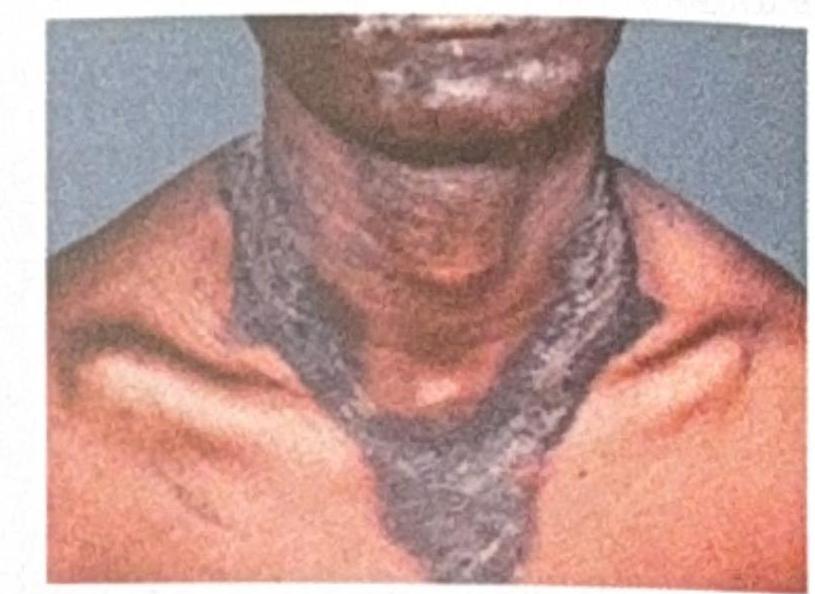
1 questionsA 45-year-old man presents with the following skin changes (as shown in the image). What relevant history should be taken to diagnose this condition?
NEET-PG 2021 - Internal Medicine NEET-PG Practice Questions and MCQs
Question 51: A 45-year-old man presents with the following skin changes (as shown in the image). What relevant history should be taken to diagnose this condition?
- A. Dementia
- B. History of dietary pattern, dementia, and diarrhea (Correct Answer)
- C. Dietary history
- D. Depression
Explanation: ***History of dietary pattern, dementia, and diarrhea*** - The image displays skin changes consistent with a "Casal's necklace" pattern, characteristic of **pellagra**, a disease caused by **niacin (Vitamin B3) deficiency**. - Pellagra is classically associated with the "3 Ds": **dermatitis** (the observed skin changes), **diarrhea**, and **dementia**. A comprehensive history should therefore include questions about dietary patterns (especially corn-based diets lacking tryptophan and niacin), gastrointestinal symptoms like diarrhea, and neurological/psychiatric symptoms indicative of dementia. *Dementia* - While **dementia** is one of the classic "3 Ds" of pellagra (niacin deficiency), it is only one component of the presentation and insufficient on its own to guide a complete diagnostic history for this condition. - Focusing solely on dementia would miss crucial aspects like dietary intake and gastrointestinal symptoms that are integral to diagnosing pellagra. *Dietary history* - A **dietary history** is indeed very relevant for diagnosing pellagra, as it helps identify potential niacin deficiency, commonly associated with diets heavily reliant on corn without proper preparation. - However, pellagra is not only characterized by dermatological signs and dietary insufficiency but also by gastrointestinal and neurological symptoms. Limiting the history to diet alone would therefore be incomplete. *Depression* - **Depression** can be a symptom of various nutritional deficiencies and other medical conditions, but it is not one of the classic "3 Ds" of pellagra, which are dermatitis, diarrhea, and dementia. - While mood changes might be present in some patients with niacin deficiency, focusing solely on depression would not encompass the full clinical picture of pellagra and could lead to misdiagnosis.
Microbiology
1 questionsA child presented with bluish-white spots in the mouth followed by a rash. What is the genome of the most likely causative agent?
NEET-PG 2021 - Microbiology NEET-PG Practice Questions and MCQs
Question 51: A child presented with bluish-white spots in the mouth followed by a rash. What is the genome of the most likely causative agent?
- A. Enveloped virus with single-stranded RNA (Correct Answer)
- B. Double stranded Naked RNA
- C. Naked virus with single-stranded RNA
- D. Double stranded Enveloped RNA
Explanation: ***Enveloped virus with single-stranded RNA*** - Bluish-white spots in the mouth (**Koplik spots**) followed by a rash are pathognomonic for **measles**, which is caused by the **measles virus**. - The measles virus is a **paramyxovirus**, characterized as an **enveloped, negative-sense, single-stranded RNA virus**. *Double stranded Naked RNA* - No major human pathogen belongs to this specific genomic and structural classification. - Most **dsRNA viruses** like **rotavirus** are **naked** but cause gastroenteritis, not measles. *Naked virus with single-stranded RNA* - Viruses like **rhinovirus** (common cold) or **poliovirus** fit this description but do not cause Koplik spots or measles. - **Naked viruses** lack a lipid envelope, making them generally more resistant to environmental factors. *Double stranded Enveloped RNA* - There are no known medically significant human viruses that are both **enveloped** and contain **double-stranded RNA**. - Viral genomes are typically either DNA or RNA, and RNA viruses are usually single-stranded (positive or negative sense) or double-stranded, with or without an envelope.
Patient Safety
1 questionsAn 11-year-old girl is experiencing symptoms of fever and sore throat, and a throat swab was taken for culture. After the culture, which bag should be used to discard the swab?
NEET-PG 2021 - Patient Safety NEET-PG Practice Questions and MCQs
Question 51: An 11-year-old girl is experiencing symptoms of fever and sore throat, and a throat swab was taken for culture. After the culture, which bag should be used to discard the swab?
- A. Blue bag
- B. Red bag (Correct Answer)
- C. White bag
- D. Yellow bag
- E. Black bag
Explanation: ***Red bag*** - This bag is designated for disposal of **infectious medical waste**, including items contaminated with blood, body fluids, or cultures. - The throat swab, potentially containing pathogenic microorganisms, falls under this category of **biohazardous waste**. *Blue bag* - This bag is typically used for **reusable linen** or certain types of **non-infectious waste** in healthcare settings. - It is not appropriate for discarding items that have been in contact with patient samples, like a throat swab. *White bag* - White bags are generally used for **general waste** or **non-hazardous office waste**, which is not infectious. - A throat swab from a patient with a suspected infection is considered hazardous and infectious, making a white bag unsuitable. *Yellow bag* - Yellow bags are used for the disposal of **clinical waste** such as anatomical/pathological waste, pharmaceutical waste, or items requiring incineration. - While some infectious waste may go in yellow bags, the red bag is more specifically designated for contaminated infectious waste like used swabs. *Black bag* - Black bags are used for **general non-hazardous waste** that does not pose any infectious or chemical risk. - A used throat swab from a patient with suspected infection is biohazardous and must not be disposed of in a black bag.
Pediatrics
3 questionsA 16-month-old child weighing 8 kg is assessed using a growth chart. The child's weight falls between the median (standard) and minus 2 standard deviations ( -2 SD ). What should be the next step in the management of this child?
An anganwadi teacher measures the weight and height of a 4-year-old child and finds that the child's height-for-age is below the normal percentile. What does this finding indicate?
A girl child has had recurrent yeast and respiratory viral infections since she was 3 months old. Considering studies for her immune status, which of the following vaccines is contraindicated?
NEET-PG 2021 - Pediatrics NEET-PG Practice Questions and MCQs
Question 51: A 16-month-old child weighing 8 kg is assessed using a growth chart. The child's weight falls between the median (standard) and minus 2 standard deviations ( -2 SD ). What should be the next step in the management of this child?
- A. Identify mild malnutrition and initiate homebased nutritional support.
- B. Recognize moderate malnutrition and provide feeding education to the mother.
- C. Reassure the mother that the child is within normal nutritional status. (Correct Answer)
- D. Diagnose severe malnutrition and refer to a Nutritional Rehabilitation center
- E. Initiate therapeutic feeding with ready-to-use therapeutic food (RUTF).
Explanation: ***Reassure the mother that the child is within normal nutritional status.*** - According to WHO growth standards, a child's weight between the **median and -2 SD** falls within the **normal range**. - Weight-for-age between +2 SD and -2 SD is considered **normal nutritional status**. - The appropriate management is to **reassure the parents**, provide anticipatory guidance on nutrition, and continue **routine growth monitoring**. - No specific nutritional intervention is required unless there are other clinical concerns. *Identify mild malnutrition and initiate home-based nutritional support.* - **Mild malnutrition (underweight)** is defined as weight-for-age between **-2 SD and -3 SD**, not between median and -2 SD. - This child's weight is **above -2 SD**, placing them in the normal range, so this intervention is not indicated. *Recognize moderate malnutrition and provide feeding education to the mother.* - **Moderate malnutrition** is indicated when a child's weight falls between **-2 SD and -3 SD**. - This child's weight is **above -2 SD** and therefore does not meet criteria for moderate malnutrition. *Diagnose severe malnutrition and refer to a Nutritional Rehabilitation center.* - **Severe acute malnutrition (SAM)** is diagnosed when weight-for-height is **below -3 SD**, or when there is visible severe wasting or bilateral pitting edema. - This child's weight is well above the threshold for severe malnutrition. *Initiate therapeutic feeding with ready-to-use therapeutic food (RUTF).* - **RUTF** is reserved for children with **severe acute malnutrition** requiring therapeutic nutritional rehabilitation. - This child has normal nutritional status and does not require therapeutic feeding products.
Question 52: An anganwadi teacher measures the weight and height of a 4-year-old child and finds that the child's height-for-age is below the normal percentile. What does this finding indicate?
- A. No malnutrition
- B. Acute malnutrition
- C. Chronic malnutrition (Correct Answer)
- D. Recent malnutrition
- E. Acute and chronic malnutrition
Explanation: ***Chronic malnutrition*** - **Height-for-age** is an indicator used to assess **long-term nutritional status**, meaning a deficit suggests chronic nutritional problems. - A child with low height-for-age is considered **stunted**, which is a hallmark of chronic malnutrition resulting from prolonged inadequate nutrient intake. - Since the question only mentions **height-for-age being low** without mentioning weight-for-height, this indicates **chronic malnutrition alone** (stunting). *No malnutrition* - A finding of **height below the normal percentile** is a direct indicator of poor growth, which contradicts the concept of no malnutrition. - This measurement tool is specifically designed to identify nutritional deficiencies. *Acute malnutrition* - **Acute malnutrition** is typically assessed using **weight-for-height** or **mid-upper arm circumference (MUAC)**, indicating recent and rapid weight loss. - A child with acute malnutrition is often referred to as **wasted**, which is different from being stunted. *Recent malnutrition* - While all malnutrition has a "recent" onset at some point, **height-for-age** reflects a cumulative effect over time, not just recent deprivation. - For assessing recent nutritional issues, **weight-for-height** or **weight-for-age** would be more appropriate indicators. *Acute and chronic malnutrition* - This condition (also called **wasted and stunted**) occurs when a child has both **low weight-for-height** (acute/wasting) AND **low height-for-age** (chronic/stunting). - The question states only that **height-for-age is below normal**, with no mention of weight-for-height status, so we cannot diagnose acute malnutrition component. - This would require assessment of both anthropometric indicators.
Question 53: A girl child has had recurrent yeast and respiratory viral infections since she was 3 months old. Considering studies for her immune status, which of the following vaccines is contraindicated?
- A. Killed IPV (Inactivated Poliovirus Vaccine)
- B. DPT (Diphtheria, Pertussis, Tetanus)
- C. TT/Td (Tetanus toxoid)
- D. Measles/MMR (Correct Answer)
- E. Hepatitis B vaccine
Explanation: ***Measles/MMR*** - This patient's history of **recurrent yeast and respiratory viral infections** suggests a potential **immunodeficiency**, which is a contraindication for **live attenuated vaccines** like MMR (Measles, Mumps, Rubella). - Administering live attenuated vaccines to immunocompromised individuals can lead to **uncontrolled replication of the vaccine virus**, causing severe disease. *Killed IPV (Inactivated Poliovirus Vaccine)* - **Inactivated vaccines** do not contain live viruses and are generally safe for immunocompromised individuals. - The patient's underlying immune status does not contraindicate killed vaccines, as there is **no risk of vaccine-induced infection**. *DPT (Diphtheria, Pertussis, Tetanus)* - DPT is a **non-live vaccine** (consisting of toxoids and inactivated bacterial components), making it safe for individuals with immunodeficiency. - These vaccines do not pose a risk of causing the disease in immunocompromised patients, even if their **immune response is suboptimal**. *TT/Td (Tetanus toxoid)* - Tetanus toxoid vaccines are **inactivated vaccines** and are therefore safe for individuals with impaired immune function. - The concern with immunodeficiency is the **ability to mount an effective immune response**, not the safety of the vaccine itself. *Hepatitis B vaccine* - Hepatitis B is a **recombinant inactivated vaccine** that is safe for immunocompromised patients. - While the vaccine may have **reduced immunogenicity** in this population, it is not contraindicated and does not pose a risk of vaccine-induced disease.