Community Medicine
1 questionsAfter the admission of a road traffic accident (RTA) case, there is a spillage of blood on the hospital floor. Which disinfectant should be used to clean the floor?
NEET-PG 2021 - Community Medicine NEET-PG Practice Questions and MCQs
Question 41: After the admission of a road traffic accident (RTA) case, there is a spillage of blood on the hospital floor. Which disinfectant should be used to clean the floor?
- A. Formaldehyde
- B. Chlorhexidine
- C. Ethyl alcohol
- D. Sodium Hypochlorite (Correct Answer)
Explanation: ***Sodium Hypochlorite*** - **Sodium hypochlorite** is highly effective against a broad spectrum of microorganisms, including **viruses, bacteria, and fungi**, making it ideal for blood spills. - Its **oxidizing action** denatures proteins and nucleic acids, effectively decontaminating surfaces potentially contaminated with bloodborne pathogens. *Formaldehyde* - Primarily used as a **sterilant** or for **tissue preservation**, not typically for general surface cleaning due to its toxicity and strong odor. - Its slow action and **irritating fumes** make it unsuitable for routine decontamination in a clinical setting. *Chlorhexidine* - Primarily an **antiseptic** used for skin disinfection and surgical scrubs due to its residual activity. - It has limited efficacy against some viruses and is not the first choice for large-scale surface decontamination of blood spills due to potential staining and cost. *Ethyl alcohol* - Effective as a **disinfectant** for small surfaces and medical equipment, but evaporates quickly, limiting its contact time for thorough disinfection of large spills. - It is flammable and can damage certain materials, making it less suitable for blood on floors.
Internal Medicine
2 questionsA female engineer works for 12-14 hours a day and reports consuming only fast food, with no vegetables or fruits in her diet. Her hemoglobin (Hb) count is $9 \mathrm{~g} / \mathrm{dL}$, and her mean corpuscular volume (MCV) is 120 fL . Peripheral smear (PS) shows the presence of macrocytes. What is the most likely diagnosis?
A known case of AIDS with a productive cough and fever is found to have consolidation in the right infrascapular area. Chest X-ray shows right lower lobe consolidation, and the CD4 count is 55 per microlitre. What is the most common cause of this presentation?
NEET-PG 2021 - Internal Medicine NEET-PG Practice Questions and MCQs
Question 41: A female engineer works for 12-14 hours a day and reports consuming only fast food, with no vegetables or fruits in her diet. Her hemoglobin (Hb) count is $9 \mathrm{~g} / \mathrm{dL}$, and her mean corpuscular volume (MCV) is 120 fL . Peripheral smear (PS) shows the presence of macrocytes. What is the most likely diagnosis?
- A. Folic acid deficiency (Correct Answer)
- B. Combined Vitamin B12 and Folic acid deficiency
- C. Iron deficiency anemia
- D. Vitamin B12 deficiency
- E. Anemia of chronic disease
Explanation: ***Folic acid deficiency*** - A **highly restrictive diet** lacking vegetables and fruits, combined with **macrocytic anemia** (Hb 9 g/dL, MCV 120 fL), strongly suggests folic acid deficiency. - Folic acid is essential for **DNA synthesis**, and its deficiency leads to impaired erythrocyte maturation, resulting in **large, immature red blood cells (macrocytes)**. - **Folate stores deplete within 3-4 months** of inadequate intake, making dietary deficiency clinically significant. - The patient's diet explicitly lacks **folate-rich foods** (green vegetables, fruits, legumes). *Vitamin B12 deficiency* - Also causes **macrocytic anemia** with identical hematological findings. - However, **Vitamin B12 is found in animal products** (meat, dairy, eggs), which are commonly present in fast food. - **B12 stores last 3-5 years**, so dietary deficiency takes much longer to develop unless there is **malabsorption** (pernicious anemia, gastrectomy). - No evidence of malabsorption or strict veganism in this case. *Combined Vitamin B12 and Folic acid deficiency* - While theoretically possible, the dietary history points more specifically to **folate deficiency**. - Combined deficiencies are more common in **severe malnutrition** or **malabsorption syndromes**. - Fast food typically contains adequate B12 from animal products. *Iron deficiency anemia* - Presents as **microcytic hypochromic anemia** with **low MCV** (<80 fL). - This patient has **macrocytic anemia** (MCV 120 fL), which directly contradicts iron deficiency. - Caused by **chronic blood loss** or inadequate iron intake, leading to small, pale RBCs. *Anemia of chronic disease* - Usually presents as **normocytic** or **mildly microcytic** anemia, not macrocytic. - While chronic stress and poor nutrition could contribute, the **high MCV (120 fL)** and **macrocytes** are inconsistent with this diagnosis. - Anemia of chronic disease typically has **normal to low MCV** and **normal RBC morphology** without macrocytosis.
Question 42: A known case of AIDS with a productive cough and fever is found to have consolidation in the right infrascapular area. Chest X-ray shows right lower lobe consolidation, and the CD4 count is 55 per microlitre. What is the most common cause of this presentation?
- A. Staphylococcus aureus
- B. Pneumocystis jirovecii
- C. Streptococcus pneumoniae (Correct Answer)
- D. Mycoplasma pneumoniae
- E. Mycobacterium tuberculosis
Explanation: ***Streptococcus pneumoniae*** - Despite severe immunocompromise (CD4 count 55), **bacterial pneumonia**, especially **Streptococcus pneumoniae**, remains the most common cause of pneumonia in patients with AIDS. - The presentation of productive cough, fever, and focal consolidation on chest X-ray (**right lower lobe consolidation**) is typical for bacterial pneumonia. *Staphylococcus aureus* - While *Staphylococcus aureus* can cause pneumonia in AIDS patients, particularly those with IV drug use or recent hospitalization, it is **less common** than *Streptococcus pneumoniae*. - *S. aureus* pneumonia often presents with **abscess formation** or **necrotizing pneumonia**, which is not explicitly mentioned. *Pneumocystis jirovecii* - *Pneumocystis jirovecii* pneumonia (PJP) is a common opportunistic infection in AIDS patients with **CD4 counts below 200**, but it typically presents with **diffuse interstitial infiltrates** or **no consolidation** on chest X-ray. - The classic presentation is **dry cough**, progressive dyspnea, and hypoxia, rather than focal consolidation and productive sputum. *Mycoplasma pneumoniae* - *Mycoplasma pneumoniae* causes **"walking pneumonia"** and is characterized by a less severe cough, **fewer systemic symptoms**, and usually **interstitial or patchy infiltrates**, not frank consolidation. - It is also **less common** in immunocompromised patients with such a low CD4 count compared to typical bacterial pathogens. *Mycobacterium tuberculosis* - While tuberculosis is an important opportunistic infection in AIDS patients with **CD4 counts below 100**, it typically presents with **chronic symptoms** (weeks to months), night sweats, weight loss, and often **upper lobe cavitary disease** or **miliary pattern** on chest X-ray. - The **acute presentation** with productive cough and **focal lobar consolidation** is more consistent with bacterial pneumonia than TB.
Microbiology
5 questionsA truck driver presented with a painless, demarcated ulcer on the penis and inguinal lymphadenopathy. What is the best method to visualize the motility of the most likely causative agent?
A patient was suspected of having brucellosis. A serum sample was sent for a standard agglutination test, which was initially negative but became positive after dilution of the sample. What is the most likely reason for the initial negative test?
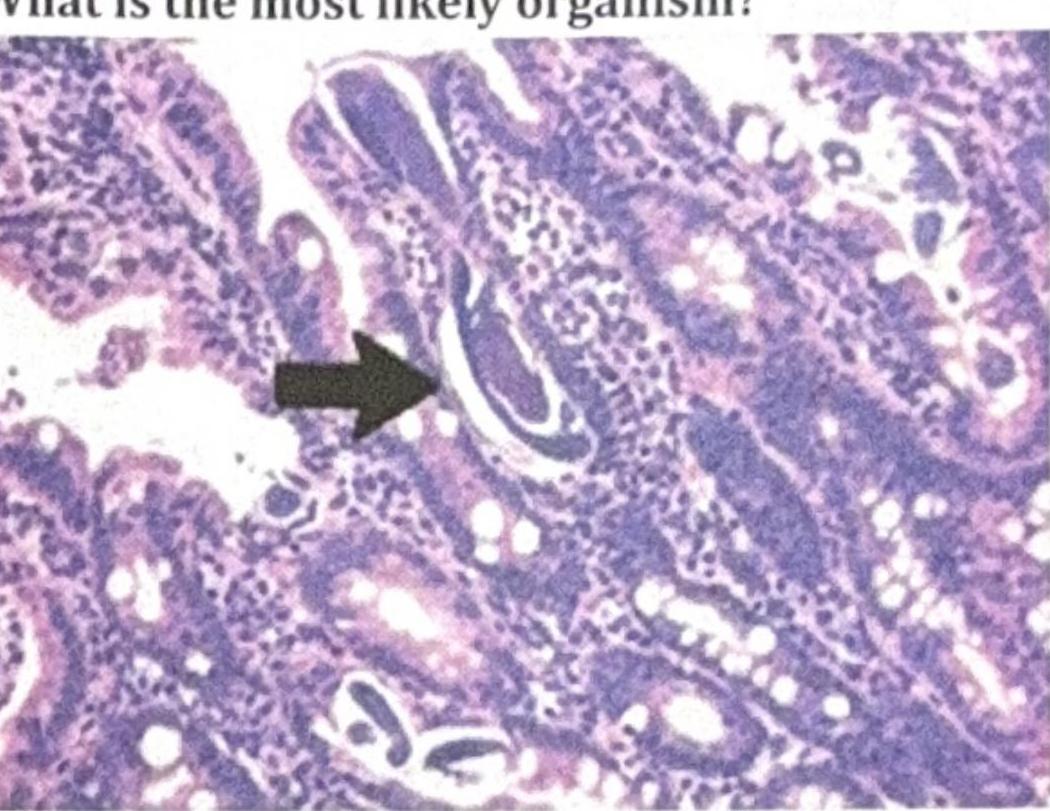
A patient on steroids presented with nocturnal cough and chronic urticaria. Bronchoalveolar lavage (BAL) staining was done, and the organism shown in the image was identified. What is the most likely organism?
A child presented with bloody stools and abdominal pain. Which enrichment medium should be used for processing the fecal sample?
What is the vector for Leishmania, a parasite characterized by a prominent kinetoplast in its morphological forms?
NEET-PG 2021 - Microbiology NEET-PG Practice Questions and MCQs
Question 41: A truck driver presented with a painless, demarcated ulcer on the penis and inguinal lymphadenopathy. What is the best method to visualize the motility of the most likely causative agent?
- A. Fluorescent microscopy
- B. Light microscopy
- C. Dark field microscopy (Correct Answer)
- D. Electron microscopy
Explanation: ***Dark field microscopy*** - The symptoms (painless, demarcated penile ulcer and inguinal lymphadenopathy) are highly suggestive of **primary syphilis**, caused by *Treponema pallidum*. - **Dark field microscopy** is the gold standard for visualizing the characteristic **corkscrew motility** of *T. pallidum* directly from lesion exudate. *Fluorescent microscopy* - This technique uses **fluorochromes** to stain structures and is often used in **immunofluorescence** assays to detect antibodies or antigens. - While useful for some microbial identification, it is not the primary method for visualizing the motility of *Treponema pallidum*. *Light microscopy* - Standard light microscopy has **insufficient resolution** to clearly visualize the thin, coiled spirochetes of *Treponema pallidum* or their motility. - The organisms are generally **too small and refractile** to be easily seen without specialized illumination. *Electron microscopy* - Provides extremely **high resolution** and is used for studying viral structures or detailed cellular ultrastructure. - It is **not practical** for routine clinical diagnosis, especially for live, motile bacteria, and is not used to observe motility.
Question 42: A patient was suspected of having brucellosis. A serum sample was sent for a standard agglutination test, which was initially negative but became positive after dilution of the sample. What is the most likely reason for the initial negative test?
- A. Antigen antibody complexes
- B. Postzone phenomenon
- C. Complement inactivation
- D. Prozone phenomenon (Correct Answer)
Explanation: ***Correct: Prozone phenomenon*** - The **prozone phenomenon** occurs when there is a very high concentration of antibodies in the patient's serum, leading to the formation of small antigen-antibody complexes that do not agglutinate or precipitate. - Diluting the sample reduces the antibody concentration, allowing for optimal antigen-antibody lattice formation and visible agglutination. - This is the classic explanation for a **negative test becoming positive after dilution** in brucellosis serology. *Incorrect: Antigen antibody complexes* - While agglutination tests rely on the formation of **antigen-antibody complexes**, the initial negative result despite a positive finding after dilution indicates a specific issue with complex *visibility* or *stability* rather than the general presence of complexes. - This option is too general and doesn't explain why dilution would change the result from negative to positive. *Incorrect: Postzone phenomenon* - The **postzone phenomenon** occurs when there is an *excess of antigen* relative to antibody, leading to no visible agglutination. - In such a case, diluting the sample (which would reduce antigen concentration or keep antibody concentration too low) would typically *not* lead to a positive result; in fact, further dilution of antibodies would worsen the outcome. - Postzone is the opposite mechanism and would not be corrected by dilution. *Incorrect: Complement inactivation* - **Complement inactivation** is not directly relevant to the mechanism of agglutination tests, which primarily depend on direct antibody-antigen binding for visible clumping. - These tests do not typically require complement activity for their primary reaction, nor are they inhibited by complement inactivation.
Question 43: A patient on steroids presented with nocturnal cough and chronic urticaria. Bronchoalveolar lavage (BAL) staining was done, and the organism shown in the image was identified. What is the most likely organism?
- A. Enterobius vermicularis
- B. Strongyloides stercoralis (Correct Answer)
- C. Capillaria philippinensis
- D. Ancylostoma duodenale
Explanation: ***Strongyloides stercoralis*** - The image shows a nematode larva in a **bronchoalveolar lavage (BAL) sample**, consistent with **Strongyloides stercoralis**, which is known for its ability to **autoinfect** and cause chronic infections. - The patient's **steroid use** can lead to **Strongyloides hyperinfection syndrome**, explaining the pulmonary symptoms (**nocturnal cough**) due to larval migration into the lungs and the chronic **urticaria** often associated with strongyloidiasis. *Enterobius vermicularis* - This organism primarily causes **pinworm infection**, characterized by **perianal itching** and is typically identified by the **scotch tape test** for eggs, not usually found in BAL or associated with chronic urticaria. - It does not commonly cause significant pulmonary symptoms or hyperinfection syndrome, especially not triggered by steroid use. *Capillaria philippinensis* - This nematode causes **intestinal capillariasis**, characterized by **chronic diarrhea**, **abdominal pain**, and **malabsorption**. - It is not typically associated with pulmonary symptoms like nocturnal cough or chronic urticaria, and is transmitted through fish consumption. *Ancylostoma duodenale* - This is a **hookworm** that causes **iron deficiency anemia**. While it does have a lung migration phase that can cause transient cough, it is not typically associated with chronic urticaria or severe pulmonary disease due to steroid-induced hyperinfection. - The image shows larvae, but the clinical context strongly points to *Strongyloides* due to the steroid use and specific symptoms.
Question 44: A child presented with bloody stools and abdominal pain. Which enrichment medium should be used for processing the fecal sample?
- A. Blood agar
- B. Selenite F broth (Correct Answer)
- C. Alkaline peptone water
- D. Muller Hinton Broth
Explanation: ***Selenite F broth*** - This **enrichment medium** is specifically designed to isolate **Salmonella** and some species of **Shigella**, which are common causes of bloody stools and abdominal pain in children. - It inhibits the growth of commensal gut flora, allowing pathogenic bacteria to proliferate and be subsequently identified on selective media. *Blood agar* - Blood agar is a **general-purpose enrichment medium** that supports the growth of a wide range of bacteria but does not selectively enrich for specific pathogens. - It would be ineffective in outcompeting the normal fecal flora to isolate rarer enteric pathogens causing the symptoms. *Alkaline peptone water* - This medium is primarily used for the enrichment of **Vibrio cholerae** species, which typically cause watery diarrhea, not bloody stools. - While it helps in the isolation of *Vibrio* species, it is not suitable for the suspected pathogens in this clinical scenario. *Muller Hinton Broth* - Muller-Hinton media are primarily used for **antimicrobial susceptibility testing** (antibiotic sensitivity testing) and are not designed for the primary isolation or enrichment of specific pathogens from clinical samples. - It would not provide a selective advantage for the recovery of organisms causing bloody diarrhea from a fecal sample.
Question 45: What is the vector for Leishmania, a parasite characterized by a prominent kinetoplast in its morphological forms?
- A. Female Anopheles Mosquito
- B. Triatomine bug
- C. Sand fly (Correct Answer)
- D. TseTse fly
Explanation: ***Sand fly*** - **Sand flies** (genus *Phlebotomus* in the Old World and *Lutzomyia* in the New World) are the biological vectors responsible for transmitting *Leishmania* parasites to humans and other mammals. - The parasite exists in two main forms; the **promastigote** (flagellated) in the sand fly gut and the **amastigote** (non-flagellated) within host macrophages. *Female Anopheles Mosquito* - The **female Anopheles mosquito** is the primary vector for **malaria**, caused by *Plasmodium* parasites, and not *Leishmania*. - *Plasmodium* also undergoes sporogonic development in the mosquito, but it does not have a prominent kinetoplast in its mature forms. *Triatomine bug* - The **triatomine bug**, also known as the "kissing bug", is the vector for **Chagas disease**, caused by *Trypanosoma cruzi*. - While *Trypanosoma cruzi* is also a hemoflagellate with a kinetoplast, it is associated with different disease manifestations and geographical distribution than *Leishmania*. *TseTse fly* - The **tsetse fly** (genus *Glossina*) is the vector responsible for transmitting **African Trypanosomiasis**, or sleeping sickness, caused by *Trypanosoma brucei*. - Like *Leishmania*, *Trypanosoma brucei* also possesses a kinetoplast, but it causes a clinically distinct disease and is transmitted by a different insect vector.
Patient Safety
2 questionsSwab is discarded in which color bin
Which of the following is most appropriate for managing a blood spill?
NEET-PG 2021 - Patient Safety NEET-PG Practice Questions and MCQs
Question 41: Swab is discarded in which color bin
- A. White bag
- B. Yellow bag (Correct Answer)
- C. Red bag
- D. Blue bag
- E. Green bag
Explanation: ***Yellow bag*** - Items in the **yellow bag** include **infectious/clinical waste** that may or may not be contaminated with human waste and may contain chemicals or pharmaceutical waste. - As **swabs** are used for collecting biological samples that may contain infectious agents, they are classified as **infectious waste** and must be disposed of in a yellow bag for appropriate incineration. *White bag* - **White bags** are typically used for the disposal of **amalgam waste**, which includes teeth with amalgam fillings (unless the tooth is a biopsy sample), removed amalgam fillings, and encapsulated dental amalgam. - This category is distinct from general clinical waste, which swabs fall under. *Red bag* - **Red bags** are used for **anatomical waste**, which includes body parts, organs, and visible blood. - **Swabs** do not fall into this category, as they are not anatomical waste, even if they contain blood. *Blue bag* - **Blue bags** are designated for the disposal of **pharmaceutical waste** that is not cytotoxic or cytostatic. - This typically includes expired or unused medications, not general clinical waste like swabs. *Green bag* - **Green bags** are used for **general/non-infectious waste** such as disposable items not contaminated with body fluids. - **Swabs** used for biological sample collection are considered infectious waste, not general waste, so they do not belong in green bags.
Question 42: Which of the following is most appropriate for managing a blood spill?
- A. Chlorhexidine
- B. Formaldehyde
- C. Ethyl Alcohol
- D. Sodium Hypochlorite (Correct Answer)
- E. Hydrogen Peroxide
Explanation: ***Sodium Hypochlorite*** - **Sodium hypochlorite** (bleach) is a widely recommended disinfectant for cleaning up blood spills due to its broad-spectrum antimicrobial activity. - It effectively **inactivates viruses**, bacteria, and fungi, including bloodborne pathogens like HIV, HBV, and HCV. - **CDC recommends** a 1:10 dilution of household bleach for blood spill decontamination with appropriate contact time. *Chlorhexidine* - **Chlorhexidine** is primarily an antiseptic used for skin disinfection before medical procedures. - While it has antimicrobial properties, it is not the preferred agent for decontaminating surfaces from large blood spills due to its less potent virucidal action compared to bleach. *Formaldehyde* - **Formaldehyde** is a potent disinfectant and sterilant, often used in histology and for sterilizing medical equipment. - However, it is highly toxic, a known carcinogen, and has a strong irritating odor, making it unsuitable for routine blood spill cleanup in clinical settings. *Ethyl Alcohol* - **Ethyl alcohol** (ethanol) is an effective antiseptic for skin and small surface disinfection, particularly against bacteria and some viruses. - Its efficacy against non-enveloped viruses and spores is limited, and it evaporates quickly, which makes it less reliable for disinfecting large blood spills that require sustained contact time. *Hydrogen Peroxide* - **Hydrogen peroxide** has antimicrobial properties and is used for surface disinfection in some healthcare settings. - However, it is less effective than sodium hypochlorite against certain bloodborne pathogens, requires higher concentrations for virucidal activity, and can be corrosive to some surfaces. - It may be unstable in storage and loses potency over time, making it less reliable for blood spill management protocols.