Anatomy
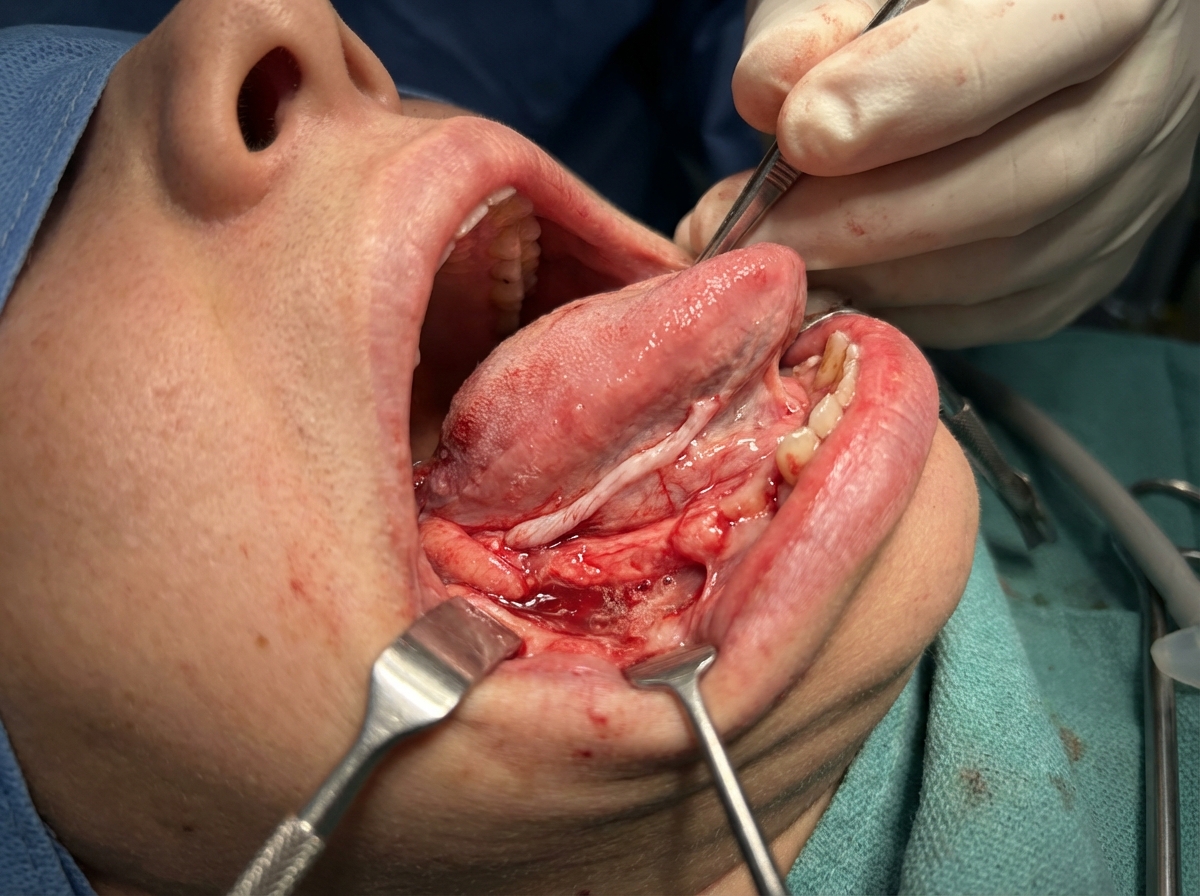
1 questionsWhich of the following statements is true regarding the structure shown in the image?
NEET-PG 2021 - Anatomy NEET-PG Practice Questions and MCQs
Question 111: Which of the following statements is true regarding the structure shown in the image?
- A. Hypoglossal nerve
- B. Lingual nerve (Correct Answer)
- C. Nerve to mylohyoid
- D. Inferior alveolar nerve
- E. Glossopharyngeal nerve
Explanation: ***Lingual nerve*** - The image appears to depict a **surgical field in the floor of the mouth**, likely during an excision of a lesion, where the **lingual nerve** is a key structure that needs to be identified and preserved due to its superficial position. - The lingual nerve provides **general sensation** and **taste (chorda tympani fibers)** to the anterior two-thirds of the tongue, and its injury would result in loss of these functions. *Hypoglossal nerve* - The **hypoglossal nerve** (CN XII) innervates the **intrinsic and extrinsic muscles of the tongue** (except the palatoglossus) and is deep to the submandibular duct. - While important in floor of mouth surgery, it is typically located more inferiorly and medially, deeper than the very superficial structure shown, which appears to be the lingual nerve. *Nerve to mylohyoid* - The **nerve to mylohyoid** is a branch of the inferior alveolar nerve and innervates the **mylohyoid muscle** and the **anterior belly of the digastric muscle**. - This nerve is located more inferiorly, lying on the surface of the mylohyoid muscle, and is less likely to be the prominent superficial structure highlighted in this context near the tongue root or oral mucosa. *Inferior alveolar nerve* - The **inferior alveolar nerve** is a branch of the mandibular nerve (V3) and primarily provides **sensation to the mandibular teeth** and **gingiva**; it enters the mandibular foramen. - This nerve is located deep within the mandible and jaw, not superficially within the oral cavity or floor of the mouth as depicted, making it an unlikely choice for the superficial structure shown. *Glossopharyngeal nerve* - The **glossopharyngeal nerve** (CN IX) provides **general sensation and taste** to the **posterior one-third of the tongue** and innervates the stylopharyngeus muscle. - This nerve courses deep in the pharyngeal region and does not run superficially in the anterior floor of the mouth as shown in the image, making it an incorrect choice for this superficial anterior structure.
Internal Medicine
2 questionsA 60-year-old male patient has an antral carcinoma spreading to the head of the pancreas with multiple small metastases to the right lobe of the liver. What is the best treatment approach?
An 85-year-old male with prostate cancer, Gleason score of 6 , and PSA <8 ng/mL. What is the best management approach?
NEET-PG 2021 - Internal Medicine NEET-PG Practice Questions and MCQs
Question 111: A 60-year-old male patient has an antral carcinoma spreading to the head of the pancreas with multiple small metastases to the right lobe of the liver. What is the best treatment approach?
- A. Surgical resection with adjuvant chemotherapy
- B. Radiation therapy alone
- C. Palliative chemotherapy (Correct Answer)
- D. Supportive care only
Explanation: Palliative chemotherapy - The presence of **multiple small metastases** in the liver indicates **metastatic disease**, which is generally considered incurable with surgery [2]. - **Palliative chemotherapy** aims to control disease progression, alleviate symptoms, and improve quality of life in patients with advanced metastatic cancer. Surgical resection with adjuvant chemotherapy - **Surgical resection** is not indicated due to the presence of **distant metastases** (to the liver), classifying the disease as Stage IV [1]. - **Adjuvant chemotherapy** is given after curative surgery to reduce recurrence risk, which is not the goal here as the disease is already metastatic. Radiation therapy alone - **Radiation therapy alone** is typically reserved for localized disease or for palliative symptom management (e.g., pain from bone metastases), not for widespread metastatic disease. - It would not adequately address the systemic nature of **multiple liver metastases** from a pancreatic primary. Supportive care only - While supportive care is crucial, **palliative chemotherapy** offers a chance to prolong survival and manage symptoms more effectively than supportive care alone in suitable patients with advanced pancreatic cancer. - Skipping chemotherapy entirely would mean foregoing potential benefits in terms of disease control and quality of life, especially for patients with a good performance status.
Question 112: An 85-year-old male with prostate cancer, Gleason score of 6 , and PSA <8 ng/mL. What is the best management approach?
- A. Active surveillance/Watchful waiting (Correct Answer)
- B. Radical prostatectomy
- C. External beam radiation therapy
- D. Androgen deprivation therapy
Explanation: Androgen deprivation therapy - **Hormonal therapy** is primarily used for advanced, metastatic, or high-risk localized prostate cancer [1], or as an adjunct to radiation therapy. - It is not indicated as a primary first-line treatment for **low-risk, localized prostate cancer** in an elderly patient, as its side effects (e.g., hot flashes, fatigue, bone loss, cardiovascular effects) can significantly impact quality of life without offering a survival advantage in this specific scenario.
Radiology
1 questionsExamine the abdominal X-ray shown. What is the most likely diagnosis based on the findings?

NEET-PG 2021 - Radiology NEET-PG Practice Questions and MCQs
Question 111: Examine the abdominal X-ray shown. What is the most likely diagnosis based on the findings?
- A. Small bowel ileus
- B. Pneumoperitoneum
- C. Intestinal Obstruction (Correct Answer)
- D. Large bowel obstruction
Explanation: ***Intestinal Obstruction*** - The abdominal X-ray demonstrates **distended loops of bowel** with **multiple air-fluid levels**, which are classic radiographic signs of intestinal obstruction. - The presence of multiple, wide air-fluid levels visible in a **stepladder pattern** is a hallmark of bowel obstruction. - **Valvulae conniventes** (transverse folds crossing the entire width of bowel) suggest **small bowel** involvement when visible with distension. *Small bowel ileus* - While ileus can show distended bowel loops, it typically presents with **gas distributed throughout the small and large bowel** without a clear transition point. - Ileus shows **less pronounced air-fluid levels** and lacks the characteristic stepladder pattern seen in mechanical obstruction. - The clinical context and presence of multiple distinct air-fluid levels favor mechanical obstruction over ileus. *Large bowel obstruction* - Large bowel obstruction would show **dilated colon** with **haustrations** (incomplete folds that don't cross the entire lumen). - The obstruction would typically show dilation **proximal to the obstruction** with collapsed bowel distally. - The pattern in this image is more consistent with small bowel or generalized intestinal obstruction rather than isolated large bowel obstruction. *Pneumoperitoneum* - Pneumoperitoneum (free air in the peritoneal cavity) appears as **air under the diaphragm** on upright films or as **Rigler's sign** (both sides of bowel wall visible) on supine films. - This is a sign of **bowel perforation**, not obstruction with air-fluid levels within the bowel lumen. - The air-fluid levels seen here are **intraluminal**, not free intraperitoneal air.
Surgery
6 questionsAsymptomatic varicose veins would fall under which category of the CEAP classification system?
Which nerve is most commonly injured during submandibular gland surgery?
A patient is found to have an asymptomatic common bile duct (CBD) stone two years after cholecystectomy on routine imaging. What is the most appropriate initial management?
In which condition is gas under the diaphragm most commonly seen on imaging?
A patient with a left hypochondrium contusion presents with systolic blood pressure of 70 mm Hg and pulse rate of 110 bpm. What is the best step in management?
Mr. Ramu, a 35-year-old male, sustained a straddle injury in a motor vehicle accident and presents to the emergency department with blood at the urethral meatus. What is the next appropriate step in his management?
NEET-PG 2021 - Surgery NEET-PG Practice Questions and MCQs
Question 111: Asymptomatic varicose veins would fall under which category of the CEAP classification system?
- A. C1 (Telangiectasias or reticular veins)
- B. C2 (Varicose veins) (Correct Answer)
- C. C3 (Edema)
- D. C4 (Skin changes)
Explanation: ***C2 (Varicose veins)*** - The CEAP classification uses 'C' for clinical manifestations, with **C2 specifically indicating the presence of varicose veins**. - Since the patient has **asymptomatic varicose veins**, C2 accurately captures this clinical state without implying more severe complications. - Varicose veins are classified as C2 **regardless of whether they are symptomatic or asymptomatic**. *C1 (Telangiectasias or reticular veins)* - C1 refers to smaller veins, such as **telangiectasias (spider veins)** and **reticular veins**, which are distinct from the larger, tortuous varicose veins. - These are less prominent venous abnormalities compared to varicose veins. *C3 (Edema)* - C3 indicates the **presence of edema** due to venous insufficiency. - The question specifies **asymptomatic varicose veins** without mention of edema, making C3 incorrect. *C4 (Skin changes)* - C4 denotes **skin changes** related to chronic venous insufficiency, such as pigmentation, eczema, or lipodermatosclerosis. - These are more advanced signs of venous disease and are not present in a patient with only varicose veins without complications.
Question 112: Which nerve is most commonly injured during submandibular gland surgery?
- A. Lingual nerve
- B. Marginal mandibular branch of facial nerve (Correct Answer)
- C. Mylohyoid nerve
- D. Hypoglossal nerve
Explanation: ***Marginal mandibular branch of facial nerve*** - The **marginal mandibular nerve** courses superficially over and along the superior border of the submandibular gland, making it the **most vulnerable** structure during surgery - It is at highest risk during elevation of the gland, ligation of the facial vessels, and dissection near the gland's superior border - Injury leads to **weakness or paralysis of the depressor muscles of the lower lip** (depressor anguli oris and depressor labii inferioris), causing an asymmetric smile and difficulty with lip movements - This is the **most common nerve injury** in submandibular gland surgery due to its superficial anatomical position *Incorrect: Lingual nerve* - The **lingual nerve** passes medial to the submandibular duct and deep to the gland - While it can be injured during dissection of the submandibular duct or deeper aspects of the gland, it is **less commonly injured** than the marginal mandibular nerve - Damage results in **loss of taste and general sensation** to the anterior two-thirds of the tongue on the ipsilateral side *Incorrect: Mylohyoid nerve* - The **mylohyoid nerve** travels on the inferior surface of the mylohyoid muscle, generally beneath and protected by this muscle - It supplies the mylohyoid and anterior belly of the digastric muscles - Injury is **uncommon** during routine submandibular gland excision due to its protected anatomical position *Incorrect: Hypoglossal nerve* - The **hypoglossal nerve** lies deep and inferior to the submandibular gland - It supplies motor innervation to the intrinsic and extrinsic muscles of the tongue - It is the **least commonly injured** nerve as it is well-protected by its deep position, unless dissection is carried excessively deep or inferiorly
Question 113: A patient is found to have an asymptomatic common bile duct (CBD) stone two years after cholecystectomy on routine imaging. What is the most appropriate initial management?
- A. ERCP with sphincterotomy and stone extraction (Correct Answer)
- B. Keep on active surveillance
- C. Medical dissolution therapy with ursodeoxycholic acid
- D. Surgical exploration and choledochotomy
Explanation: ***ERCP with sphincterotomy and stone extraction*** - This is the **gold standard management** for CBD stones discovered after cholecystectomy, even when asymptomatic - **Post-cholecystectomy CBD stones will not pass spontaneously** as there is no gallbladder to contract and propel stones forward - The **risk of complications** (acute cholangitis, acute pancreatitis, biliary obstruction) from leaving the stone in place outweighs the risk of ERCP - ERCP has a **high success rate (>90%)** with acceptable complication rates (pancreatitis 3-5%, bleeding <1%, perforation <1%) - **Prophylactic stone removal** prevents future emergency presentations and allows for planned intervention under optimal conditions *Keep on active surveillance* - **Not appropriate** for CBD stones in post-cholecystectomy patients, as these stones will not pass spontaneously - Unlike gallbladder stones, CBD stones carry a **significant risk of serious complications** including ascending cholangitis and acute biliary pancreatitis - Active surveillance might be considered only in patients with **prohibitive surgical risk** or very limited life expectancy - Modern guidelines recommend **intervention for all CBD stones** found post-cholecystectomy regardless of symptoms *Surgical exploration and choledochotomy* - This is a more **invasive approach** with higher morbidity compared to ERCP - Reserved for cases where **ERCP fails or is not feasible** (altered anatomy, large impacted stones, intrahepatic stones) - Not appropriate as **initial management** when less invasive endoscopic options are available - May be considered if ERCP is unsuccessful after 1-2 attempts *Medical dissolution therapy with ursodeoxycholic acid* - **Ineffective for CBD stones** - UDCA works only for small cholesterol stones in a functioning gallbladder - Requires months to years of therapy with **poor success rates** even for gallbladder stones - **Not recommended** for choledocholithiasis in any clinical scenario - This patient has already undergone cholecystectomy, making dissolution therapy completely irrelevant
Question 114: In which condition is gas under the diaphragm most commonly seen on imaging?
- A. Tertiary
- B. Retained stone
- C. Secondary (Correct Answer)
- D. Primary
Explanation: ***Correct: Secondary*** - **Gas under the diaphragm** is a classic sign of a **perforated viscus**, which is a severe form of **secondary peritonitis**. - Secondary peritonitis typically arises from the **rupture or perforation of an abdominal organ**, allowing gas and contents to leak into the peritoneal cavity. *Incorrect: Tertiary* - **Tertiary peritonitis** refers to persistent or recurrent peritonitis after seemingly adequate surgical and antibiotic treatment for primary or secondary peritonitis. - It is associated with **immunocompromised states** or **low-virulence organisms** and does not typically present with free gas under the diaphragm. *Incorrect: Retained stone* - A **retained stone** (e.g., gallstone, renal stone) can cause obstruction or inflammation but does not directly lead to **gas under the diaphragm**. - While it might indirectly lead to perforation if neglected, it's not the most common direct cause of **free peritoneal gas**. *Incorrect: Primary* - **Primary peritonitis** (also known as spontaneous bacterial peritonitis) occurs without an apparent source of contamination within the abdominal cavity, often in patients with ascites and **liver cirrhosis**. - It is characterized by bacterial infection of the ascitic fluid but does not involve a perforated viscus or **free gas under the diaphragm**.
Question 115: A patient with a left hypochondrium contusion presents with systolic blood pressure of 70 mm Hg and pulse rate of 110 bpm. What is the best step in management?
- A. Conservative management with observation
- B. Chest tube insertion
- C. Antibiotic therapy
- D. Emergency surgical exploration (Correct Answer)
Explanation: ***Emergency surgical exploration*** - The patient's **hypotension** (BP 70 mmHg) and **tachycardia** (HR 110 bpm) indicate **hemodynamic instability**, suggesting active bleeding, likely from a splenic or liver injury in the context of a left hypochondrium contusion. - While initial resuscitation with IV fluids is started simultaneously, this degree of shock (class III-IV hemorrhage) with a high-risk mechanism typically requires **emergency surgical exploration** to identify and control the source of bleeding. - According to **ATLS protocols**, patients who are non-responders or transient responders to initial resuscitation with ongoing hemodynamic instability are candidates for immediate operative intervention. *Conservative management with observation* - This approach is appropriate only for **hemodynamically stable** patients with solid organ injuries, often with minor extravasation or hematomas that are not actively bleeding. - The patient's severe hypotension and tachycardia preclude conservative management, as it would risk further decompensation and mortality due to ongoing blood loss. *Chest tube insertion* - This procedure is indicated for managing conditions like **pneumothorax** or **hemothorax**, which might present with respiratory distress, decreased breath sounds, and potentially hemodynamic compromise if severe. - While a chest injury could coexist, the primary concern here is profound shock following an abdominal contusion, suggesting intra-abdominal hemorrhage rather than a thoracic injury as the initial priority. *Antibiotic therapy* - **Antibiotic therapy** is important for preventing or treating infections, particularly in cases of bowel perforation or open wounds, but it does not address acute hemodynamic instability from hemorrhage. - Administering antibiotics before surgically addressing the source of bleeding in a hypotensive patient would be a misprioritization and would not stabilize their condition.
Question 116: Mr. Ramu, a 35-year-old male, sustained a straddle injury in a motor vehicle accident and presents to the emergency department with blood at the urethral meatus. What is the next appropriate step in his management?
- A. CECT Abdomen
- B. FAST
- C. Abdomen X-ray
- D. Retrograde urethrogram (Correct Answer)
Explanation: ***Retrograde urethrogram*** - **Blood at the urethral meatus** after a straddle injury is highly suggestive of **urethral injury**, and a retrograde urethrogram is the diagnostic test of choice to assess the integrity of the urethra. - This procedure involves injecting contrast into the urethra to visualize any extravasation, strictures, or complete disruptions before attempting catheterization. *CECT Abdomen* - A CECT abdomen is primarily used to assess **solid organ injuries** or **intra-abdominal bleeding**, which is not the primary concern suggested by blood at the urethral meatus. - While broad abdominal trauma may warrant a CECT, it does not directly evaluate urethral integrity. *FAST* - **FAST (Focused Assessment with Sonography for Trauma)** is a rapid ultrasound examination to detect **free fluid (blood)** in the peritoneal or pericardial cavities. - It is used to identify **intra-abdominal or pericardial hemorrhage** and guide resuscitation, but it does not visualize the urethra. *Abdomen X-ray* - An abdomen X-ray can detect **fractures of the pelvis** or foreign bodies, but it does not provide detailed imaging of soft tissues like the urethra. - It would not show urethral extravasation or disruption, making it insufficient for diagnosing urethral injury.