Internal Medicine
4 questionsA patient presents with breathlessness and wheezing. Absolute eosinophil count is 500 cells/ $\mu \mathrm{L}$. Chest X-ray shows a miliary pattern. What is the most likely diagnosis?
A patient presents with breathing difficulty and generalized weakness. On auscultation, a middiastolic murmur with a prominent "a" wave is observed. What is the most likely diagnosis?
A patient presents with confusion, altered mental status, and unusual behavior. On examination, CNS features such as disorientation and lethargy are noted. Laboratory results reveal a urine osmolality of 1000 mOsm/kg and a plasma osmolality of 250 mOsm/kg. What is the most likely electrolyte imbalance?
30-year-old male, weighing 70 kg , presents with a serum sodium level of $120 \mathrm{mEq} / \mathrm{L}$. Calculate the total sodium deficit.
NEET-PG 2021 - Internal Medicine NEET-PG Practice Questions and MCQs
Question 101: A patient presents with breathlessness and wheezing. Absolute eosinophil count is 500 cells/ $\mu \mathrm{L}$. Chest X-ray shows a miliary pattern. What is the most likely diagnosis?
- A. Tropical pulmonary eosinophilia (Correct Answer)
- B. Bronchial asthma
- C. Miliary Tuberculosis (TB)
- D. Hypersensitivity pneumonitis
- E. Allergic bronchopulmonary aspergillosis (ABPA)
Explanation: ***Tropical pulmonary eosinophilia*** - This condition is characterized by **eosinophilia** (absolute eosinophil count >500 cells/µL), **respiratory symptoms** such as breathlessness and wheezing, and a **miliary pattern** on chest X-ray, all consistent with the patient's presentation. - It results from a **hypersensitivity reaction** to microfilariae from Wuchereria bancrofti or Brugia malayi in individuals living in endemic regions. *Bronchial asthma* - While bronchial asthma can cause **breathlessness** and **wheezing**, a miliary pattern on chest X-ray is **not typical**, nor is an eosinophil count of 500 cells/µL, though eosinophilia can occur. - Asthma is primarily a disease of reversible airway obstruction, often triggered by **allergens** or irritants. *Miliary Tuberculosis (TB)* - **Miliary TB** would present with a miliary pattern on chest X-ray and breathlessness, but it is typically associated with **low or normal eosinophil counts**, and wheezing is less common. - Fever, night sweats, and weight loss are also common symptoms of Miliary TB. *Hypersensitivity pneumonitis* - This condition involves inflammation of the lung alveoli due to inhalation of organic dusts or chemicals, causing **breathlessness** and, occasionally, wheezing, but **eosinophilia is not a primary feature**. - Chest X-ray findings can be diverse, but a **miliary pattern** is less specific than for tropical pulmonary eosinophilia. *Allergic bronchopulmonary aspergillosis (ABPA)* - ABPA can present with **eosinophilia**, **wheezing**, and respiratory symptoms, but chest X-ray typically shows **central bronchiectasis** and **fleeting infiltrates** rather than a miliary pattern. - It occurs in patients with asthma or cystic fibrosis and is characterized by **hypersensitivity to Aspergillus fumigatus**.
Question 102: A patient presents with breathing difficulty and generalized weakness. On auscultation, a middiastolic murmur with a prominent "a" wave is observed. What is the most likely diagnosis?
- A. Mitral Regurgitation (MR)
- B. Mitral Stenosis (MS)
- C. Tricuspid Regurgitation (TR)
- D. Tricuspid Stenosis (TS) (Correct Answer)
- E. Pulmonary Stenosis (PS)
Explanation: ***Tricuspid Stenosis (TS)*** - A **middiastolic murmur** in the tricuspid area (usually left lower sternal border) along with a **prominent "a" wave** (due to increased right atrial pressure against a stenotic tricuspid valve) is pathognomonic for tricuspid stenosis. - The symptoms of **breathing difficulty** and **generalized weakness** can arise from reduced cardiac output and venous congestion characteristic of TS. *Mitral Regurgitation (MR)* - MR typically presents with a **holosystolic murmur** best heard at the apex and radiating to the axilla. - It does not characteristically produce a middiastolic murmur or a prominent "a" wave. *Mitral Stenosis (MS)* - MS causes a **diastolic rumble** with an **opening snap**, best heard at the apex, but it is not typically associated with a pronounced "a" wave in the jugular venous pulse unless there's associated pulmonary hypertension and right heart strain. - The murmur is usually localized to the apex, whereas tricuspid murmurs are typically heard from the lower left sternal border. *Tricuspid Regurgitation (TR)* - TR is characterized by a **holosystolic murmur** that increases with inspiration, heard at the left lower sternal border. - It typically causes a prominent **"v" wave** in the jugular venous pulse due to regurgitant flow into the right atrium, not a prominent "a" wave. *Pulmonary Stenosis (PS)* - PS presents with a **systolic ejection murmur** at the left upper sternal border (pulmonic area), not a diastolic murmur. - While it can cause right heart strain, it does not produce the characteristic middiastolic murmur or prominent "a" wave seen in tricuspid stenosis.
Question 103: A patient presents with confusion, altered mental status, and unusual behavior. On examination, CNS features such as disorientation and lethargy are noted. Laboratory results reveal a urine osmolality of 1000 mOsm/kg and a plasma osmolality of 250 mOsm/kg. What is the most likely electrolyte imbalance?
- A. Hypokalemia
- B. Hyperkalemia
- C. Hyponatremia (Correct Answer)
- D. Hypernatremia
- E. Hypercalcemia
Explanation: ***Hyponatremia*** - The **low plasma osmolality** (250 mOsm/kg) combined with a **high urine osmolality** (1000 mOsm/kg) indicates that the kidneys are inappropriately concentrating urine despite diluted plasma, a hallmark finding in euvolemic hyponatremia. - **Confusion**, **altered mental status**, and **unusual behavior** are classic neurological symptoms associated with hyponatremia, particularly when it develops acutely or severely. *Hypokalemia* - **Hypokalemia** is characterized by low serum potassium and can cause muscle weakness, arrhythmias, and fatigue, but it does not directly explain the given plasma and urine osmolality findings. - The neurological symptoms described are not typical primary manifestations of hypokalemia. *Hyperkalemia* - **Hyperkalemia** involves high serum potassium, commonly leading to cardiac arrhythmias and muscle weakness. - The provided **osmolality values** are not consistent with a primary diagnosis of hyperkalemia. *Hypernatremia* - **Hypernatremia** is defined by high serum sodium and would present with **high plasma osmolality**, which contradicts the given plasma osmolality of 250 mOsm/kg. - While it can cause neurological symptoms, the osmolality findings rule it out. *Hypercalcemia* - **Hypercalcemia** can present with neurological symptoms including confusion and lethargy ("stones, bones, groans, and psychiatric overtones"). - However, hypercalcemia does not produce the characteristic **low plasma osmolality with high urine osmolality** pattern seen in this case.
Question 104: 30-year-old male, weighing 70 kg , presents with a serum sodium level of $120 \mathrm{mEq} / \mathrm{L}$. Calculate the total sodium deficit.
- A. 630 mEq
- B. 280 mEq
- C. 420 mEq
- D. 840 mEq (Correct Answer)
- E. 1260 mEq
Explanation: ***840 mEq*** - The formula for calculating **total sodium deficit** is: **(Desired Na - Actual Na) × Total Body Water (TBW)**. - In a male, TBW is approximately **60% of body weight**. For a 70 kg male, **TBW = 0.6 × 70 kg = 42 L**. - With a desired sodium of **140 mEq/L** (normal) and actual sodium of **120 mEq/L**, the total deficit is: - **(140 - 120) × 42 = 20 × 42 = 840 mEq** - This represents the **complete calculated sodium deficit** needed to restore serum sodium to normal levels. - **Note:** In clinical practice, this entire deficit is NOT replaced rapidly. Typically, only **6-12 mEq/L increase per 24 hours** is recommended to prevent **osmotic demyelination syndrome**, but the question asks for the total calculated deficit. *630 mEq* - This value represents a **partial correction target**, corresponding to raising serum sodium to approximately **135 mEq/L** instead of 140 mEq/L: (135 - 120) × 42 = 630 mEq. - Alternatively, it equals about **75% of the total deficit** (840 × 0.75 = 630). - While this may reflect a practical clinical target, it does not answer the question which asks for the **total deficit**. *420 mEq* - This corresponds to raising serum sodium by **10 mEq/L** (10 × 42 = 420 mEq). - This represents the **maximum recommended increase in the first 24 hours** to prevent complications. - It is a safe initial correction amount but not the total calculated deficit. *280 mEq* - This represents an even smaller increment, roughly equivalent to raising serum sodium by **6-7 mEq/L**. - This would be an **ultra-conservative initial correction** for chronic hyponatremia. - It significantly underestimates the total sodium deficit. *1260 mEq* - This is an **overestimation** that might result from incorrectly using 100% body weight as TBW instead of 60%: (140 - 120) × 70 = 1400 mEq (close to this range). - Or from miscalculation using wrong formula components. - This exceeds the actual total sodium deficit.
Pharmacology
1 questionsA patient with hypertension, peripheral edema, and chronic kidney disease (CKD) presents for management. Which of the following medications would be the best choice?
NEET-PG 2021 - Pharmacology NEET-PG Practice Questions and MCQs
Question 101: A patient with hypertension, peripheral edema, and chronic kidney disease (CKD) presents for management. Which of the following medications would be the best choice?
- A. Aliskiren
- B. Beta blocker
- C. Prazosin
- D. Chlorthalidone (Correct Answer)
- E. Furosemide
Explanation: ***Chlorthalidone*** - **Chlorthalidone** is a **thiazide-type diuretic** that is effective in managing hypertension and associated edema, even in patients with moderate CKD (eGFR >30 mL/min/1.73m²). - Its long duration of action and proven cardiovascular benefits make it a good choice for hypertension control in this clinical context. - **Superior to loop diuretics for blood pressure control** and has better evidence for reducing cardiovascular events. *Aliskiren* - **Aliskiren** is a **direct renin inhibitor** that blocks the renin-angiotensin-aldosterone system (RAAS). - However, in patients with CKD, particularly those with existing hypertension and peripheral edema, it is generally **not preferred due to potential risks** of hyperkalemia, renal impairment, and hypotension, especially when combined with ACE inhibitors or ARBs. *Beta blocker* - While **beta-blockers** can treat hypertension, they are **not the first-line choice** for patients with both hypertension and significant peripheral edema. - They also have potential side effects like bradycardia, fatigue, and bronchospasm, and may mask symptoms of hypoglycemia in diabetic patients. *Prazosin* - **Prazosin** is an **alpha-1 adrenergic blocker** that can reduce blood pressure but is primarily used for **hypertension with benign prostatic hyperplasia (BPH)** due to its dilating effect on the bladder neck. - It's **not typically a first-line agent** for essential hypertension with peripheral edema and carries a risk of **first-dose syncope**. *Furosemide* - **Furosemide** is a **loop diuretic** that is more effective than thiazides for managing edema, especially in severe CKD (eGFR <30). - However, for **blood pressure control** in patients with moderate CKD and edema, **thiazide-type diuretics like chlorthalidone are preferred** due to their superior antihypertensive efficacy and cardiovascular benefits. - Loop diuretics have a shorter duration of action and are less effective for chronic hypertension management.
Surgery
5 questionsWhat surgery is shown here in the image?
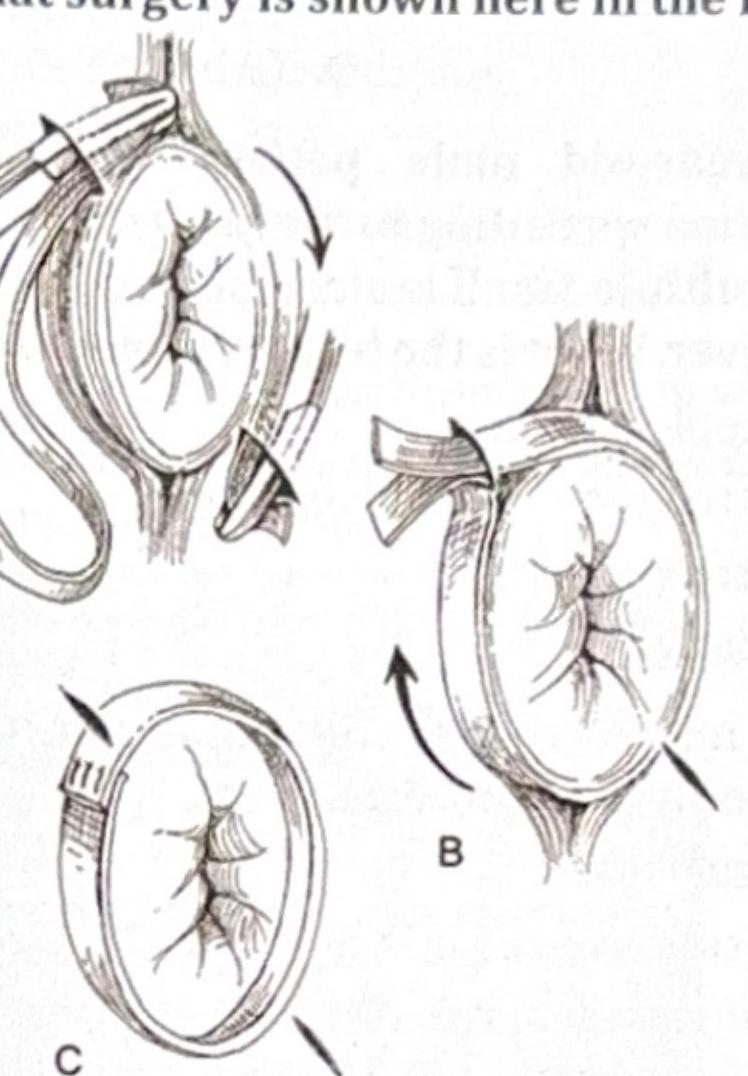
A patient presents with upper limb swelling after undergoing a modified radical mastectomy (MRM). What is the most likely cause?
Which of the following is the most commonly performed repair for a direct inguinal hernia?
A patient presents with breathlessness and decreased air entry into the right lung following a road traffic accident (RTA) and is hypotensive. What is the next step in management?
After a total thyroidectomy, the surgeon is unable to extubate the patient, who shows cyanosis and respiratory distress. What is the most likely cause of the inability to extubate?
NEET-PG 2021 - Surgery NEET-PG Practice Questions and MCQs
Question 101: What surgery is shown here in the image?
- A. Hemorrhoidectomy
- B. Altemeier operation
- C. Wells procedure
- D. Thiersch wiring (Correct Answer)
Explanation: ***Thiersch wiring*** - The image clearly depicts a **suture or wire** placed circumferentially around the anus to reduce its caliber, which is the hallmark of a **Thiersch procedure**. - This technique is used to treat **anal incontinence** by constricting the anal opening and improving sphincter function. *Hemorrhoidectomy* - This procedure involves the **surgical removal of hemorrhoids** and the images do not show any identifiable hemorrhoidal tissue being excised. - While bleeding and prolapse can be associated with hemorrhoids, the depicted technique with circumferential wiring is not used for their removal. *Altemeier operation* - The Altemeier operation is a type of **perineal rectosigmoidectomy** for rectal prolapse that involves resecting the prolapsed segment of the rectum. - The image does not illustrate resection of rectal tissue; instead, it shows a constricting device around the anus. *Wells procedure* - The Wells procedure, or **rectopexy**, involves anchoring the rectum to the sacrum to correct rectal prolapse. - This procedure typically involves an abdominal approach and fixation techniques, which are not represented in the illustration.
Question 102: A patient presents with upper limb swelling after undergoing a modified radical mastectomy (MRM). What is the most likely cause?
- A. Angiosarcoma
- B. Recurrence
- C. Upper limb Lymphedema (Correct Answer)
- D. Metastasis
Explanation: ***Upper limb Lymphedema*** - **Lymphedema** is a common complication after **modified radical mastectomy (MRM)** due to the removal of axillary lymph nodes and subsequent disruption of lymphatic drainage pathways. - This disruption leads to an accumulation of lymphatic fluid in the interstitial tissues, causing **swelling** in the ipsilateral upper limb. *Angiosarcoma* - **Angiosarcoma** (Stewart-Treves syndrome) is a very rare, aggressive tumor that can occur in the chronic lymphedematous limb after mastectomy. - It presents as multiple **violaceous nodules or plaques** in the affected limb, which is not described as the initial finding. *Recurrence* - **Recurrence** of breast cancer in the axilla or chest wall could cause swelling, but it would typically involve a palpable mass, skin changes, or pain, which are not mentioned as the primary symptom. - While recurrence can lead to lymphatic obstruction, **lymphedema** is a more direct and common post-operative complication. *Metastasis* - **Metastasis** to the axillary or supraclavicular lymph nodes could cause lymphatic obstruction and swelling. - However, lymphedema from direct surgical disruption of lymphatics is a more immediate and common cause of upper limb swelling following MRM, especially without other signs of widespread disease.
Question 103: Which of the following is the most commonly performed repair for a direct inguinal hernia?
- A. Lichtenstein repair (Correct Answer)
- B. Bassini's repair
- C. Herniotomy
- D. All of the options
Explanation: ***Lichtenstein repair*** - The **Lichtenstein repair** is a **tension-free mesh repair** and is the most commonly performed technique for direct inguinal hernias due to its low recurrence rates. - This technique involves placing a **synthetic mesh** over the deficient posterior wall of the inguinal canal, reinforcing the weakened area. *Bassini's repair* - **Bassini's repair** is a tissue-based repair that involves suturing the conjoined tendon to the inguinal ligament. - It creates tension on the repair, which historically led to **higher recurrence rates** compared to mesh repairs. *Herniotomy* - **Herniotomy** is the surgical removal of the **hernia sac** without repairing the defect in the abdominal wall. - This procedure is typically reserved for **pediatric patients** with indirect inguinal hernias due to the good intrinsic muscle tone and relatively small defect, but it is not the primary repair for direct inguinal hernias in adults. *All of the options* - While all listed procedures are methods for hernia management, only the **Lichtenstein repair** is considered the most commonly performed repair for direct inguinal hernias in current practice. - The other options are less commonly performed or reserved for specific patient populations.
Question 104: A patient presents with breathlessness and decreased air entry into the right lung following a road traffic accident (RTA) and is hypotensive. What is the next step in management?
- A. Wide bore needle decompression
- B. Needle insertion at 5th ICS in mid-axillary line
- C. Needle insertion at 2nd ICS in midclavicular line (MCL) (Correct Answer)
- D. Fluid resuscitation using wide bore cannula
Explanation: ***Needle insertion at 2nd ICS in midclavicular line (MCL)*** - The combination of **breathlessness**, **decreased air entry**, **hypotension** following trauma indicates a **tension pneumothorax**, which requires immediate decompression. - **Needle decompression** at the **2nd intercostal space (ICS)** in the **midclavicular line (MCL)** is the recommended immediate life-saving procedure to relieve pressure according to **ATLS guidelines**. - This option is the **most complete and precise answer**, specifying both the procedure and the exact anatomical location needed for safe execution. *Wide bore needle decompression* - While this correctly identifies the procedure type (needle decompression with a wide bore needle), it lacks the **critical anatomical specification** needed for clinical application. - In an emergency, knowing **where** to insert the needle is as important as knowing to perform the procedure - **2nd ICS at MCL** is the standard taught location. - This option is incomplete compared to the option that specifies the exact anatomical landmark. *Needle insertion at 5th ICS in mid-axillary line* - The **5th ICS in the mid-axillary line** is the appropriate location for inserting a **chest drain (tube thoracostomy)**, which is a definitive treatment but not the immediate emergency intervention. - For **tension pneumothorax**, immediate **needle decompression at 2nd ICS MCL** must be performed first to relieve life-threatening pressure, followed by chest tube insertion. - Using this location for initial needle decompression is not standard ATLS protocol. *Fluid resuscitation using wide bore cannula* - While **fluid resuscitation** is important for a trauma patient with hypotension, it will not address the primary life-threatening issue of **tension pneumothorax**. - The immediate priority is to relieve the pressure on the heart and lungs, as hypotension in this context is due to **obstructive shock** from impaired venous return and cardiac output. - Fluids alone will not correct the mechanical obstruction caused by the tension pneumothorax.
Question 105: After a total thyroidectomy, the surgeon is unable to extubate the patient, who shows cyanosis and respiratory distress. What is the most likely cause of the inability to extubate?
- A. Bilateral recurrent laryngeal nerve palsy (Correct Answer)
- B. Unilateral recurrent laryngeal nerve palsy
- C. Superior laryngeal nerve palsy
- D. Hemorrhage
Explanation: ***Bilateral recurrent laryngeal nerve palsy*** - After total thyroidectomy, injury to both **recurrent laryngeal nerves** can lead to paralysis of the abductor muscles of the vocal cords causing them to approximate, leading to **airway obstruction**, cyanosis, and respiratory distress. - This condition prevents successful extubation and often necessitates **reintubation** or **tracheostomy**. *Unilateral recurrent laryngeal nerve palsy* - Causes **hoarseness** due to unilateral vocal cord paralysis but typically does not result in severe airway obstruction or inability to extubate. - The unaffected vocal cord can usually compensate sufficiently to maintain an adequate airway for breathing. *Superior laryngeal nerve palsy* - Primarily affects the **protective reflexes of the larynx** and vocal cord tension (pitch), leading to issues like **aspiration risk** and a weak, breathy voice. - It does not directly cause vocal cord paralysis in a position that obstructs the airway. *Hemorrhage* - While a significant **post-operative hemorrhage** in the neck can cause airway compression and respiratory distress, it usually manifests as **neck swelling** and possibly hypovolemic shock. - The scenario explicitly states "inability to extubate," suggesting a vocal cord issue rather than external compression by a hematoma.