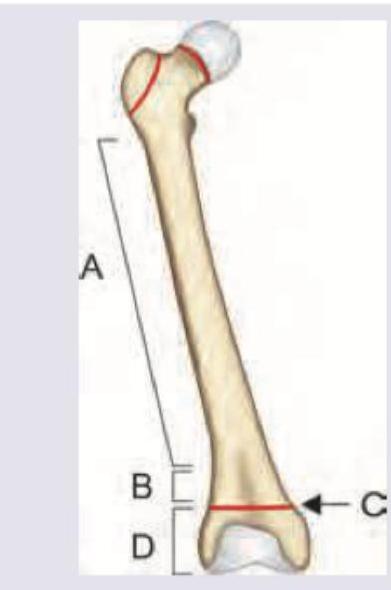
In a child with rickets which part of the bone is affected?
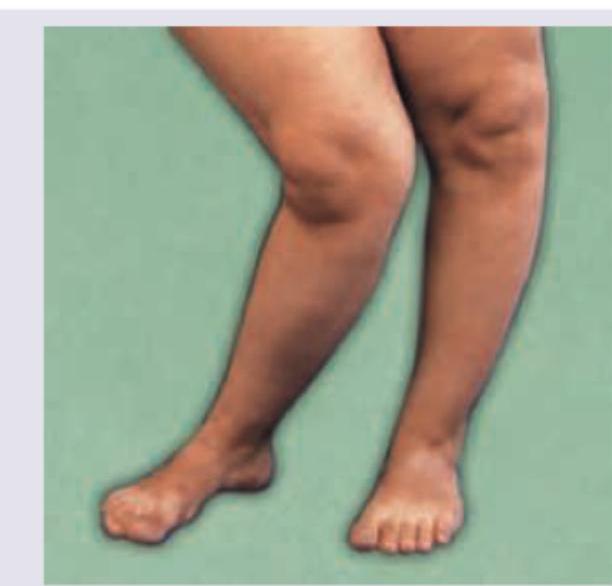
Identify the deformity seen in this child with rickets:
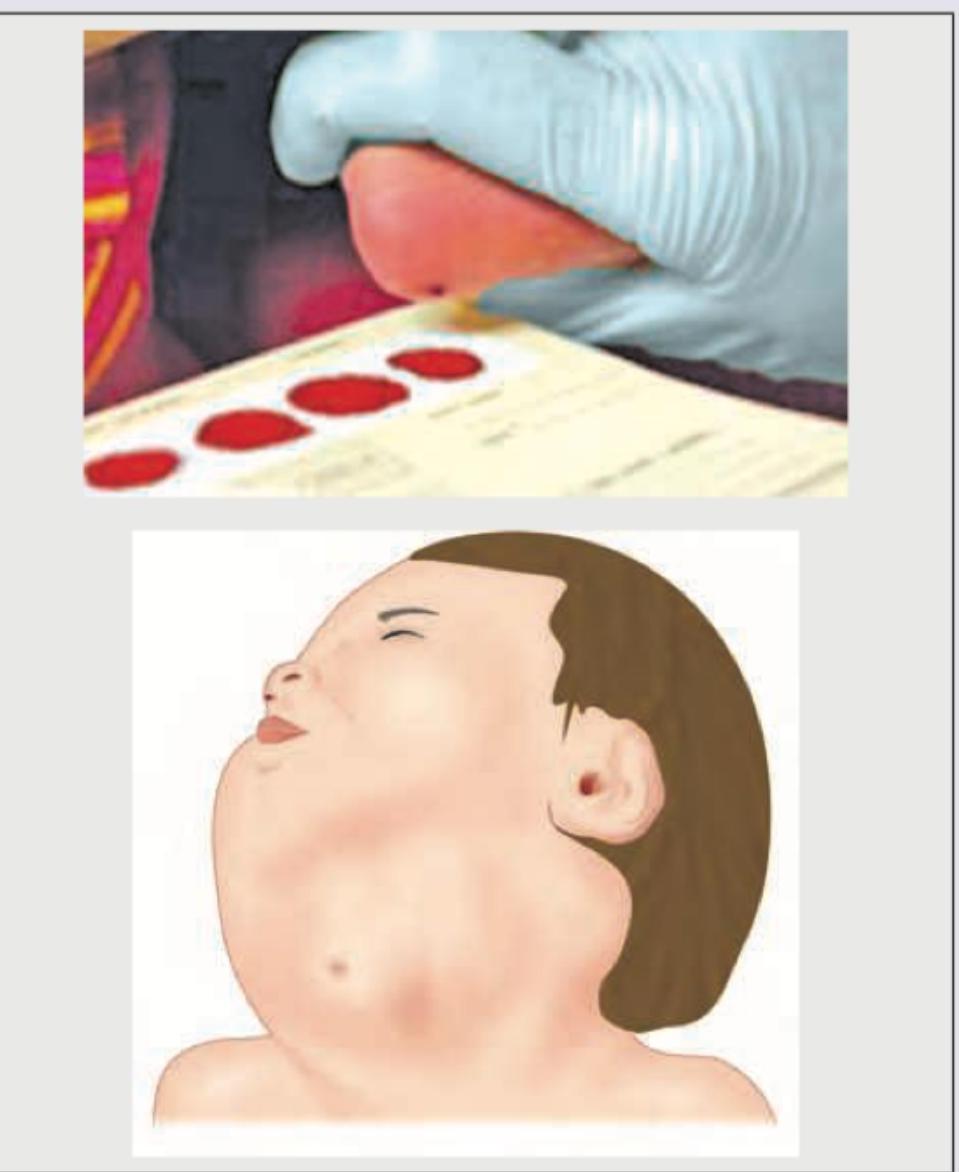
In a neonate with the following findings, what is the likely etiology of hypothyroidism? (NEET Pattern 2018)
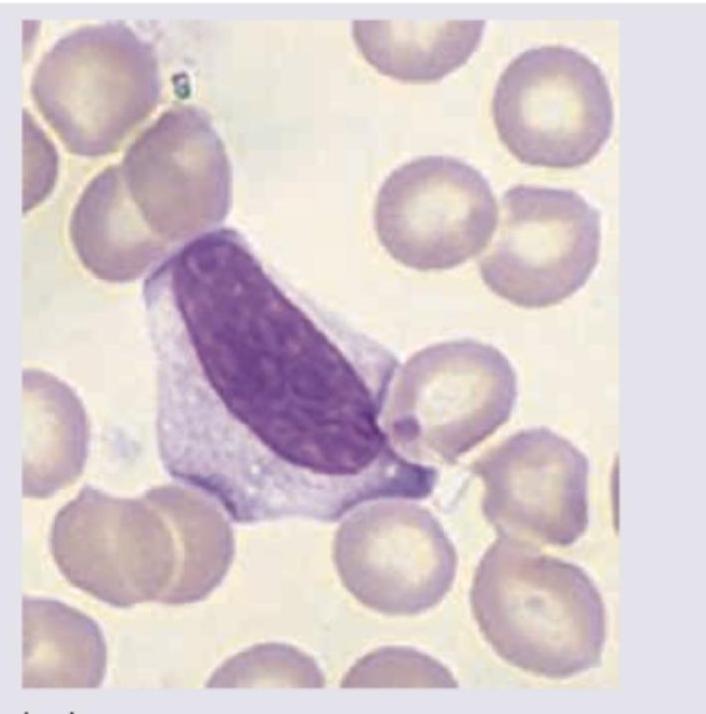
The following cell type is seen in peripheral smear of a patient with membrane over the tonsils. All can be used in treatment except?
NEET-PG 2018 - Pediatrics NEET-PG Practice Questions and MCQs
Question 21: In a child with rickets which part of the bone is affected?
- A. A
- B. B
- C. C (Correct Answer)
- D. D
Explanation: ***C*** - C points to the **growth plate (physis) and metaphyseal region**, which is the **primary site of pathology in rickets**. - Rickets causes defective mineralization at the growth plate where endochondral ossification occurs, leading to accumulation of unmineralized osteoid and disorganized chondrocyte columns. - The **metaphysis** (the region including the growth plate) shows the characteristic radiological findings: widening, fraying, cupping, and loss of sharp margins. *A* - A indicates the **diaphysis** (shaft of the bone), which consists of mature cortical bone. - The diaphysis is **not primarily affected** in rickets, though severe cases may lead to bowing deformities due to bone softening. - The initial and primary pathological changes occur at the actively growing regions, not the shaft. *B* - B points to the **metaphysis**, which is the flared region of long bone adjacent to the growth plate. - The metaphysis is indeed significantly affected in rickets, showing widening and irregular mineralization. - However, if the image distinguishes between the broader metaphyseal region (B) and the specific growth plate zone (C), then C represents the more precise site where the pathological process of defective mineralization originates. *D* - D points to the **epiphysis**, the rounded end of the long bone that forms part of the joint. - The epiphysis consists of already-formed bone and is **not the primary site** of rickets pathology. - Rickets affects the zone of provisional calcification at the growth plate, not the pre-existing epiphyseal bone.
Question 22: Identify the deformity seen in this child with rickets:
- A. Genu varum (Bow legs) (Correct Answer)
- B. Genu valgum (knock knees)
- C. Windswept deformity
- D. Gunstock deformity
Explanation: ***Genu varum (Bow legs)*** - The image shows the knees bowed outwards resulting in a **bow-legged appearance**, which is characteristic of **genu varum**. - **Rickets** is a common cause of genu varum, as the softened bones are unable to bear weight and bend outwards. *Genu valgum (knock knees)* - **Genu valgum** presents as the knees bending inwards, appearing to "knock" against each other, which is the opposite of what is seen in the image. - While rickets can also cause genu valgum, the depicted deformity clearly shows outward bowing. *Windswept deformity* - A **windswept deformity** involves one knee being in **valgus** (knock-kneed) and the other in **varus** (bow-legged). - The image does not show this combination; both knees appear to be bowed outwards. *Gunstock deformity* - **Gunstock deformity** is an angular deformity of the elbow, typically related to a **supracondylar humerus fracture**. - This deformity affects the upper limb and is not related to the lower limb presentation in the image.
Question 23: In a neonate with the following findings, what is the likely etiology of hypothyroidism? (NEET Pattern 2018)
- A. Chronic lymphocytic thyroiditis
- B. Thyroid dyshormonogenesis
- C. Thyroid dysgenesis (Correct Answer)
- D. None of above
Explanation: ***Thyroid dysgenesis*** - The image shows a neonate with **cretinism features** (e.g., puffy face, large tongue, umbilical hernia) and a **newborn screening card** being collected (heel prick blood spots). - **Thyroid dysgenesis** (aplasia, hypoplasia, or ectopic thyroid) is the most common cause of **congenital hypothyroidism**, accounting for about 85% of cases. *Chronic lymphocytic thyroiditis* - Also known as **Hashimoto's thyroiditis**, this is an **autoimmune condition** that primarily affects adults and older children, not typically neonates. - While it can lead to hypothyroidism, it is an **acquired** rather than a congenital cause. *Thyroid dyshormonogenesis* - This refers to genetic defects in the **synthesis of thyroid hormones** due to enzymatic deficiencies within a structurally normal thyroid gland. - While it is a **congenital cause** of hypothyroidism, it is less common than thyroid dysgenesis (accounting for about 10-15% of cases). *None of above* - This option is incorrect because **thyroid dysgenesis** is a highly likely etiology given the clinical presentation and context of newborn screening.
Question 24: The following cell type is seen in peripheral smear of a patient with membrane over the tonsils. All can be used in treatment except?
- A. Acyclovir (Correct Answer)
- B. Prednisolone
- C. IVIG
- D. Acetaminophen
Explanation: ***Acyclovir*** - The image depicts an **atypical lymphocyte** (Downey cell), characteristic of **infectious mononucleosis**, commonly caused by the **Epstein-Barr virus (EBV)**. - Acyclovir is an **antiviral medication** primarily used for **herpes simplex virus (HSV)** and **varicella-zoster virus (VZV)** infections, and it is **not effective against EBV**. *Prednisolone* - **Corticosteroids** like prednisolone may be used in severe cases of infectious mononucleosis, especially when complications such as **airway obstruction** due to tonsillar hypertrophy, **hemolytic anemia**, or **thrombocytopenia** are present. - They help to **reduce inflammation** and suppress the immune response. *IVIG* - **Intravenous immunoglobulin (IVIG)** can be used in rare, severe, or complicated cases of infectious mononucleosis, particularly if there are significant **hematologic complications** (e.g., severe thrombocytopenia, severe hemolytic anemia) or in patients with **immunodeficiency**. - IVIG provides **passive immunity** and modulates the immune response. *Acetaminophen* - **Acetaminophen (paracetamol)** is a common **analgesic** and **antipyretic** used to manage symptomatic relief for fever, sore throat, and muscle aches associated with infectious mononucleosis. - It helps to **alleviate discomfort** and improve patient well-being during the acute phase of the illness.