Biochemistry
1 questionsWhich of the following is an example of an X-linked disorder?
NEET-PG 2018 - Biochemistry NEET-PG Practice Questions and MCQs
Question 71: Which of the following is an example of an X-linked disorder?
- A. Color blindness (Correct Answer)
- B. Thalassemia
- C. Azoospermia
- D. Sickle cell anemia
Explanation: ***Color blindness*** - **Color blindness**, particularly red-green color blindness, is a classic example of an **X-linked recessive disorder**. - It results from mutations in genes encoding **photopigments** located on the X chromosome, affecting more males than females. - Represents one of the most commonly cited examples of X-linked inheritance in medical education. *Thalassemia* - **Thalassemia** is an **autosomal recessive disorder** affecting the synthesis of hemoglobin chains (α or β chains). - Not an X-linked condition; mutations are in genes on chromosome 16 (α-thalassemia) or chromosome 11 (β-thalassemia). - Commonly seen in populations from the Mediterranean, Middle East, and Asia. *Azoospermia* - **Azoospermia** (absence of sperm in ejaculate) is a clinical finding, not a specific genetic disorder. - Can result from various genetic causes including **Y-chromosome microdeletions** and **autosomal mutations** (e.g., CFTR gene in congenital bilateral absence of vas deferens). - Not classified as an X-linked disorder. *Sickle cell anemia* - **Sickle cell anemia** is an **autosomal recessive disorder** caused by a mutation in the β-globin gene on chromosome 11. - Results from substitution of valine for glutamic acid at position 6 of the β-globin chain (HbS). - Not an X-linked condition; both males and females are equally affected when inheriting two copies of the mutant allele.
Community Medicine
1 questionsIncidence of a disease is 4 per 1000 of population with duration of 2 years. Calculate the prevalence?
NEET-PG 2018 - Community Medicine NEET-PG Practice Questions and MCQs
Question 71: Incidence of a disease is 4 per 1000 of population with duration of 2 years. Calculate the prevalence?
- A. 8 per 1000 (Correct Answer)
- B. 4 per 1000
- C. 2 per 1000
- D. 6 per 1000
Explanation: ***8 per 1000*** - Prevalence can be estimated by multiplying the **incidence rate** by the **duration of the disease**. - In this case, 4/1000 (incidence) * 2 years (duration) = **8 per 1000**. *4 per 1000* - This value represents the **incidence** of the disease, which is the rate of new cases, not the total number of existing cases (prevalence). - Prevalence includes both new and existing cases over a specified period. *2 per 1000* - This value is obtained by dividing the incidence by the duration (4/2), which is not the correct formula for calculating prevalence in this context. - Doing so would incorrectly imply a lower disease burden than what is indicated by the incidence and duration. *6 per 1000* - This option is simply the sum of incidence and duration (4+2), which does not represent a valid epidemiological calculation for prevalence. - Prevalence is determined by considering both the rate of new cases and how long individuals typically live with the disease.
Dermatology
1 questionsCutis marmorata occurs due to exposure to –
NEET-PG 2018 - Dermatology NEET-PG Practice Questions and MCQs
Question 71: Cutis marmorata occurs due to exposure to –
- A. Cold temperature (Correct Answer)
- B. Dust
- C. Hot temperature
- D. Humidity
Explanation: ***Cold temperature*** - **Cutis marmorata** is a physiological response to **cold temperatures**, characterized by a mottled, reticulated vascular pattern on the skin. - This occurs due to **vasoconstriction** of the small arteries and arterioles, alongside **vasodilation** of the venules, creating the characteristic marbled appearance. *Dust* - Exposure to **dust** typically causes **irritation**, allergic reactions, or respiratory issues, such as **dermatitis**, **contact urticaria**, or **asthma**. - It does not directly lead to the characteristic vascular changes seen in cutis marmorata. *Hot temperature* - **Hot temperatures** generally cause **vasodilation** in the skin to facilitate **heat dissipation**, leading to redness and warmth. - This is the opposite physiological response to cutis marmorata, which involves vasoconstriction. *Humidity* - **Humidity** primarily affects **skin hydration** and the rate of perspiration, potentially exacerbating certain skin conditions like **eczema** or **fungal infections**. - High or low humidity does not directly induce the vascular changes that result in cutis marmorata.
Internal Medicine
1 questionsTRALI occurs within how many hours of transfusion?
NEET-PG 2018 - Internal Medicine NEET-PG Practice Questions and MCQs
Question 71: TRALI occurs within how many hours of transfusion?
- A. 6 hours (Correct Answer)
- B. 48 hours
- C. 72 hours
- D. 12 hours
Explanation: ***6 hours*** - **Transfusion-related acute lung injury (TRALI)** is defined as new acute lung injury occurring during or within **6 hours** after the completion of a blood transfusion [1]. - It is a severe and potentially life-threatening transfusion reaction characterized by **acute respiratory distress**, **hypoxemia**, and **bilateral pulmonary infiltrates** on chest imaging [1]. *48 hours* - While other transfusion reactions or complications may manifest within 48 hours, TRALI has a more **acute onset**, typically within the first 6 hours. - A pulmonary event occurring between 6 and 48 hours post-transfusion might be considered **delayed TRALI** or another diagnosis like **transfusion-associated circulatory overload (TACO)**, but the classic definition refers to the 6-hour window. *72 hours* - Reactions occurring 72 hours after transfusion are generally considered **delayed transfusion reactions**, which include conditions like **delayed hemolytic transfusion reactions** or **post-transfusion purpura**. - This timeframe is too long for the typical presentation of TRALI, which is characterized by rapid onset. *12 hours* - Although 12 hours falls within an acute window, the most commonly accepted and diagnostically crucial timeframe for TRALI is **within 6 hours** of transfusion. - A reaction occurring between 6 and 12 hours would still be considered suspiciously TRALI, but the strict definition emphasizes the earlier onset.
Microbiology
2 questionsWhich of the following organisms is MOST associated with histamine production in scombroid fish poisoning?
Which organism is the most common cause of acute bacterial prostatitis?
NEET-PG 2018 - Microbiology NEET-PG Practice Questions and MCQs
Question 71: Which of the following organisms is MOST associated with histamine production in scombroid fish poisoning?
- A. Morganella morganii (Correct Answer)
- B. P. aeruginosa
- C. Staphylococcus
- D. Salmonella
Explanation: ***Morganella morganii*** - ***Morganella morganii*** is the **MOST commonly implicated organism** in **scombroid fish poisoning** - It produces the enzyme **histidine decarboxylase**, which converts **histidine** (abundant in scombroid fish like tuna, mackerel, bonito) to **histamine** - When fish are stored at improper temperatures (>15°C), *M. morganii* proliferates and produces large amounts of **histamine** - Other histamine-producing bacteria include *Klebsiella*, *Proteus*, *Enterobacter*, and *Photobacterium* species - Symptoms mimic an **allergic reaction**: flushing, headache, palpitations, urticaria, diarrhea *Staphylococcus* - ***Staphylococcus aureus*** causes **staphylococcal food poisoning** through preformed **enterotoxins** (not histamine) - Associated with protein-rich foods left at room temperature - Causes rapid-onset nausea, vomiting, and abdominal cramps - **Not a significant cause** of scombroid fish poisoning *Salmonella* - ***Salmonella*** species cause **gastroenteritis** through direct infection and invasion of intestinal mucosa - Symptoms include **diarrhea**, **fever**, and **abdominal cramps** with longer incubation period (6-72 hours) - **Not associated** with histamine production or scombroid poisoning *P. aeruginosa* - ***Pseudomonas aeruginosa*** is an **opportunistic pathogen** causing hospital-acquired infections - Associated with wound infections, pneumonia, and UTIs in immunocompromised patients - **Not a cause** of foodborne histamine poisoning
Question 72: Which organism is the most common cause of acute bacterial prostatitis?
- A. Enterococcus
- B. Streptococcus viridans
- C. Peptostreptococcus
- D. E.coli (Correct Answer)
Explanation: ***E.coli*** - **E.coli** is the most common cause of **acute bacterial prostatitis**, accounting for a significant majority of cases. - It is a **gram-negative rod** commonly found in the gastrointestinal tract and can ascend into the urinary tract and prostate. *Enterococcus* - While **Enterococcus species** can cause urinary tract infections and, less commonly, prostatitis, they are a distant second to E.coli in frequency. - They are **gram-positive cocci** and are often associated with catheter-associated infections or healthcare-acquired infections. *Streptococcus viridans* - **Streptococcus viridans** group bacteria are typically commensals of the oral cavity and are more known for causing **endocarditis** or dental infections. - They are not a common cause of acute bacterial prostatitis. *Peptostreptococcus* - **Peptostreptococcus** is a genus of **anaerobic gram-positive cocci** commonly found in the normal flora of the mouth, gastrointestinal tract, and vagina. - They are typically involved in **polymicrobial anaerobic infections** but are not a primary or common cause of acute bacterial prostatitis.
Pathology
1 questionsBernard–Soulier syndrome is caused by a deficiency of which glycoprotein complex?
NEET-PG 2018 - Pathology NEET-PG Practice Questions and MCQs
Question 71: Bernard–Soulier syndrome is caused by a deficiency of which glycoprotein complex?
- A. TNF
- B. von Willebrand factor (vWf)
- C. Gp Ib-IX-V complex (Correct Answer)
- D. Gp IIb/IIIa
Explanation: ***Gp 1b*** - Bernard–Soulier syndrome is primarily caused by a deficiency in **Gp1b**, which is crucial for platelet adhesion to the von Willebrand factor (vWF) [1]. - This results in **thrombocytopenia** and large platelets, which are characteristic features of the syndrome. *Gp 2b/3a* - Gp2b/3a is associated with **Glanzmann thrombasthenia**, not Bernard–Soulier syndrome [1]. - This receptor is essential for platelet aggregation and binds fibrinogen, contributing to a different bleeding disorder. *TNF* - Tumor Necrosis Factor (TNF) is a cytokine involved in systemic inflammation and does not directly relate to platelet function or deficiencies. - Deficiency of TNF is unrelated to bleeding disorders like Bernard–Soulier syndrome. *vWf* - von Willebrand factor (vWf) deficiency is associated with **von Willebrand disease**, which presents differently than Bernard–Soulier syndrome. - vWf is essential for the aggregation of platelets but is not the deficient factor in this syndrome. **References:** [1] Kumar V, Abbas AK, et al.. Robbins and Cotran Pathologic Basis of Disease. 9th ed. Red Blood Cell and Bleeding Disorders, pp. 668-669.
Pharmacology
2 questionsWhich drug decreases the bone resorption in osteoporosis?
Endothelin primarily acts through which type of receptors?
NEET-PG 2018 - Pharmacology NEET-PG Practice Questions and MCQs
Question 71: Which drug decreases the bone resorption in osteoporosis?
- A. Teriparatide
- B. Risedronate (Correct Answer)
- C. Cortisone
- D. Cimetidine
Explanation: ***Risedronate*** - **Risedronate** is a **bisphosphonate**, a class of drugs that inhibits osteoclast activity, thereby decreasing **bone resorption**. - By reducing the rate at which bone is broken down, it helps to preserve **bone mineral density** in patients with osteoporosis. *Teriparatide* - **Teriparatide** is a **parathyroid hormone analog** that primarily works by stimulating **osteoblast activity** to promote new bone formation. - While it treats osteoporosis, its primary mechanism is **anabolic** (bone building), not directly decreasing bone resorption as its main effect. *Cortisone* - **Cortisone** is a **glucocorticoid** that can actually *worsen* osteoporosis by increasing **bone resorption** and decreasing **bone formation** with long-term use. - It is used to treat inflammatory conditions, not to decrease bone resorption for osteoporosis. *Cimetidine* - **Cimetidine** is an **H2-receptor antagonist** used to reduce stomach acid production, commonly for conditions like GERD or ulcers. - It has no known effect on **bone metabolism** or **osteoporosis**.
Question 72: Endothelin primarily acts through which type of receptors?
- A. Calcium receptors
- B. General receptor type (GPCRs)
- C. Endothelin receptor type B (ETB)
- D. Endothelin receptor type A (ETA) (Correct Answer)
Explanation: ***Endothelin receptor type A (ETA)*** - **ETA receptors** are primarily responsible for the **vasoconstrictive effects** of endothelin-1 in various tissues, leading to increased vascular tone and blood pressure. - Activation of **ETA receptors** on vascular smooth muscle cells mediates signaling pathways that result in **smooth muscle contraction**. *Endothelin receptor type B (ETB)* - **ETB receptors** have dual roles, mediating both **vasoconstriction** (via smooth muscle ETB) and **vasodilation** (via endothelial ETB, stimulating nitric oxide and prostacyclin release). - They also play a significant role in **clearance of endothelin-1** from circulation. *General receptor type (GPCRs)* - While **endothelin receptors (ETA and ETB)** are indeed **G protein-coupled receptors (GPCRs)**, "General receptor type (GPCRs)" is too broad and not the most specific answer for how endothelin *primarily acts*. - Endothelin's specific effects are mediated through its dedicated subtypes of GPCRs, not the general class. *Calcium receptors* - **Calcium receptors** (e.g., calcium-sensing receptors) are involved in sensing extracellular calcium levels and regulating calcium homeostasis. - Endothelin's mechanism involves **intracellular calcium mobilization** *after* receptor activation, but it does not act *through* calcium receptors.
Radiology
1 questionsWhat is the structure seen in the X-ray?
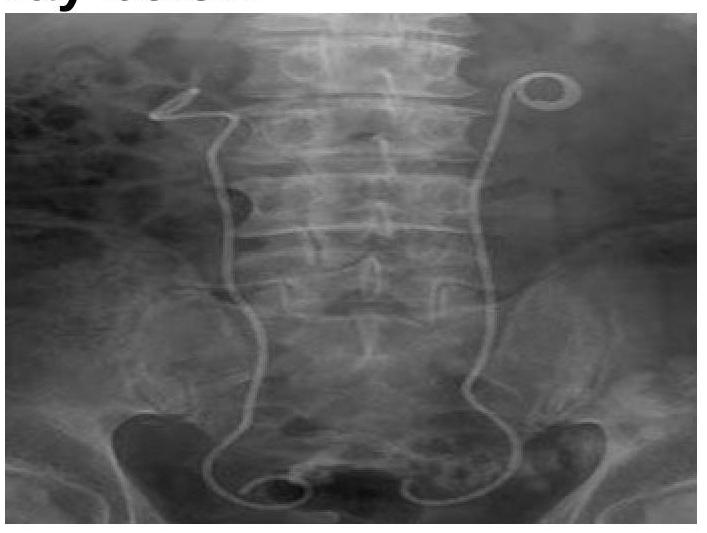
NEET-PG 2018 - Radiology NEET-PG Practice Questions and MCQs
Question 71: What is the structure seen in the X-ray?
- A. Stent (Correct Answer)
- B. Surgical clips
- C. Foley catheter
- D. Intravesical wire
Explanation: ***Stent*** - The image clearly shows **bilateral coiled structures** (pigtails) at the proximal and distal ends within the renal pelvis and bladder, which are characteristic features of **double J stents (ureteral stents)**. - These devices are used to maintain patency in the **ureters**, often to bypass obstructions or facilitate urine drainage. *Surgical clips* - **Surgical clips** are typically small, dense, metallic objects used to ligate vessels or tissue, appearing as tiny, bright specks on X-rays. - The structures seen in the image are long, tubular, and coiled, which is inconsistent with the appearance of surgical clips. *Foley catheter* - A **Foley catheter** is a flexible tube inserted into the bladder to drain urine, sometimes with a balloon tip. - It would typically be seen entirely within the **bladder**, and its path would not extend bilaterally into the renal pelvis as shown. *Intravesical wire* - An **intravesical wire** (a wire entirely within the bladder) would appear as a coiled or linear structure confined to the bladder itself. - The structures in the image extend from the renal region down into the bladder, traversing the **ureters**, which is not typical for an intravesical wire.