Anatomy
1 questionsUreteric bud develops from:
NEET-PG 2018 - Anatomy NEET-PG Practice Questions and MCQs
Question 41: Ureteric bud develops from:
- A. Mesonephros (Correct Answer)
- B. Metanephros
- C. Pronephros
- D. Genital sinus
Explanation: ***Mesonephros*** - The **ureteric bud** arises as an outgrowth of the **mesonephric duct** (Wolffian duct), which is the duct of the mesonephros. - The ureteric bud emerges from the **caudal portion of the mesonephric duct** near its entry into the cloaca around the 5th week of development. - It plays a crucial role in forming the **collecting system of the kidney**, including the ureter, renal pelvis, major and minor calyces, and collecting ducts. - **Note:** While technically the ureteric bud arises from the mesonephric duct (not the mesonephric tubules), "mesonephros" is accepted as the answer referring to the mesonephric duct system. *Metanephros* - The **metanephric mesoderm** (metanephric blastema) is induced by the ureteric bud to form the **definitive kidney**. - The metanephros forms the **nephrons** (from Bowman's capsule to distal convoluted tubule). - It does not give rise to the ureteric bud; rather, it interacts with it through **reciprocal induction**. *Pronephros* - The **pronephros** is the first, transient, and **non-functional** kidney structure in human embryonic development. - It appears in the **cervical region** around week 4 and completely **regresses** by week 5. - It does not contribute to the formation of the ureteric bud or the adult kidney. *Genital sinus* - The **urogenital sinus** is derived from the ventral part of the cloaca after division by the urorectal septum. - It gives rise to the **bladder**, parts of the urethra, and contributes to external genitalia. - It is not involved in the development of the ureteric bud or the kidney's collecting system.
Biochemistry
1 questionsWhich enzyme deficiency causes Lesch-Nyhan syndrome?
NEET-PG 2018 - Biochemistry NEET-PG Practice Questions and MCQs
Question 41: Which enzyme deficiency causes Lesch-Nyhan syndrome?
- A. Hypoxanthine-guanine phosphoribosyltransferase (HGPRT) (Correct Answer)
- B. Xanthine oxidase
- C. Adenine phosphoribosyltransferase (APRT)
- D. AMP deaminase
Explanation: ***Hypoxanthine-guanine phosphoribosyltransferase (HGPRT)*** - **Lesch-Nyhan syndrome** is an X-linked recessive disorder caused by a severe deficiency of the enzyme **HGPRT**. - This deficiency leads to a buildup of **uric acid** due to impaired purine salvage, as well as neurologic dysfunction and self-mutilation. *Xanthine oxidase deficiency* - This deficiency leads to **xanthinuria**, characterized by high levels of xanthine in the urine, which can cause **kidney stones**. - It does not cause the severe neurological and behavioral symptoms seen in Lesch-Nyhan syndrome. *Adenine phosphoribosyltransferase (APRT) deficiency* - Deficiency of **APRT** causes a rare disorder resulting in the overproduction of **2,8-dihydroxyadenine**, which can form renal stones. - While it is involved in purine metabolism, it does not lead to the specific clinical presentation of Lesch-Nyhan syndrome. *AMP deaminase deficiency* - **AMP deaminase deficiency** is a relatively common enzyme defect that can cause exercise-induced myalgia or fatigue. - It affects muscle function and energy metabolism but is not associated with the severe hyperuricemia and neurobehavioral symptoms of Lesch-Nyhan syndrome.
Internal Medicine
1 questionsA boy presented with multiple non suppurative osteomyelitis with sickle cell anaemia. What will be the causative organism?
NEET-PG 2018 - Internal Medicine NEET-PG Practice Questions and MCQs
Question 41: A boy presented with multiple non suppurative osteomyelitis with sickle cell anaemia. What will be the causative organism?
- A. Salmonella (Correct Answer)
- B. H. influenzae
- C. Enterobacter species
- D. Staphylococcus aureus
Explanation: ***Salmonella*** - **Salmonella species** are a well-known cause of **osteomyelitis** in patients with **sickle cell anemia**, due to factors like gut mucosal damage and functional asplenia. [1] - The unique pathophysiology of sickle cell disease, including areas of bone infarction and compromised reticulendothelial system function, predisposes these patients to **Salmonella infections**. [1] *Staphylococcus aureus* - While **Staphylococcus aureus** is the most common cause of osteomyelitis in the general population, it is less likely to be the causative organism in patients with **sickle cell anemia** compared to Salmonella. - Its presence usually indicates other predisposing factors like trauma or prosthetic devices. *H. influenzae* - **Haemophilus influenzae** was a common cause of osteomyelitis in children before widespread vaccination but is now rare, especially with routine immunizations. - It is not specifically associated with a higher risk in patients with **sickle cell disease** for osteomyelitis compared to other pathogens. *Enterobacter species* - **Enterobacter species** can cause osteomyelitis, particularly in immunocompromised individuals or following surgery, but they are not uniquely associated with **sickle cell anemia** as a primary cause compared to Salmonella. - Their involvement in non-suppurative osteomyelitis in this specific patient population is less common.
Obstetrics and Gynecology
5 questionsBest time to perform the quadruple test is:
What type of uterine anomaly is shown in this X-ray HSG image?

What are the effects of Progesterone-only pills?
Which of the following is not a high-risk pregnancy?
What is meant by Superfecundation?
NEET-PG 2018 - Obstetrics and Gynecology NEET-PG Practice Questions and MCQs
Question 41: Best time to perform the quadruple test is:
- A. 8-12 weeks
- B. 11-15 weeks
- C. 15-20 weeks (Correct Answer)
- D. 18-22 weeks
Explanation: ***15-20 weeks*** - The quadruple test measures levels of four substances (**alpha-fetoprotein**, **human chorionic gonadotropin**, **unconjugated estriol**, and **inhibin A**) in the mother's blood. - This window is optimal for detecting neural tube defects and chromosomal abnormalities like **Down syndrome** and **Trisomy 18**, allowing for timely counseling and further diagnostic testing if needed. *8-12 weeks* - This period is generally too early for the quadruple test to be accurate, as the levels of the markers would not be sufficiently distinct for reliable screening. - The **combined first-trimester screening** (nuchal translucency and blood tests for PAPP-A and hCG) is typically performed during this time. *11-15 weeks* - While some components might be detectable at the later end of this range, 15-20 weeks offers a more accurate window for all four markers of the quadruple test. - **Integrated screening**, which combines first and second-trimester markers, would involve blood draws around 10-14 weeks and then 15-20 weeks. *18-22 weeks* - This period is generally considered too late for optimal results of the quadruple test, as the fetal markers might be less indicative or diagnostic interventions options might be limited. - A **detailed ultrasound** for anatomical survey is usually performed around this time.
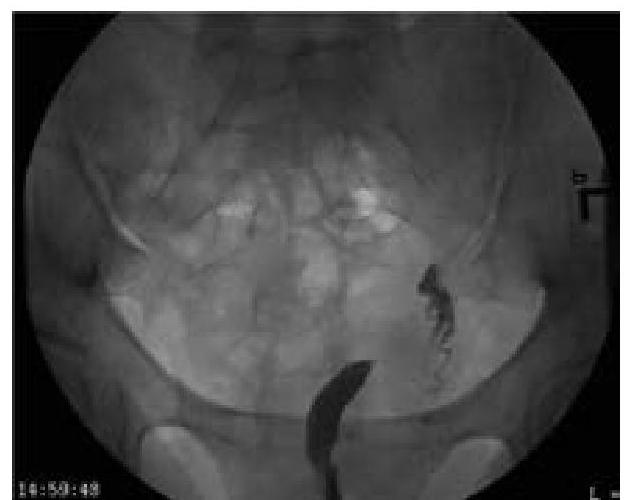
Question 42: What type of uterine anomaly is shown in this X-ray HSG image?
- A. Septate uterus
- B. Uterus didelphys
- C. Unicornuate uterus (Correct Answer)
- D. Bicornuate uterus
Explanation: ***Unicornuate uterus*** - The image shows a single, elongated uterine horn with a single fallopian tube arising from it, consistent with a **unicornuate uterus**. - This congenital anomaly results from the **failure of one Müllerian duct to develop**, leading to an abnormally shaped uterus. *Septate uterus* - A **septate uterus** would show a normal uterine fundus with an internal septum dividing the uterine cavity. - This image clearly depicts only **one rudimentary horn** and no visible septum. *Uterus didelphys* - **Uterus didelphys** involves two completely separate uteri, each with its own cervix and vagina. - The image does not show evidence of a **second, separate uterine structure**. *Bicornuate uterus* - A **bicornuate uterus** is characterized by two distinct uterine horns, which fuse at the cervix or lower uterine segment, creating a heart-shaped appearance of the fundus. - The image shows a **single, long horn** rather than two distinct horns.
Question 43: What are the effects of Progesterone-only pills?
- A. All of the options may occur (Correct Answer)
- B. May suppress ovulation
- C. Thins the lining of the uterus
- D. Thickens cervical mucus
Explanation: ***All of the options may occur*** - Progesterone-only pills (POPs) work through **multiple complementary mechanisms** that collectively provide effective contraception. - All three effects occur simultaneously and contribute to the overall contraceptive efficacy of POPs. - Understanding these mechanisms helps explain why POPs are effective despite lower hormone doses compared to combined oral contraceptives. **Mechanism 1: May suppress ovulation** - POPs can **partially suppress ovulation**, preventing the release of an egg. - Traditional POPs suppress ovulation in approximately 40-60% of cycles, while newer desogestrel-containing POPs achieve higher rates (97-99%). - This effect depends on the dose and type of progestin used in the formulation. **Mechanism 2: Thins the lining of the uterus** - Progesterone causes **endometrial atrophy**, making the uterine lining thin and unsuitable for embryo implantation. - This hostile uterine environment acts as a backup contraceptive mechanism if ovulation and fertilization occur. - Endometrial changes occur consistently with POP use. **Mechanism 3: Thickens cervical mucus** - This is the **primary and most consistent mechanism** of POPs. - Progesterone significantly **increases cervical mucus viscosity** and reduces its quantity within hours of administration. - The thickened mucus creates a physical barrier that prevents sperm penetration, motility, and viability.
Question 44: Which of the following is not a high-risk pregnancy?
- A. Age 25-30 years (Correct Answer)
- B. Diabetes mellitus
- C. Previous history of manual removal of placenta
- D. Anemia
Explanation: ***Age 25-30 years*** - An age of **25-30 years** is generally considered the optimal reproductive age range, and pregnancies within this bracket are typically classified as low-risk based on age alone. - This age range carries the lowest statistical risk for both maternal and fetal complications, assuming no other co-morbidities. *Previous history of manual removal of placenta* - A previous history of manual removal of the placenta indicates a risk factor for **recurrent placental retention** or **morbidly adherent placenta** in future pregnancies, making it a high-risk factor. - This history suggests an increased likelihood of complications such as **postpartum hemorrhage** and can influence the management of subsequent deliveries. *Anemia* - **Anemia** in pregnancy, especially severe iron deficiency anemia, is considered a high-risk factor due to increased maternal and fetal morbidity. - It can lead to complications such as **preterm delivery**, **low birth weight**, and difficulties tolerating blood loss during delivery. *Diabetes mellitus* - **Diabetes mellitus**, whether pre-existing or gestational, makes a pregnancy high-risk due to potential adverse effects on both the mother and the fetus. - Risks include **preeclampsia**, **macrosomia**, **neonatal hypoglycemia**, and **congenital anomalies**.
Question 45: What is meant by Superfecundation?
- A. Fertilization of ova and then its division
- B. Fertilization of two or more ova in one intercourse
- C. Fertilization of two or more ova in different intercourses in same menstrual cycle (Correct Answer)
- D. Fertilization of second ovum after first one is already implanted
Explanation: ***Fertilization of two or more ova in different intercourses in same menstrual cycle*** - **Superfecundation** occurs when two or more ova released during the same menstrual cycle are fertilized by sperm from **separate acts of coitus**. - This can lead to **dizygotic twins** or multiples conceived at different times within a short window, potentially from different biological fathers. *Fertilization of two or more ova in one intercourse* - This scenario describes the fertilization of multiple ova within a **single sexual encounter**, often leading to **dizygotic multiples** but not superfecundation. - Superfecundation specifically implies fertilization from **separate instances of intercourse**. *Fertilization of ova and then its division* - This describes the formation of **monozygotic (identical) twins**, where a single fertilized ovum (zygote) later splits into two or more embryos. - It is distinct from superfecundation, which involves fertilization of **multiple ova**. *Fertilization of second ovum after first one is already implanted* - This describes **superfetation**, a rare phenomenon where a new pregnancy (fertilization and conception) occurs **while already pregnant** from a previous cycle. - Superfecundation, conversely, involves **multiple conceptions within the same menstrual cycle**, not across different cycles.
Physiology
1 questionsWhat happens to gas exchange when the Va/Q ratio approaches infinity?
NEET-PG 2018 - Physiology NEET-PG Practice Questions and MCQs
Question 41: What happens to gas exchange when the Va/Q ratio approaches infinity?
- A. Partial pressure of O2 becomes negligible.
- B. No exchange of O2 and CO2 occurs. (Correct Answer)
- C. Partial pressure of CO2 becomes negligible.
- D. Partial pressures of both CO2 and O2 remain normal.
Explanation: ***No exchange of O2 and CO2 occurs.*** - When the **Va/Q ratio approaches infinity**, it signifies a scenario of **ventilation without perfusion** (Q approaches zero). - This represents **alveolar dead space** - despite adequate ventilation, there is **no blood flow** to participate in gas exchange. - Therefore, **no O2 enters the blood** and **no CO2 leaves the blood**, making this the most accurate description of what happens to gas exchange. *Partial pressure of O2 becomes negligible.* - This statement is incorrect because with **no blood flow** (Q = 0), the alveolar air retains high O2 partial pressure. - O2 is being delivered via ventilation but not removed by blood, so **alveolar PO2** would approach that of **inspired air (~150 mmHg)**, not become negligible. *Partial pressure of CO2 becomes negligible.* - While this statement is technically true (alveolar PCO2 would approach zero/inspired air levels), it doesn't directly answer what happens to **gas exchange**. - With no blood flowing through the alveolus, no **CO2 from venous blood** can reach the alveolus to be excreted. - However, the question asks about **gas exchange** itself, not just partial pressures, making the first option more comprehensive. *Partial pressures of both CO2 and O2 remain normal.* - This statement is incorrect as the **Va/Q mismatch** significantly alters the partial pressures of both gases. - In infinite Va/Q scenario (dead space ventilation), **alveolar PO2 would be high** (approaching inspired air ~150 mmHg) and **alveolar PCO2 would be low** (approaching zero).
Radiology
1 questionsWhat is the structure seen in the X-ray?

NEET-PG 2018 - Radiology NEET-PG Practice Questions and MCQs
Question 41: What is the structure seen in the X-ray?
- A. Stent (Correct Answer)
- B. Surgical clips
- C. Foley catheter
- D. Intravesical wire
Explanation: ***Stent*** - The image clearly shows **bilateral coiled structures** (pigtails) at the proximal and distal ends within the renal pelvis and bladder, which are characteristic features of **double J stents (ureteral stents)**. - These devices are used to maintain patency in the **ureters**, often to bypass obstructions or facilitate urine drainage. *Surgical clips* - **Surgical clips** are typically small, dense, metallic objects used to ligate vessels or tissue, appearing as tiny, bright specks on X-rays. - The structures seen in the image are long, tubular, and coiled, which is inconsistent with the appearance of surgical clips. *Foley catheter* - A **Foley catheter** is a flexible tube inserted into the bladder to drain urine, sometimes with a balloon tip. - It would typically be seen entirely within the **bladder**, and its path would not extend bilaterally into the renal pelvis as shown. *Intravesical wire* - An **intravesical wire** (a wire entirely within the bladder) would appear as a coiled or linear structure confined to the bladder itself. - The structures in the image extend from the renal region down into the bladder, traversing the **ureters**, which is not typical for an intravesical wire.