Anatomy
1 questionsUreteric bud develops from:
NEET-PG 2018 - Anatomy NEET-PG Practice Questions and MCQs
Question 21: Ureteric bud develops from:
- A. Mesonephros (Correct Answer)
- B. Metanephros
- C. Pronephros
- D. Genital sinus
Explanation: ***Mesonephros*** - The **ureteric bud** arises as an outgrowth of the **mesonephric duct** (Wolffian duct), which is the duct of the mesonephros. - The ureteric bud emerges from the **caudal portion of the mesonephric duct** near its entry into the cloaca around the 5th week of development. - It plays a crucial role in forming the **collecting system of the kidney**, including the ureter, renal pelvis, major and minor calyces, and collecting ducts. - **Note:** While technically the ureteric bud arises from the mesonephric duct (not the mesonephric tubules), "mesonephros" is accepted as the answer referring to the mesonephric duct system. *Metanephros* - The **metanephric mesoderm** (metanephric blastema) is induced by the ureteric bud to form the **definitive kidney**. - The metanephros forms the **nephrons** (from Bowman's capsule to distal convoluted tubule). - It does not give rise to the ureteric bud; rather, it interacts with it through **reciprocal induction**. *Pronephros* - The **pronephros** is the first, transient, and **non-functional** kidney structure in human embryonic development. - It appears in the **cervical region** around week 4 and completely **regresses** by week 5. - It does not contribute to the formation of the ureteric bud or the adult kidney. *Genital sinus* - The **urogenital sinus** is derived from the ventral part of the cloaca after division by the urorectal septum. - It gives rise to the **bladder**, parts of the urethra, and contributes to external genitalia. - It is not involved in the development of the ureteric bud or the kidney's collecting system.
Biochemistry
1 questionsWhich of the following is an example of an X-linked disorder?
NEET-PG 2018 - Biochemistry NEET-PG Practice Questions and MCQs
Question 21: Which of the following is an example of an X-linked disorder?
- A. Color blindness (Correct Answer)
- B. Thalassemia
- C. Azoospermia
- D. Sickle cell anemia
Explanation: ***Color blindness*** - **Color blindness**, particularly red-green color blindness, is a classic example of an **X-linked recessive disorder**. - It results from mutations in genes encoding **photopigments** located on the X chromosome, affecting more males than females. - Represents one of the most commonly cited examples of X-linked inheritance in medical education. *Thalassemia* - **Thalassemia** is an **autosomal recessive disorder** affecting the synthesis of hemoglobin chains (α or β chains). - Not an X-linked condition; mutations are in genes on chromosome 16 (α-thalassemia) or chromosome 11 (β-thalassemia). - Commonly seen in populations from the Mediterranean, Middle East, and Asia. *Azoospermia* - **Azoospermia** (absence of sperm in ejaculate) is a clinical finding, not a specific genetic disorder. - Can result from various genetic causes including **Y-chromosome microdeletions** and **autosomal mutations** (e.g., CFTR gene in congenital bilateral absence of vas deferens). - Not classified as an X-linked disorder. *Sickle cell anemia* - **Sickle cell anemia** is an **autosomal recessive disorder** caused by a mutation in the β-globin gene on chromosome 11. - Results from substitution of valine for glutamic acid at position 6 of the β-globin chain (HbS). - Not an X-linked condition; both males and females are equally affected when inheriting two copies of the mutant allele.
Community Medicine
1 questionsAccording to WHO classification, severe thinness is defined as a BMI below which value?
NEET-PG 2018 - Community Medicine NEET-PG Practice Questions and MCQs
Question 21: According to WHO classification, severe thinness is defined as a BMI below which value?
- A. 18
- B. 14
- C. < 16 (Correct Answer)
- D. 13
Explanation: ***Correct: < 16 kg/m²*** - The WHO classifies **BMI < 16 kg/m²** as **severe thinness (Grade 3 thinness)** - This represents critically low body weight with significant health risks - Values like 12, 13, 14, or 15 all fall into this severe thinness category *18* - BMI **18.5-24.9 kg/m²** is classified as **normal/healthy weight** by WHO - BMI **17.0-18.49 kg/m²** is classified as **mild thinness (Grade 1)** - 18 is not the threshold for severe thinness *14* - 14 kg/m² is **an example of a value** that falls within severe thinness - However, the question asks for the **threshold/cutoff value**, which is **16 kg/m²** - Any BMI below 16 (including 14, 13, 12) indicates severe thinness *13* - Like option 14, this is **a value within** the severe thinness range - The **defining threshold** is **< 16 kg/m²**, not 13 - The question asks for the classification cutoff, not an example value within the range
Microbiology
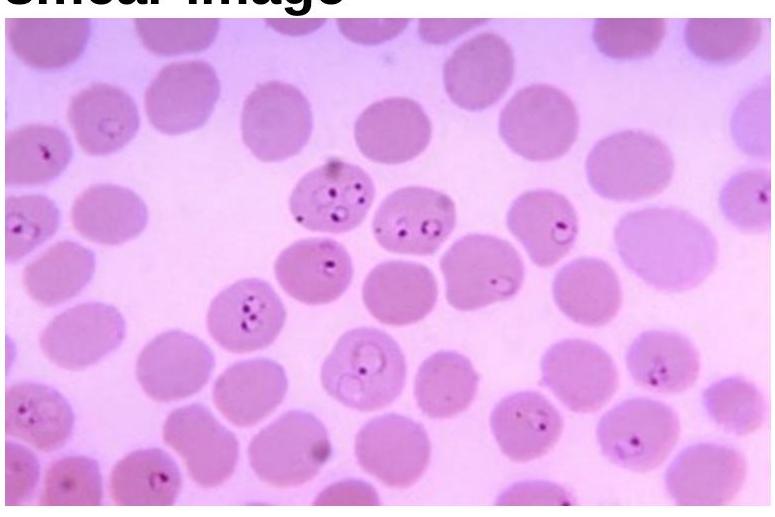
1 questionsIdentify the organism related to the blood smear image.
NEET-PG 2018 - Microbiology NEET-PG Practice Questions and MCQs
Question 21: Identify the organism related to the blood smear image.
- A. Plasmodium falciparum (Correct Answer)
- B. Salmonella Typhi
- C. Toxoplasma gondii
- D. Treponema pallidum
Explanation: ***Plasmodium falciparum*** - The image clearly displays multiple **ring-form trophozoites** within red blood cells, some of which are *appliqué* or *accolade* forms (rings on the periphery of the red blood cell) and **multiple rings per red blood cell**, which are characteristic of *P. falciparum*. - Presence of **multiple parasites per red blood cell** and various developmental stages including occasional **banana-shaped gametocytes**, though not prominent in this specific field, are key indicators of *P. falciparum* infection, differentiating it from other malarial species. - *P. falciparum* is the most dangerous malarial species and can cause **cerebral malaria** and other severe complications. *Salmonella Typhi* - This bacterium causes **typhoid fever** and is typically identified through **blood culture** or serological tests (Widal test), not by direct visualization within red blood cells on a peripheral blood smear. - *Salmonella Typhi* is an **intracellular bacterium** that primarily infects phagocytic cells (macrophages), not erythrocytes, and does not present as ring forms or other parasitic stages in blood smears. *Toxoplasma gondii* - This parasite causes **toxoplasmosis** and is typically found as **tachyzoites** or **bradyzoites** (within cysts) in tissue samples or less commonly in macrophages in disseminated disease, but not as ring forms within red blood cells on a peripheral blood smear. - Diagnosis usually involves **serological testing** for IgM/IgG antibodies or PCR, as opposed to direct visualization of unique forms in blood smears. *Treponema pallidum* - This is the spirochete responsible for **syphilis** and is too small and thin (0.1-0.2 μm diameter) to be seen with standard light microscopy on routine blood smears. - It is best identified using **dark-field microscopy** or serological tests (VDRL, RPR, TPPA, FTA-ABS) and does not infect red blood cells in the manner shown.
Obstetrics and Gynecology
3 questionsWhich of the following is not a high-risk pregnancy?
What type of uterine anomaly is shown in this X-ray HSG image?

Which of the following methods is known as a fimbriectomy procedure?
NEET-PG 2018 - Obstetrics and Gynecology NEET-PG Practice Questions and MCQs
Question 21: Which of the following is not a high-risk pregnancy?
- A. Age 25-30 years (Correct Answer)
- B. Diabetes mellitus
- C. Previous history of manual removal of placenta
- D. Anemia
Explanation: ***Age 25-30 years*** - An age of **25-30 years** is generally considered the optimal reproductive age range, and pregnancies within this bracket are typically classified as low-risk based on age alone. - This age range carries the lowest statistical risk for both maternal and fetal complications, assuming no other co-morbidities. *Previous history of manual removal of placenta* - A previous history of manual removal of the placenta indicates a risk factor for **recurrent placental retention** or **morbidly adherent placenta** in future pregnancies, making it a high-risk factor. - This history suggests an increased likelihood of complications such as **postpartum hemorrhage** and can influence the management of subsequent deliveries. *Anemia* - **Anemia** in pregnancy, especially severe iron deficiency anemia, is considered a high-risk factor due to increased maternal and fetal morbidity. - It can lead to complications such as **preterm delivery**, **low birth weight**, and difficulties tolerating blood loss during delivery. *Diabetes mellitus* - **Diabetes mellitus**, whether pre-existing or gestational, makes a pregnancy high-risk due to potential adverse effects on both the mother and the fetus. - Risks include **preeclampsia**, **macrosomia**, **neonatal hypoglycemia**, and **congenital anomalies**.
Question 22: What type of uterine anomaly is shown in this X-ray HSG image?
- A. Septate uterus
- B. Uterus didelphys
- C. Unicornuate uterus (Correct Answer)
- D. Bicornuate uterus
Explanation: ***Unicornuate uterus*** - The image shows a single, elongated uterine horn with a single fallopian tube arising from it, consistent with a **unicornuate uterus**. - This congenital anomaly results from the **failure of one Müllerian duct to develop**, leading to an abnormally shaped uterus. *Septate uterus* - A **septate uterus** would show a normal uterine fundus with an internal septum dividing the uterine cavity. - This image clearly depicts only **one rudimentary horn** and no visible septum. *Uterus didelphys* - **Uterus didelphys** involves two completely separate uteri, each with its own cervix and vagina. - The image does not show evidence of a **second, separate uterine structure**. *Bicornuate uterus* - A **bicornuate uterus** is characterized by two distinct uterine horns, which fuse at the cervix or lower uterine segment, creating a heart-shaped appearance of the fundus. - The image shows a **single, long horn** rather than two distinct horns.
Question 23: Which of the following methods is known as a fimbriectomy procedure?
- A. Uchida procedure
- B. Irving procedure
- C. Madlener procedure
- D. Kroener procedure (Correct Answer)
Explanation: ***Kroener procedure*** - The **Kroener procedure** is a method of **tubal ligation** particularly known as a **fimbriectomy**, where the fimbriated end of the fallopian tube is removed. - This sterilization technique primarily involves excising the **fimbriae**, preventing **ovum capture** and subsequent fertilization. *Uchida procedure* - The **Uchida procedure** involves **injecting a sclerosing solution** under the serosa of the fallopian tube, then excising a small segment and ligating the ends. - This method aims to **bury the fimbriated end** within the broad ligament, but it is not a fimbriectomy. *Irving procedure* - The **Irving procedure** involves **tying and transecting the fallopian tube**, then burying the severed medial end into the posterior wall of the uterus. - This technique is designed to prevent **fistula formation** and recanalization but does not involve fimbriectomy. *Madlener procedure* - The **Madlener procedure** involves **crushing a section** of the fallopian tube, usually a knuckle, and then ligating it. - This method is simpler but has a **higher failure rate** compared to other sterilization techniques and does not involve removal of the fimbriae.
Pathology
2 questionsWhich gene is primarily associated with Cowden syndrome?
In which type of Hodgkin's lymphoma are classical Reed-Sternberg cells most characteristically observed?
NEET-PG 2018 - Pathology NEET-PG Practice Questions and MCQs
Question 21: Which gene is primarily associated with Cowden syndrome?
- A. PTEN (Correct Answer)
- B. RB1
- C. KRAS
- D. TP53
Explanation: ***PTEN*** - Cowden syndrome is an **autosomal dominant** inherited disorder caused by germline mutations in the **PTEN (phosphatase and tensin homolog) tumor suppressor gene**. - The PTEN gene plays a crucial role in cell growth, proliferation, and apoptosis, and its dysfunction leads to uncontrolled cell growth and the development of multiple **hamartomas** and increased cancer risk. *TP53* - Mutations in the **TP53 gene** are primarily associated with Li-Fraumeni syndrome, a different inherited cancer predisposition syndrome characterized by a high risk of various cancers including sarcomas, breast cancer, and adrenocortical carcinoma. - While both inherited cancer syndromes involve tumor suppressor gene mutations, the specific gene affected and the clinical presentation differ significantly. *RB1* - The **RB1 gene** is a tumor suppressor gene primarily associated with **retinoblastoma**, a rare childhood eye cancer, and an increased risk of other cancers like osteosarcoma. - It plays a critical role in cell cycle regulation, and its mutation leads to uncontrolled cell division in the retina and other tissues. *KRAS* - The **KRAS gene** is an oncogene, not a tumor suppressor gene, and its mutations are frequently found in various sporadic cancers, particularly **colorectal cancer**, pancreatic cancer, and lung cancer. - KRAS mutations lead to constitutive activation of signaling pathways that promote cell growth and survival, but they are not the primary genetic cause of inherited Cowden syndrome.
Question 22: In which type of Hodgkin's lymphoma are classical Reed-Sternberg cells most characteristically observed?
- A. Lymphocyte depleted
- B. Nodular sclerosis
- C. Lymphocyte predominance
- D. Mixed cellularity Hodgkin (Correct Answer)
Explanation: ***Lymphocyte predominance*** - The **Hodgkin's lymphoma (HL) lymphocyte predominance** variant characteristically displays a predominance of lymphocytes in the cellular makeup [1]. - This subtype is often associated with a better prognosis and fewer symptoms than other types of HL [1]. *Lymphocyte depleted* - This subtype features a significant decrease in lymphocytes, leading to a **higher proportion of Reed-Sternberg cells** [3]. - It typically presents with a more aggressive clinical course, which contrasts with lymphocyte predominance [3]. *Mixed cellularity hodgkin* - Mixed cellularity shows a variety of cell types, including a significant number of **Reed-Sternberg cells**, but does not demonstrate **lymphocyte predominance** [2]. - This subtype is generally found in older patients and associated with advanced disease, unlike lymphocyte predominance [2]. *Nodular sclerosis* - Nodular sclerosis subtype is characterized by **collagen bands** and a particular architecture that is distinct from lymphocyte predominance [2]. - It primarily affects younger patients and can often involve mediastinal lymph nodes; however, it does not have the features of lymphocyte predominance [2]. **References:** [1] Kumar V, Abbas AK, et al.. Robbins and Cotran Pathologic Basis of Disease. 9th ed. Diseases of White Blood Cells, Lymph Nodes, Spleen, and Thymus, p. 618. [2] Kumar V, Abbas AK, et al.. Robbins and Cotran Pathologic Basis of Disease. 9th ed. Diseases of White Blood Cells, Lymph Nodes, Spleen, and Thymus, pp. 616-618. [3] Cross SS. Underwood's Pathology: A Clinical Approach. 6th ed. Common Clinical Problems From Diseases Of The Urinary And Male Genital Tracts, pp. 559-560.
Psychiatry
1 questionsWhich of the following is a key distinguishing feature of delirium compared to dementia?
NEET-PG 2018 - Psychiatry NEET-PG Practice Questions and MCQs
Question 21: Which of the following is a key distinguishing feature of delirium compared to dementia?
- A. Visual hallucinations
- B. Gradual memory loss
- C. Acute onset of confusion and disorientation (Correct Answer)
- D. Difficulty in recognizing familiar people
Explanation: ***Acute onset of confusion and disorientation*** - Delirium is characterized by a **sudden (acute) onset** of mental status changes, including fluctuations in attention, awareness, and cognition, often presenting as **confusion and disorientation**. - Its symptoms typically develop over hours to days, contrasting sharply with the more chronic and insidious progression of dementia. *Gradual memory loss* - **Gradual memory loss** is a hallmark symptom of **dementia**, a neurocognitive disorder characterized by a progressive decline in cognitive function over months to years. - While memory impairment can occur in delirium, its onset is rapid and associated with a fluctuating course, not a steady decline. *Visual hallucinations* - While visual hallucinations can occur in **delirium**, they are not its most unique distinguishing feature from **dementia**, as they can also be prominent in certain types of dementia, such as **Lewy body dementia**. - The acute, fluctuating nature of **cognitive impairment** is a more defining characteristic of delirium. *Difficulty in recognizing familiar people* - **Prosopagnosia** or the inability to recognize familiar faces, is a symptom that can manifest in advanced stages of **dementia** due to widespread brain atrophy. - While patients with delirium might appear confused or disoriented to the point of not recognizing familiar individuals, this is usually part of a global, acute cognitive impairment and not a primary, isolated deficit.