Dermatology
3 questionsComment on the image shown:

A 24-year-old male presents with a lesion at the site shown in the image for 4 years. He says it has increased in thickness over the years. Diagnosis is:

Which of the following layers is absent in psoriasis?

NEET-PG 2018 - Dermatology NEET-PG Practice Questions and MCQs
Question 281: Comment on the image shown:
- A. Corn
- B. Callosity (Correct Answer)
- C. Warts
- D. Cutaneous horn
Explanation: ***Callosity*** - The image shows **diffuse, hyperkeratotic thickening** spread over a wide area of the palm, characteristic of callosity formation from repeated friction and pressure. - Callosities present as **broad, flat lesions** without a central core, causing painless epidermal thickening over pressure areas. *Corn* - A corn is a **small, localized lesion** with a **painful central core**, unlike the diffuse, widespread thickening seen in this image. - Corns are typically **punctate and well-demarcated**, occurring over bony prominences rather than broad palmar surfaces. *Warts* - **Warts** are caused by **human papillomavirus (HPV)** and show characteristic **black puncta** (thrombosed capillaries) upon paring, which are not visible here. - They present with a **rough, papillomatous surface** with elevated borders, different from the smooth, flat hyperkeratotic appearance shown. *Cutaneous horn* - A **cutaneous horn** appears as a **conical projection** of hyperkeratotic material resembling an animal horn, typically on sun-exposed areas. - It presents as a **solitary, horn-like protrusion** rather than the multiple, flat, diffusely thickened lesions demonstrated in this image.
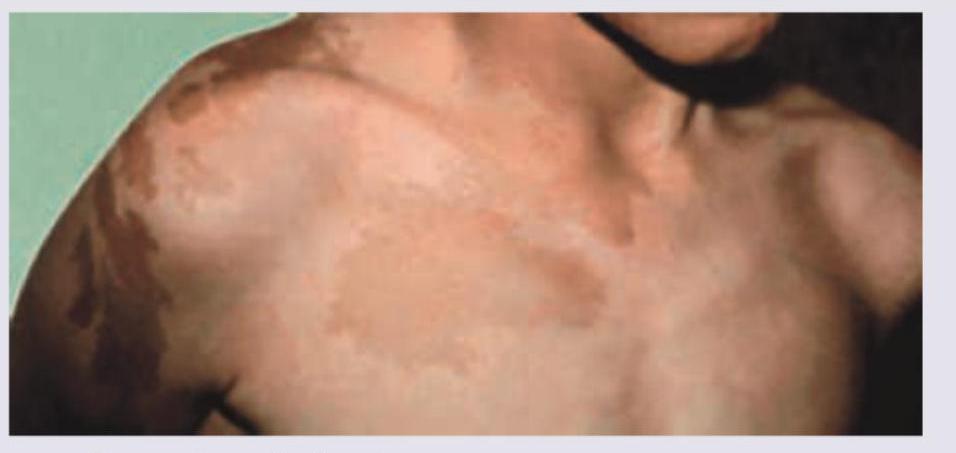
Question 282: A 24-year-old male presents with a lesion at the site shown in the image for 4 years. He says it has increased in thickness over the years. Diagnosis is:
- A. Spitz nevus
- B. Hyper-melanosis of Ito
- C. Becker's nevus (Correct Answer)
- D. Congenital melanocytic nevus
Explanation: ***Becker's nevus*** - This lesion typically presents as a **unilateral, hyperpigmented patch** that often appears during childhood or adolescence, increasing in size and thickness with associated **hypertrichosis** (increased hair growth). The image shows a large, irregularly shaped, hyperpigmented area on the torso of a young male, consistent with this description. - The history of increasing thickness over four years further supports **Becker's nevus**, as it is known to progress in thickness and texture, often becoming more indurated and sometimes verrucous. *Spitz nevus* - Spitz nevus is a benign melanocytic nevus typically presenting as a **pink or red, dome-shaped papule or nodule**, commonly on the face or limbs. - It rapidly grows but does not typically present as a large, hyperpigmented patch with associated hypertrichosis like the lesion shown. *Hyper-melanosis of Ito* - Hypermelanosis of Ito (also known as incontinentia pigmenti achromians) is characterized by **streaky or whorled hypopigmented (lighter) skin lesions**, often present at birth or in early infancy. - The image clearly shows a **hyperpigmented (darker) lesion**, which directly contradicts the characteristic hypopigmentation of hypermelanosis of Ito. *Congenital melanocytic nevus* - Congenital melanocytic nevi are typically present **at birth** or become apparent shortly thereafter. While they can be large and hyperpigmented, they usually do not have the prominent feature of increasing thickness and hypertrichosis developing many years later in adolescence or early adulthood in the same way as Becker's nevus. - The description of a lesion appearing during adolescence and increasing in thickness and hairiness for four years makes Becker's nevus a more specific diagnosis than a general congenital melanocytic nevus.
Question 283: Which of the following layers is absent in psoriasis?
- A. A
- B. B (Correct Answer)
- C. C
- D. D
Explanation: ***B*** - The layer labeled 'B' corresponds to the **stratum granulosum (granular layer)** of the epidermis, which is **absent or markedly thinned in areas of parakeratosis** in psoriatic lesions. - The loss/absence of the stratum granulosum in psoriasis is a characteristic histological feature, particularly in regions showing parakeratosis (retention of nuclei in the stratum corneum). - This is considered the classic answer for "which layer is absent in psoriasis" in medical examinations. *A* - The layer labeled 'A' is the **stratum corneum (horny layer)**, which is actually **thickened** in psoriasis (hyperkeratosis) and shows **parakeratosis** (retention of nuclei). - The stratum corneum is not absent but rather abnormal, showing retained nuclei and increased thickness with scaling. *C* - The layer labeled 'C' represents the **stratum spinosum (prickle cell layer)**, which is significantly **thickened (acanthosis)** in psoriasis due to increased keratinocyte proliferation. - Acanthosis (thickening of the spinous layer) is a hallmark feature of psoriasis, not absence of this layer. *D* - The layer labeled 'D' points to the **stratum basale (basal layer)**, which contains actively dividing keratinocytes and is always present in the epidermis. - In psoriasis, the basal keratinocytes show increased proliferation and shortened cell cycle, leading to epidermal hyperplasia, but the layer is never absent.
General Medicine
2 questionsIn the score shown below, alphabet P stands for?

Which nerve is thickened in this patient of Hansen disease?

NEET-PG 2018 - General Medicine NEET-PG Practice Questions and MCQs
Question 281: In the score shown below, alphabet P stands for?
- A. Pulse rate
- B. Pressure
- C. Pallor severity (Correct Answer)
- D. Physical activity
Explanation: ***Pallor severity*** - In the context of the **APGAR score**, 'P' stands for **Pallor/Appearance**, which assesses the infant's skin color. - A healthy color (pink) indicates good oxygenation, while **pallor or cyanosis** suggests poorer perfusion and is scored lower. *Pulse rate* - **Pulse rate** is represented by the first 'A' in APGAR, which stands for **Activity** (muscle tone) or sometimes **Appearance** (skin color), not 'P'. - The 'P' in the APGAR score is specifically for the assessment of the infant's **appearance or skin color**. *Pressure* - The APGAR score does not include an assessment of **pressure** as one of its five components. - The components are **Appearance, Pulse, Grimace, Activity, and Respiration**. *Physical activity* - **Physical activity** (muscle tone) is represented by the second 'A' in APGAR. - The letter 'P' in APGAR specifically refers to **pallor or appearance**.
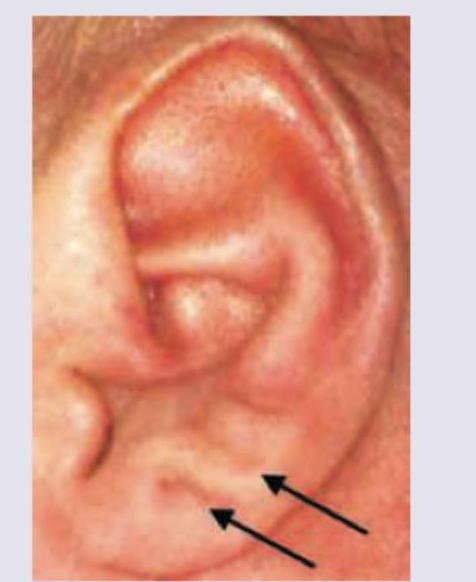
Question 282: Which nerve is thickened in this patient of Hansen disease?
- A. Greater auricular (Correct Answer)
- B. Transverse cervical nerve
- C. Greater occipital nerve
- D. Lesser occipital nerve
Explanation: ***Greater auricular nerve*** - The image shows a **thickened, cord-like structure** indicative of a hypertrophied nerve, characteristic of **Hansen's disease (leprosy)** affecting a peripheral nerve. The location points towards the greater auricular nerve. - The **greater auricular nerve** is a common site for thickening in leprosy due to its superficial course, making it susceptible to the inflammatory response caused by *Mycobacterium leprae*. *Transverse cervical nerve* - While it is a superficial cervical nerve, involvement of the **transverse cervical nerve** in leprosy is less common or prominent for palpation compared to the greater auricular nerve. - Thickening of this nerve might present with sensory changes over the anterior neck, but it is not typically as clearly palpable as the greater auricular nerve in its common course. *Greater occipital nerve* - The **greater occipital nerve** would be located more posteriorly on the scalp and neck, supplying sensation to the posterior scalp. - Its thickening would typically cause pain or sensory changes in the occipital region, which does not align with the visibly thickened nerve shown in the image. *Lesser occipital nerve* - The **lesser occipital nerve** is also located more posteriorly and superiorly in the neck, innervating the skin behind the ear. - While it can be affected in leprosy, its anatomical position and typical presentation of thickening are distinct from the prominent cord visible in the image, which is clearly positioned more anteriorly and inferiorly near the earlobe.
Pediatrics
5 questionsDuring evaluation of a child with Down syndrome, the following finding is noted. Identify?

What is the expected karyotype in this child with the following findings and having pulmonic stenosis on Echocardiography?

Which condition is characterized by the sign shown in the image?

In a child with rickets which part of the bone is affected?

Identify the deformity seen in this child with rickets:

NEET-PG 2018 - Pediatrics NEET-PG Practice Questions and MCQs
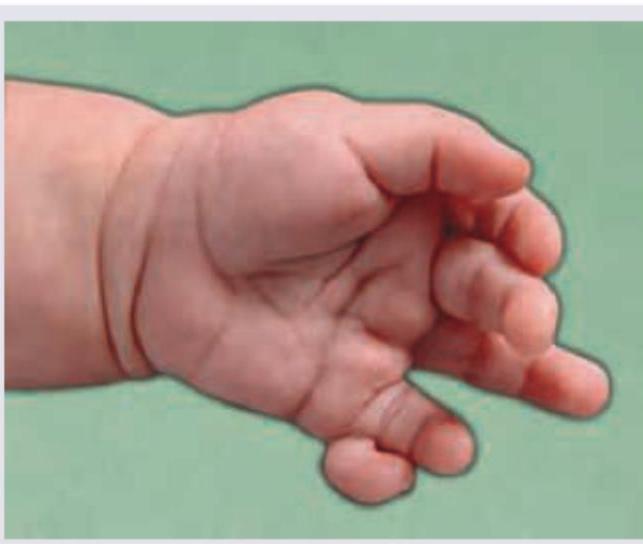
Question 281: During evaluation of a child with Down syndrome, the following finding is noted. Identify?
- A. Simian crease (Correct Answer)
- B. Kennedy crease
- C. Sydney line
- D. Sandal gap
Explanation: ***Simian crease*** - The image displays a **single palmar crease** (also known as a simian crease or transverse palmar crease), which is a common physical finding in individuals with **Down syndrome (Trisomy 21)**. - This crease runs straight across the palm, often replacing the usual two major palmar creases. *Kennedy crease* - This is **not a recognized medical term** for a palmar crease or any specific dermatological finding. - The feature shown in the image is a clearly defined, single transverse palmar crease. *Sydney line* - A **Sydney line** is another type of palmar crease abnormality where the proximal transverse crease extends across the entire palm, reaching the ulnar edge. - While it is a variation of palmar creases, the crease in the image appears as a single, bold transverse crease, more consistent with a **simian crease**. *Sandal gap* - A **sandal gap** refers to a wide space between the first and second toes, sometimes seen in newborns, including those with Down syndrome. - This finding relates to the **foot**, not the hand, and is not depicted in the provided image.
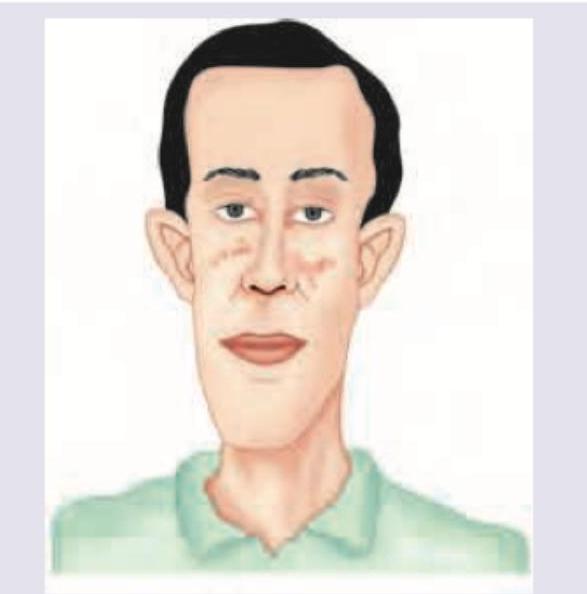
Question 282: What is the expected karyotype in this child with the following findings and having pulmonic stenosis on Echocardiography?
- A. 46,XX
- B. 45,X
- C. 46,XY (Correct Answer)
- D. 47,XXY
Explanation: ***46,XY*** - The image depicts a child with features suggestive of **Noonan Syndrome**, characterized by widely spaced eyes, low-set ears, a short webbed neck, and **pulmonic stenosis**. - Noonan Syndrome is a **cardiofacial cutaneous syndrome** that is genetically heterogeneous; however, it typically presents with a **normal karyotype of 46,XY** for males or 46,XX for females, as it arises from mutations in genes like *PTPN11*, *SOS1*, *RAF1*, or *KRAS*, rather than chromosomal aneuploidies. *46,XX* - This karyotype represents a **normal female**. While females can have Noonan Syndrome, the general characteristic features pointing towards a male child in the provided image makes this option less likely in this specific context. - The question asks for the expected karyotype in "this child," implying a specific gender based on the drawing; however, if the child were female with Noonan Syndrome, 46,XX would be expected. *45,X* - This karyotype corresponds to **Turner Syndrome**, which typically affects females and is characterized by features such as **short stature**, a webbed neck, and **coarctation of the aorta** (not pulmonic stenosis). - While there is some phenotypic overlap (e.g., webbed neck), the presence of pulmonic stenosis and other facial features are more consistent with Noonan syndrome, which is not associated with a monosomy of the X chromosome. *47,XXY* - This karyotype represents **Klinefelter Syndrome**, which affects males and is characterized by **tall stature**, **hypogonadism**, and **gynecomastia**. - The features in the image, including the **facial dysmorphism** and **pulmonic stenosis**, are inconsistent with the typical presentation of Klinefelter Syndrome.
Question 283: Which condition is characterized by the sign shown in the image?
- A. Kwashiorkor (Correct Answer)
- B. Marasmus
- C. Pellagra
- D. None of above
Explanation: ***Kwashiorkor*** - The image shows sparse, dry, and discolored hair, sometimes described as having a **"flag sign"** due to alternating bands of light and dark hair, which is characteristic of **protein-energy malnutrition (PEM)**, specifically kwashiorkor. - Kwashiorkor results from a severe protein deficiency with relatively adequate calorie intake, leading to hair changes, **edema**, and a distended abdomen. *Marasmus* - Marasmus is characterized by severe muscle wasting and loss of subcutaneous fat due to a deficiency in both protein and overall calorie intake, but **hair changes are less prominent** than in kwashiorkor. - Individuals with marasmus appear incredibly emaciated and "skeletal" but typically do not exhibit the same degree of hair discoloration or edema. *Pellagra* - Pellagra is caused by a deficiency of **niacin (vitamin B3)** and is characterized by the "3 Ds": **dermatitis**, **diarrhea**, and **dementia**. - While it can affect hair quality, it does not typically present with the specific hair changes, such as the "flag sign," seen in the image. *None of above* - The distinct hair abnormalities depicted in the image are highly suggestive of a specific nutritional deficiency, making "None of the above" incorrect.
Question 284: In a child with rickets which part of the bone is affected?
- A. A
- B. B
- C. C (Correct Answer)
- D. D
Explanation: ***C*** - C points to the **growth plate (physis) and metaphyseal region**, which is the **primary site of pathology in rickets**. - Rickets causes defective mineralization at the growth plate where endochondral ossification occurs, leading to accumulation of unmineralized osteoid and disorganized chondrocyte columns. - The **metaphysis** (the region including the growth plate) shows the characteristic radiological findings: widening, fraying, cupping, and loss of sharp margins. *A* - A indicates the **diaphysis** (shaft of the bone), which consists of mature cortical bone. - The diaphysis is **not primarily affected** in rickets, though severe cases may lead to bowing deformities due to bone softening. - The initial and primary pathological changes occur at the actively growing regions, not the shaft. *B* - B points to the **metaphysis**, which is the flared region of long bone adjacent to the growth plate. - The metaphysis is indeed significantly affected in rickets, showing widening and irregular mineralization. - However, if the image distinguishes between the broader metaphyseal region (B) and the specific growth plate zone (C), then C represents the more precise site where the pathological process of defective mineralization originates. *D* - D points to the **epiphysis**, the rounded end of the long bone that forms part of the joint. - The epiphysis consists of already-formed bone and is **not the primary site** of rickets pathology. - Rickets affects the zone of provisional calcification at the growth plate, not the pre-existing epiphyseal bone.
Question 285: Identify the deformity seen in this child with rickets:
- A. Genu varum (Bow legs) (Correct Answer)
- B. Genu valgum (knock knees)
- C. Windswept deformity
- D. Gunstock deformity
Explanation: ***Genu varum (Bow legs)*** - The image shows the knees bowed outwards resulting in a **bow-legged appearance**, which is characteristic of **genu varum**. - **Rickets** is a common cause of genu varum, as the softened bones are unable to bear weight and bend outwards. *Genu valgum (knock knees)* - **Genu valgum** presents as the knees bending inwards, appearing to "knock" against each other, which is the opposite of what is seen in the image. - While rickets can also cause genu valgum, the depicted deformity clearly shows outward bowing. *Windswept deformity* - A **windswept deformity** involves one knee being in **valgus** (knock-kneed) and the other in **varus** (bow-legged). - The image does not show this combination; both knees appear to be bowed outwards. *Gunstock deformity* - **Gunstock deformity** is an angular deformity of the elbow, typically related to a **supracondylar humerus fracture**. - This deformity affects the upper limb and is not related to the lower limb presentation in the image.