Internal Medicine
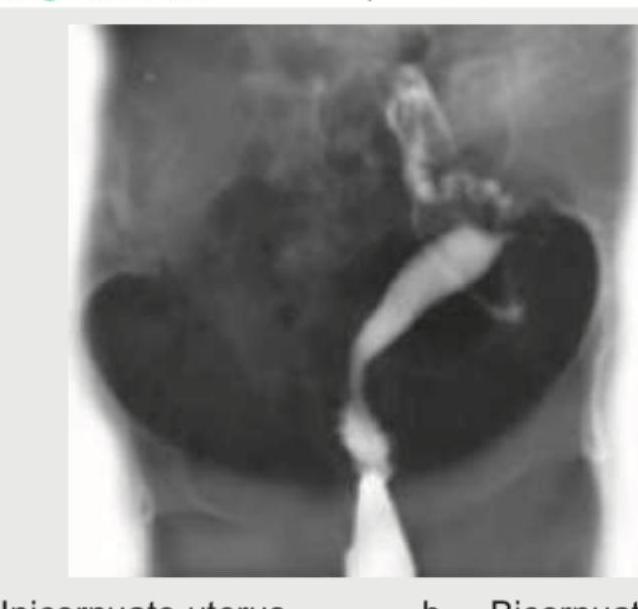
2 questionsWhich one of the following is implicated in the etiology of these adhesions around the liver?

Identify the following abnormality?

NEET-PG 2018 - Internal Medicine NEET-PG Practice Questions and MCQs
Question 261: Which one of the following is implicated in the etiology of these adhesions around the liver?
- A. Chlamydial infection (Correct Answer)
- B. Perforion of dermoid cyst
- C. Pseudomyxoma peritonei
- D. Liver metastases in ovarian cancer
Explanation: ***Chlamydial infection*** - The image shows **Fitz-Hugh-Curtis syndrome**, characterized by **violin-string adhesions** visible between the liver capsule and the parietal peritoneum. - This condition is a perihepatitis that occurs as a complication of **pelvic inflammatory disease (PID)**, most commonly caused by **Chlamydia trachomatis** or Neisseria gonorrhoeae. *Perforation of dermoid cyst* - A perforated dermoid cyst (mature cystic teratoma) typically causes a **chemical peritonitis** due to the leakage of sebaceous material, hair, and other contents. - While it can lead to adhesions, these are usually diffuse and not specifically the **violin-string type perihepatic adhesions** characteristic of Fitz-Hugh-Curtis syndrome. *Pseudomyxoma peritonei* - Pseudomyxoma peritonei is characterized by the accumulation of **gelatinous ascites** and mucin-producing tumor cells in the peritoneal cavity, often originating from a ruptured appendiceal mucinous neoplasm. - It results in widespread mucinous deposits and adhesions, which are distinct from the fibrous, violin-string adhesions around the liver seen in the image. *Liver metastases in ovarian cancer* - Liver metastases from ovarian cancer would appear as **nodular lesions within the liver parenchyma** or on its surface, not as fibrous adhesions between the liver and abdominal wall. - While ovarian cancer can cause ascites and peritoneal carcinomatosis, the presentation of **perihepatic adhesions** in the image is not typical for direct metastatic spread to the liver surface in this manner.
Question 262: Identify the following abnormality?
- A. Encephalocoele
- B. Prosencephaly
- C. Schizencephaly (Correct Answer)
- D. Lissencephaly
Explanation: ***Schizencephaly*** - The image shows a **cleft-like defect** extending from the pial surface to the ventricle, lined by **gray matter**, which is characteristic of schizencephaly. - This typically results in communication between the **subarachnoid space** and the **ventricular system**. *Encephalocoele* - An encephalocoele is a **protrusion of brain tissue** and meninges through a defect in the skull, which is not depicted in this image. - It usually presents as a **sac-like bulge** on the head, often in the occipital or frontal regions. *Prosencephaly* - This term usually refers to the malformation spectrum associated with **holoprosencephaly**, characterized by a failure of the prosencephalon (forebrain) to properly divide. - Features include **fusion of the cerebral hemispheres**, a single ventricle, and facial anomalies, not a cortical cleft as seen here. *Lissencephaly* - Lissencephaly is characterized by a **lack of gyri and sulci** (smooth brain surface) or abnormally broad and flattened gyri, leading to a thickened cortex. - The image clearly displays presence of gyri and sulci, although with an additional unusual cleft, ruling out a primary diagnosis of lissencephaly.
Pediatrics
4 questionsNeonate is brought at 3 weeks of age, with projectile vomiting. USG was performed and is shown below. When can the abdominal mass in this condition be best palpated?

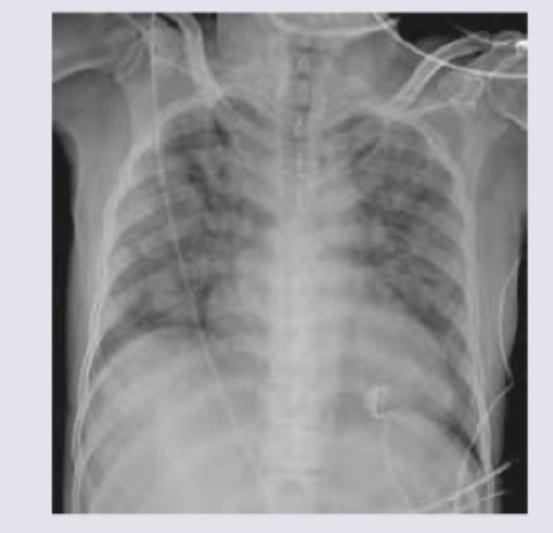
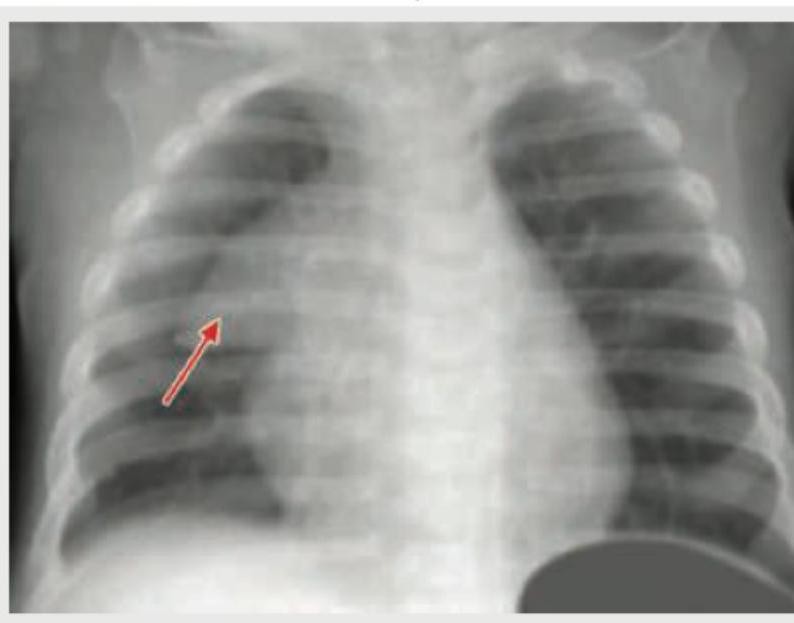
A 1-year-old child with severe acute malnutrition develops pneumonia which is not responding to treatment. Chest X-ray picture is given. What is the likely etiology?

A 12-month-old child who was previously well presented with low grade fever and respiratory distress and on examination there is bilateral wheeze. There is a history of URI in elder sibling. What is the diagnosis?
A child with history of diarrhea 1 week back presents with sudden onset pallor and oliguria. Peripheral smear findings are shown below. Which of the following is unlikely finding in this disorder?

NEET-PG 2018 - Pediatrics NEET-PG Practice Questions and MCQs
Question 261: Neonate is brought at 3 weeks of age, with projectile vomiting. USG was performed and is shown below. When can the abdominal mass in this condition be best palpated?
- A. During feeding (Correct Answer)
- B. In umbilical area
- C. In epigastric area
- D. In Right upper quadrant
Explanation: ***During feeding*** - In **hypertrophic pyloric stenosis**, the characteristic **"olive" mass** formed by the thickened pylorus is most easily palpable **during feeding or immediately after vomiting**. - During this time, the infant’s abdominal muscles are relaxed, making palpation of the mass in the **epigastrium (right upper quadrant)** more successful. *In umbilical area* - The umbilical area is typically where **omphaloceles** or **umbilical hernias** are found, not the pyloric mass. - The pylorus is located much higher in the epigastric region, to the right of the midline. *In epigastric area* - While the pyloric mass is located in the **epigastric area**, palpation is more difficult when the infant is crying or agitated. - The question asks when it can be *best* palpated, emphasizing the conditions under which it is most detectable. *In Right upper quadrant* - The pylorus is indeed located in the **right upper quadrant/epigastrium**. - However, the optimal timing for palpation is during feeding or after vomiting, as the infant's abdomen is relaxed at that point.
Question 262: A 1-year-old child with severe acute malnutrition develops pneumonia which is not responding to treatment. Chest X-ray picture is given. What is the likely etiology?
- A. Mycoplasma
- B. Pneumococcus
- C. Staphylococcus aureus (Correct Answer)
- D. Adenovirus
Explanation: ***Staphylococcus aureus*** - The chest X-ray shows extensive **bilateral infiltrates** with areas of potential **abscess formation** or **necrotizing pneumonia**, suggested by the poorly defined lucencies within consolidation, which are characteristic of Staphylococcal infection, especially in immunocompromised individuals like a malnourished child. - Staphylococcal pneumonia is often severe, can lead to **necrosis**, **cavitation**, and is known for its **resistance to common antibiotics**, explaining the poor response to initial treatment in a severely malnourished child. *Mycoplasma* - Mycoplasma pneumoniae typically causes **"walking pneumonia"** with milder symptoms and **diffuse interstitial infiltrates** visible on Chest X-ray, which are not as severe or focal as seen in the image. - It's less common to cause rapidly progressing, severe, and necrotizing pneumonia in this age group, even in malnourished children. *Pneumococcus* - **Streptococcus pneumoniae (Pneumococcus)** usually causes **lobar pneumonia** with dense, homogeneous consolidation in one lobe, often with a visible air bronchogram, rather than the more patchy, bilateral, and potentially necrotizing pattern seen here. - While it can be severe, especially in malnourished children, the radiographic pattern is less typical for pneumococcal infection. *Adenovirus* - Adenovirus can cause a range of respiratory infections, from common colds to severe pneumonia, especially in young children. However, the Chest X-ray findings typically include **perihilar infiltrates**, **bronchial wall thickening**, and hyperinflation, which do not fully match the extensive, severe, and potentially cavitating pattern observed. - While it can cause severe pneumonia, the given X-ray features, particularly the suggestion of necrosis, are less characteristic of adenoviral infection.
Question 263: A 12-month-old child who was previously well presented with low grade fever and respiratory distress and on examination there is bilateral wheeze. There is a history of URI in elder sibling. What is the diagnosis?
- A. Congestive cardiac failure
- B. Pneumonia
- C. Acute bronchiolitis (Correct Answer)
- D. Asthma exacerbation
Explanation: ***Acute bronchiolitis*** - The clinical presentation of a **12-month-old** with **low-grade fever**, **respiratory distress**, and **bilateral wheeze**, along with the history of a preceding **URI in an elder sibling**, is highly characteristic of acute bronchiolitis, commonly caused by **Respiratory Syncytial Virus (RSV)**. - Bronchiolitis primarily affects infants and toddlers, causing inflammation and obstruction of the small airways, leading to wheezing and increased work of breathing. - The **age (12 months)** and **contact history** are key diagnostic clues. *Congestive cardiac failure* - While congestive cardiac failure can cause respiratory distress, it typically presents with other signs like **tachycardia**, **hepatomegaly**, and potentially a cardiac murmur, which are not mentioned here. - Wheezing can occur in cardiac failure but is usually accompanied by **rales** and signs of fluid overload rather than prominent diffuse wheezing as the primary respiratory finding in an otherwise well child. *Pneumonia* - Pneumonia would more typically present with a **higher fever**, **cough**, and focal lung findings such as **crackles** or **dullness to percussion**, rather than predominantly bilateral wheezing. - Chest X-ray in pneumonia often shows **infiltrates** or **consolidation**, whereas in bronchiolitis, it commonly shows hyperinflation or peribronchial thickening. *Asthma exacerbation* - Asthma is uncommon as a first diagnosis in a child under **2 years of age**, especially in a **previously well** child with no history of recurrent wheezing episodes. - The **contact history with URI in a sibling** and the **acute, first-time presentation** strongly favor an infectious etiology (bronchiolitis) rather than asthma. - Asthma exacerbations typically occur in children with a known history of reactive airway disease and recurrent wheezing episodes.
Question 264: A child with history of diarrhea 1 week back presents with sudden onset pallor and oliguria. Peripheral smear findings are shown below. Which of the following is unlikely finding in this disorder?
- A. Coomb's test negative
- B. Increased urinary sodium excretion
- C. Thrombocytopenia
- D. Elevated PT (Correct Answer)
Explanation: ***Elevated PT*** - **Hemolytic-uremic syndrome (HUS)** is a microangiopathic hemolytic anemia with **normal coagulation parameters**. - **PT** or **aPTT** are not typically elevated in HUS, making this an unlikely finding. *Coomb's test negative* - HUS is a **non-immune hemolytic anemia**, meaning the red cell destruction is not antibody-mediated. - A **negative Coombs test** is an expected finding in HUS, differentiating it from autoimmune hemolytic anemia. *Increased urinary sodium excretion* - HUS causes **acute kidney injury (AKI)**, often leading to tubular damage and impaired sodium reabsorption. - This can result in **increased fractional excretion of sodium** and high urinary sodium concentrations. *Thrombocytopenia* - **Thrombocytopenia** is a hallmark feature of HUS, caused by platelet consumption in the microthrombi formed in the damaged microvasculature. - The severity of thrombocytopenia can vary but is almost always present.
Radiology
4 questionsThe following Skull X-ray is seen in:

The following barium swallow study shows which of the following?

Which of the following will be the most probable diagnostic finding in the patient with X-Ray skull shown below?

Identify this condition?

NEET-PG 2018 - Radiology NEET-PG Practice Questions and MCQs
Question 261: The following Skull X-ray is seen in:
- A. Thalassemia (Correct Answer)
- B. Multiple myeloma
- C. Histiocytosis-X
- D. Paget's disease
Explanation: ***Thalassemia*** - The image shows a classic **hair-on-end appearance** of the skull, which is a characteristic radiological finding in severe forms of thalassemia. - This appearance results from **marrow hyperplasia** in response to chronic hemolysis, leading to widening of the diploic space and expansion of bone marrow at the expense of outer cortical bone. *Multiple myeloma* - Multiple myeloma typically presents with multiple well-demarcated, **punched-out lytic lesions** in the skull, without a "hair-on-end" pattern. - The bone lesions are due to plasma cell infiltration and osteoclast activation, leading to discrete areas of bone destruction. *Histiocytosis-X* - Histiocytosis-X, also known as Langerhans cell histiocytosis, can cause **lytic bone lesions** in the skull, often referred to as "geographic" or "punched-out" lesions. - While it can cause diffuse bone involvement, it does not typically produce the organized trabecular pattern characteristic of "hair-on-end." *Paget's disease* - Paget's disease of bone often manifests as areas of **bone enlargement**, cortical thickening, and a mixture of lytic and sclerotic changes, sometimes described as a **cotton-wool appearance** in the skull. - It does not present with the "hair-on-end" pattern, which is primarily associated with conditions causing chronic marrow expansion.
Question 262: The following barium swallow study shows which of the following?
- A. Esophageal varices (Correct Answer)
- B. Schatzki ring
- C. Candida esophagitis
- D. Reflux esophagitis
Explanation: ***Esophageal varices*** - The Barium Swallow image clearly demonstrates a **serpiginous**, worm-like, or **rosary bead-like appearance** along the esophageal wall, which is characteristic of esophageal varices. - Varices are dilated submucosal veins and appear as **filling defects** on barium studies, especially when distended. *Schatzki ring* - A Schatzki ring is a **thin, symmetric mucosal ring** at the esophagogastric junction, causing solid food dysphagia. - It presents as a **smooth, circumferential narrowing** on a barium swallow, which is not seen here. *Candida esophagitis* - Candida esophagitis typically appears as **ulcerations, plaques, or nodularity** with an irregular, cobblestone pattern on barium swallow. - This image does not show the characteristic **"shaggy" or "cobblestone"** appearance associated with candidal plaques. *Reflux esophagitis* - Reflux esophagitis can manifest as **mucosal irregularity, erosions, or strictures**, but not the distinct serpiginous filling defects seen in this image. - Severe reflux can cause peptic strictures, which appear as **smooth, tapered narrowings**, different from the irregular variceal pattern.
Question 263: Which of the following will be the most probable diagnostic finding in the patient with X-Ray skull shown below?
- A. Elevated SAP
- B. CD1A positivity (Correct Answer)
- C. Bence Jones proteins
- D. Elevated HbA2
Explanation: ***CD1A positivity*** - The skull X-ray shows multiple punched-out lytic lesions without sclerotic borders, characteristic of **Langerhans Cell Histiocytosis (LCH)**. - **Langerhans cells** in LCH express surface markers like **CD1a** and S100 protein, which are diagnostic when detected via **immunohistochemistry on tissue biopsy**. - CD1a positivity is the **gold standard** for confirming LCH diagnosis. *Elevated SAP* - **Serum Alkaline Phosphatase (SAP)** is typically elevated in conditions with increased osteoblastic activity or liver/biliary disease. - LCH lesions are generally **lytic** and not associated with increased osteoblastic activity, thus SAP elevation is not a specific or common finding. *Bence Jones proteins* - **Bence Jones proteins** (monoclonal light chains) are found in the urine of patients with **Multiple Myeloma**, which can also cause lytic bone lesions. - However, the image shows more discrete, "punched-out" lesions typical of LCH, whereas myeloma lesions are often more diffuse or "salt-and-pepper" in appearance, and LCH does not secrete Bence Jones proteins. *Elevated HbA2* - **Elevated HbA2** is a characteristic finding in **beta-thalassemia trait**, a genetic blood disorder. - There is no clinical or radiological indication in the provided image or question to suggest a connection to thalassemia.
Question 264: Identify this condition?
- A. Omphalocele
- B. Prune belly syndrome (Correct Answer)
- C. Gastroschisis
- D. Peritonitis
Explanation: ***Prune belly syndrome*** - The image shows the characteristic **wrinkled, prune-like appearance** of the abdominal wall due to **absent or deficient abdominal wall musculature**. - This condition is part of a triad including **urinary tract abnormalities** and **undescended testes** in males, with the distinctive loose, redundant abdominal skin. *Omphalocele* - An **omphalocele** presents with **abdominal contents herniating through the umbilical ring**, covered by a peritoneal membrane. - The image does not show any **herniated organs** or a sac-like protrusion at the umbilical area. *Gastroschisis* - **Gastroschisis** involves an **abdominal wall defect** typically to the right of the umbilical cord with **exposed bowel loops**. - No evidence of **herniated intestinal contents** or abdominal wall dehiscence is visible in this image. *Peritonitis* - **Peritonitis** is an **inflammatory condition** of the peritoneum presenting with abdominal rigidity and systemic signs. - This is not a structural abnormality visible externally but rather an **internal inflammatory process** requiring clinical assessment.