General Medicine
1 questionsThe following gait abnormality is seen in:

NEET-PG 2018 - General Medicine NEET-PG Practice Questions and MCQs
Question 251: The following gait abnormality is seen in:
- A. Avascular necrosis Hip
- B. Spastic hemiplegia
- C. Polio (Correct Answer)
- D. Leprosy
Explanation: The image shows **foot drop**, characterized by inability to dorsiflex the foot, requiring the patient to lift the leg higher during walking to clear the ground. ***Polio*** - **Polio** commonly causes **flaccid paralysis** affecting anterior horn cells, frequently resulting in foot drop due to weakness of **dorsiflexor muscles**. - This is a well-recognized complication, especially in countries like India where polio cases occurred historically, making it a clinically relevant cause. *Leprosy* - While **leprosy** can affect peripheral nerves including the **common peroneal nerve**, foot drop is a less common presentation compared to other nerve involvement patterns. - More typically seen in **advanced, untreated cases** and is relatively rare compared to other causes of foot drop. *Avascular necrosis Hip* - **Avascular necrosis (AVN) of the hip** causes **antalgic gait** due to hip pain but does not cause foot drop. - It affects the **hip joint** rather than the neural pathways controlling dorsiflexion of the foot. *Spastic hemiplegia* - **Spastic hemiplegia** results in spastic gait patterns with **circumduction**, not the flaccid foot drop pattern shown. - Characterized by **spasticity and hyperreflexia** rather than the flaccid weakness seen in foot drop.
Internal Medicine
4 questionsAll are true about the mid brain stroke syndrome shown except:

A patient in ICU was given blood transfusion. 3 hours later SpO2 is reduced to 75% with respiratory difficulty. CVP is 15 cm water and PCWP is 25 mm Hg . CXR is shown below. What is the diagnosis?

A patient undergone a Solid organ transplant is having the following lesions which are present on oral mucosa and sites shown below. Which of the following is incriminated in causing the same?

The finding shown below is used for diagnosis of CNS parasitic lesion. Which of the following best describes the condition?

NEET-PG 2018 - Internal Medicine NEET-PG Practice Questions and MCQs
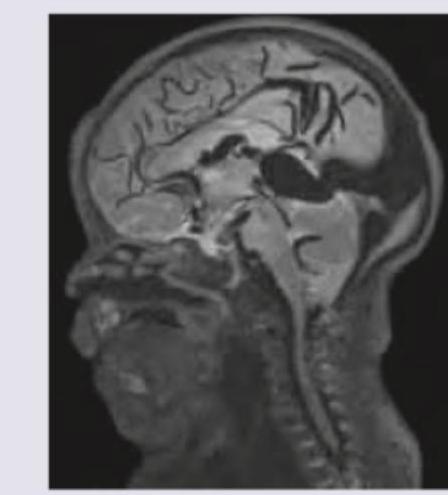
Question 251: All are true about the mid brain stroke syndrome shown except:
- A. Dorsal midbrain lesion
- B. Anterior cerebral peduncle is involved (Correct Answer)
- C. Contralateral tremor and ataxia
- D. Red nucleus involvement causes movement disorders
Explanation: ***Anterior cerebral peduncle is involved*** - The **anterior cerebral peduncle (crus cerebri)** is located in the **ventral midbrain** and contains descending motor tracts, but the lesion shown affects the **dorsal midbrain structures**. - This statement is **false** because the lesion does not extend to involve the anterior cerebral peduncle, making this the correct answer for the "except" question. *Dorsal midbrain lesion* - The image clearly shows a lesion in the **dorsal aspect of the midbrain**, affecting structures such as the **red nucleus** and surrounding areas. - This statement is **true** as it accurately describes the anatomical location of the stroke shown in the image. *Ipsilateral 3rd nerve palsy* - **Weber's syndrome** (ventral midbrain stroke) commonly presents with ipsilateral 3rd nerve palsy, and some dorsal midbrain lesions can extend to affect **oculomotor nerve fascicles**. - This statement is **true** as 3rd nerve palsy can occur with midbrain strokes, particularly when the lesion affects nerve pathways in the midbrain. *Contralateral hemiplegia* - Midbrain strokes can cause **contralateral weakness** through involvement of **corticospinal tract fibers** that pass through or near the affected area. - This statement is **true** as motor deficits are commonly seen in midbrain stroke syndromes, even with dorsal lesions that may affect descending motor connections.
Question 252: A patient in ICU was given blood transfusion. 3 hours later SpO2 is reduced to 75% with respiratory difficulty. CVP is 15 cm water and PCWP is 25 mm Hg . CXR is shown below. What is the diagnosis?
- A. Tension pneumothorax
- B. Transfusion related acute lung injury
- C. Transfusion associated circulatory overload (Correct Answer)
- D. Mismatched blood transfusion
Explanation: ***Transfusion associated circulatory overload*** - The combination of **respiratory difficulty**, **reduced SpO2**, **elevated CVP (15 cm water)**, and **markedly elevated PCWP (25 mm Hg)** after a blood transfusion strongly indicates hydrostatic pulmonary edema due to fluid overload. - The CXR image showing **diffuse bilateral infiltrates** (pulmonary edema) further supports this diagnosis, especially with the elevated cardiac filling pressures. *Tension pneumothorax* - A tension pneumothorax would present with **unilateral lung collapse**, **tracheal deviation**, and potentially **hypotension**, none of which are explicitly described or suggested by the CXR. - While it causes respiratory distress, the hemodynamic parameters (CVP and PCWP) and bilateral CXR findings are inconsistent with a pneumothorax. *Transfusion related acute lung injury* - TRALI also causes acute respiratory distress and hypoxemia after transfusion, but it is characterized by **non-cardiogenic pulmonary edema** with a **normal or low CVP** and **normal or mildly elevated PCWP** (<18 mm Hg), differentiating it from TACO. - The elevated CVP and PCWP strongly point away from TRALI, which is immune-mediated and involves capillary leakage. *Mismatched blood transfusion* - An acute hemolytic transfusion reaction (mismatched blood transfusion) typically presents with symptoms such as **fever, chills, flank pain, hemoglobinuria**, and potentially **DIC** or **renal failure**. - While it's a serious transfusion reaction, the primary clinical presentation and elevated cardiac filling pressures are not characteristic of an acute hemolytic reaction.
Question 253: A patient undergone a Solid organ transplant is having the following lesions which are present on oral mucosa and sites shown below. Which of the following is incriminated in causing the same?
- A. KSHV (Correct Answer)
- B. HHV6
- C. HHV7
- D. CMV
Explanation: ***KSHV*** - The image shows multiple **violaceous cutaneous lesions** which are characteristic of **Kaposi's sarcoma (KS)**. - In a solid organ transplant recipient, KS is commonly associated with **Kaposi's sarcoma-associated herpesvirus (KSHV)**, also known as HHV-8. Immunosuppression due to antirejection medications can reactivate latent KSHV infection. *HHV6* - HHV-6 is primarily associated with **roseola infantum** (exanthem subitum) in children. - While HHV-6 can cause complications in immunocompromised individuals, its typical manifestations do not involve the characteristic violaceous skin lesions seen in Kaposi's sarcoma. *HHV7* - HHV-7 is also associated with **roseola-like illnesses** and is generally considered a less pathogenic virus compared to other human herpesviruses. - It does not cause Kaposi's sarcoma, and its clinical manifestations in transplant patients are typically different from the lesions depicted. *CMV* - **Cytomegalovirus (CMV)** is a common opportunistic infection in solid organ transplant recipients, causing a variety of clinical syndromes. - While CMV can lead to numerous symptoms (e.g., fever, leukopenia, pneumonitis, colitis), it does not directly cause the characteristic skin lesions of Kaposi's sarcoma.
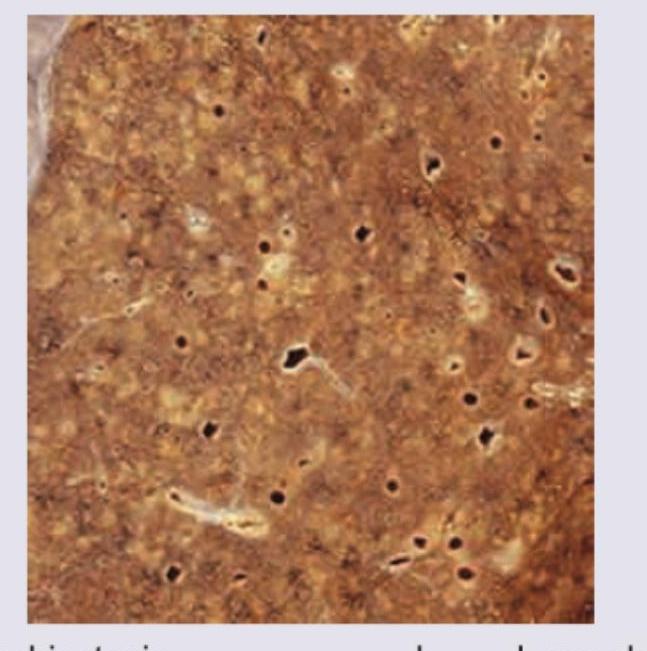
Question 254: The finding shown below is used for diagnosis of CNS parasitic lesion. Which of the following best describes the condition?
- A. Minor criteria
- B. Absolute criteria
- C. Epidemiological criteria
- D. Major criteria
Explanation: ***Major criteria*** - The image likely depicts **multiple calcified cysts**, which in the context of CNS parasitic lesions (e.g., neurocysticercosis), would be considered a **major diagnostic criterion** for the disease. - Major criteria are significant findings, often radiographic evidence of **cysts or calcifications**, that strongly support a diagnosis of neurocysticercosis when combined with other criteria. *Minor criteria* - Minor criteria include less specific findings, such as **seizures** or headaches, or findings that support the diagnosis but are not definitive on their own. - While supportive, these findings are typically not sufficient for diagnosis without major or other criteria. *Absolute criteria* - Absolute criteria are definitive findings, such as a **histopathological demonstration of the parasite** or direct visualization of the scolex on imaging, which are direct proof of infection. - The image shows calcifications, which are strong evidence but not necessarily "absolute" proof of active parasitic presence without further context like a viable cyst with a scolex. *Epidemiological criteria* - Epidemiological criteria relate to the patient's **exposure history** or origin from areas endemic for the parasite. - These criteria help in narrowing down the differential diagnosis but do not provide direct evidence of the lesion itself.
Pediatrics
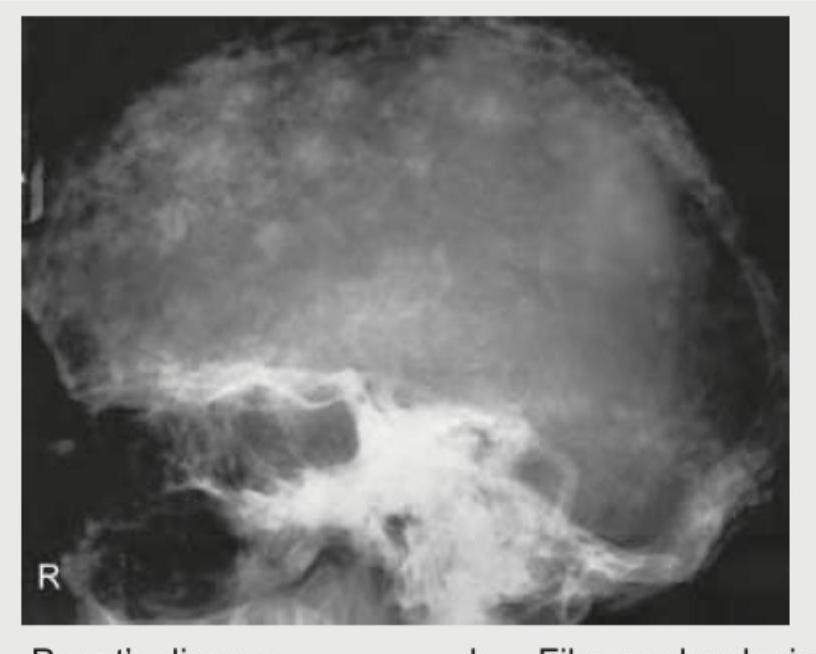
1 questionsWhich of the following diseases will lead to the following appearance?

NEET-PG 2018 - Pediatrics NEET-PG Practice Questions and MCQs
Question 251: Which of the following diseases will lead to the following appearance?
- A. Polio
- B. Paget's disease (Correct Answer)
- C. Cerebellar lesion
- D. Ankylosing Spondylitis
Explanation: ***Paget's disease*** - The image depicts a bowing of the legs and a generalized stooped posture, which are characteristic findings in advanced **Paget's disease of bone**. - **Paget's disease** is a chronic bone disorder characterized by abnormal bone remodeling, leading to enlarged and misshapen bones that can cause **kyphosis** and **bowed limbs**. *Polio* - **Polio** (poliomyelitis) primarily affects the nervous system, leading to **muscle weakness** and **paralysis**, which can result in limb deformities, but not typically the widespread bone enlargement and bowing seen here. - While polio can cause limb asymmetry and deformities due to muscle wasting, it does not involve the characteristic bone remodeling and generalized skeletal changes seen in the image. *Cerebellar lesion* - A **cerebellar lesion** primarily affects coordination, balance, and motor control, leading to ataxia, tremors, and gait disturbances. - It does not directly cause the skeletal deformities or bone bowing illustrated in the image. *Ankylosing Spondylitis* - **Ankylosing spondylitis** is a chronic inflammatory disease primarily affecting the axial skeleton, leading to progressive spinal stiffness and fusion (a "bamboo spine"). - While it can cause a significant **kyphosis** (forward curvature of the spine), it does not typically lead to the wide-set bowed legs or general bone enlargement often seen in Paget's disease.
Radiology
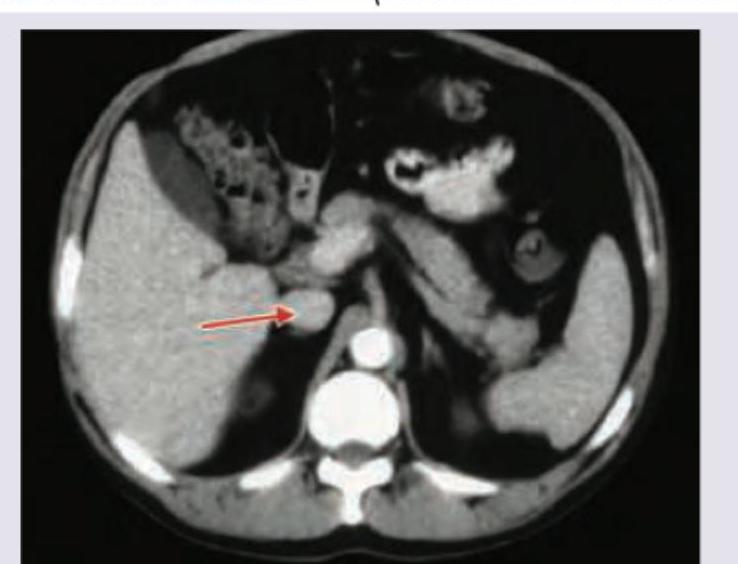
4 questionsIdentify the structure shown in CT abdomen section. (Recent NEET Pattern 2018-19)

A 32-year-old lady presents with history of first trimester miscarriage and underwent HSG. The diagnosis is: (Recent NEET Pattern 2018-19)

The Gut blood vessel marked (Red arrow) in the angiogram is: (Recent NEET Pattern 2018-19)

Comment on the arrow marked structure in CXR of an infant: (Recent NEET Pattern 2018-19)

NEET-PG 2018 - Radiology NEET-PG Practice Questions and MCQs
Question 251: Identify the structure shown in CT abdomen section. (Recent NEET Pattern 2018-19)
- A. Inferior vena cava
- B. Portal vein (Correct Answer)
- C. Splenic vein
- D. Superior mesenteric vein
Explanation: ***Portal vein*** - The arrow points to a vessel receiving blood from the splenic and superior mesenteric veins, which is characteristic of the **portal vein** entering the **liver parenchyma**. - The portal vein is typically seen anterior to the **inferior vena cava** and posterior to the **common hepatic artery** at this level. *Inferior vena cava* - The **inferior vena cava (IVC)** is a large, retroperitoneal vessel located posterior to the liver and to the right of the aorta. - The structure indicated by the arrow is clearly within the liver substance, not in the typical position of the IVC. *Splenic vein* - The **splenic vein** runs horizontally behind the body of the pancreas and joins with the superior mesenteric vein to form the portal vein. - The vessel shown is within the liver, distal to the formation of the portal vein. *Superior mesenteric vein* - The **superior mesenteric vein (SMV)** typically runs vertically in the mesentery and joins the splenic vein to form the portal vein. - The indicated structure is within the liver hilum, not in the anatomical location of the SMV.
Question 252: A 32-year-old lady presents with history of first trimester miscarriage and underwent HSG. The diagnosis is: (Recent NEET Pattern 2018-19)
- A. Unicornuate uterus (Correct Answer)
- B. Uterus didelphys
- C. Arcuate uterus
- D. Bicornuate uterus
Explanation: ***Unicornuate uterus*** - A **unicornuate uterus** develops from one **Müllerian duct**, resulting in a single functional uterine horn with a characteristic **banana-shaped** or crescent-shaped cavity. - On **HSG**, it appears as a single, elongated cavity that **deviates to one side** and is typically smaller than normal, associated with increased risk of **first trimester miscarriage**. *Bicornuate uterus* - Would show **two distinct uterine horns** separated by a deep fundal cleft, with the uterus appearing **heart-shaped** externally. - HSG would demonstrate **bifurcation** of the uterine cavity into two separate horns at the fundal level with an **intercornual angle >105 degrees**. *Uterus didelphys* - Complete duplication with **two separate uterine bodies**, cervices, and often vaginas resulting from total failure of **Müllerian duct fusion**. - HSG would show **two completely separate uterine cavities** with no communication, not consistent with the single cavity shown. *Arcuate uterus* - Mildest form of **Müllerian anomaly** with only a slight **fundal indentation** and essentially normal uterine cavity size. - HSG shows a **broad, smooth, mild concave contour** of the fundus, not consistent with the elongated, deviated cavity shown.
Question 253: The Gut blood vessel marked (Red arrow) in the angiogram is: (Recent NEET Pattern 2018-19)
- A. Superior mesenteric artery (Correct Answer)
- B. Inferior mesenteric artery
- C. Splenic artery
- D. Gastroepiploic artery
Explanation: ***Superior mesenteric artery*** - The image shows an **abdominal angiogram** with a vessel arising from the anterior aspect of the aorta and branching extensively, consistent with the **superior mesenteric artery (SMA)**. - The SMA typically supplies the **midgut structures**, which include the duodenum (distal to the major duodenal papilla), jejunum, ileum, cecum, ascending colon, and the proximal two-thirds of the transverse colon. *Inferior mesenteric artery* - The **inferior mesenteric artery (IMA)** originates lower down the aorta, usually at the level of L3, and supplies the hindgut (distal one-third of the transverse colon, descending colon, sigmoid colon, and rectum). - The branching pattern and location in the angiogram do not match the expected origin and distribution of the IMA. *Splenic artery* - The **splenic artery** is a branch of the celiac trunk, which arises higher than the vessel shown and typically courses towards the left to supply the spleen, stomach, and pancreas. - Its branching pattern and location are distinctly different from the vessel highlighted in the image, which is clearly supplying mesenteric structures. *Gastroepiploic artery* - The **gastroepiploic arteries** (right and left) are branches primarily supplying the greater curvature of the stomach and the greater omentum. - These arteries are much smaller and are situated along the stomach, not originating directly from the aorta in this manner or having such a widespread mesenteric distribution.
Question 254: Comment on the arrow marked structure in CXR of an infant: (Recent NEET Pattern 2018-19)
- A. Lingular lobe pneumonia
- B. Sail sign (Correct Answer)
- C. Pneumothorax
- D. Dextrocardia
Explanation: ***Sail sign*** - The arrow points to an elevated, well-defined triangular shadow in the right upper mediastinum, characteristic of the **thymus gland** in an infant. - This appearance is known as the **"sail sign"** due to its resemblance to a boat's sail, caused by the normal shape of the thymus in young children. *Lingular lobe pneumonia* - Lingular lobe pneumonia would appear as an **area of consolidation** or opacification, usually in the left mid-to-lower lung field, which is not depicted here. - This pathology typically results in a loss of the normal markings of the lung parenchyma, unlike the clear outline seen in the image. *Pneumothorax* - A pneumothorax would present as a **collection of air** in the pleural space, characterized by the absence of lung markings in the affected area and a visible visceral pleural line. - There is no evidence of displaced lung tissue, collapsed lung, or an abnormal air collection in the image. *Dextrocardia* - Dextrocardia refers to a condition where the **heart is located on the right side** of the chest. - In this image, the cardiac silhouette is clearly on the left side, indicating a normally positioned heart.