Biochemistry
2 questionsTrilene is degraded by:
Which of the following is an example of an X-linked disorder?
NEET-PG 2018 - Biochemistry NEET-PG Practice Questions and MCQs
Question 11: Trilene is degraded by:
- A. Glutathione conjugation
- B. Cytochrome P450 oxidation (Correct Answer)
- C. Direct renal excretion
- D. Acetylation
Explanation: ***Cytochrome P450 oxidation*** - **Trichloroethylene (Trilene)** was historically used as an inhalational anesthetic and industrial solvent - In humans, it undergoes **hepatic metabolism primarily through cytochrome P450 enzymes**, particularly **CYP2E1** - The oxidation pathway produces metabolites including **chloral hydrate, trichloroethanol, and trichloroacetic acid** - This is a classic example of **Phase I detoxification** involving oxidative biotransformation - The metabolites are then conjugated (Phase II) or excreted renally *Glutathione conjugation* - While some chlorinated compounds undergo glutathione conjugation as a Phase II reaction - For trichloroethylene, **oxidation by CYP450 is the primary metabolic pathway**, not direct glutathione conjugation - GSH conjugation may occur with some metabolites but is not the main degradation route *Direct renal excretion* - Trilene is **lipophilic** and requires hepatic metabolism before elimination - Direct renal excretion without biotransformation is **minimal** - Metabolites (after oxidation) are excreted via kidneys *Acetylation* - **Acetylation** is a Phase II conjugation reaction typically for compounds with **amino or sulfonamide groups** - Trichloroethylene lacks the appropriate functional groups for acetylation - This pathway is **not involved** in Trilene metabolism
Question 12: Which of the following is an example of an X-linked disorder?
- A. Color blindness (Correct Answer)
- B. Thalassemia
- C. Azoospermia
- D. Sickle cell anemia
Explanation: ***Color blindness*** - **Color blindness**, particularly red-green color blindness, is a classic example of an **X-linked recessive disorder**. - It results from mutations in genes encoding **photopigments** located on the X chromosome, affecting more males than females. - Represents one of the most commonly cited examples of X-linked inheritance in medical education. *Thalassemia* - **Thalassemia** is an **autosomal recessive disorder** affecting the synthesis of hemoglobin chains (α or β chains). - Not an X-linked condition; mutations are in genes on chromosome 16 (α-thalassemia) or chromosome 11 (β-thalassemia). - Commonly seen in populations from the Mediterranean, Middle East, and Asia. *Azoospermia* - **Azoospermia** (absence of sperm in ejaculate) is a clinical finding, not a specific genetic disorder. - Can result from various genetic causes including **Y-chromosome microdeletions** and **autosomal mutations** (e.g., CFTR gene in congenital bilateral absence of vas deferens). - Not classified as an X-linked disorder. *Sickle cell anemia* - **Sickle cell anemia** is an **autosomal recessive disorder** caused by a mutation in the β-globin gene on chromosome 11. - Results from substitution of valine for glutamic acid at position 6 of the β-globin chain (HbS). - Not an X-linked condition; both males and females are equally affected when inheriting two copies of the mutant allele.
Community Medicine
1 questionsAccording to WHO classification, severe thinness is defined as a BMI below which value?
NEET-PG 2018 - Community Medicine NEET-PG Practice Questions and MCQs
Question 11: According to WHO classification, severe thinness is defined as a BMI below which value?
- A. 18
- B. 14
- C. < 16 (Correct Answer)
- D. 13
Explanation: ***Correct: < 16 kg/m²*** - The WHO classifies **BMI < 16 kg/m²** as **severe thinness (Grade 3 thinness)** - This represents critically low body weight with significant health risks - Values like 12, 13, 14, or 15 all fall into this severe thinness category *18* - BMI **18.5-24.9 kg/m²** is classified as **normal/healthy weight** by WHO - BMI **17.0-18.49 kg/m²** is classified as **mild thinness (Grade 1)** - 18 is not the threshold for severe thinness *14* - 14 kg/m² is **an example of a value** that falls within severe thinness - However, the question asks for the **threshold/cutoff value**, which is **16 kg/m²** - Any BMI below 16 (including 14, 13, 12) indicates severe thinness *13* - Like option 14, this is **a value within** the severe thinness range - The **defining threshold** is **< 16 kg/m²**, not 13 - The question asks for the classification cutoff, not an example value within the range
Microbiology
2 questionsAcute Hemorrhagic Conjunctivitis is primarily caused by which type of Enterovirus?
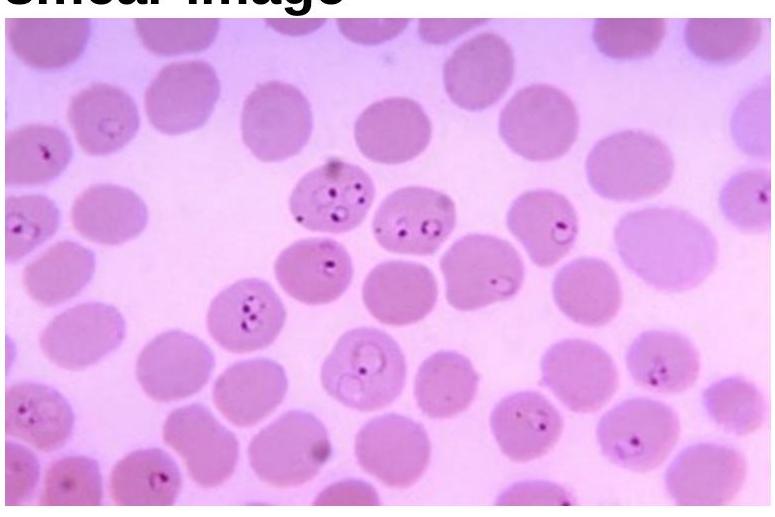
Identify the organism related to the blood smear image.
NEET-PG 2018 - Microbiology NEET-PG Practice Questions and MCQs
Question 11: Acute Hemorrhagic Conjunctivitis is primarily caused by which type of Enterovirus?
- A. Enterovirus type 68
- B. Enterovirus type 69
- C. Enterovirus type 70 (Correct Answer)
- D. Enterovirus type 71
Explanation: ***Enterovirus type 70*** - **Enterovirus type 70** is the most common cause of **Acute Hemorrhagic Conjunctivitis (AHC)**, particularly in epidemic outbreaks. - AHC presents with rapid onset of **ocular pain**, **redness**, **swelling**, and **subconjunctival hemorrhages**. *Enterovirus type 68* - **Enterovirus D68 (EV-D68)** is primarily known for causing **respiratory illnesses**, ranging from mild to severe, and is associated with acute flaccid myelitis. - While it can cause respiratory symptoms, it is not a primary cause of **Acute Hemorrhagic Conjunctivitis**. *Enterovirus type 69* - **Enterovirus type 69** is a rare serotype and is not typically associated with specific human diseases or large-scale outbreaks. - Unlike EV70, it is not recognized as a significant cause of **conjunctivitis**. *Enterovirus type 71* - **Enterovirus A71 (EV-A71)** is a common cause of **hand, foot, and mouth disease (HFMD)**, especially in children, and can also lead to severe neurological complications. - While it causes various infections, it is not the primary cause of **hemorrhagic conjunctivitis**.
Question 12: Identify the organism related to the blood smear image.
- A. Plasmodium falciparum (Correct Answer)
- B. Salmonella Typhi
- C. Toxoplasma gondii
- D. Treponema pallidum
Explanation: ***Plasmodium falciparum*** - The image clearly displays multiple **ring-form trophozoites** within red blood cells, some of which are *appliqué* or *accolade* forms (rings on the periphery of the red blood cell) and **multiple rings per red blood cell**, which are characteristic of *P. falciparum*. - Presence of **multiple parasites per red blood cell** and various developmental stages including occasional **banana-shaped gametocytes**, though not prominent in this specific field, are key indicators of *P. falciparum* infection, differentiating it from other malarial species. - *P. falciparum* is the most dangerous malarial species and can cause **cerebral malaria** and other severe complications. *Salmonella Typhi* - This bacterium causes **typhoid fever** and is typically identified through **blood culture** or serological tests (Widal test), not by direct visualization within red blood cells on a peripheral blood smear. - *Salmonella Typhi* is an **intracellular bacterium** that primarily infects phagocytic cells (macrophages), not erythrocytes, and does not present as ring forms or other parasitic stages in blood smears. *Toxoplasma gondii* - This parasite causes **toxoplasmosis** and is typically found as **tachyzoites** or **bradyzoites** (within cysts) in tissue samples or less commonly in macrophages in disseminated disease, but not as ring forms within red blood cells on a peripheral blood smear. - Diagnosis usually involves **serological testing** for IgM/IgG antibodies or PCR, as opposed to direct visualization of unique forms in blood smears. *Treponema pallidum* - This is the spirochete responsible for **syphilis** and is too small and thin (0.1-0.2 μm diameter) to be seen with standard light microscopy on routine blood smears. - It is best identified using **dark-field microscopy** or serological tests (VDRL, RPR, TPPA, FTA-ABS) and does not infect red blood cells in the manner shown.
Obstetrics and Gynecology
2 questionsBest time to perform the quadruple test is:
What is meant by Superfecundation?
NEET-PG 2018 - Obstetrics and Gynecology NEET-PG Practice Questions and MCQs
Question 11: Best time to perform the quadruple test is:
- A. 8-12 weeks
- B. 11-15 weeks
- C. 15-20 weeks (Correct Answer)
- D. 18-22 weeks
Explanation: ***15-20 weeks*** - The quadruple test measures levels of four substances (**alpha-fetoprotein**, **human chorionic gonadotropin**, **unconjugated estriol**, and **inhibin A**) in the mother's blood. - This window is optimal for detecting neural tube defects and chromosomal abnormalities like **Down syndrome** and **Trisomy 18**, allowing for timely counseling and further diagnostic testing if needed. *8-12 weeks* - This period is generally too early for the quadruple test to be accurate, as the levels of the markers would not be sufficiently distinct for reliable screening. - The **combined first-trimester screening** (nuchal translucency and blood tests for PAPP-A and hCG) is typically performed during this time. *11-15 weeks* - While some components might be detectable at the later end of this range, 15-20 weeks offers a more accurate window for all four markers of the quadruple test. - **Integrated screening**, which combines first and second-trimester markers, would involve blood draws around 10-14 weeks and then 15-20 weeks. *18-22 weeks* - This period is generally considered too late for optimal results of the quadruple test, as the fetal markers might be less indicative or diagnostic interventions options might be limited. - A **detailed ultrasound** for anatomical survey is usually performed around this time.
Question 12: What is meant by Superfecundation?
- A. Fertilization of ova and then its division
- B. Fertilization of two or more ova in one intercourse
- C. Fertilization of two or more ova in different intercourses in same menstrual cycle (Correct Answer)
- D. Fertilization of second ovum after first one is already implanted
Explanation: ***Fertilization of two or more ova in different intercourses in same menstrual cycle*** - **Superfecundation** occurs when two or more ova released during the same menstrual cycle are fertilized by sperm from **separate acts of coitus**. - This can lead to **dizygotic twins** or multiples conceived at different times within a short window, potentially from different biological fathers. *Fertilization of two or more ova in one intercourse* - This scenario describes the fertilization of multiple ova within a **single sexual encounter**, often leading to **dizygotic multiples** but not superfecundation. - Superfecundation specifically implies fertilization from **separate instances of intercourse**. *Fertilization of ova and then its division* - This describes the formation of **monozygotic (identical) twins**, where a single fertilized ovum (zygote) later splits into two or more embryos. - It is distinct from superfecundation, which involves fertilization of **multiple ova**. *Fertilization of second ovum after first one is already implanted* - This describes **superfetation**, a rare phenomenon where a new pregnancy (fertilization and conception) occurs **while already pregnant** from a previous cycle. - Superfecundation, conversely, involves **multiple conceptions within the same menstrual cycle**, not across different cycles.
Physiology
1 questionsWhat is the physiological response of the kidney during shock?
NEET-PG 2018 - Physiology NEET-PG Practice Questions and MCQs
Question 11: What is the physiological response of the kidney during shock?
- A. GFR decreases
- B. Perfusion of kidney decreases
- C. Afferent arteriole resistance increases
- D. Renal blood flow decreases (Correct Answer)
Explanation: ***Renal blood flow decreases*** - During shock, the **primary and most fundamental** physiological change affecting the kidney is a marked **reduction in renal blood flow (RBF)**. - Shock triggers intense **sympathetic activation** and **renin-angiotensin system (RAS) activation**, causing preferential **vasoconstriction** of renal vessels to redirect blood to vital organs (brain, heart). - RBF can drop to as low as **20-30% of normal** in severe shock, making this the hallmark renal response. - This reduction in RBF is the **upstream event** that triggers all other renal changes during shock. *Perfusion of kidney decreases* - While technically correct, "decreased perfusion" is **essentially synonymous** with decreased blood flow in this context. - The term "renal blood flow" is the **standard physiological terminology** used in medical literature to describe this phenomenon, making it the more precise answer. *Afferent arteriole resistance increases* - This is a **mechanism** by which RBF decreases, not the overall response itself. - Increased afferent arteriolar resistance is **secondary** to sympathetic activation and angiotensin II effects during shock. - It describes the "how" rather than the "what" of the kidney's response. *GFR decreases* - GFR reduction is a **consequence** of decreased RBF and increased afferent arteriolar resistance. - While clinically important (oliguria/acute kidney injury), it's a **downstream effect** rather than the primary physiological response. - The relationship: ↓RBF → ↓Glomerular hydrostatic pressure → ↓GFR
Surgery
2 questionsWhere will be the placement location for Auditory Brainstem Implant?
Which of the following is the preferred graft material for femoropopliteal bypass?
NEET-PG 2018 - Surgery NEET-PG Practice Questions and MCQs
Question 11: Where will be the placement location for Auditory Brainstem Implant?
- A. Scala tympani
- B. Recess of 4th ventricle (Correct Answer)
- C. IAC
- D. Back of ear
Explanation: ***Recess of 4th ventricle*** - An **Auditory Brainstem Implant (ABI)** is placed on the **cochlear nucleus** in the brainstem, which is anatomically located near the **lateral recess of the fourth ventricle**. - The implant stimulates these nuclei directly, bypassing the damaged auditory nerve in patients who cannot benefit from cochlear implants. *Scala tympani* - The **scala tympani** is the location for electrode placement in a **cochlear implant**, not an auditory brainstem implant. - Cochlear implants stimulate the intact auditory nerve within the cochlea. *IAC* - The **internal auditory canal (IAC)** houses the auditory and facial nerves, but it is not the target site for an ABI. - The ABI is designed for patients whose auditory nerve (which passes through the IAC) is non-functional. *Back of ear* - The "back of the ear" is the general area where the **external processor of a cochlear implant** or a **bone-anchored hearing aid** is typically worn, not the surgical placement site for an ABI. - The ABI's internal component is surgically placed within the cranium.
Question 12: Which of the following is the preferred graft material for femoropopliteal bypass?
- A. PTFE
- B. Dacron
- C. Reversed saphenous (Correct Answer)
- D. None of the options
Explanation: ***Reversed saphenous*** - The **autologous reversed saphenous vein** is considered the **gold standard** for femoropopliteal bypass due to its superior patency rates and resistance to infection. - The vein's valves are bypassed by reversing its orientation, ensuring unidirectional blood flow. *Dacron* - **Dacron (polyethylene terephthalate)** grafts are synthetic and commonly used for large-diameter arterial bypasses, such as in the aorta, but have **inferior patency in infrainguinal bypasses** compared to autologous vein. - **Higher rates of thrombosis and infection** are observed with Dacron in smaller leg vessels due to compliance mismatch and increased anastomotic intimal hyperplasia. *PTFE* - **Polytetrafluoroethylene (PTFE)** grafts are synthetic and are an option when autologous vein is unavailable, particularly for above-knee femoropopliteal bypasses. - However, PTFE generally has **lower long-term patency rates** and a higher risk of complications like **graft thrombosis and infection** compared to autologous vein grafts. *None of the options* - This option is incorrect because the **reversed saphenous vein** is indeed a preferred and highly effective graft material for femoropopliteal bypass. - The clinical evidence strongly supports its use over synthetic alternatives when available.