Anatomy
1 questionsWhat is the primary function of the deltoid muscle?
NEET-PG 2018 - Anatomy NEET-PG Practice Questions and MCQs
Question 161: What is the primary function of the deltoid muscle?
- A. Adduction of the shoulder
- B. Abduction of the shoulder (Correct Answer)
- C. Flexion of the elbow
- D. Extension of the wrist
Explanation: ***Abduction of the shoulder*** - The **deltoid muscle** is the major muscle responsible for **abducting the arm** at the shoulder joint, particularly after the initial 15-20 degrees. - Its different parts (anterior, middle, posterior) also contribute to flexion, extension, and rotation, but **abduction** is its primary and most powerful action. *Adduction of the shoulder* - **Adduction of the shoulder** involves moving the arm towards the midline of the body, which is primarily performed by muscles such as the **latissimus dorsi** and **pectoralis major**. - While some fibers of the deltoid can assist in adduction from certain positions, it is not its primary function. *Flexion of the elbow* - **Flexion of the elbow** involves bending the arm at the elbow joint and is primarily performed by muscles like the **biceps brachii**, **brachialis**, and **brachioradialis**. - The deltoid muscle is located at the shoulder and has no direct action on the elbow joint. *Extension of the wrist* - **Extension of the wrist** involves bending the hand backward at the wrist joint and is primarily performed by muscles in the forearm such as the **extensor carpi radialis** and **extensor digitorum**. - The deltoid muscle is a shoulder muscle and does not act on the wrist joint.
Dermatology
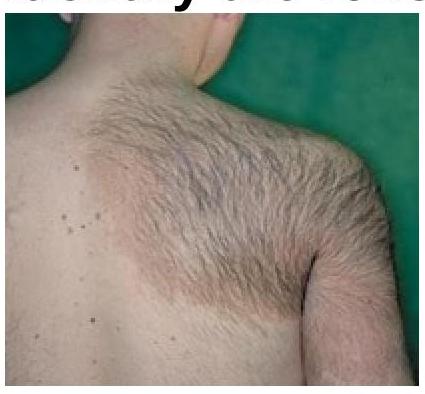
1 questionsIdentify the skin lesion shown in the image.
NEET-PG 2018 - Dermatology NEET-PG Practice Questions and MCQs
Question 161: Identify the skin lesion shown in the image.
- A. Becker nevus (Correct Answer)
- B. Hypopigmented macule
- C. Spitz nevus
- D. Epidermal nevus
Explanation: ***Becker nevus*** - This image clearly shows a large, **hyperpigmented patch with overlying coarse terminal hairs**, characteristic of a Becker nevus. - Becker nevi typically develop in adolescence and are often found on the shoulder or upper trunk, as seen here. *Hypopigmented macule* - A **hypopigmented macule** would appear as an area of skin with **reduced pigmentation** (lighter than the surrounding skin), which is contrary to the darker lesion shown. - There would also be no indication of **increased hair growth** within a typical hypopigmented macule. *Spitz nevus* - A Spitz nevus is a benign melanocytic nevus often appearing as a **dome-shaped, pink or red papule or nodule**, commonly on the face or limbs. - It does not present as a large, hairy, **hyperpigmented patch** as depicted in the image. *Epidermal nevus* - An epidermal nevus is a **congenital lesion** formed by an overgrowth of epidermal cells, but its appearance is typically a **verrucous (wart-like) plaque** or linearly arranged papules. - While it can be hyperpigmented, it generally **lacks the prominent hypertrichosis** (excessive hair growth) seen in the image.
Internal Medicine
1 questionsWhich of the following is the MOST characteristic feature of ataxia telangiectasia?
NEET-PG 2018 - Internal Medicine NEET-PG Practice Questions and MCQs
Question 161: Which of the following is the MOST characteristic feature of ataxia telangiectasia?
- A. Increases the risk of lymphoid malignancies (Correct Answer)
- B. Increase in serum alpha-fetoprotein (AFP) levels
- C. Genetic inheritance pattern is autosomal recessive
- D. None of the options
Explanation: ***Increases the risk of lymphoid malignancies*** - Ataxia-telangiectasia (A-T) is characterized by a high predisposition to **lymphoid malignancies**, particularly lymphomas and leukemias, due to defective DNA repair mechanisms. - The **ATM gene mutation** in A-T leads to chromosomal instability, making cells more susceptible to uncontrolled proliferation associated with cancer. *Increase in serum alpha-fetoprotein (AFP) levels* - While elevated serum **alpha-fetoprotein (AFP)** is a biochemical hallmark of Ataxia-telangiectasia, it is a laboratory finding, not a direct clinical feature or primary characteristic of the disease pathology itself. - AFP elevation in A-T is thought to be related to **hepatic dysfunction** or impaired clearance, but not as directly defining as the increased malignancy risk. *Genetic inheritance pattern is autosomal recessive* - The **autosomal recessive** inheritance pattern describes how the disease is passed down through families, specifically requiring two copies of the mutated gene. - While fundamental to the genetics of A-T, it is a mode of inheritance and not a *characteristic clinical feature* or direct pathophysiological consequence of the disease. *None of the options* - This option is incorrect because the increased risk of lymphoid malignancies is indeed a highly characteristic and clinically significant feature of Ataxia-telangiectasia.
Obstetrics and Gynecology
3 questionsWhich drug regimen is given to a pregnant woman with HIV infection?
Based on the provided image, which of the following is the correct diagnosis?

Which of the following statements about the placenta is correct?
NEET-PG 2018 - Obstetrics and Gynecology NEET-PG Practice Questions and MCQs
Question 161: Which drug regimen is given to a pregnant woman with HIV infection?
- A. Tenofovir disoproxil fumarate with emtricitabine
- B. Tenofovir disoproxil fumarate with lamivudine
- C. Abacavir with lamivudine
- D. All of the options (Correct Answer)
Explanation: ***All of the options*** - All listed regimens—**Tenofovir disoproxil fumarate (TDF) with emtricitabine (FTC)**, **TDF with lamivudine (3TC)**, and **Abacavir (ABC) with lamivudine (3TC)**—are commonly used and generally safe combinations of **nucleoside/nucleotide reverse transcriptase inhibitors (NRTIs)** in pregnant women with HIV. - The choice of regimen depends on factors such as individual patient characteristics, viral resistance patterns, and potential side effects, but all mentioned regimens are considered **first-line options** in various guidelines for preventing mother-to-child transmission (PMTCT). *Tenofovir disoproxil fumarate with emtricitabine* - This combination is a common and effective **NRTI backbone** for HIV treatment, including in pregnancy, offering good efficacy and a generally favorable safety profile. - It is frequently paired with a third agent (e.g., a **non-nucleoside reverse transcriptase inhibitor (NNRTI)** or an **integrase strand transfer inhibitor (INSTI)**) as part of a highly active antiretroviral therapy (HAART) regimen. *Tenofovir disoproxil fumarate with lamivudine* - This is another widely used and effective **NRTI combination** and is also a recommended backbone for pregnant women with HIV. - While similar to TDF/FTC, some guidelines might prefer one over the other based on specific regional recommendations or drug availability. *Abacavir with lamivudine* - **Abacavir/lamivudine** is a well-established NRTI combination that is safe and effective in pregnancy, provided the mother is **HLA-B*5701 negative** to avoid hypersensitivity reactions. - It is considered a suitable alternative to TDF-containing regimens, especially when there are contraindications or intolerances to TDF.
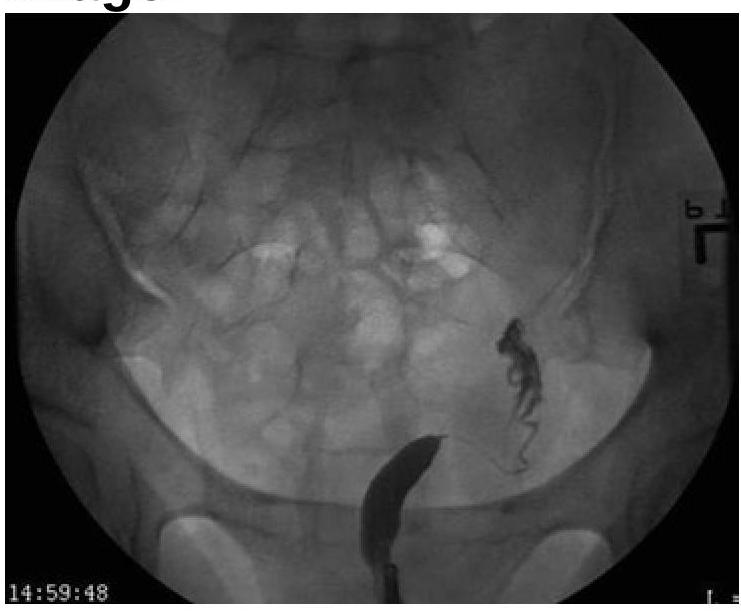
Question 162: Based on the provided image, which of the following is the correct diagnosis?
- A. Uterus didelphys
- B. Bicornuate Uterus
- C. Unicornuate Uterus (Correct Answer)
- D. Septate uterus
Explanation: ***Unicornuate Uterus*** - The image distinctly shows **only one fallopian tube and one rudimentary uterine horn** on the right side, indicating a unicornuate uterus. - This malformation results from the **incomplete development of one Müllerian duct**, leading to a single, banana-shaped uterine cavity. *Uterus didelphys* - This condition involves **two completely separate uteri**, each with its own cervix and vagina. - The image does not show evidence of two distinct uterine bodies or cervices. *Bicornuate Uterus* - A bicornuate uterus is characterized by **two uterine horns that fuse caudally**, creating a heart-shaped appearance with a shared cervix. - The image clearly lacks the characteristic heart shape and shows only one functional horn. *Septate uterus* - A septate uterus has a **fibrous or muscular septum** dividing the uterine cavity, while the external uterine contour remains normal. - The image does not show a septum or a normal external uterine contour with an internal division; instead, it presents with a single underdeveloped horn.
Question 163: Which of the following statements about the placenta is correct?
- A. The placenta produces estrogen. (Correct Answer)
- B. The placenta has 2 arteries and 1 vein.
- C. The placental artery carries deoxygenated blood from the fetus to the placenta.
- D. Wharton's jelly is found in the umbilical cord.
Explanation: ***The placenta produces estrogen.*** - The **placenta** is an important endocrine organ, producing various hormones including **estrogen** (specifically estriol) and progesterone. - These hormones are crucial for maintaining the pregnancy and supporting fetal development. *The placental artery carries deoxygenated blood from the fetus to the placenta.* - This statement is incorrect as the **umbilical arteries** (not placental arteries) carry **deoxygenated blood and waste products** from the fetus to the placenta. - The **umbilical vein** carries **oxygenated blood and nutrients** from the placenta to the fetus. *The placenta has 2 arteries and 1 vein.* - This describes the typical composition of the **umbilical cord**, not the placenta itself. - The **placenta** is a distinct organ that connects the mother and fetus, facilitating nutrient and gas exchange. *Wharton's jelly is found in the umbilical cord.* - This statement is correct, but the question asks about the **placenta**, not the umbilical cord. - **Wharton's jelly** is a gelatinous substance that protects and supports the blood vessels within the umbilical cord.
Pathology
1 questionsThe following statement about keloid is true:
NEET-PG 2018 - Pathology NEET-PG Practice Questions and MCQs
Question 161: The following statement about keloid is true:
- A. Extended excision is the treatment of choice
- B. Elevated levels of growth factor is not seen
- C. It will have more collagen and vascularity (Correct Answer)
- D. They do not extend beyond the wound
Explanation: ***It will have more collagen and vascularity*** - Keloid scars are characterized by an **overgrowth of dense, fibrous tissue**, primarily composed of **collagen fibers**, which explains the increased collagen content [1], [2]. - They also exhibit an increased number of **blood vessels (vascularity)** compared to normal skin, contributing to their often reddish or purple appearance. *Extended excision is the treatment of choice* - **Surgical excision alone** is generally **not the treatment of choice** for keloids because it has a **high recurrence rate** (often greater than 50-100%) [1]. - If excision is performed, it must be combined with **adjuvant therapies** such as corticosteroids, cryotherapy, or radiation therapy to reduce the risk of recurrence. *Elevated levels of growth factor is not seen* - Keloids are associated with **elevated levels of various growth factors**, such as **transforming growth factor-beta (TGF-$\beta$)** and ** basic fibroblast growth factor (bFGF)** [3]. - These growth factors play a crucial role in promoting **fibroblast proliferation** and **collagen synthesis**, contributing to the excessive scar formation [3]. *They do not extend beyond the wound* - This statement describes a **hypertrophic scar**, not a keloid. - **Keloids are distinctive** because they characteristically **extend beyond the boundaries of the original wound** or injury, often infiltrating surrounding healthy tissue [1]. **References:** [1] Kumar V, Abbas AK, et al.. Robbins and Cotran Pathologic Basis of Disease. 9th ed. Inflammation and Repair, p. 121. [2] Cross SS. Underwood's Pathology: A Clinical Approach. 6th ed. (Basic Pathology) introduces the student to key general principles of pathology, both as a medical science and as a clinical activity with a vital role in patient care. Part 2 (Disease Mechanisms) provides fundamental knowledge about the cellular and molecular processes involved in diseases, providing the rationale for their treatment. Part 3 (Systematic Pathology) deals in detail with specific diseases, with emphasis on the clinically important aspects., pp. 106-107. [3] Kumar V, Abbas AK, et al.. Robbins and Cotran Pathologic Basis of Disease. 9th ed. Inflammation and Repair, pp. 117-119.
Radiology
1 questionsWhat condition is shown in the MR angiogram of the skull?

NEET-PG 2018 - Radiology NEET-PG Practice Questions and MCQs
Question 161: What condition is shown in the MR angiogram of the skull?
- A. Vein of Galen malformation (Correct Answer)
- B. Dandy-Walker malformation
- C. Pneumocephalus
- D. Crouzon syndrome
Explanation: ***Vein of Galen malformation*** - The image provided is an **MR angiogram (MRA)**, which clearly shows a **large, dilated vein of Galen**. This is the characteristic appearance of a Vein of Galen malformation. - This congenital vascular malformation involves a direct artery-to-vein shunt, leading to the characteristic aneurysmal dilatation of the vein. *Dandy-Walker malformation* - This is a congenital brain malformation characterized by **agenesis or hypoplasia of the cerebellar vermis** and cystic dilation of the fourth ventricle. - While it affects brain structures, it does not involve the type of vascular abnormality seen in the image. *Pneumocephalus* - **Pneumocephalus** refers to the presence of **air within the intracranial cavity**, often due to trauma or surgery. - It would appear as dark areas on imaging, representing air, not the bright, dilated vascular structures seen here. *Crouzon syndrome* - **Crouzon syndrome** is a genetic disorder characterized by **craniosynostosis**, which is the premature fusion of skull sutures. - This condition primarily affects bone growth and skull shape, with no direct involvement of the cerebral vasculature as depicted in the MRA.
Surgery
2 questionsWhich is the best investigation for carcinoma of the head of pancreas?
Site for placing an electrode in auditory brain stem implant is?
NEET-PG 2018 - Surgery NEET-PG Practice Questions and MCQs
Question 161: Which is the best investigation for carcinoma of the head of pancreas?
- A. Transduodenal/transperitoneal sampling
- B. Guided biopsy
- C. ERCP
- D. EUS (Correct Answer)
Explanation: ***EUS*** - **Endoscopic ultrasound (EUS)** provides the highest resolution imaging of the pancreas and allows for **fine-needle aspiration (FNA)** of suspicious lesions, offering definitive tissue diagnosis. - Its ability to visualize small, early-stage tumors and regional lymph nodes makes it the **most accurate method for diagnosis and staging** of pancreatic head carcinoma. *Guided biopsy* - While a biopsy is necessary for definitive diagnosis, 'guided biopsy' is a broad term that doesn't specify the highly effective EUS guidance. - Other biopsy methods that are not guided by EUS may be less accurate and carry higher risks for pancreatic lesions. *ERCP* - **Endoscopic retrograde cholangiopancreatography (ERCP)** is primarily a therapeutic procedure used for **biliary drainage** in cases of obstruction caused by pancreatic head tumors. - Although it can visualize ductal abnormalities and allow brush cytology, it is **less sensitive for direct tumor visualization** and tissue acquisition compared to EUS-FNA. *Transduodenal/transperitoneal sampling* - These are **invasive surgical approaches** for obtaining tissue samples, typically reserved when less invasive methods like EUS-FNA are unsuccessful or when intraoperative confirmation is needed. - They carry **higher risks** and are not considered the "best investigation" for initial diagnosis due to their invasiveness and potential for complications.
Question 162: Site for placing an electrode in auditory brain stem implant is?
- A. Round window
- B. Sinus tympani
- C. Lateral ventricle
- D. Recess of fourth ventricle (Correct Answer)
Explanation: ***Recess of fourth ventricle*** - The auditory brainstem implant (ABI) electrode arrays are typically placed on the surface of the **cochlear nucleus**, which lies in the **lateral recess of the fourth ventricle and cerebellopontine angle**. - This placement allows direct stimulation of the central auditory pathways, bypassing a damaged or absent auditory nerve. *Round window* - The round window is the site for electrode placement in a **cochlear implant**, not an auditory brainstem implant. - A cochlear implant stimulates the **auditory nerve terminals** within the cochlea. *Sinus tympani* - The sinus tympani is an **anatomical space** within the middle ear. - It is not a site for implant electrode placement for either cochlear or brainstem implants. *Lateral ventricle* - The lateral ventricles are spaces within the brain that contain **cerebrospinal fluid** and are not directly involved in the auditory pathway for implant stimulation. - Implants for hearing are generally directed towards the auditory neural structures.