Biochemistry
1 questionsWhich of the following statements about DNA polymerase I is correct?
NEET-PG 2018 - Biochemistry NEET-PG Practice Questions and MCQs
Question 91: Which of the following statements about DNA polymerase I is correct?
- A. Participates in the synthesis of Okazaki fragments.
- B. Is the primary enzyme for DNA replication in bacteria
- C. Involved in DNA repair processes. (Correct Answer)
- D. Not essential for DNA replication in bacteria.
Explanation: ***Involved in DNA repair processes.*** - **DNA polymerase I** possesses **5' to 3' exonuclease activity**, which is crucial for removing **RNA primers** and damaged DNA segments during DNA repair. - Its **DNA repair function** is essential for maintaining genome integrity by excising incorrect nucleotides and filling the gaps. - DNA pol I plays a key role in **nick translation** and **gap filling** after primer removal during DNA replication. *Participates in the synthesis of Okazaki fragments.* - **DNA polymerase III** is the primary enzyme responsible for synthesizing **Okazaki fragments** on the lagging strand during bacterial DNA replication. - While DNA polymerase I does **process** Okazaki fragments by removing RNA primers and filling gaps, it does not *synthesize* them. *Is the primary enzyme for DNA replication in bacteria* - **DNA polymerase III** is the main enzyme responsible for the bulk of DNA synthesis during replication in **bacteria**. - DNA polymerase I plays a more specialized role in **primer removal** and **gap filling** rather than primary elongation. *Not essential for DNA replication in bacteria.* - **DNA polymerase I** is **essential** for bacterial viability despite not being the primary replicative polymerase. - Its crucial role in **primer removal** and **gap filling** after primer excision is indispensable for completing DNA replication and repair processes.
Internal Medicine
3 questionsA boy presented with multiple non suppurative osteomyelitis with sickle cell anaemia. What will be the causative organism?
TRALI occurs within how many hours of transfusion?
Which one of the following statements about Graves' disease is FALSE?
NEET-PG 2018 - Internal Medicine NEET-PG Practice Questions and MCQs
Question 91: A boy presented with multiple non suppurative osteomyelitis with sickle cell anaemia. What will be the causative organism?
- A. Salmonella (Correct Answer)
- B. H. influenzae
- C. Enterobacter species
- D. Staphylococcus aureus
Explanation: ***Salmonella*** - **Salmonella species** are a well-known cause of **osteomyelitis** in patients with **sickle cell anemia**, due to factors like gut mucosal damage and functional asplenia. [1] - The unique pathophysiology of sickle cell disease, including areas of bone infarction and compromised reticulendothelial system function, predisposes these patients to **Salmonella infections**. [1] *Staphylococcus aureus* - While **Staphylococcus aureus** is the most common cause of osteomyelitis in the general population, it is less likely to be the causative organism in patients with **sickle cell anemia** compared to Salmonella. - Its presence usually indicates other predisposing factors like trauma or prosthetic devices. *H. influenzae* - **Haemophilus influenzae** was a common cause of osteomyelitis in children before widespread vaccination but is now rare, especially with routine immunizations. - It is not specifically associated with a higher risk in patients with **sickle cell disease** for osteomyelitis compared to other pathogens. *Enterobacter species* - **Enterobacter species** can cause osteomyelitis, particularly in immunocompromised individuals or following surgery, but they are not uniquely associated with **sickle cell anemia** as a primary cause compared to Salmonella. - Their involvement in non-suppurative osteomyelitis in this specific patient population is less common.
Question 92: TRALI occurs within how many hours of transfusion?
- A. 6 hours (Correct Answer)
- B. 48 hours
- C. 72 hours
- D. 12 hours
Explanation: ***6 hours*** - **Transfusion-related acute lung injury (TRALI)** is defined as new acute lung injury occurring during or within **6 hours** after the completion of a blood transfusion [1]. - It is a severe and potentially life-threatening transfusion reaction characterized by **acute respiratory distress**, **hypoxemia**, and **bilateral pulmonary infiltrates** on chest imaging [1]. *48 hours* - While other transfusion reactions or complications may manifest within 48 hours, TRALI has a more **acute onset**, typically within the first 6 hours. - A pulmonary event occurring between 6 and 48 hours post-transfusion might be considered **delayed TRALI** or another diagnosis like **transfusion-associated circulatory overload (TACO)**, but the classic definition refers to the 6-hour window. *72 hours* - Reactions occurring 72 hours after transfusion are generally considered **delayed transfusion reactions**, which include conditions like **delayed hemolytic transfusion reactions** or **post-transfusion purpura**. - This timeframe is too long for the typical presentation of TRALI, which is characterized by rapid onset. *12 hours* - Although 12 hours falls within an acute window, the most commonly accepted and diagnostically crucial timeframe for TRALI is **within 6 hours** of transfusion. - A reaction occurring between 6 and 12 hours would still be considered suspiciously TRALI, but the strict definition emphasizes the earlier onset.
Question 93: Which one of the following statements about Graves' disease is FALSE?
- A. Common in male (Correct Answer)
- B. Referred to as toxic diffuse goiter
- C. Results in hyperthyroidism
- D. Autoimmune disorder
Explanation: ***Common in male*** - Graves' disease is significantly **more common in females** than males, with a female-to-male ratio of approximately 7:1 [1]. It is a female predominant disease [2]. - The peak incidence is between the ages of 20 and 50 years, and it is the most common cause of **hyperthyroidism** in women [1], [2]. *Results in hyperthyroidism* - Graves' disease is characterized by the production of **autoantibodies** against the TSH receptor, leading to excessive stimulation of the thyroid gland [1]. - This overstimulation results in **increased synthesis and release of thyroid hormones**, causing a state of hyperthyroidism [2]. *Autoimmune disorder* - Graves' disease is a classic example of an **organ-specific autoimmune disease** [2]. - The immune system mistakenly produces antibodies that mimic the action of TSH, leading to thyroid overactivity [1]. *Referred to as toxic diffuse goiter* - The term "toxic" refers to the **hyperthyroid state** (thyrotoxicosis), and "diffuse goiter" describes the generally uniform enlargement of the entire thyroid gland [1]. - This terminology accurately reflects the typical presentation of Graves' disease, which involves an overactive, diffusely enlarged thyroid gland [2].
Microbiology
2 questionsIdentify the organism related to the blood smear image.

Which organism is the most common cause of acute bacterial prostatitis?
NEET-PG 2018 - Microbiology NEET-PG Practice Questions and MCQs
Question 91: Identify the organism related to the blood smear image.
- A. Plasmodium falciparum (Correct Answer)
- B. Salmonella Typhi
- C. Toxoplasma gondii
- D. Treponema pallidum
Explanation: ***Plasmodium falciparum*** - The image clearly displays multiple **ring-form trophozoites** within red blood cells, some of which are *appliqué* or *accolade* forms (rings on the periphery of the red blood cell) and **multiple rings per red blood cell**, which are characteristic of *P. falciparum*. - Presence of **multiple parasites per red blood cell** and various developmental stages including occasional **banana-shaped gametocytes**, though not prominent in this specific field, are key indicators of *P. falciparum* infection, differentiating it from other malarial species. - *P. falciparum* is the most dangerous malarial species and can cause **cerebral malaria** and other severe complications. *Salmonella Typhi* - This bacterium causes **typhoid fever** and is typically identified through **blood culture** or serological tests (Widal test), not by direct visualization within red blood cells on a peripheral blood smear. - *Salmonella Typhi* is an **intracellular bacterium** that primarily infects phagocytic cells (macrophages), not erythrocytes, and does not present as ring forms or other parasitic stages in blood smears. *Toxoplasma gondii* - This parasite causes **toxoplasmosis** and is typically found as **tachyzoites** or **bradyzoites** (within cysts) in tissue samples or less commonly in macrophages in disseminated disease, but not as ring forms within red blood cells on a peripheral blood smear. - Diagnosis usually involves **serological testing** for IgM/IgG antibodies or PCR, as opposed to direct visualization of unique forms in blood smears. *Treponema pallidum* - This is the spirochete responsible for **syphilis** and is too small and thin (0.1-0.2 μm diameter) to be seen with standard light microscopy on routine blood smears. - It is best identified using **dark-field microscopy** or serological tests (VDRL, RPR, TPPA, FTA-ABS) and does not infect red blood cells in the manner shown.
Question 92: Which organism is the most common cause of acute bacterial prostatitis?
- A. Enterococcus
- B. Streptococcus viridans
- C. Peptostreptococcus
- D. E.coli (Correct Answer)
Explanation: ***E.coli*** - **E.coli** is the most common cause of **acute bacterial prostatitis**, accounting for a significant majority of cases. - It is a **gram-negative rod** commonly found in the gastrointestinal tract and can ascend into the urinary tract and prostate. *Enterococcus* - While **Enterococcus species** can cause urinary tract infections and, less commonly, prostatitis, they are a distant second to E.coli in frequency. - They are **gram-positive cocci** and are often associated with catheter-associated infections or healthcare-acquired infections. *Streptococcus viridans* - **Streptococcus viridans** group bacteria are typically commensals of the oral cavity and are more known for causing **endocarditis** or dental infections. - They are not a common cause of acute bacterial prostatitis. *Peptostreptococcus* - **Peptostreptococcus** is a genus of **anaerobic gram-positive cocci** commonly found in the normal flora of the mouth, gastrointestinal tract, and vagina. - They are typically involved in **polymicrobial anaerobic infections** but are not a primary or common cause of acute bacterial prostatitis.
Obstetrics and Gynecology
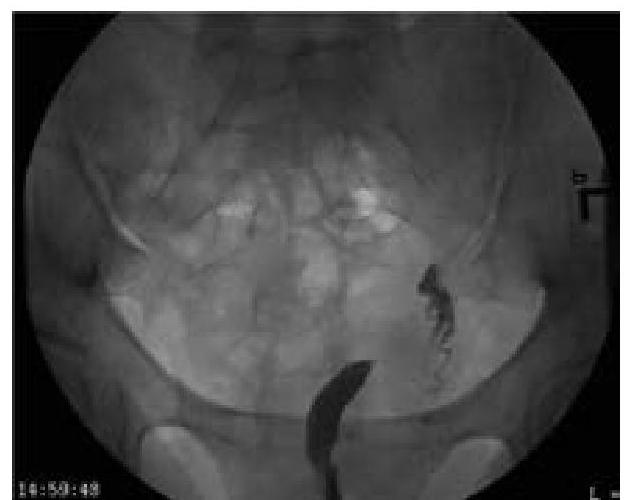
2 questionsWhat type of uterine anomaly is shown in this X-ray HSG image?
What is meant by Superfecundation?
NEET-PG 2018 - Obstetrics and Gynecology NEET-PG Practice Questions and MCQs
Question 91: What type of uterine anomaly is shown in this X-ray HSG image?
- A. Septate uterus
- B. Uterus didelphys
- C. Unicornuate uterus (Correct Answer)
- D. Bicornuate uterus
Explanation: ***Unicornuate uterus*** - The image shows a single, elongated uterine horn with a single fallopian tube arising from it, consistent with a **unicornuate uterus**. - This congenital anomaly results from the **failure of one Müllerian duct to develop**, leading to an abnormally shaped uterus. *Septate uterus* - A **septate uterus** would show a normal uterine fundus with an internal septum dividing the uterine cavity. - This image clearly depicts only **one rudimentary horn** and no visible septum. *Uterus didelphys* - **Uterus didelphys** involves two completely separate uteri, each with its own cervix and vagina. - The image does not show evidence of a **second, separate uterine structure**. *Bicornuate uterus* - A **bicornuate uterus** is characterized by two distinct uterine horns, which fuse at the cervix or lower uterine segment, creating a heart-shaped appearance of the fundus. - The image shows a **single, long horn** rather than two distinct horns.
Question 92: What is meant by Superfecundation?
- A. Fertilization of ova and then its division
- B. Fertilization of two or more ova in one intercourse
- C. Fertilization of two or more ova in different intercourses in same menstrual cycle (Correct Answer)
- D. Fertilization of second ovum after first one is already implanted
Explanation: ***Fertilization of two or more ova in different intercourses in same menstrual cycle*** - **Superfecundation** occurs when two or more ova released during the same menstrual cycle are fertilized by sperm from **separate acts of coitus**. - This can lead to **dizygotic twins** or multiples conceived at different times within a short window, potentially from different biological fathers. *Fertilization of two or more ova in one intercourse* - This scenario describes the fertilization of multiple ova within a **single sexual encounter**, often leading to **dizygotic multiples** but not superfecundation. - Superfecundation specifically implies fertilization from **separate instances of intercourse**. *Fertilization of ova and then its division* - This describes the formation of **monozygotic (identical) twins**, where a single fertilized ovum (zygote) later splits into two or more embryos. - It is distinct from superfecundation, which involves fertilization of **multiple ova**. *Fertilization of second ovum after first one is already implanted* - This describes **superfetation**, a rare phenomenon where a new pregnancy (fertilization and conception) occurs **while already pregnant** from a previous cycle. - Superfecundation, conversely, involves **multiple conceptions within the same menstrual cycle**, not across different cycles.
Pathology
2 questionsBernard–Soulier syndrome is caused by a deficiency of which glycoprotein complex?
Anaplasia is
NEET-PG 2018 - Pathology NEET-PG Practice Questions and MCQs
Question 91: Bernard–Soulier syndrome is caused by a deficiency of which glycoprotein complex?
- A. TNF
- B. von Willebrand factor (vWf)
- C. Gp Ib-IX-V complex (Correct Answer)
- D. Gp IIb/IIIa
Explanation: ***Gp 1b*** - Bernard–Soulier syndrome is primarily caused by a deficiency in **Gp1b**, which is crucial for platelet adhesion to the von Willebrand factor (vWF) [1]. - This results in **thrombocytopenia** and large platelets, which are characteristic features of the syndrome. *Gp 2b/3a* - Gp2b/3a is associated with **Glanzmann thrombasthenia**, not Bernard–Soulier syndrome [1]. - This receptor is essential for platelet aggregation and binds fibrinogen, contributing to a different bleeding disorder. *TNF* - Tumor Necrosis Factor (TNF) is a cytokine involved in systemic inflammation and does not directly relate to platelet function or deficiencies. - Deficiency of TNF is unrelated to bleeding disorders like Bernard–Soulier syndrome. *vWf* - von Willebrand factor (vWf) deficiency is associated with **von Willebrand disease**, which presents differently than Bernard–Soulier syndrome. - vWf is essential for the aggregation of platelets but is not the deficient factor in this syndrome. **References:** [1] Kumar V, Abbas AK, et al.. Robbins and Cotran Pathologic Basis of Disease. 9th ed. Red Blood Cell and Bleeding Disorders, pp. 668-669.
Question 92: Anaplasia is
- A. Changing one type of epithelium to another
- B. Nuclear chromatin
- C. Lack of differentiation (Correct Answer)
- D. Morphological changes
Explanation: ***Lack of differentiation*** - Anaplasia refers to a **loss of differentiation** in cells, making them more primitive and less specialized [1]. - It is often seen in **malignant tumors**, indicating a poor prognosis and aggressive behavior [1]. *Morphological changes* - While anaplasia involves **morphological changes**, this term is too broad and can relate to various cellular alterations, not exclusively anaplasia [1]. - Anaplasia specifically emphasizes **lack of differentiation**, distinct from general changes in cell appearance [1]. *Changing one type of epithelium to another* - This describes a process known as **metaplasia**, where one adult cell type transforms into another, not anaplasia. - Anaplasia signifies a **de-differentiation** rather than a change to a different epithelial type [1]. *Nuclear chromatin* - While changes in **nuclear chromatin** can occur in anaplastic cells, this does not define anaplasia itself [1]. - Anaplasia primarily refers to **loss of cell differentiation**, making this option insufficient to describe the concept [1]. **References:** [1] Kumar V, Abbas AK, et al.. Robbins and Cotran Pathologic Basis of Disease. 9th ed. Neoplasia, pp. 276-280.