Which of these steps is followed first for the management of shoulder dystocia after McRoberts maneuver?
In a woman complaining of AUB following image was seen in endoscopic examination of uterus. What will be the diagnosis?
Which drug regimen is given to a pregnant woman with HIV infection?
Which of the following statements about the placenta is correct?
What is the most common symptom treated with hormone therapy (HT) in menopausal women?
Based on the provided image, which of the following is the correct diagnosis?
Which of the following is the most common cause of perforation of uterus in non-pregnant state?
A 16-year-old girl comes to you with primary amenorrhea; on evaluation there is absent breast development, she has a normal stature, her FSH and LH levels are found to be high and she has a karyotype of 46XX. What is the probable diagnosis?
Shoulder dystocia is managed by all of the following except:-
In Peripartum cardiomyopathy, cardiac failure occurs at:-
NEET-PG 2018 - Obstetrics and Gynecology NEET-PG Practice Questions and MCQs
Question 11: Which of these steps is followed first for the management of shoulder dystocia after McRoberts maneuver?
- A. 90 degree rotation of posterior shoulder
- B. Emergency c-section
- C. Suprapubic pressure (Correct Answer)
- D. Sharp flexion of hip joints towards abdomen
Explanation: ***Suprapubic pressure*** - After performing the **McRoberts maneuver**, applying **suprapubic pressure** is the next step to aid in dislodging the anterior shoulder from behind the pubic symphysis. - This maneuver helps to adduct the fetal shoulders and rotates the anterior shoulder into a more oblique diameter, often allowing for delivery. *90-degree rotation of posterior shoulder* - This describes components of the **Wood's screw maneuver**, which, while effective, is typically attempted *after* suprapubic pressure if initial maneuvers fail. - The Wood's screw maneuver involves rotating the fetal shoulders to disimpact the anterior shoulder, but it is not the *first* step following McRoberts and suprapubic pressure. *Emergency C-section* - An **emergency C-section** is reserved for cases where all other *manual maneuvers* have failed to resolve shoulder dystocia and is not a primary or early step in the management algorithm. - The goal is to first attempt less invasive maneuvers to deliver the baby vaginally, as a C-section carries its own set of risks. *Sharp flexion of hip joints towards abdomen* - This action describes the **McRoberts maneuver** itself, which involves hyperflexing the mother's hips towards her abdomen to flatten the sacrum and rotate the symphysis pubis cephalad. - The question asks for the step *after* McRoberts maneuver, not the maneuver itself.
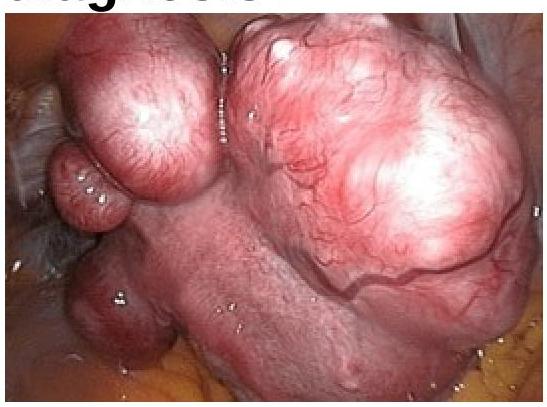
Question 12: In a woman complaining of AUB following image was seen in endoscopic examination of uterus. What will be the diagnosis?
- A. Leiomyoma (Correct Answer)
- B. Adenomyosis
- C. Ovarian neoplasm
- D. Carcinoma of uterus
Explanation: ***Leiomyoma*** - The image shows **well-circumscribed, smooth, rounded masses protruding into the uterine cavity**, which are characteristic of **submucous (intracavitary) leiomyomas (fibroids)** seen on hysteroscopy. - Submucous leiomyomas are benign smooth muscle tumors that project into the endometrial cavity and commonly cause **abnormal uterine bleeding (AUB)** due to increased endometrial surface area, distortion of the endometrial cavity, ulceration of overlying endometrium, and interference with normal uterine contractility. - On **hysteroscopic examination**, they appear as firm, pale, smooth-surfaced masses with overlying endometrium. *Adenomyosis* - Adenomyosis involves the presence of **endometrial tissue within the myometrium**, leading to diffuse uterine enlargement. - On hysteroscopy, it may show a **globally irregular endometrial surface** with small endometrial openings or cystic spaces, but not the discrete, well-circumscribed protruding masses seen in the image. - While it can cause AUB and dysmenorrhea, the appearance is distinctly different from submucous leiomyomas. *Ovarian neoplasm* - Ovarian neoplasms originate in the **ovaries**, which are separate from the uterus. - **Hysteroscopic examination** visualizes only the **endometrial cavity** and cannot directly visualize ovarian pathology. - Ovarian masses do not protrude into the uterine cavity. *Carcinoma of uterus* - Endometrial carcinoma typically presents on hysteroscopy as **irregular, friable, ulcerative, or fungating lesions** with abnormal vascularity and易出血 (easy bleeding). - The **smooth, well-defined, and rounded appearance** with intact overlying mucosa in the image is characteristic of benign leiomyomas, not malignant growths. - Uterine sarcomas are rare and would show more irregular, infiltrative features rather than well-circumscribed masses.
Question 13: Which drug regimen is given to a pregnant woman with HIV infection?
- A. Tenofovir disoproxil fumarate with emtricitabine
- B. Tenofovir disoproxil fumarate with lamivudine
- C. Abacavir with lamivudine
- D. All of the options (Correct Answer)
Explanation: ***All of the options*** - All listed regimens—**Tenofovir disoproxil fumarate (TDF) with emtricitabine (FTC)**, **TDF with lamivudine (3TC)**, and **Abacavir (ABC) with lamivudine (3TC)**—are commonly used and generally safe combinations of **nucleoside/nucleotide reverse transcriptase inhibitors (NRTIs)** in pregnant women with HIV. - The choice of regimen depends on factors such as individual patient characteristics, viral resistance patterns, and potential side effects, but all mentioned regimens are considered **first-line options** in various guidelines for preventing mother-to-child transmission (PMTCT). *Tenofovir disoproxil fumarate with emtricitabine* - This combination is a common and effective **NRTI backbone** for HIV treatment, including in pregnancy, offering good efficacy and a generally favorable safety profile. - It is frequently paired with a third agent (e.g., a **non-nucleoside reverse transcriptase inhibitor (NNRTI)** or an **integrase strand transfer inhibitor (INSTI)**) as part of a highly active antiretroviral therapy (HAART) regimen. *Tenofovir disoproxil fumarate with lamivudine* - This is another widely used and effective **NRTI combination** and is also a recommended backbone for pregnant women with HIV. - While similar to TDF/FTC, some guidelines might prefer one over the other based on specific regional recommendations or drug availability. *Abacavir with lamivudine* - **Abacavir/lamivudine** is a well-established NRTI combination that is safe and effective in pregnancy, provided the mother is **HLA-B*5701 negative** to avoid hypersensitivity reactions. - It is considered a suitable alternative to TDF-containing regimens, especially when there are contraindications or intolerances to TDF.
Question 14: Which of the following statements about the placenta is correct?
- A. The placenta produces estrogen. (Correct Answer)
- B. The placenta has 2 arteries and 1 vein.
- C. The placental artery carries deoxygenated blood from the fetus to the placenta.
- D. Wharton's jelly is found in the umbilical cord.
Explanation: ***The placenta produces estrogen.*** - The **placenta** is an important endocrine organ, producing various hormones including **estrogen** (specifically estriol) and progesterone. - These hormones are crucial for maintaining the pregnancy and supporting fetal development. *The placental artery carries deoxygenated blood from the fetus to the placenta.* - This statement is incorrect as the **umbilical arteries** (not placental arteries) carry **deoxygenated blood and waste products** from the fetus to the placenta. - The **umbilical vein** carries **oxygenated blood and nutrients** from the placenta to the fetus. *The placenta has 2 arteries and 1 vein.* - This describes the typical composition of the **umbilical cord**, not the placenta itself. - The **placenta** is a distinct organ that connects the mother and fetus, facilitating nutrient and gas exchange. *Wharton's jelly is found in the umbilical cord.* - This statement is correct, but the question asks about the **placenta**, not the umbilical cord. - **Wharton's jelly** is a gelatinous substance that protects and supports the blood vessels within the umbilical cord.
Question 15: What is the most common symptom treated with hormone therapy (HT) in menopausal women?
- A. Endometriosis
- B. Uterine bleeding
- C. Hot flashes (Correct Answer)
- D. Breast cancer
Explanation: ***Hot flashes*** - **Vasomotor symptoms**, including hot flashes and night sweats, are the most frequent and bothersome symptoms experienced by menopausal women, leading them to seek medical attention and hormone therapy. - HT is highly effective in reducing the frequency and severity of hot flashes by stabilizing **thermoregulation** in the hypothalamus. *Breast cancer* - **Breast cancer** is a potential risk associated with hormone therapy, particularly with combined estrogen-progestin therapy, not a symptom treated by HT. - Women with a history of breast cancer or those at high risk are generally advised against HT due to this increased risk. *Endometriosis* - While **estrogen-dependent diseases** like endometriosis can be aggravated by HRT, endometriosis itself is a condition that typically improves after menopause. - HT is not used to treat endometriosis; in certain cases, it might be used to manage menopausal symptoms in women with a history of endometriosis after specific surgical interventions. *Uterine bleeding* - **Uterine bleeding** can be a side effect of hormone therapy, especially when progestin is not adequately balanced with estrogen in women with a uterus. - Abnormal uterine bleeding is a symptom that requires investigation to rule out other causes, and it is not a primary symptom treated by HT.
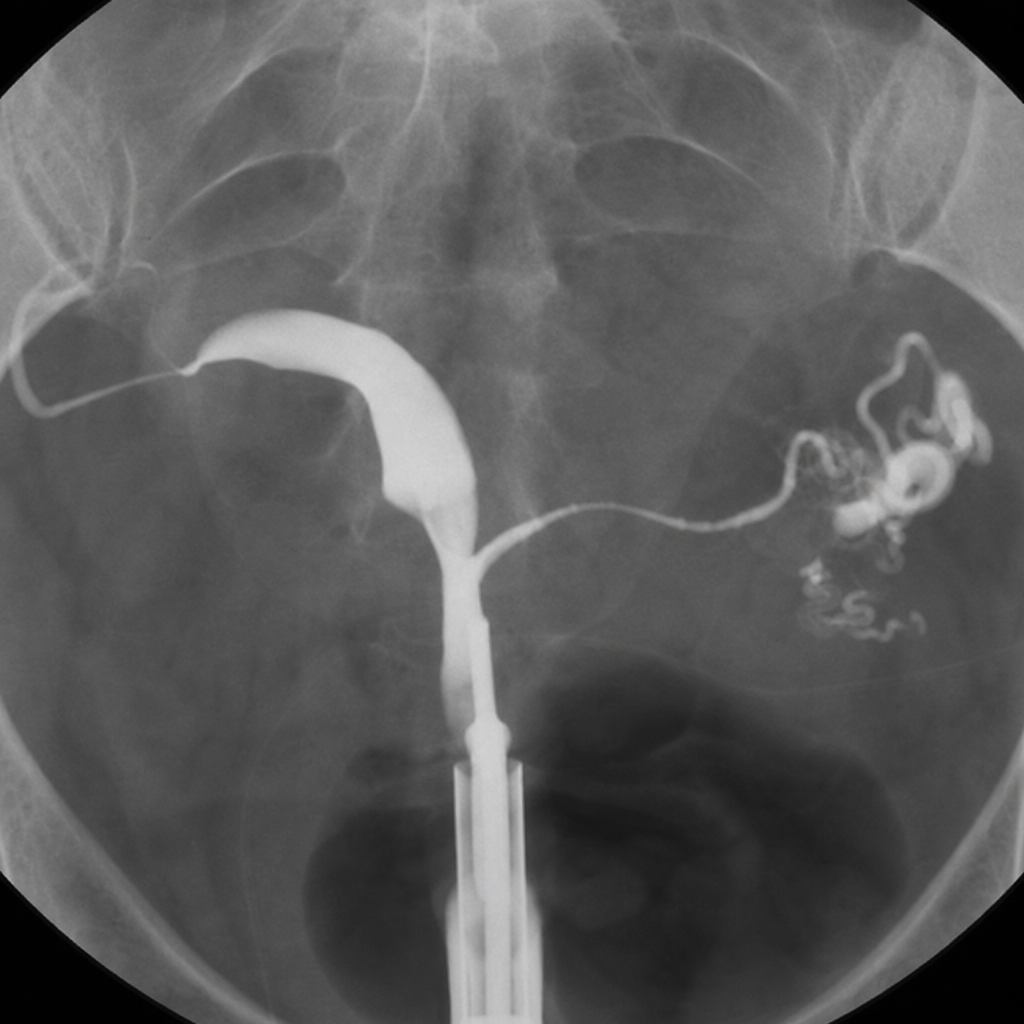
Question 16: Based on the provided image, which of the following is the correct diagnosis?
- A. Uterus didelphys
- B. Bicornuate Uterus
- C. Unicornuate Uterus (Correct Answer)
- D. Septate uterus
Explanation: ***Unicornuate Uterus*** - The image distinctly shows **only one fallopian tube and one rudimentary uterine horn** on the right side, indicating a unicornuate uterus. - This malformation results from the **incomplete development of one Müllerian duct**, leading to a single, banana-shaped uterine cavity. *Uterus didelphys* - This condition involves **two completely separate uteri**, each with its own cervix and vagina. - The image does not show evidence of two distinct uterine bodies or cervices. *Bicornuate Uterus* - A bicornuate uterus is characterized by **two uterine horns that fuse caudally**, creating a heart-shaped appearance with a shared cervix. - The image clearly lacks the characteristic heart shape and shows only one functional horn. *Septate uterus* - A septate uterus has a **fibrous or muscular septum** dividing the uterine cavity, while the external uterine contour remains normal. - The image does not show a septum or a normal external uterine contour with an internal division; instead, it presents with a single underdeveloped horn.
Question 17: Which of the following is the most common cause of perforation of uterus in non-pregnant state?
- A. Dilatation and curettage (Correct Answer)
- B. Laparoscopy
- C. IUCD
- D. Carcinoma Endometrium
Explanation: ***Dilatation and curettage*** - **Dilatation and curettage (D&C)** is the most frequent iatrogenic cause of uterine perforation in the non-pregnant state due to the blind nature of the procedure, especially in cases of uterine anatomical variations or reduced uterine wall integrity. - The risk of perforation is higher in postmenopausal women due to **atrophic, thinned uterine walls**, and in procedures performed for conditions like endometrial hyperplasia or polyps. *Laparoscopy* - While laparoscopic procedures involve inserting instruments into the abdomen, **uterine perforation during laparoscopy itself is rare**, as it usually involves instrumentation *outside* the uterus unless direct uterine manipulation or hysteroscopy is part of the procedure. - Laparoscopy more commonly results in complications like bowel or vascular injury due to trocar insertion, rather than uterine perforation. *IUCD* - **Intrauterine contraceptive device (IUCD)** insertion can cause uterine perforation, but it is less common than with D&C, with an estimated incidence of 1-2 per 1000 insertions. - Perforation during IUCD insertion is typically an immediate event, whereas D&C-related perforations can occur at any stage of the curettage. *Carcinoma Endometrium* - **Endometrial carcinoma** does not typically cause spontaneous uterine perforation, though it can weaken the uterine wall, making it more susceptible to perforation during diagnostic or therapeutic procedures like D&C. - Perforation directly attributable to the carcinoma itself without instrumental intervention is exceedingly rare.
Question 18: A 16-year-old girl comes to you with primary amenorrhea; on evaluation there is absent breast development, she has a normal stature, her FSH and LH levels are found to be high and she has a karyotype of 46XX. What is the probable diagnosis?
- A. Testicular feminizing syndrome
- B. Turner syndrome
- C. Kallmann syndrome
- D. Gonadal dysgenesis (Correct Answer)
Explanation: ***Gonadal dysgenesis*** - **Primary amenorrhea** with **absent breast development** and **high FSH/LH** (hypergonadotropic hypogonadism) in a **46,XX individual** with **normal stature** points to **46,XX gonadal dysgenesis** (pure gonadal dysgenesis). - In this condition, the gonads fail to develop properly despite a normal female karyotype, leading to non-functional streak ovaries that fail to produce estrogen, hence the lack of secondary sexual characteristics and elevated gonadotropins due to lack of negative feedback. - Unlike Turner syndrome, patients have normal stature and a normal 46,XX karyotype. *Testicular feminizing syndrome* - Individuals with **complete androgen insensitivity syndrome (CAIS)**, formerly called testicular feminizing syndrome, have a **46,XY karyotype** and develop external female characteristics due to complete androgen resistance. - They present with **primary amenorrhea** but typically have **well-developed breasts** (from peripheral aromatization of testosterone to estrogen) and a blind-ending vagina, which contradicts the absent breast development in this case. *Turner syndrome* - Characterized by a **45,X karyotype** (or variants with mosaicism) and typically presents with **short stature**, primary amenorrhea, and gonadal dysgenesis. - While it causes **primary amenorrhea** and **absent breast development** with high FSH/LH, the **normal stature** and **46,XX karyotype** in this patient rule out Turner syndrome. *Kallmann syndrome* - This condition is characterized by **hypogonadotropic hypogonadism** associated with **anosmia or hyposmia** due to defective GnRH secretion. - Patients present with **low FSH and LH levels**, which contradicts the **high gonadotropin levels** seen in this case.
Question 19: Shoulder dystocia is managed by all of the following except:-
- A. Woods cork screw method
- B. Supra pubic pressure
- C. Fundal pressure by an able nurse (Correct Answer)
- D. Zavanelli maneuver
Explanation: ***Fundal pressure by an able nurse*** - **Fundal pressure** is contraindicated in shoulder dystocia because it can worsen the impaction of the anterior shoulder against the symphysis pubis and potentially lead to uterine rupture or fetal injury. - Applying pressure from above pushes the fetus further into the birth canal obstruction, increasing the risk of **fetal asphyxia** and **brachial plexus injury**. *Woods cork screw method* - This maneuver involves rotating the fetal shoulders by applying pressure to the posterior aspect of the **posterior shoulder**, which often helps to disimpact the anterior shoulder. - It is a recognized and effective technique used to resolve **shoulder dystocia**. *Supra pubic pressure* - **Suprapubic pressure** is applied externally over the maternal suprapubic bone to dislodge the anterior shoulder from behind the symphysis pubis. - This maneuver is often performed first after the initial attempts at fetal head traction and **McRoberts maneuver** to help release the impacted shoulder. *Zavanelli maneuver* - The **Zavanelli maneuver** involves pushing the fetal head back into the uterus and performing an immediate cesarean section. - It is considered a **last-resort maneuver** for severe shoulder dystocia when other techniques have failed, carrying significant risks but sometimes necessary to prevent fetal death.
Question 20: In Peripartum cardiomyopathy, cardiac failure occurs at:-
- A. Within 24 months after delivery.
- B. Within 5 months after delivery. (Correct Answer)
- C. Within 6 weeks after delivery.
- D. Within 7 days after delivery.
Explanation: ***Within 5 months after delivery.*** - Peripartum cardiomyopathy (PPCM) is defined as the development of **cardiac failure** in the **last month of pregnancy** or within **5 months after delivery**, in the absence of any other identifiable cause. - Among the given options, "within 5 months after delivery" represents the **postpartum component** of the diagnostic timeframe and is the most complete answer. - This time frame is a key diagnostic criterion recognized by major cardiology societies (some recent guidelines extend this to 6 months postpartum). - **Note:** The complete definition includes both antepartum (last month of pregnancy) and postpartum (up to 5 months) periods. *Within 24 months after delivery.* - This timeframe is **too broad** and does not align with the standard diagnostic criteria for PPCM. - While some women may experience ongoing cardiac dysfunction or relapse, the initial diagnosis of PPCM is restricted to within 5 months postpartum. - Extended cardiac issues beyond 5 months may represent persistent PPCM or dilated cardiomyopathy rather than new-onset PPCM. *Within 6 weeks after delivery.* - While many cases of PPCM manifest within **6 weeks postpartum** (the traditional puerperium), this definition is **too restrictive**. - Symptoms can appear up to **5 months after delivery**, and using only 6 weeks would miss a significant proportion of cases. - This period captures the most acute presentations but doesn't encompass the entire recognized diagnostic window. *Within 7 days after delivery.* - The onset within **7 days after delivery** represents only the **immediate postpartum period** and is an overly narrow definition. - PPCM can develop much later in the postpartum period (up to 5 months), making this timeframe inadequate for diagnosis. - Using this restrictive criterion would result in many missed diagnoses.