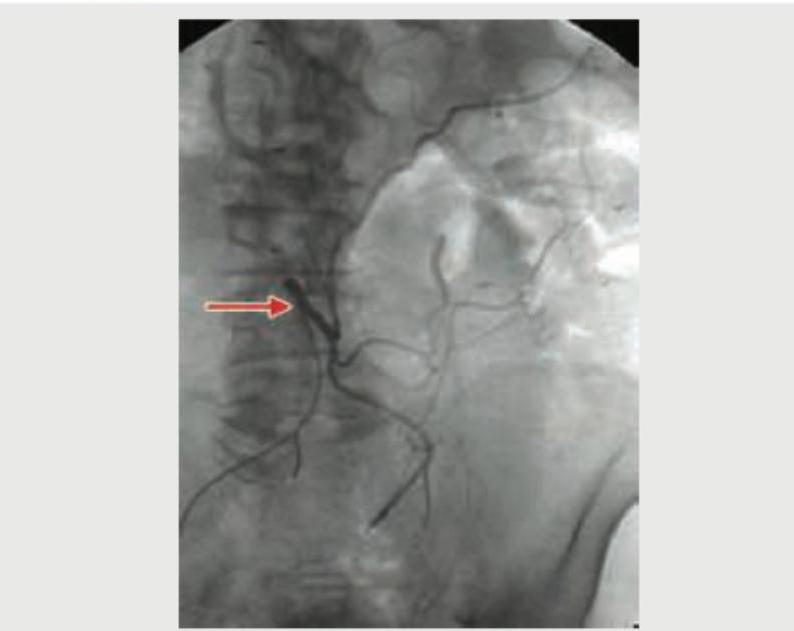
Testicular artery is a branch of -
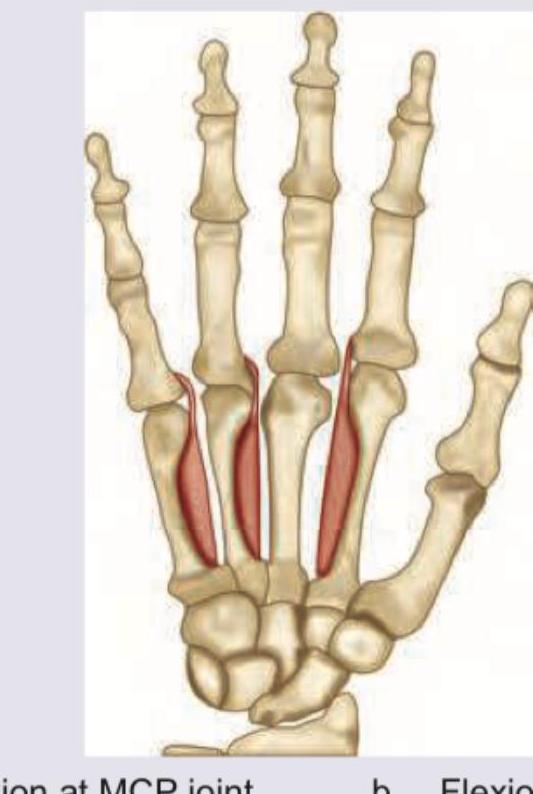
Identify the function of the muscles marked in red:
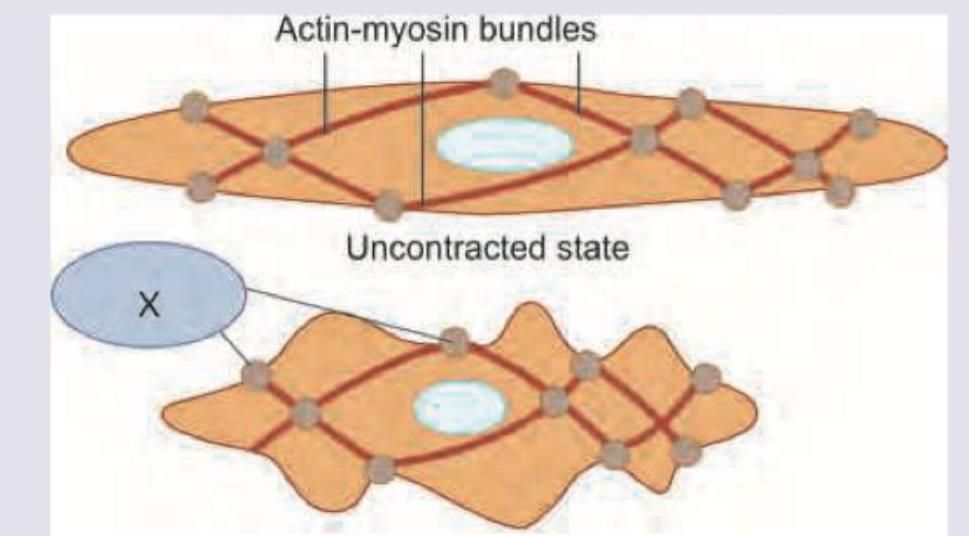
Which is correct about structures marked as "X" found in smooth muscle?
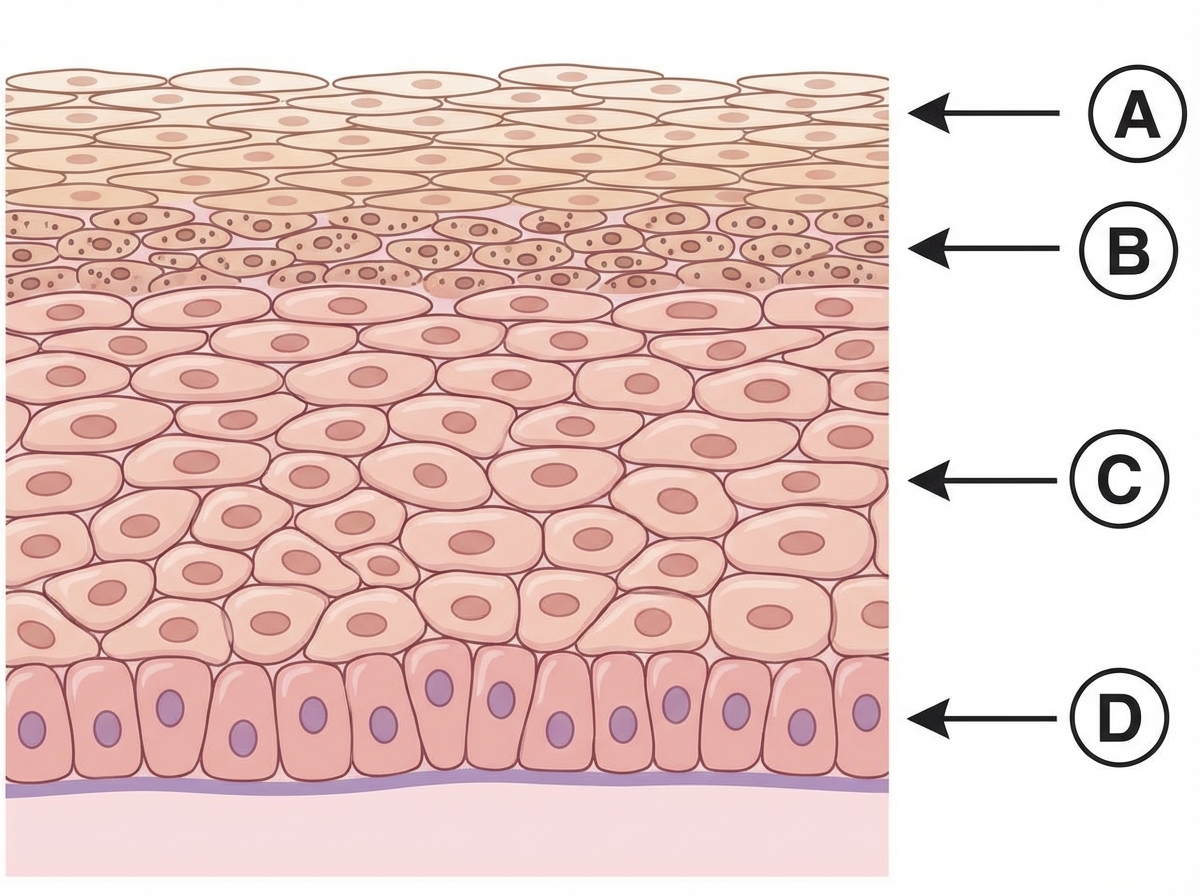
Which of the following has maximum smooth muscle as compared to wall thickness?
NEET-PG 2018 - Anatomy NEET-PG Practice Questions and MCQs
Question 21: Testicular artery is a branch of -
- A. Common iliac artery
- B. External iliac artery
- C. Internal iliac artery
- D. Abdominal aorta (Correct Answer)
Explanation: ***Abdominal aorta*** - The **testicular arteries**, also known as **gonadal arteries**, originate directly from the anterior aspect of the **abdominal aorta**. - They typically arise just inferior to the **renal arteries** at the level of the second lumbar vertebra (L2) and descend to supply the testes. *Common iliac artery* - The common iliac artery is a terminal branch of the **abdominal aorta**, but it gives rise to the internal and external iliac arteries, not directly the testicular artery. [2] - It bifurcates at the level of the sacroiliac joint. [3] *External iliac artery* - The external iliac artery primarily supplies the **lower limb** and gives off the inferior epigastric and deep circumflex iliac arteries. [1] - It does not directly provide branches to the testes. *Internal iliac artery* - The internal iliac artery primarily supplies the **pelvic organs**, gluteal region, and perineum. - While it has numerous branches, none of them are the main gonadal arteries; it contributes to the blood supply of the reproductive organs through other smaller branches. [3]
Question 22: Identify the function of the muscles marked in red:
- A. Flexion at MCP joint (Correct Answer)
- B. Flexion at IP joint
- C. Extension at MCP joint
- D. Abduction at MCP joint
Explanation: ***Flexion at MCP joint*** - The muscles shown in red are the **lumbricals**, which primarily function to **flex the metacarpophalangeal (MCP) joints** and **extend the interphalangeal (IP) joints**. - This is their most fundamental action when identifying lumbrical function, as they originate from **flexor digitorum profundus tendons** and insert into the **extensor expansion**, providing precise **MCP joint flexion**. - This unique action creates the **"lumbrical grip"** essential for precision handling. *Flexion at IP joint* - Lumbricals actually **extend the interphalangeal (IP) joints**, not flex them, making this option anatomically incorrect. - **Flexion at IP joints** is performed by the **flexor digitorum superficialis** (PIP joints) and **flexor digitorum profundus** (DIP joints). - The lumbrical insertion into the **extensor hood** produces IP extension, the opposite of this option. *Extension at MCP joint* - **Extension at the MCP joints** is primarily performed by the **extensor digitorum** and other **extrinsic extensor muscles**. - Lumbricals produce the opposite action, **flexing the MCP joints** rather than extending them. *Abduction at MCP joint* - **Abduction at the MCP joints** is primarily performed by the **dorsal interossei muscles** using the **DAB** (Dorsal ABduct) mnemonic. - Lumbricals do not contribute to **finger abduction** but rather focus on **MCP flexion, IP extension**, and **fine motor control**.
Question 23: Which is correct about structures marked as "X" found in smooth muscle?
- A. A band
- B. Dense bodies (Correct Answer)
- C. Calmodulin
- D. H band
Explanation: ***Dense bodies*** - The structures marked "X" are **dense bodies**, which are analogous to **Z-discs** in skeletal muscle, serving as attachment points for **actin filaments**. - They are crucial for transmitting the contractile force generated by the **actin-myosin bundles** to the cell membrane, leading to the characteristic corkscrew-like contraction of smooth muscle cells. *A band* - The **A band** is a region found in **striated muscle** (skeletal and cardiac muscle) where thick and thin filaments overlap, corresponding to the length of the myosin filaments. - Smooth muscle lacks the organized sarcomeric structure, and thus, **A bands** are not present. *Calmodulin* - **Calmodulin** is a calcium-binding protein that plays a key role in smooth muscle contraction by activating **myosin light chain kinase (MLCK)**. - However, it is a soluble protein involved in signaling, not a structural component like the dense bodies shown in the image. *H band* - The **H band** is located within the **A band** of a **sarcomere** in striated muscle, representing the central region where only thick (myosin) filaments are present. - Similar to the **A band**, the **H band** is a feature of striated muscle and is not found in the unstriated smooth muscle cells.
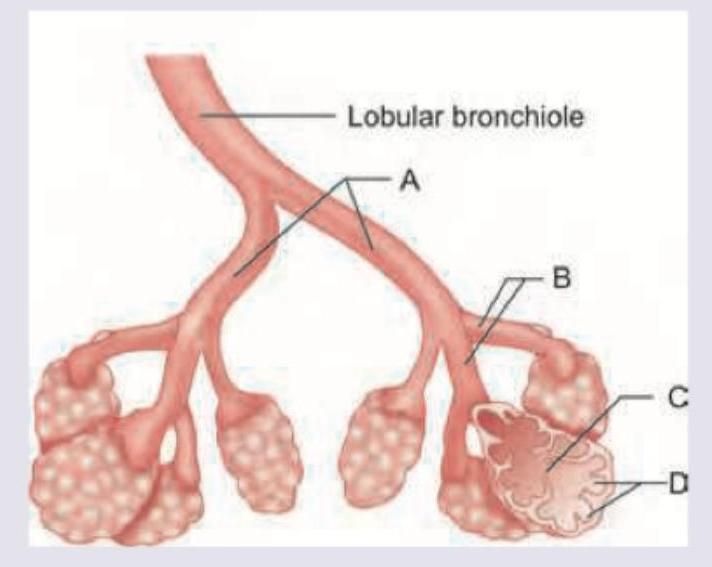
Question 24: Which of the following has maximum smooth muscle as compared to wall thickness?
- A. A (Correct Answer)
- B. B
- C. C
- D. D
Explanation: ***A*** - Structure A represents a **terminal bronchiole**, which has the **maximum proportion of smooth muscle relative to wall thickness** among all respiratory structures. - Terminal bronchioles lack cartilage and respiratory epithelium (no alveoli), making smooth muscle the dominant structural component of their walls, comprising a high percentage of the total wall thickness. - This abundant smooth muscle allows for precise control of **bronchoconstriction** and **bronchodilation**, which is crucial for regulating air distribution to the respiratory zones. *B* - Structure B appears to be a **respiratory bronchiole** or an **alveolar duct**, which is more distal than terminal bronchioles and has less smooth muscle relative to its wall thickness. - As airways progress distally from terminal bronchioles toward the alveoli, smooth muscle gradually decreases as the primary function shifts from conduction and airflow regulation to gas exchange. - Respiratory bronchioles have alveoli budding from their walls, which reduces the proportion of smooth muscle in the overall wall structure. *C* - Structure C points to an **alveolar sac**, which is composed primarily of **alveoli** clustered together. Alveolar walls are extremely thin to facilitate efficient gas exchange and contain very little to no smooth muscle. - The function of alveoli is gas exchange, not airflow regulation, hence they lack the contractile elements like smooth muscle that are abundant in conducting airways. *D* - Structure D points to an **individual alveolus**, which is the primary site of gas exchange. Alveolar walls are extremely thin and consist of type I pneumocytes (for gas exchange), type II pneumocytes (surfactant production), and alveolar macrophages. - **Alveoli** lack smooth muscle entirely, as their structure is optimized for diffusion and not for active constriction or dilation.