Anatomy
2 questionsSensory supply of the palm is from which nerves?
Ophthalmic artery is a branch of:
NEET-PG 2012 - Anatomy NEET-PG Practice Questions and MCQs
Question 321: Sensory supply of the palm is from which nerves?
- A. Median nerve and Radial nerve
- B. Radial nerve and ulnar nerve
- C. Ulnar nerve and Median nerve (Correct Answer)
- D. Musculocutaneous nerve and Radial nerve
Explanation: **Ulnar nerve and Median nerve** *(Correct)* - The **median nerve** provides sensory innervation to the lateral palm, including the thumb, index, middle, and radial half of the ring finger [1]. - The **ulnar nerve** supplies sensory innervation to the medial palm, including the little finger and the ulnar half of the ring finger [1]. - Together, these two nerves provide complete sensory coverage of the palm [1]. *Median nerve and Radial nerve* (Incorrect) - While the **median nerve** innervates a significant portion of the palm, the **radial nerve** primarily supplies the dorsal aspect of the hand and a small area of the thenar eminence, not the entire palm. - The radial nerve's sensory supply to the palm is usually limited to a very small area at the base of the thumb. - This combination does not provide complete palmar sensory coverage. *Radial nerve and ulnar nerve* (Incorrect) - The **radial nerve** mainly supplies the dorsum of the hand and digits, with minimal palmar contribution, making this option incorrect for primary palmar sensory supply. - The **ulnar nerve** does innervate part of the palm, but the combination with the radial nerve for complete palmar supply is inaccurate. - The median nerve, not the radial nerve, is the other major contributor to palmar sensation. *Musculocutaneous nerve and Radial nerve* (Incorrect) - The **musculocutaneous nerve** primarily innervates the lateral aspect of the forearm (as the lateral antebrachial cutaneous nerve) and does not contribute to the sensory supply of the palm. - The **radial nerve** also has a limited role in palmar sensation. - Neither of these nerves provides significant sensory innervation to the palm.
Question 322: Ophthalmic artery is a branch of:
- A. Cavernous part of ICA
- B. Cerebral part of ICA (Correct Answer)
- C. MCA
- D. Facial artery
Explanation: ***Cerebral part of ICA*** - The **ophthalmic artery** is typically the first major branch off the **internal carotid artery (ICA)** once it exits the cavernous sinus and enters the cranial cavity. - This segment of the ICA is also known as the supraclinoid or **cerebral part**, underscoring its proximity to the brain. *Cavernous part of ICA* - The **cavernous part of the ICA** is located within the cavernous sinus and typically gives off smaller branches such as the **meningohypophyseal trunk** and the **inferolateral trunk**, which supply structures within and around the sinus. - The ophthalmic artery emerges after the ICA exits the cavernous sinus, not from within it. *MCA* - The **middle cerebral artery (MCA)** is a major terminal branch of the internal carotid artery, supplying large parts of the cerebrum. - It does not give rise to the ophthalmic artery, which branches off the ICA before the ICA bifurcates into the MCA and anterior cerebral artery. *Facial artery* - The **facial artery** is a branch of the **external carotid artery**, supplying structures of the face. - The ophthalmic artery is a primary supply to the orbit and is derived from the internal carotid artery, a completely separate vascular system.
Biochemistry
6 questionsWhich enzyme is primarily associated with the reduction of NADP+ to NADPH in the pentose phosphate pathway?
Which isoenzyme of lactate dehydrogenase (LDH) is predominantly elevated in liver injury?
Fluoroacetate inhibits?
Glucose oxidase converts glucose to?
Which of the following is required for fatty acid synthesis ?
Which hormone inhibits hormone-sensitive lipase?
NEET-PG 2012 - Biochemistry NEET-PG Practice Questions and MCQs
Question 321: Which enzyme is primarily associated with the reduction of NADP+ to NADPH in the pentose phosphate pathway?
- A. G6PD (Correct Answer)
- B. APDH
- C. α-keto glutarate dehydrogenases
- D. None of the options
Explanation: ***G6PD*** - **Glucose-6-phosphate dehydrogenase (G6PD)** catalyzes the first committed step in the pentose phosphate pathway, converting **glucose-6-phosphate** to **6-phosphogluconolactone**. - This reaction involves the reduction of **NADP+ to NADPH**, making G6PD the primary enzyme for NADPH production in this pathway. *APDH* - **APDH (adenosine phosphosulfate reductase)** is involved in sulfur metabolism and has no direct role in the pentose phosphate pathway or NADPH production. - This enzyme primarily functions in prokaryotes for the **reduction of APS (adenosine 5'-phosphosulfate)**. *α-keto glutarate dehydrogenases* - **Alpha-ketoglutarate dehydrogenase** is a mitochondrial enzyme part of the **Krebs cycle**, converting **alpha-ketoglutarate to succinyl-CoA**. - This enzyme is crucial for ATP production and generates **NADH**, not NADPH, in its reaction. *None of the options* - This option is incorrect because **G6PD** is indeed the primary enzyme responsible for NADPH generation in the pentose phosphate pathway.
Question 322: Which isoenzyme of lactate dehydrogenase (LDH) is predominantly elevated in liver injury?
- A. LDH-3
- B. LDH-5 (Correct Answer)
- C. LDH-1
- D. LDH-2
Explanation: ***LDH-5 isoenzyme most significant in hepatic conditions*** - **LDH-5** is the predominant isoenzyme found in the **liver** and skeletal muscle. - An elevation of **LDH-5** is highly indicative of **hepatocellular damage** or injury. *LDH-1 isoenzyme associated with cardiac tissue* - **LDH-1** is primarily present in the **heart** and red blood cells. - Its elevation suggests conditions like **myocardial infarction** or hemolytic anemia, not liver injury. *LDH-3 isoenzyme typical in respiratory system* - **LDH-3** is found in the **lungs**, kidneys, and other tissues. - While it can be elevated in **pulmonary embolism** or renal disease, it is not specific for liver injury. *LDH-2 isoenzyme linked to erythrocyte metabolism* - **LDH-2** is abundant in **red blood cells** and also found in the heart and kidneys. - Elevations are often seen in conditions involving **hemolysis** or myocardial damage, similar to LDH-1.
Question 323: Fluoroacetate inhibits?
- A. Citrate synthase
- B. Succinate dehydrogenase
- C. Alpha-ketoglutarate dehydrogenase
- D. Aconitase (Correct Answer)
Explanation: ***Aconitase*** - **Fluoroacetate** is metabolically converted to **fluorocitrate**, which is a potent competitive inhibitor of **aconitase**. - **Aconitase** is the enzyme responsible for converting **citrate to isocitrate** in the **Krebs cycle**, and its inhibition blocks the cycle. *Citrate synthase* - This enzyme is responsible for the formation of **citrate** from **acetyl-CoA** and **oxaloacetate**. - While fluoroacetate indirectly affects the cycle, it does not directly inhibit **citrate synthase**. *Succinate dehydrogenase* - This enzyme is part of the **Krebs cycle** and the **electron transport chain**, converting **succinate to fumarate**. - **Malonate** is a competitive inhibitor of succinate dehydrogenase, not **fluoroacetate**. *Alpha-ketoglutarate dehydrogenase* - This enzyme catalyzes the conversion of **alpha-ketoglutarate to succinyl-CoA** in the **Krebs cycle**. - Specific inhibitors of this enzyme include **arsenite** and **mercury compounds**, but not fluoroacetate.
Question 324: Glucose oxidase converts glucose to?
- A. Glucuronic acid
- B. Galactonic acid
- C. Gluconic acid (Correct Answer)
- D. Iduronic acid
Explanation: ***Gluconic acid*** - **Glucose oxidase** specifically catalyzes the oxidation of glucose, producing **gluconic acid** and hydrogen peroxide. - This reaction forms the basis for many common **glucose diagnostic tests**, such as those used in blood glucose monitors. *Glucuronic acid* - **Glucuronic acid** is formed from the oxidation of glucose at carbon 6, typically through the **uronic acid pathway**. - It is known for its role in **detoxification** and conjugation reactions in the liver, not as a direct product of glucose oxidase. *Galactonic acid* - **Galactonic acid** is an oxidized form of galactose, a different monosaccharide from glucose. - Its formation is not associated with the action of **glucose oxidase**, an enzyme specific to glucose. *Iduronic acid* - **Iduronic acid** is a C5 epimer of glucuronic acid and is a common component of various **glycosaminoglycans** like dermatan sulfate and heparan sulfate. - It is not produced by the action of **glucose oxidase** on glucose.
Question 325: Which of the following is required for fatty acid synthesis ?
- A. NADPH (Correct Answer)
- B. NADH
- C. FADH₂
- D. None of the options
Explanation: ***NADPH*** - **NADPH** is crucial for fatty acid synthesis, providing the **reducing power** needed for the successive reduction steps. - The enzymes involved, such as **fatty acid synthase**, utilize **NADPH** for the conversion of keto groups to hydroxyl groups and then to saturated methylene groups. *NADH* - **NADH** plays a primary role in **oxidative phosphorylation** and the electron transport chain to generate ATP. - It is generally produced during **catabolic reactions** and is not primarily used as a reducing agent in anabolic processes like fatty acid synthesis. *FADH* - **FADH2** (reduced form of FAD, not FADH) is a coenzyme involved in redox reactions, particularly in the **Krebs cycle** and beta-oxidation of fatty acids. - Like NADH, it is mostly involved in **catabolic processes** that generate energy, rather than anabolic processes requiring reducing equivalents for synthesis. *None of the options* - This option is incorrect because **NADPH** is indeed required for fatty acid synthesis, serving as the essential reducing agent. - The other coenzymes mentioned (NADH, FADH) have different metabolic roles, primarily in energy production rather than biosynthesis.
Question 326: Which hormone inhibits hormone-sensitive lipase?
- A. Insulin (Correct Answer)
- B. GH
- C. ACTH
- D. Thyroid hormone
Explanation: ***Insulin*** - **Insulin** is a key anabolic hormone that promotes energy storage and inhibits catabolic processes, including the breakdown of triglycerides. - It directly inhibits **hormone-sensitive lipase (HSL)** activity, thus reducing the release of free fatty acids from adipose tissue. *Thyroid hormone* - **Thyroid hormones** (T3 and T4) generally promote catabolism and increase metabolic rate, including the mobilization of lipids. - They tend to **stimulate rather than inhibit** hormone-sensitive lipase expression and activity. *GH* - **Growth hormone (GH)** has lipolytic effects, meaning it promotes the breakdown of fats to provide energy. - GH typically **stimulates HSL activity** and increases the release of free fatty acids from adipocytes. *ACTH* - **Adrenocorticotropic hormone (ACTH)** primarily stimulates the adrenal cortex to produce cortisol. - **Cortisol** can have lipolytic effects in certain contexts and does not directly inhibit HSL; instead, catecholamines act as direct stimulators of HSL.
Physiology
2 questionsWhich of the following factors increases stroke volume?
Transducin is a protein found in:
NEET-PG 2012 - Physiology NEET-PG Practice Questions and MCQs
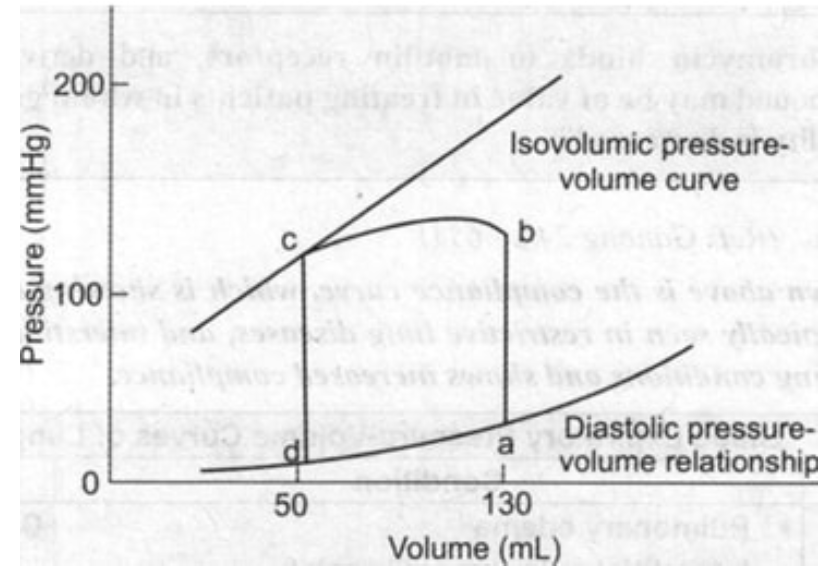
Question 321: Which of the following factors increases stroke volume?
- A. Increased end-diastolic and end-systolic volumes
- B. Decreased end-diastolic and end-systolic volumes
- C. Increased end-diastolic volume and decreased end-systolic volume (Correct Answer)
- D. Decreased end-diastolic volume and increased end-systolic volume
Explanation: ***Increased end-diastolic volume and decreased end-systolic volume*** - **Stroke volume (SV)** is calculated as **End-Diastolic Volume (EDV)** minus **End-Systolic Volume (ESV)**. Therefore, increasing the volume before contraction while decreasing the volume after contraction will maximize the ejected blood. - A higher **EDV** signifies greater **preload** (more blood filling the ventricle), and a lower **ESV** indicates more complete ejection of blood, often due to increased **contractility** or decreased **afterload**. *Increased end-diastolic and end-systolic volumes* - While an **increased EDV** would tend to increase stroke volume, an **increased ESV** suggests that the heart is ejecting less blood per beat, which would decrease stroke volume. - The combined effect makes it less likely to unequivocally increase stroke volume, as the increase in ESV might offset or even surpass the effect of increased EDV. *Decreased end-diastolic and end-systolic volumes* - Both a **decreased EDV** (less filling) and a **decreased ESV** (more complete ejection) work against each other in terms of stroke volume calculation. - If **EDV** decreases, there's less blood to eject, and if the decrease in **EDV** is proportionally larger than the decrease in **ESV**, stroke volume will decrease. *Decreased end-diastolic volume and increased end-systolic volume* - A **decreased EDV** means less blood is available for ejection, reducing preload and the amount of blood the heart can pump. - An **increased ESV** means the heart is ejecting less blood with each beat, indicating reduced contractility or increased afterload, both of which would decrease stroke volume.
Question 322: Transducin is a protein found in:
- A. Glomerulus
- B. Retina (Correct Answer)
- C. Skeletal muscle
- D. Adrenal medulla
Explanation: ***Retina*** - **Transducin** is a **G-protein** crucial for **phototransduction** in the retina. - It plays a key role in the cascade that converts light signals into electrical impulses within **rod** and **cone photoreceptor cells**. *Glomerulus* - The **glomerulus** is a capillary network in the **kidney** responsible for filtering blood. - Its primary proteins are involved in filtration barriers, such as **podocin** and **nephrin**, not transducin. *Skeletal muscle* - **Skeletal muscle** contains proteins like **actin**, **myosin**, and **troponins** for contraction. - Transducin is not involved in muscle contraction or skeletal muscle function. *Adrenal medulla* - The **adrenal medulla** produces **catecholamines** like epinephrine and norepinephrine. - Proteins in this gland are involved in hormone synthesis, storage, and release, not light perception.