Anatomy
3 questionsInferior parathyroid develops from which pharyngeal pouch?
Which structure(s) passes behind the inguinal ligament:
The thoracic duct crosses from the right to the left at the level of
NEET-PG 2012 - Anatomy NEET-PG Practice Questions and MCQs
Question 191: Inferior parathyroid develops from which pharyngeal pouch?
- A. 1st
- B. 2nd
- C. 3rd (Correct Answer)
- D. 4th
Explanation: The inferior parathyroid glands develop from the dorsal wing of the third pharyngeal pouch. Due to their origin, they often migrate further caudally than the superior parathyroid glands, sometimes even locating within the thymus which also develops from the third pouch. *1st* - The first pharyngeal pouch contributes to the formation of the eustachian tube, tympanic cavity, and mastoid air cells. - It has no role in the development of the parathyroid glands. *2nd* - The second pharyngeal pouch mainly gives rise to the palatine tonsils and their crypts. - It is not involved in the development of parathyroid tissue. *4th* - The fourth pharyngeal pouch gives rise to the superior parathyroid glands and the parafollicular cells (C cells) of the thyroid, which produce calcitonin. - While it forms parathyroid tissue, it is for the superior glands, not the inferior ones.
Question 192: Which structure(s) passes behind the inguinal ligament:
- A. Femoral branch of genitofemoral nerve
- B. Femoral vein
- C. Psoas major
- D. All of the options (Correct Answer)
Explanation: ***Correct: All of the options*** All three structures pass deep to (behind) the inguinal ligament as they transition from the pelvis/abdomen into the thigh [1]. The inguinal ligament forms the superior border of the femoral triangle [1]. ***Femoral branch of genitofemoral nerve (Correct)*** - Pierces the **psoas major** muscle and descends along its anterior surface - Passes through the **lacuna musculorum** (lateral compartment) deep to the inguinal ligament - Lies **lateral to the femoral artery** - Provides sensory innervation to the skin over the femoral triangle ***Femoral vein (Correct)*** - Continuation of the popliteal vein from the lower limb - Passes through the **lacuna vasorum** (medial compartment/femoral canal) within the **femoral sheath** - Located **medial to the femoral artery** behind the inguinal ligament [1] - Carries deoxygenated blood back to the heart via the external iliac vein ***Psoas major (Correct)*** - Major hip flexor muscle originating from lumbar vertebrae (T12-L5) - Passes through the **lacuna musculorum** deep to the inguinal ligament - Located **lateral to the femoral vessels** - Combines with iliacus to form iliopsoas, inserting on the lesser trochanter of femur
Question 193: The thoracic duct crosses from the right to the left at the level of
- A. T12 vertebra
- B. T2 vertebra
- C. T4-T5 vertebra (Correct Answer)
- D. T6 vertebra
Explanation: ***T4-T5 vertebra*** - The **thoracic duct** crosses from the right to the left side of the vertebral column at the level of the **T4-T5 vertebrae**, specifically just above the root of the left lung. - This crossover is an important anatomical landmark as it signifies the duct's ascent towards the neck to drain into the left subclavian vein. *T12 vertebra* - The **thoracic duct** originates from the **cisterna chyli** at the level of the L1 or L2 vertebra and ascends into the thorax at or below the T12 vertebra, it does not cross over at this level. - This level primarily marks its entry into the thoracic cavity, not its main crossover point. *T6 vertebra* - While the **thoracic duct** is present in the thorax at this level, it does not undergo its characteristic crossover from right to left at the T6 vertebra. - The duct continues its ascent along the right side of the vertebral column before moving across. *T2 vertebra* - By the level of the T2 vertebra, the **thoracic duct** has already crossed to the left side of the vertebral column and is ascending towards its termination in the neck. - The crossover event occurs more inferiorly, at the T4-T5 level.
Obstetrics and Gynecology
1 questionsWhich structure do cytotrophoblasts invade during implantation?
NEET-PG 2012 - Obstetrics and Gynecology NEET-PG Practice Questions and MCQs
Question 191: Which structure do cytotrophoblasts invade during implantation?
- A. Decidua capsularis
- B. Decidua vera
- C. Decidua basalis (Correct Answer)
- D. Decidua parietalis
Explanation: ***Decidua basalis*** - The **cytotrophoblasts** invade the maternal **decidua basalis**, which is the portion of the **endometrium** directly underlying the implanted embryo, forming the maternal component of the **placenta**. - This invasion is crucial for establishing the **placenta** and allowing for nutrient and waste exchange between the mother and the fetus. *Decidua parietalis* - The **decidua parietalis** is the portion of the **endometrium** lining the rest of the **uterine cavity**, not directly involved in the immediate implantation site. - It plays a role later in pregnancy, fusing with the **decidua capsularis** as the **embryo** grows. *Decidua capsularis* - The **decidua capsularis** is the portion of the endometrium that overlies the implanted embryo, separating it from the uterine lumen. - It does not undergo invasion by the **cytotrophoblasts** in the same way the **decidua basalis** does. *Decidua vera* - The **decidua vera** is another term for the **decidua parietalis**, referring to the endometrial lining of the uterine cavity that is not involved in the implantation site. - It is not directly invaded by **cytotrophoblasts** during implantation.
Physiology
6 questionsWhich one of the following is the CORRECT statement regarding coronary blood flow?
Which part of the brain is responsible for setting posture before planned movement?
Lesion of preoptic nucleus of hypothalamus is associated with which of the following conditions?
What is the primary factor that determines the resting membrane potential in a nerve fiber?
During acclimatization to hot environments, increased sweating efficiency is primarily due to enhanced sensitivity of which receptors?
What is the average progressive velocity of human sperm under standard laboratory conditions?
NEET-PG 2012 - Physiology NEET-PG Practice Questions and MCQs
Question 191: Which one of the following is the CORRECT statement regarding coronary blood flow?
- A. Coronary blood flow is directly related to perfusion pressure and inversely related to resistance (Correct Answer)
- B. Coronary blood flow is inversely related to perfusion pressure and directly related to resistance
- C. Coronary blood flow is directly related to perfusion pressure and also to resistance
- D. Coronary blood flow is inversely related to both pressure and resistance
Explanation: ***Coronary blood flow is directly related to perfusion pressure and inversely related to resistance*** - According to Ohm's law, **blood flow** is directly proportional to the **pressure gradient (perfusion pressure)** and inversely proportional to the **vascular resistance**. - This fundamental principle applies to coronary circulation, meaning higher pressure drives more flow, while higher resistance impedes it. *Coronary blood flow is inversely related to perfusion pressure and directly related to resistance* - This statement contradicts the basic principles of **fluid dynamics** and **Ohm's law**, where a higher pressure gradient generally leads to increased flow. - Direct proportionality to resistance would imply that increased obstruction leads to increased flow, which is physiologically incorrect. *Coronary blood flow is directly related to perfusion pressure and also to resistance* - While a direct relationship with **perfusion pressure** is correct, directly relating flow to **resistance** is incorrect. - Increased resistance, such as that caused by **atherosclerosis**, reduces blood flow, not increases it. *Coronary blood flow is inversely related to both pressure and resistance* - An inverse relationship with **pressure** is incorrect as an increase in the driving pressure should increase flow. - An inverse relationship with **resistance** is correct, but the inverse relationship with pressure makes the entire statement incorrect.
Question 192: Which part of the brain is responsible for setting posture before planned movement?
- A. Motor cortex
- B. Frontal eye fields
- C. Premotor cortex
- D. Supplementary motor cortex (Correct Answer)
Explanation: ***Supplementary motor cortex*** - The **supplementary motor cortex (SMA)** is responsible for **anticipatory postural adjustments** that occur before voluntary movements - It plays a key role in **internal generation and planning of complex motor sequences** - SMA activation precedes movement, ensuring **postural stability and coordination** - Essential for **bilateral coordination** and **motor programming** *Premotor cortex* - The **premotor cortex** is primarily involved in **externally guided movements** and selection of movements based on sensory cues - While it participates in motor planning, it is more focused on **sensory-motor integration** rather than anticipatory postural control *Motor cortex* - The **primary motor cortex** executes voluntary movements by sending signals directly to spinal motor neurons - Responsible for **fine motor control** and determining the **force and direction** of muscle contractions - Functions in **movement execution** rather than preparatory postural adjustments *Frontal eye fields* - The **frontal eye fields** control **voluntary saccadic eye movements** and visual attention - Not involved in trunk or limb **postural preparation** for planned movements
Question 193: Lesion of preoptic nucleus of hypothalamus is associated with which of the following conditions?
- A. Impaired thermoregulation
- B. Increased body temperature
- C. Hyperthermia (Correct Answer)
- D. Normal thermoregulation
Explanation: ***Hyperthermia*** - The **preoptic nucleus** of the anterior hypothalamus is the primary **heat-loss center** containing warm-sensitive neurons. - Lesion of this area impairs **heat dissipation mechanisms** (sweating, cutaneous vasodilation), preventing the body from lowering its temperature. - Results in **hyperthermia** - a pathological elevation of core body temperature due to failure of heat dissipation, not a change in set point. - This is the **most specific and clinically accurate** term for this condition. *Impaired thermoregulation* - While technically true, this is too **broad and non-specific**. - Impaired thermoregulation could refer to inability to either increase or decrease temperature. - In medical terminology, we use more specific terms like "hyperthermia" to describe the actual clinical condition. *Increased body temperature* - This is a **general descriptive term** rather than a specific clinical diagnosis. - While the body temperature is indeed increased, **hyperthermia** is the precise medical term that indicates the mechanism (impaired heat dissipation). - Less specific than "hyperthermia" for exam purposes. *Normal thermoregulation* - Clearly incorrect - a lesion in the primary thermoregulatory center would **abolish normal temperature control**. - The preoptic nucleus is essential for detecting and responding to temperature changes.
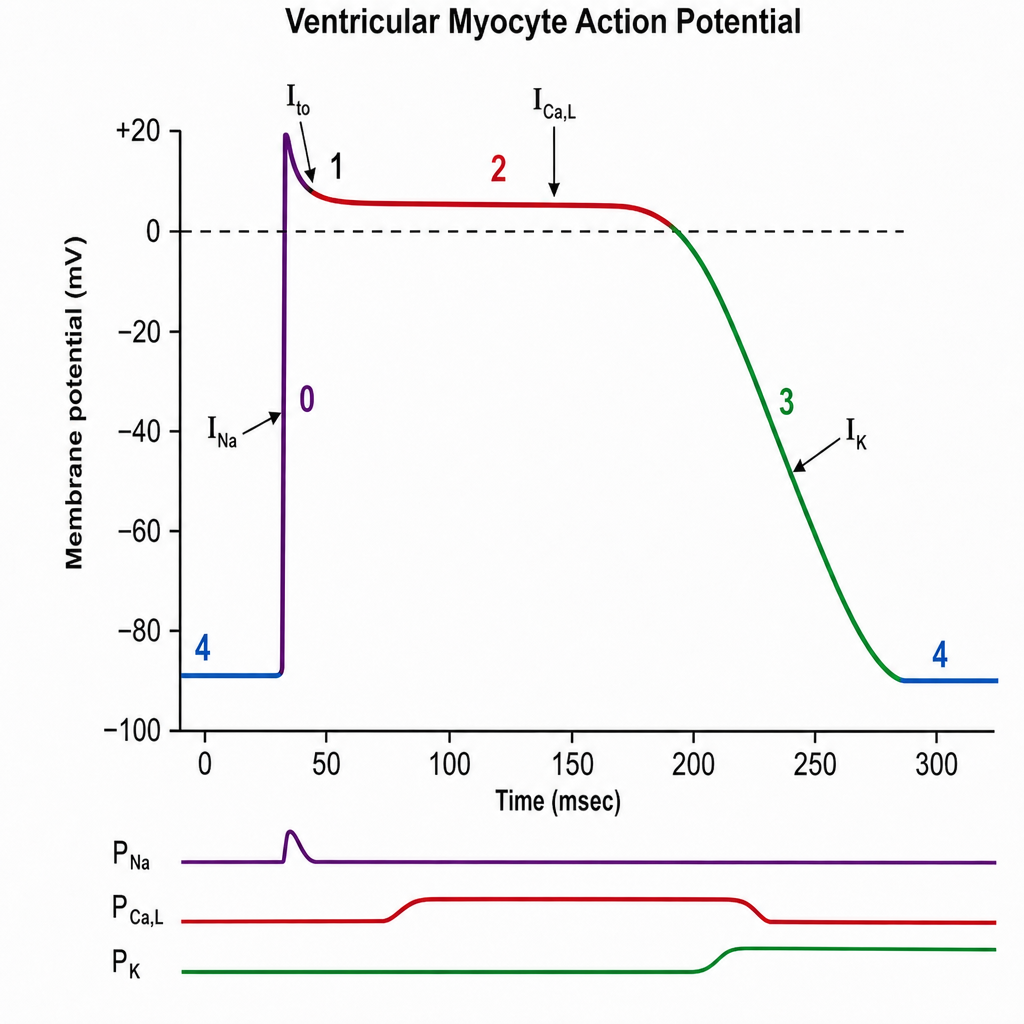
Question 194: What is the primary factor that determines the resting membrane potential in a nerve fiber?
- A. Is equal to the resting potential of cardiac muscle fibers.
- B. Can be accurately measured using intracellular electrodes.
- C. Increases with elevated extracellular potassium concentration.
- D. Is primarily determined by the equilibrium potential of potassium ions. (Correct Answer)
Explanation: ***Is primarily determined by the equilibrium potential of potassium ions*** - The **resting membrane potential** of a nerve fiber is predominantly set by the efflux of **potassium ions** through leak channels, bringing the membrane potential close to potassium's equilibrium potential. - The high permeability of the nerve membrane to **potassium** at rest means that K+ movement is the most significant factor influencing the potential. *Is equal to the resting potential of cardiac muscle fibers* - **Cardiac muscle fibers** have a distinct resting potential (around -80 to -90 mV) influenced by different ion channels and regulatory mechanisms compared to nerve fibers (around -70 mV). - While both involve potassium currents, their specific conductances and the contribution of other ions differ significantly. *Can be accurately measured using intracellular electrodes* - While **intracellular electrodes** are indeed used to measure the resting membrane potential, this statement describes a measurement method, not the *primary factor* that determines the potential itself. - The method of measurement does not explain the underlying biophysical mechanisms that establish the potential. *Increases with elevated extracellular potassium concentration* - An **elevated extracellular potassium concentration** would make the resting membrane potential *less negative* (depolarize) rather than "increase" it in the typical sense of a more positive value. - This is because a higher external K+ reduces the concentration gradient for potassium efflux, bringing the membrane potential closer to zero.
Question 195: During acclimatization to hot environments, increased sweating efficiency is primarily due to enhanced sensitivity of which receptors?
- A. Adrenergic receptors
- B. Noradrenergic receptors
- C. Dopaminergic receptors
- D. Cholinergic receptors (Correct Answer)
Explanation: ***Cholinergic receptors*** - **Sweat glands** are innervated by **sympathetic postganglionic fibers** that release **acetylcholine**, acting on **muscarinic cholinergic receptors** to stimulate sweating. - During **acclimatization**, the sweat glands become more sensitive to acetylcholine, resulting in **increased sweating efficiency** and a lower threshold temperature for sweating. *Adrenergic receptors* - Adrenergic receptors are primarily involved in the sympathetic nervous system's response to **norepinephrine** and **epinephrine**, mediating effects like **vasoconstriction** and **bronchodilation**. - They are not the primary receptors responsible for stimulating **eccrine sweat gland** secretion in response to heat. *Noradrenergic receptors* - **Noradrenergic receptors** are a type of adrenergic receptor that respond to **norepinephrine** (noradrenaline). - While sympathetic activity increases in hot environments, the primary stimulation of **sweat glands** is via **acetylcholine** acting on cholinergic receptors, not noradrenergic receptors. *Dopaminergic receptors* - **Dopaminergic receptors** respond to **dopamine** and are involved in various functions including **motor control**, **reward**, and **neuroendocrine regulation**. - These receptors are not directly involved in the physiological regulation of **sweating efficiency** during heat acclimatization.
Question 196: What is the average progressive velocity of human sperm under standard laboratory conditions?
- A. 1-3 mm/min (Correct Answer)
- B. 4-6 mm/min
- C. 6-9 mm/min
- D. 10-13 mm/min
Explanation: ***1-3 mm/min*** - The typical average progressive velocity of human sperm, categorized as **Grade A (rapid progressive)** motility, ranges from **25 micrometers/second or faster**, which translates to approximately 1-3 mm/minute. - This velocity is crucial for sperm to traverse the female reproductive tract and reach the ovum for fertilization. *4-6 mm/min* - This velocity range is significantly faster than the **average progressive velocity** observed in viable human sperm under standard laboratory conditions. - While some individual sperm may achieve higher speeds, this range is not representative of the **average progressive motility** of a healthy sperm population. *6-9 mm/min* - This progressive velocity is exceptionally high and not typically observed as the average for human sperm, even for highly motile sperm. - Such a high velocity would indicate an **abnormally fast movement** not compatible with biological norms for average progressive motility. *10-13 mm/min* - This range represents an extremely rapid progressive velocity for human sperm, well beyond physiological averages. - It does not align with the standard measurements for **progressive motility**, which are generally much lower.