Anatomy
1 questionsIdentify the pelvis type given below.
FMGE 2023 - Anatomy FMGE Practice Questions and MCQs
Question 271: Identify the pelvis type given below.
- A. Platypoid
- B. Anthropoid
- C. Android (Correct Answer)
- D. Gynecoid
Explanation: ***Android*** - This pelvis is characterized by a **heart-shaped** or triangular inlet, with a narrow forepelvis, as seen in the image. - It features **prominent ischial spines** and a narrow subpubic arch, making it unfavorable for vaginal delivery and associated with a higher risk of **dystocia**. *Platypoid* - The platypoid pelvis has a **kidney-shaped** or **transversely oval** inlet, where the transverse diameter is significantly wider than the anteroposterior diameter. - This type is the rarest and is unfavorable for childbirth as the fetal head may have difficulty engaging in the short anteroposterior diameter. *Anthropoid* - The anthropoid pelvis has a **long, narrow, oval-shaped** inlet, where the anteroposterior diameter is greater than the transverse diameter. - This shape often leads to the engagement of the fetal head in the **occiput-posterior** position but is generally favorable for vaginal delivery. *Gynecoid* - This is the classic female pelvis, featuring a **rounded** or slightly oval inlet with a wide transverse diameter, which is most favorable for childbirth. - It has a wide **subpubic arch** (greater than 90 degrees), non-prominent ischial spines, and a spacious pelvic cavity, facilitating an uncomplicated vaginal delivery.
Community Medicine
1 questionsVitamin A deficiency leads to?
FMGE 2023 - Community Medicine FMGE Practice Questions and MCQs
Question 271: Vitamin A deficiency leads to?
- A. Xerophthalmia (Correct Answer)
- B. Beriberi
- C. Neuropathy
- D. Pellagra
Explanation: ***Xerophthalmia***- **Vitamin A** (retinol) is essential for the formation of **rhodopsin**, the photopigment necessary for low-light vision, making deficiency a primary cause of **night blindness** (nyctalopia).- Deficiency leads to **keratinization** of the *corneal and conjunctival epithelium*, resulting in dryness of the eye (*xerosis*), progressing to corneal ulcers and potentially blindness (*keratomalacia*).*Beriberi*- Caused by a deficiency of **Vitamin B1** (**thiamine**), which is crucial for carbohydrate metabolism.- Symptoms include **peripheral neuropathy** (dry beriberi) or high-output cardiac failure (wet beriberi).*Pellagra*- Caused by a deficiency of **Vitamin B3** (**niacin**), or its precursor **tryptophan**.- Classically presents with the '3 Ds': **dermatitis**, **diarrhea**, and **dementia** (and eventually death).*Neuropathy*- While severe Vitamin A deficiency can cause secondary issues, primary **neuropathy** is mainly associated with deficiencies of B-vitamins like **B1** (thiamine), **B6** (pyridoxine), or **B12** (cobalamin).- *Neuropathy* is a symptom and not the specific disease term commonly linked directly and primarily to Vitamin A deficiency, which is **xerophthalmia**.
Dermatology
2 questionsA patient presented with multiple painful blisters on an erythematous base along a dermatome on the trunk as shown in the image. What is the diagnosis?
A 45-year-old truck driver with a history of multiple sex partners presented to the dermatological department, as shown below. What is the likely diagnosis?
FMGE 2023 - Dermatology FMGE Practice Questions and MCQs
Question 271: A patient presented with multiple painful blisters on an erythematous base along a dermatome on the trunk as shown in the image. What is the diagnosis?
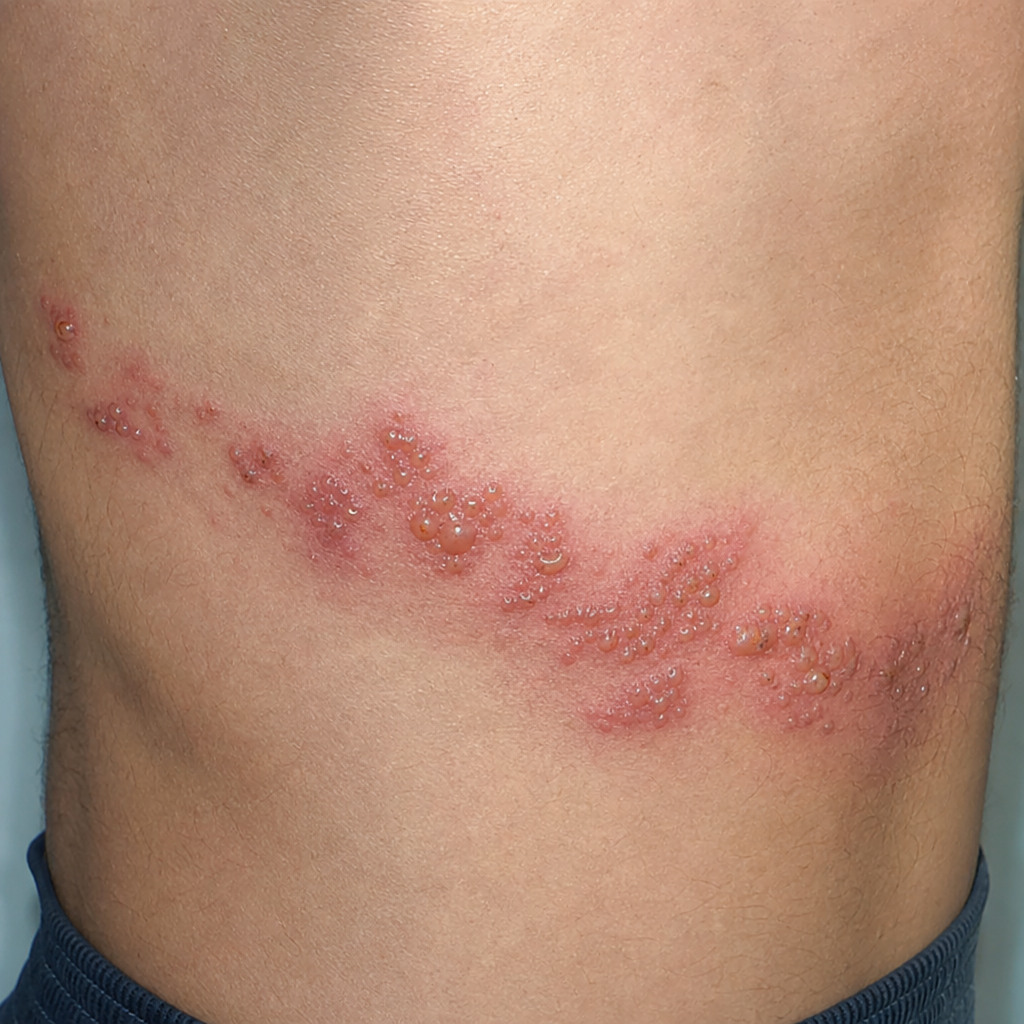
- A. Herpes simplex
- B. Herpes zoster (Correct Answer)
- C. Molluscum contagiosum
- D. Chicken pox
Explanation: ***Herpes zoster*** - This diagnosis is indicated by the classic presentation of a **painful, unilateral vesicular eruption** on an erythematous base, which is confined to a single **dermatome**. - It is caused by the **reactivation** of the latent **varicella-zoster virus (VZV)** from the dorsal root ganglia, which previously caused chickenpox. *Herpes simplex* - Herpes simplex virus (HSV) typically causes vesicular lesions grouped around the **orolabial** (HSV-1) or **genital** (HSV-2) regions, not in a dermatomal pattern on the trunk. - While it can cause a widespread eruption (eczema herpeticum), it does not characteristically follow a single nerve distribution like herpes zoster. *Molluscum contagiosum* - This condition presents as discrete, flesh-colored, **dome-shaped papules** with central **umbilication**, not as painful vesicles on an erythematous base. - It is caused by a **poxvirus**, and the lesions are typically scattered and not confined to a dermatome. *Chicken pox* - Chickenpox (primary VZV infection) presents as a **generalized, diffuse vesicular rash** that affects the entire body, rather than being limited to a single dermatome. - The rash appears in successive crops, resulting in lesions at **various stages of development** (papules, vesicles, and crusted lesions) simultaneously.
Question 272: A 45-year-old truck driver with a history of multiple sex partners presented to the dermatological department, as shown below. What is the likely diagnosis?
- A. Secondary syphilis (Correct Answer)
- B. Lichen planus
- C. Scabies
- D. Psoriasis
Explanation: ***Secondary syphilis*** - The image shows a classic **maculopapular rash** involving the **palms**, a hallmark feature of secondary syphilis, which is caused by the spirochete **Treponema pallidum**. - The patient's history of **multiple sex partners** is a significant risk factor, and other associated findings can include generalized lymphadenopathy, fever, and **condylomata lata**. *Lichen planus* - Characterized by the "6 P's": **pruritic, polygonal, planar, purple papules and plaques**, often with fine white lines on the surface known as **Wickham's striae**. - The lesions in the image lack these classic features and are not typically pruritic, distinguishing it from the presented case. *Scabies* - This is an intensely **pruritic** infestation caused by the mite **Sarcoptes scabiei**, which creates linear **burrows**, especially in the **interdigital web spaces**, wrists, and axillae. - The rash in secondary syphilis is classically non-pruritic, and the morphology is maculopapular rather than burrow-like. *Psoriasis* - Typically presents as **well-demarcated erythematous plaques** with a **silvery scale** on extensor surfaces like the elbows and knees. - While palmoplantar psoriasis occurs, it usually manifests as hyperkeratotic plaques or pustules, not the diffuse maculopapular rash seen here.
ENT
1 questionsA 2-year-old child was brought to the emergency department. The child was having difficulty in speaking and breathing. An X-ray was performed, given below. Which among the following is the best treatment for this condition?
FMGE 2023 - ENT FMGE Practice Questions and MCQs
Question 271: A 2-year-old child was brought to the emergency department. The child was having difficulty in speaking and breathing. An X-ray was performed, given below. Which among the following is the best treatment for this condition?
- A. Esophagoscopy (Correct Answer)
- B. Oxygen
- C. Tracheostomy
- D. Laryngoscopy
Explanation: ***Esophagoscopy*** - The flat, circular appearance of the coin on an AP X-ray is characteristic of a foreign body in the **esophagus** (coins in the trachea appear sagittal/linear on AP view). - An **esophageal foreign body** can compress the trachea from behind, causing respiratory distress, especially in young children with a narrow airway. - **Esophagoscopy** is the definitive treatment for removing esophageal foreign bodies and will relieve both the mechanical obstruction and the tracheal compression causing respiratory symptoms. - This should be performed urgently in a child with respiratory compromise, with anesthesia support ready to secure the airway if needed. *Tracheostomy* - A **tracheostomy** would be indicated for direct **tracheal or laryngeal obstruction** that cannot be relieved by other means. - However, in this case, the foreign body is in the **esophagus** (not the trachea), and the respiratory distress is due to external compression of the trachea. - Performing a tracheostomy would not remove the foreign body and is unnecessarily invasive when the definitive treatment (esophagoscopy) can address both the obstruction and the symptoms. *Laryngoscopy* - A **laryngoscopy** is used to visualize the larynx and can remove foreign bodies at or above the vocal cords. - The X-ray findings indicate an **esophageal** foreign body, not a laryngeal one, making laryngoscopy inappropriate for definitive management. *Oxygen* - Supplemental **oxygen** is an important supportive measure to improve oxygen saturation in any patient with respiratory distress. - However, it does not address the underlying mechanical problem (the esophageal foreign body compressing the trachea) and is not definitive treatment.
Internal Medicine
4 questionsA 50-year-old smoker presents to the hospital with a painless oral lesion and white patch that develops in the oral cavity, as shown in the image. What is the diagnosis?
A patient presented to OPD with complaints of fatigue, loss of appetite, constipation, urinary symptoms of kidney stone, and increased urination. The patient has a history of psychiatric disorder; you suspect a case of hyperparathyroidism. Which of the following investigations is useful in this condition?
An elderly male on bed rest for many months presented with breathlessness and chest pain. What is the next best step in the management of this patient?
A chronic smoker presented with bilateral pitting pedal edema, and abdominal distension. On examination, he had ascites and auscultation revealed an S3. Which of the following defects can be seen in this patient?
FMGE 2023 - Internal Medicine FMGE Practice Questions and MCQs
Question 271: A 50-year-old smoker presents to the hospital with a painless oral lesion and white patch that develops in the oral cavity, as shown in the image. What is the diagnosis?
- A. Leukoplakia (Correct Answer)
- B. Candidiasis
- C. Lichen planus
- D. Oral cancer
Explanation: ***Leukoplakia*** - Leukoplakia is a clinical diagnosis for a white patch or plaque on the oral mucosa that **cannot be scraped off**, distinguishing it from other lesions like candidiasis. - It is strongly associated with chronic irritation, particularly **tobacco use** (as in this smoker), and is considered a **premalignant condition** with a risk of transforming into squamous cell carcinoma. *Candidiasis* - Oral candidiasis (thrush) presents as creamy white, curd-like plaques that **can typically be scraped off**, revealing an underlying erythematous and sometimes bleeding base. - It is an opportunistic fungal infection more common in **immunocompromised** patients, infants, or those using steroids or broad-spectrum antibiotics. *Lichen planus* - Oral lichen planus is a chronic inflammatory autoimmune disease that classically appears as a fine, lace-like network of white lines known as **Wickham's striae**. - While it can present as plaques, the typical reticular pattern is a key differentiating feature, and it is not primarily caused by smoking. *Oral cancer* - While this lesion could be oral cancer (squamous cell carcinoma), **leukoplakia** is the correct clinical descriptive term for the white patch itself. A definitive diagnosis of cancer requires a **biopsy**. - Oral cancers often present as **indurated ulcers**, red patches (erythroplakia), or fungating masses, which may or may not be painful, in addition to white patches.
Question 272: A patient presented to OPD with complaints of fatigue, loss of appetite, constipation, urinary symptoms of kidney stone, and increased urination. The patient has a history of psychiatric disorder; you suspect a case of hyperparathyroidism. Which of the following investigations is useful in this condition?
- A. Sestamibi scan (Correct Answer)
- B. USG neck
- C. CT neck
- D. PET scan
Explanation: ***Sestamibi scan*** - This is the standard **nuclear medicine study** used for localizing hyperfunctioning **parathyroid adenomas** prior to surgery (parathyroidectomy), essential for confirming the source of hypercalcemia [1]. - The scan is highly sensitive because the tracer (**Technetium-99m Sestamibi**) is retained longer in the hyperactive parathyroid tissue than in the surrounding thyroid tissue [1]. *USG neck* - **Ultrasonography** is an anatomical study that is often used as a basic initial imaging step due to its non-invasiveness, but it has lower overall sensitivity (50-80%) in localization. - It is poor at locating **ectopic or deep-seated adenomas** and cannot confirm if the lesion is truly hyperfunctioning, which is critical for diagnosis. *CT neck* - **Computed Tomography** is generally reserved for situations where non-invasive methods fail, especially when trying to localize **ectopic glands** deep in the **mediastinum** or neck. - It is not preferred as a first-line investigation due to the associated **radiation exposure** and lack of functional information regarding the glandular activity. *PET scan* - Standard **FDG-PET scans** are mostly ineffective for localizing benign parathyroid adenomas because they rarely exhibit the high metabolic activity required for tracer uptake. - Specialized PET tracers, such as **11C-methionine**, may be used in complicated cases of persistent or recurrent hyperparathyroidism, but are not routine for initial diagnosis. Note: The patient's presentation of kidney stones, psychiatric symptoms, and polyuria is consistent with primary hyperparathyroidism secondary to hypercalcemia [2, 3].
Question 273: An elderly male on bed rest for many months presented with breathlessness and chest pain. What is the next best step in the management of this patient?
- A. ECG
- B. CT thorax
- C. CT pulmonary angiogram (Correct Answer)
- D. Echocardiography
Explanation: ***CT pulmonary angiogram***- This is the **gold standard** imaging investigation for diagnosing **pulmonary embolism (PE)**, offering rapid confirmation of emboli within the pulmonary arteries [1].- The patient's history of prolonged **bed rest** (immobilization) makes them high-risk for **Deep Vein Thrombosis (DVT)**, predisposing them to PE, which manifests as acute breathlessness and chest pain [2].*ECG*- An ECG is a standard initial test (often alongside chest X-ray) to exclude cardiac causes like **myocardial infarction** and assess for features of right ventricular strain (e.g., **S1Q3T3 pattern**) associated with PE [1].- However, ECG findings are non-specific and cannot definitively confirm or exclude the diagnosis of PE; imaging is required.*CT thorax*- A standard non-contrast CT thorax is effective for evaluating lung parenchyma (e.g., pneumonia or malignancy).- It is inadequate for diagnosing PE, which requires intravenous contrast specifically timed to opacify the pulmonary arteries (a **CT pulmonary angiogram**).*Echocardiography*- Echocardiography is primarily used to assess the functional and prognostic impact of PE, specifically looking for **right ventricular (RV) dilation** and dysfunction.- It may be utilized in critically **hemodynamically unstable** patients suspected of PE (where immediate transport to CTPA is dangerous), but for a stable patient, CTPA provides the definitive anatomical diagnosis.
Question 274: A chronic smoker presented with bilateral pitting pedal edema, and abdominal distension. On examination, he had ascites and auscultation revealed an S3. Which of the following defects can be seen in this patient?
- A. Tricuspid regurgitation (Correct Answer)
- B. Aortic stenosis
- C. Mitral regurgitation
- D. Aortic regurgitation
Explanation: ***Tricuspid regurgitation*** - This patient presents with **classic signs of right heart failure**: bilateral pitting pedal edema, ascites, and abdominal distension indicating systemic venous congestion [1] - **Chronic smoking → COPD → pulmonary hypertension → functional tricuspid regurgitation** is a common pathophysiological sequence - **S3 gallop** indicates ventricular volume overload, which occurs in TR due to regurgitant flow - TR leads to **hepatic congestion** (causing ascites) and **peripheral edema** from elevated systemic venous pressure - Clinical triad: **elevated JVP, hepatomegaly, and peripheral edema** points to TR *Incorrect: Aortic stenosis* - Causes **left-sided heart failure**, not right-sided [2] - Classic presentation: **angina, syncope, and dyspnea** (not peripheral edema and ascites) [2] - Would not explain the systemic venous congestion seen in this patient *Incorrect: Mitral regurgitation* - Primarily causes **left-sided heart failure** with pulmonary congestion [1] - Initial presentation includes **dyspnea and pulmonary edema**, not peripheral edema [1] - While chronic MR can eventually lead to right heart failure, the **predominant right-sided signs** make this less likely *Incorrect: Aortic regurgitation* - Causes **left-sided heart failure** [3] - Classic signs include **wide pulse pressure, bounding pulses**, and water-hammer pulse [3] - Does not explain the **right-sided failure** picture with ascites and bilateral pedal edema
Pathology
1 questionsWhich of the following is true about p53?
FMGE 2023 - Pathology FMGE Practice Questions and MCQs
Question 271: Which of the following is true about p53?
- A. It retains the telomerase enzyme in the nucleus
- B. It increases telomere length in the liver.
- C. It synthesizes RNA
- D. It stabilizes RNA (Correct Answer)
Explanation: p53, known as the "**guardian of the genome**," has multiple functions beyond its classical role as a tumor suppressor [2]. While primarily known for **cell cycle arrest, DNA repair coordination, and apoptosis induction** [1], p53 also plays a role in **RNA metabolism and stabilization** through its RNA-binding properties and interaction with various RNA-binding proteins. This contributes to its regulation of gene expression at the post-transcriptional level. *Incorrect: It retains the telomerase enzyme in the nucleus* - **p53 actually REPRESSES telomerase activity** by downregulating hTERT (telomerase reverse transcriptase) expression - Loss of p53 function in cancer cells allows telomerase reactivation, contributing to cellular immortalization - This is the opposite of the stated function *Incorrect: It increases telomere length in the liver* - p53 does not increase telomere length; it inhibits telomerase activity - No specific tissue-specific telomere lengthening function in the liver *Incorrect: It synthesizes RNA* - p53 is a **transcription factor** that regulates gene expression but does not synthesize RNA itself [1] - RNA synthesis is performed by RNA polymerase enzymes [3] **References:** [1] Kumar V, Abbas AK, et al.. Robbins and Cotran Pathologic Basis of Disease. 9th ed. Neoplasia, pp. 302-304. [2] Cross SS. Underwood's Pathology: A Clinical Approach. 6th ed. (Basic Pathology) introduces the student to key general principles of pathology, both as a medical science and as a clinical activity with a vital role in patient care. Part 2 (Disease Mechanisms) provides fundamental knowledge about the cellular and molecular processes involved in diseases, providing the rationale for their treatment. Part 3 (Systematic Pathology) deals in detail with specific diseases, with emphasis on the clinically important aspects., pp. 226-227. [3] Kumar V, Abbas AK, et al.. Robbins and Cotran Pathologic Basis of Disease. 9th ed. With Illustrations By, pp. 30-31.