Anatomy
1 questionsTo what level of vertebrae does the marked structure correspond?
FMGE 2023 - Anatomy FMGE Practice Questions and MCQs
Question 251: To what level of vertebrae does the marked structure correspond?
- A. At the junction of L1 & L2
- B. At the junction of L2 & L3
- C. At the junction of T12 & L1
- D. At the junction of L3 & L4 (Correct Answer)
Explanation: ***At the junction of L3 & L4*** - The umbilicus, indicated by the arrow, is a key surface landmark that typically corresponds to the level of the **intervertebral disc** between the **L3 and L4 vertebrae**. - This anatomical relationship is important for clinical procedures, as the **supracristal plane** (a line between the iliac crests) crosses near the L4 vertebra, helping to landmark sites for **lumbar puncture**. *At the junction of L1 & L2* - This vertebral level corresponds to the **transpyloric plane**, which is a different landmark located superior to the umbilicus. - Important structures at the L1/L2 level include the **pylorus of the stomach**, the hila of the kidneys, and the termination of the spinal cord (**conus medullaris**) in adults. *At the junction of L2 & L3* - This level is superior to the anatomical position of the umbilicus. - It corresponds to the location of the inferior border of the third part of the **duodenum** and the origin of the **inferior mesenteric artery** is often around L3. *At the junction of T12 & L1* - This is a much higher vertebral level, associated with the origin of the **celiac trunk** and the **superior mesenteric artery** from the abdominal aorta. - It is located significantly superior to the umbilicus and is near the **diaphragmatic hiatus** for the aorta.
Biochemistry
2 questionsWhich of the following is not a microelement?
Which enzymes use molecular oxygen as a hydrogen acceptor to produce water?
FMGE 2023 - Biochemistry FMGE Practice Questions and MCQs
Question 251: Which of the following is not a microelement?
- A. Calcium (Correct Answer)
- B. Copper
- C. Selenium
- D. Zinc
Explanation: ***Calcium***- Calcium is classified as a **macroelement** (or major mineral) because the body requires it in large quantities, often exceeding 100 mg daily.- It is essential for **bone mineralization**, muscle contraction, and is the most abundant mineral in the human body.*Copper*- Copper is a **microelement** (or trace mineral) and is required in amounts less than 100 mg per day.- It functions as a cofactor for several antioxidant and electron transport enzymes, crucial for **iron metabolism**.*Zinc*- Zinc is a **microelement** vital for immune function, protein synthesis, and is required in trace daily amounts.- It is a necessary cofactor for the function of over 300 enzymes, playing a key role in **gene expression** and wound healing.*Selenium*- Selenium is a **microelement** known for its antioxidant properties and is required in minute quantities (micrograms) daily.- It is structurally central to **glutathione peroxidase**, an enzyme that protects cells from oxidative damage.
Question 252: Which enzymes use molecular oxygen as a hydrogen acceptor to produce water?
- A. Catalase
- B. Superoxide dismutase
- C. Cytochrome c oxidase (Correct Answer)
- D. Pyruvate dehydrogenase
Explanation: ***Cytochrome c oxidase*** - This enzyme (Complex IV of the ETC) is responsible for the final step of cellular respiration, where it accepts electrons from **Cytochrome c**. - It catalyzes the four-electron reduction of molecular oxygen (**O₂**) to two molecules of **water** (**H₂O**), utilizing O₂ as the terminal hydrogen/electron acceptor. *Catalase* - Catalase breaks down **hydrogen peroxide** (**H₂O₂**) into water and molecular oxygen, acting as a peroxidase and protecting cells from reactive oxygen species. - It facilitates the breakdown of an existing toxic product and does not use O₂ as a hydrogen acceptor in a reduction reaction. *Superoxide dismutase* - This enzyme converts the hazardous **superoxide radical** (**O₂⁻**) into molecular oxygen and hydrogen peroxide. - It is critical for antioxidant defense but is involved in dismutation reactions, not in using O₂ as the final acceptor to form water. *Pyruvate dehydrogenase* - The pyruvate dehydrogenase complex links glycolysis to the Krebs cycle by converting **pyruvate** to **acetyl-CoA** (oxidative decarboxylation). - Its electron acceptors are **NAD⁺** and **lipoic acid** (which accept hydrogens/electrons to form NADH and reduced lipoic acid), not molecular oxygen.
Internal Medicine
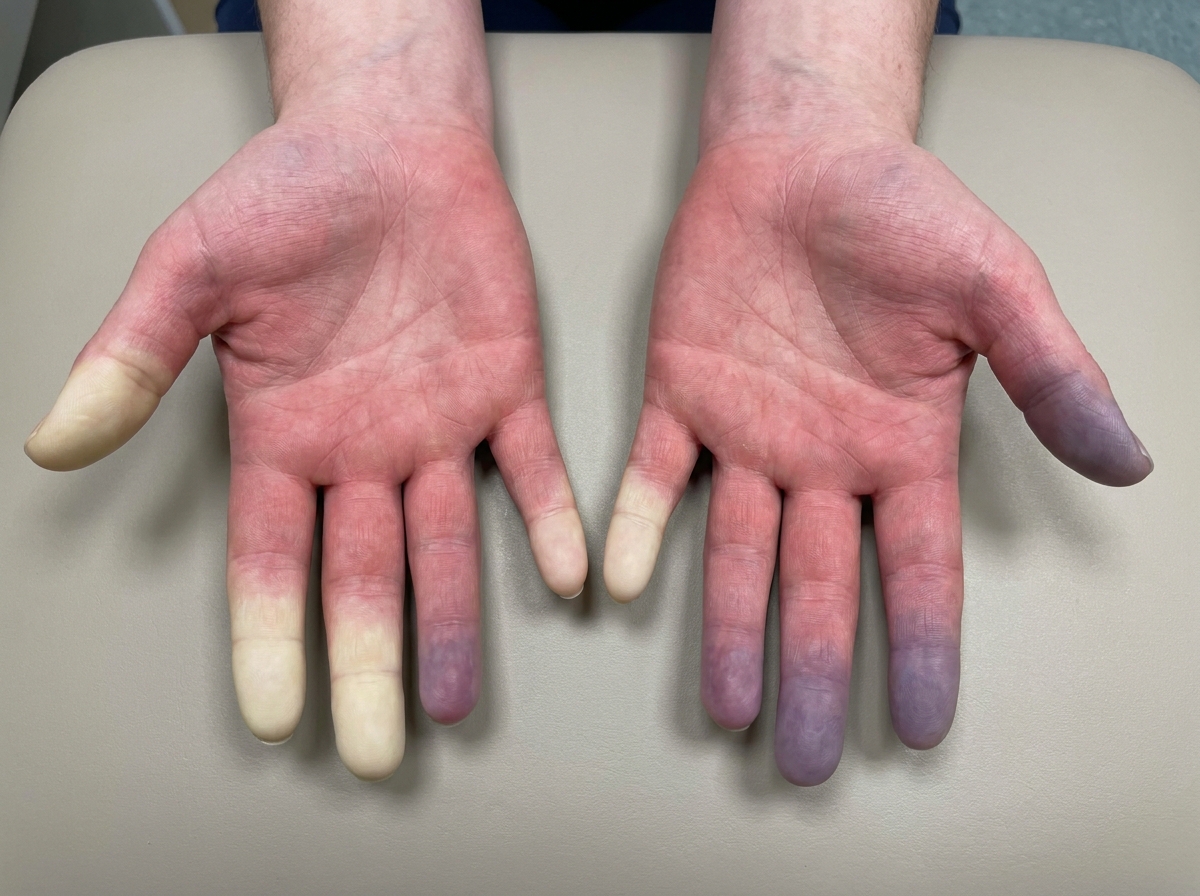
2 questionsA 17-year-old woman with no comorbidities presents with numbness and paraesthesia of the fingers along with the characteristic finding as shown in the image below. She has no history of smoking or history of other illnesses. She mentions the episodes occur when she is under excess stress or during cold temperatures. What is the most likely diagnosis?
Which of the following is not a component of qSOFA score?
FMGE 2023 - Internal Medicine FMGE Practice Questions and MCQs
Question 251: A 17-year-old woman with no comorbidities presents with numbness and paraesthesia of the fingers along with the characteristic finding as shown in the image below. She has no history of smoking or history of other illnesses. She mentions the episodes occur when she is under excess stress or during cold temperatures. What is the most likely diagnosis?
- A. b. Buerger's disease
- B. c. Atherosclerosis
- C. d. Peripheral arterial disease
- D. a. Raynaud's phenomenon (Correct Answer)
Explanation: ***Raynaud's phenomenon*** (Keep the correct option at the top and the incorrect options in the order they are provided in the input) - The clinical picture of episodic digital **numbness**, paraesthesia, and color changes specifically triggered by **cold temperatures** or **stress** is pathognomonic for Raynaud's phenomenon. - Given the patient's young age (17) and lack of underlying illness (no comorbidities), this is strongly suggestive of **Primary Raynaud's phenomenon** (Raynaud's disease). *Buerger's disease* - **Buerger's disease** (Thromboangiitis obliterans) is highly associated with heavy **tobacco use**, which conflicts with the patient's history of no smoking. - This condition involves inflammation and thrombosis of medium and small arteries, typically leading to more severe fixed ischemia, ulcers, and **gangrene**, rather than transient vasospastic episodes. *Atherosclerosis* - **Atherosclerosis** is a fixed obstruction due to plaque buildup and is extremely rare in a healthy, young 17-year-old patient. - When present, it causes symptoms like **intermittent claudication** or rest pain, which are constant and exertional, unlike the acute, episodic nature of vasospasm. *Peripheral arterial disease* - **Peripheral arterial disease (PAD)** typically refers to occlusive disease (often atherosclerotic) that leads to reduced blood flow, causing symptoms that worsen with **exertion**. - Unlike Raynaud's, PAD does not typically cause acute, reversible, triphasic color changes in response to **cold** or emotional stress.
Question 252: Which of the following is not a component of qSOFA score?
- A. Systolic blood pressure < 100 mmHg
- B. Respiratory rate >22
- C. LDH-Lactate dehydrogenase (Correct Answer)
- D. Altered mental status
Explanation: ***LDH-Lactate dehydrogenase*** - The **quick Sequential Organ Failure Assessment (qSOFA) score** is a rapid bedside tool used to identify adult patients with suspected infection who are at high risk for poor outcomes, but it does not include laboratory markers like LDH. - qSOFA only includes three simple, readily available clinical criteria (respiratory rate, mental status, and systolic BP), therefore **LDH** is not a component. *Respiratory rate >22* - A **respiratory rate of 22 breaths per minute (or higher)** is one of the three components of the qSOFA score (a score of 1 point is given if RR ≥ 22) [1]. - This parameter indicates a potential compensatory mechanism for **metabolic acidosis** or severe underlying respiratory compromise due to infection. *Altered mental status* - **Altered mental status** (Glasgow Coma Scale score < 15 or any change from baseline) is a key component of the qSOFA score (1 point) [1]. - This reflects neurological **end-organ dysfunction** secondary to systemic inflammation and hypoperfusion (sepsis-associated encephalopathy). *Systolic blood pressure < 100 mmHg* - A systolic blood pressure (SBP) **less than 100 mmHg** is the third component of the qSOFA score (1 point) [1]. - This criterion indicates **hemodynamic compromise** and potential **shock**, reflecting severe circulatory dysfunction associated with sepsis.
Pediatrics
1 questionsWhich of the following are true about nephroblastoma except:
FMGE 2023 - Pediatrics FMGE Practice Questions and MCQs
Question 251: Which of the following are true about nephroblastoma except:
- A. Treatment is chemotherapy followed by surgery (Correct Answer)
- B. Most common intra abdominal malignancy in children
- C. Early lung mets
- D. Hematogenous spread
Explanation: ***Correct Answer: Treatment is chemotherapy followed by surgery*** This is the **INCORRECT** statement (which makes it the correct answer for this EXCEPT question): - In **COG (Children's Oncology Group) protocol** used in India and US: **Primary treatment is upfront nephrectomy** (surgery first) followed by chemotherapy - SIOP protocol uses preoperative chemotherapy, but this is NOT the standard approach in India/FMGE context - **Surgery-first approach** allows for accurate staging and immediate tumor removal *Incorrect: Most common intra abdominal malignancy in children* - This is **TRUE** - Nephroblastoma (Wilms tumor) is indeed the most common intra-abdominal malignancy in children (peak age 3-4 years) *Incorrect: Early lung mets* - This is **TRUE** - Wilms tumor has propensity for **early hematogenous spread to lungs** - Lungs are the most common site of metastasis - Chest X-ray/CT is mandatory for staging *Incorrect: Hematogenous spread* - This is **TRUE** - Wilms tumor spreads via **hematogenous route** to lungs (most common), liver, and other sites - Unlike neuroblastoma which can spread lymphatically
Pharmacology
1 questionsA male patient complained of imbalance, numbness of the foot, and muscle weakness. On history taking, he revealed that he has been taking multivitamin tablets more than the prescribed dose for 1 year. Which of the following is the most likely cause of the associated symptoms seen in this patient?
FMGE 2023 - Pharmacology FMGE Practice Questions and MCQs
Question 251: A male patient complained of imbalance, numbness of the foot, and muscle weakness. On history taking, he revealed that he has been taking multivitamin tablets more than the prescribed dose for 1 year. Which of the following is the most likely cause of the associated symptoms seen in this patient?
- A. Vitamin D toxicity
- B. Vitamin B6 toxicity (Correct Answer)
- C. Vitamin C toxicity
- D. Vitamin A toxicity
Explanation: ***Vitamin B6 toxicity*** - Chronic ingestion of high-dose **pyridoxine** (Vitamin B6) is a well-known cause of **sensory polyneuropathy**, which manifests as numbness (paresthesia) and gait imbalance (**ataxia**). - The toxicity primarily targets the sensory neurons of the **dorsal root ganglia**, leading to the observed sensory and motor deficits (muscle weakness). *Vitamin D toxicity* - This condition primarily causes **hypercalcemia**, leading to symptoms such as nausea, vomiting, confusion, and generalized weakness, often affecting renal function. - It is not typically associated with a chronic, distal, sensory-dominant **peripheral neuropathy** causing numbness and foot imbalance. *Vitamin C toxicity* - Vitamin C (ascorbic acid) is generally safe; high doses typically result in mild symptoms like gastrointestinal distress and an increased risk of developing **calcium oxalate kidney stones**. - It does **not** cause neurotoxic effects such as peripheral neuropathy or chronic ataxia. *Vitamin A toxicity* - Chronic hypervitaminosis A involves symptoms such as **hepatotoxicity**, dry skin/cheilitis, **bone and joint pain**, and pseudo-tumor cerebri (increased intracranial pressure). - While neurological symptoms like headache may occur due to increased pressure, clear-cut **sensory polyneuropathy and ataxia** are not characteristic features.
Surgery
3 questionsA patient presents with urinary symptoms due to benign prostatic hyperplasia. Which of the following is used to manage the urinary symptoms in the initial stage of this condition?
Which is the least commonly used graft for coronary artery bypass graft (CABG)?
Which of the following is the recommended treatment for the ureteric stone shown in the image?
FMGE 2023 - Surgery FMGE Practice Questions and MCQs
Question 251: A patient presents with urinary symptoms due to benign prostatic hyperplasia. Which of the following is used to manage the urinary symptoms in the initial stage of this condition?
- A. Tamsulosin (Correct Answer)
- B. Finasteride
- C. Observation
- D. TURP-Transurethral resection of prostate
Explanation: ***Tamsulosin*** - **Alpha-1 adrenergic blocker** that relaxes smooth muscle in the prostate and bladder neck - Provides **rapid symptom relief** within days to weeks for moderate-to-severe LUTS (Lower Urinary Tract Symptoms) - **First-line medical therapy** for symptomatic BPH requiring treatment - Improves urinary flow rate and reduces obstructive symptoms (hesitancy, weak stream, incomplete emptying) *Finasteride* - 5-alpha reductase inhibitor that shrinks prostate size over time - Takes **6+ months** to show clinical benefit, not ideal for initial symptom relief - More appropriate for patients with large prostates (>40g) or as combination therapy *TURP (Transurethral Resection of Prostate)* - **Surgical intervention** reserved for refractory cases, complications, or failure of medical management - Not appropriate as initial management - Indications: recurrent retention, refractory hematuria, bladder stones, renal insufficiency due to BPH *Observation* - Appropriate for **asymptomatic or mildly symptomatic** patients (watchful waiting) - This patient presents with urinary symptoms requiring active management - Not suitable when symptoms are bothersome enough to prompt medical consultation
Question 252: Which is the least commonly used graft for coronary artery bypass graft (CABG)?
- A. Radial artery
- B. Long saphenous vein
- C. Internal mammary artery
- D. Intercostal artery (Correct Answer)
Explanation: ***Intercostal artery***- This artery is **rarely used** in CABG due to its small caliber, difficult harvesting, and high risk of **graft spasm**.- Its use is generally restricted to highly unusual circumstances or when all major **arterial** and **venous conduits** are unavailable. *Long saphenous vein*- The **long saphenous vein (LSV)** is the most common venous graft and is frequently used, particularly for targets other than the LAD.- Though easily accessible and long, LSV grafts have significantly lower long-term patency rates compared to arterial grafts due to susceptibility to **intimal hyperplasia** and atherosclerosis. *Internal mammary artery* - The **Internal Mammary Artery (IMA)** (or Internal Thoracic Artery) is universally considered the **gold standard** graft, particularly for the Left Anterior Descending (LAD) artery.- It offers the highest long-term patency (often >90% at 10 years), making it the most commonly preferred graft, not the least common. *Radial artery*- The **radial artery (RA)** is widely used as a second arterial conduit, offering excellent long-term patency rates superior to vein grafts but slightly less than the IMA.- Preoperative evaluation using the **Allen's test** is necessary to confirm adequate collateral circulation via the ulnar artery before harvesting.
Question 253: Which of the following is the recommended treatment for the ureteric stone shown in the image?
- A. Percutaneous nephrolithotomy
- B. Ureteroscopy (Correct Answer)
- C. ESWL
- D. Wait and watch
Explanation: ***Ureteroscopy*** - This procedure involves passing a small, flexible scope through the urethra and bladder into the ureter to directly visualize and treat the stone. - It is a highly effective and preferred treatment for stones located in the **mid and distal ureter**, allowing for either retrieval with a basket or fragmentation with a laser. *Percutaneous nephrolithotomy* - This is an invasive procedure where an instrument is passed directly into the kidney through a small incision in the back. - It is primarily indicated for the removal of **large renal stones** (typically >2 cm) or staghorn calculi located within the kidney, not for ureteric stones. *ESWL* - Extracorporeal Shock Wave Lithotripsy (ESWL) uses focused **shock waves** from outside the body to break the stone into smaller fragments that can be passed in the urine. - While an option for some ureteric and kidney stones, its success rate is lower for stones in the **lower ureter** and for harder stones, making ureteroscopy often more effective. *Wait and watch* - This approach, often combined with **Medical Expulsive Therapy** (e.g., alpha-blockers), is reserved for small, uncomplicated stones (typically **<5 mm**) that are likely to pass spontaneously. - It is not recommended for larger stones, stones causing significant obstruction or severe symptoms, or those that fail to pass after a trial period.