Anatomy
1 questionsIdentify the structure marked in the image given below.
FMGE 2023 - Anatomy FMGE Practice Questions and MCQs
Question 211: Identify the structure marked in the image given below.
- A. Internal Capsule (Correct Answer)
- B. External capsule
- C. Putamen
- D. Caudate nucleus
Explanation: ***Internal Capsule***- The **internal capsule** is a V-shaped structure of densely packed white matter tracts situated deep within the cerebral hemispheres.- It contains crucial ascending and descending fibers, including the **corticospinal tract** (motor fibers) and **thalamocortical projections** (sensory fibers).*External capsule*- The **external capsule** is a thin sheet of white matter located *lateral* to the **lenticular nucleus** (putamen and globus pallidus).- It separates the **putamen** from the **claustrum**.*Caudate nucleus*- The **caudate nucleus** is a C-shaped component of the **basal ganglia**, typically situated medial to the internal capsule and forming the lateral wall of the anterior horn of the **lateral ventricle**.- Damage to this structure is often implicated in **Huntington's disease**.*Putamen*- The **putamen** is the larger, more lateral gray matter structure of the **lenticular nucleus**, located lateral to the internal and external capsules.- It is a core component of the **basal ganglia**, involved primarily in controlling learned motor movements.
Internal Medicine
1 questionsHamman sign is seen in
FMGE 2023 - Internal Medicine FMGE Practice Questions and MCQs
Question 211: Hamman sign is seen in
- A. Pneumoperitoneum
- B. Hydropneumothorax
- C. Pneumopericardium
- D. Pneumomediastinum (Correct Answer)
Explanation: ***Pneumomediastinum*** - Hamman sign (or Hamman's crunch) is the classic auscultatory finding associated with **pneumomediastinum** (air in the mediastinum). - It is described as a **crunching, grating, or rasping sound** over the pre-cordium, synchronous with the heartbeat, caused by the heart beating against adjacent air-filled tissue. *Pneumoperitoneum* - This condition involves free air within the **peritoneal cavity**, commonly presenting with signs of **acute abdomen** and rigidity. - It is diagnosed radiographically by finding **free gas under the dome of the diaphragm**, without causing pre-cordial crunching sounds. *Pneumopericardium* - This refers to air accumulating within the **pericardial sac** surrounding the heart. - While air near the heart exists, the specific Hamman sign is due to air in the surrounding **mediastinal tissue planes**, not within the confined pericardium. *Hydropneumothorax* - This involves the presence of both fluid (*hydro*) and air (*pneumo*) within the **pleural space**, outside the mediastinum. - Clinical features are typically related to compromised lung function, demonstrating signs of both pleural effusion and **pneumothorax**, without the characteristic Hamman sign.
Obstetrics and Gynecology
1 questionsA young sexually active female patient presented to the outpatient department with complaints of lower abdominal pain, fever, vomiting, and foul-smelling vaginal discharge. On examination, the body temperature is 103 degrees Fahrenheit, pulse rate is 109 per minute and there is abdominal tenderness. Cervical motion tenderness is present on examination. What is the most likely diagnosis?
FMGE 2023 - Obstetrics and Gynecology FMGE Practice Questions and MCQs
Question 211: A young sexually active female patient presented to the outpatient department with complaints of lower abdominal pain, fever, vomiting, and foul-smelling vaginal discharge. On examination, the body temperature is 103 degrees Fahrenheit, pulse rate is 109 per minute and there is abdominal tenderness. Cervical motion tenderness is present on examination. What is the most likely diagnosis?
- A. Pelvic inflammatory disease (Correct Answer)
- B. Adenomyosis
- C. Endometriosis
- D. Appendicitis
Explanation: ***Pelvic inflammatory disease*** - The presentation —lower abdominal pain, high **fever**, **foul-smelling vaginal discharge**, and severe **cervical motion tenderness (CMT)** in a sexually active woman —is the classic clinical triad for **acute Pelvic Inflammatory Disease (PID)**. - CMT, often called the **"Chandelier sign"**, is highly characteristic of PID, indicating inflammation of the fallopian tubes and surrounding structures (*salpingitis*). *Endometriosis* - This condition is characterized by chronic, cyclical pelvic pain, **dysmenorrhea**, and **dyspareunia**, and generally lacks acute signs of infection like high fever and leukorrhea. - It results from the presence of **endometrial tissue** outside the uterus and does not cause purulent vaginal discharge or acute CMT characteristic of infectious PID. *Adenomyosis* - Typically presents with **menorrhagia** (heavy bleeding) and worsening **dysmenorrhea** in older, often multiparous women, without acute febrile illness or infectious discharge. - It involves the invasion of **endometrial tissue** into the myometrium (uterine muscle wall), leading to a diffusely enlarged, globular uterus. *Appendicitis* - While it causes acute lower abdominal pain, fever, and vomiting, **appendicitis** typically presents with pain localized to the **right lower quadrant (RLQ)** and lacks the prominent **vaginal discharge** and specific **cervical motion tenderness** seen in PID. - The primary pathology involves inflammation of the appendix, not the female genital tract, thus the absence of associated **foul-smelling vaginal discharge**.
Ophthalmology
1 questionsFundoscopy findings are shown in the image below. What is the most likely diagnosis? 
FMGE 2023 - Ophthalmology FMGE Practice Questions and MCQs
Question 211: Fundoscopy findings are shown in the image below. What is the most likely diagnosis? 
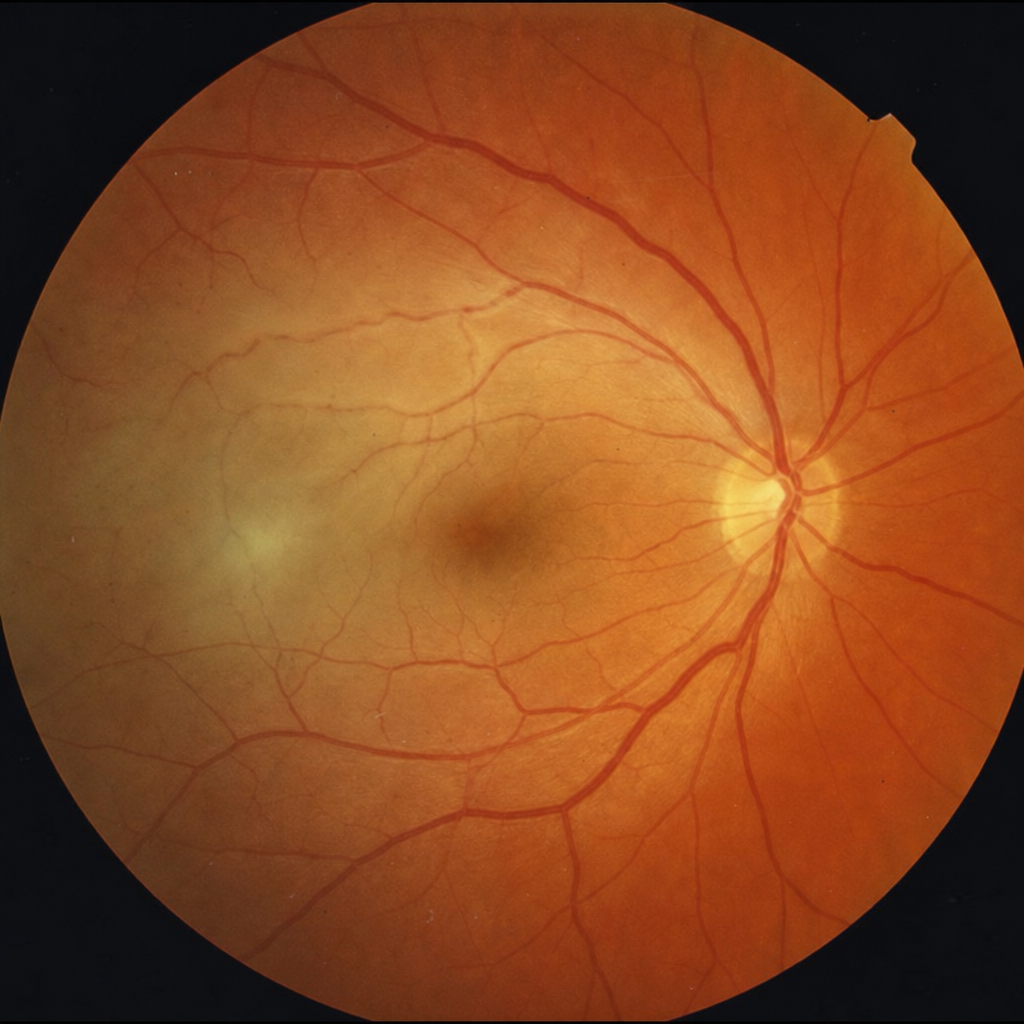
- A. Diabetic retinopathy
- B. CRVO
- C. CRAO (Correct Answer)
- D. Cystoid macular edema
Explanation: ***CRAO*** - The fundoscopy image shows a classic **cherry-red spot** at the macula, which is pathognomonic for Central Retinal Artery Occlusion (CRAO). This spot appears because the fovea receives its blood supply from the underlying choroid, which remains visible and red against the pale, ischemic retina. - CRAO presents as sudden, profound, and painless monocular vision loss. The diffuse retinal pallor is due to edema and ischemia of the inner retinal layers caused by the occlusion of the central retinal artery, often by an **embolus**. *CRVO* - Central Retinal Vein Occlusion (CRVO) is characterized by a "**blood and thunder**" fundus, featuring widespread **retinal hemorrhages**, dilated and tortuous veins, and cotton-wool spots, none of which are present in the image. - Unlike the arterial occlusion seen here, CRVO is a venous outflow obstruction, leading to venous stasis, ischemia, and hemorrhage rather than diffuse retinal pallor. *Diabetic retinopathy* - The fundoscopic findings of diabetic retinopathy include **microaneurysms**, **dot and blot hemorrhages**, **hard exudates**, and **cotton-wool spots** in its non-proliferative stage. - Proliferative diabetic retinopathy is marked by **neovascularization** (new, fragile blood vessel growth) at the disc or elsewhere, which is absent in this image. *Cystoid macular edema* - Cystoid macular edema involves fluid accumulation in the macula, which on fundoscopy may cause loss of the foveal reflex and macular thickening, but not the diffuse pallor or cherry-red spot seen here. - The characteristic finding is a **petaloid pattern** of leakage on fluorescein angiography or cystic spaces on **Optical Coherence Tomography (OCT)**.
Pediatrics
1 questionsA neonate was brought with a history of frothiness from the mouth and respiratory distress. An X-ray of the neonate is given below. What is the diagnosis?
FMGE 2023 - Pediatrics FMGE Practice Questions and MCQs
Question 211: A neonate was brought with a history of frothiness from the mouth and respiratory distress. An X-ray of the neonate is given below. What is the diagnosis?
- A. Transient tachypnea of newborn
- B. Respiratory distress syndrome
- C. Esophageal atresia with tracheo-esophageal fistula (Correct Answer)
- D. Congenital diaphragmatic hernia
Explanation: ***Esophageal atresia with tracheo-esophageal fistula*** - The clinical presentation of a neonate with excessive **frothiness from the mouth**, choking, and **respiratory distress** is highly suggestive of this diagnosis. - The X-ray confirms the diagnosis by showing a **coiled orogastric tube** (indicated by the arrow) in the blind-ending upper esophageal pouch. The presence of **gas in the stomach** indicates a communication between the trachea and the distal esophagus (a distal fistula). *Transient tachypnea of newborn* - This is a benign condition caused by delayed clearance of fetal lung fluid, presenting with rapid breathing shortly after birth, usually in term infants delivered by C-section. - The chest X-ray typically shows **perihilar streaking**, **fluid in the fissures**, and mild hyperinflation, not a coiled feeding tube. *Congenital diaphragmatic hernia* - This condition involves the herniation of abdominal contents into the chest, causing severe respiratory distress and a **scaphoid abdomen**. - The chest X-ray would show **bowel loops within the thoracic cavity** and displacement of the mediastinum, which are not seen in this image. *Respiratory distress syndrome* - Primarily seen in premature infants, this is caused by a deficiency of **pulmonary surfactant**. - The characteristic X-ray findings include low lung volumes, a diffuse **ground-glass appearance**, and **air bronchograms**.
Radiology
3 questionsWhole-body CT scan protocol for a trauma patient includes all, except
Identify the part of the bowel in the barium study given below.
A male patient presented with complaints of hematuria and recurrent urinary tract infection. You notice the following finding in his CECT. What is the likely condition indicated by the arrow in the image?
FMGE 2023 - Radiology FMGE Practice Questions and MCQs
Question 211: Whole-body CT scan protocol for a trauma patient includes all, except
- A. d.CT Abdomen
- B. c.CT Limbs (Correct Answer)
- C. b.CT Cervical spine
- D. a.CT Head
Explanation: ***c.CT Limbs***- Whole-body CT in **polytrauma** focuses on detecting time-critical injuries in the **trunk** and **head** (head, chest, abdomen/pelvis, and spine). - Routine inclusion of **CT Limbs** is not standard unless there is specific clinical suspicion of a major fracture or vascular injury based on physical examination. *a.CT Head* - Essential for rapidly excluding **intracranial hemorrhage**, **subdural/epidural hematomas**, or significant **traumatic brain injury (TBI)**, which are major causes of trauma mortality. - Typically performed first in the whole-body protocol to assess the most immediately life-threatening injuries. *b.CT Cervical spine* - Crucial for identifying potentially unstable **spinal fractures** or **ligamentous injuries** that require immediate management and prevent secondary neurological injury. - High-energy trauma mandates comprehensive assessment of the **cervical spine** as part of the primary survey protocol. *d.CT Abdomen* - Necessary for detecting **solid organ injury** (e.g., liver, spleen lacerations) and **intraperitoneal/retroperitoneal hemorrhage**, which are common sources of **exsanguination** and shock. - The abdominal scan usually extends to include the **pelvis** to assess for **pelvic fractures** and associated bleeding.
Question 212: Identify the part of the bowel in the barium study given below.
- A. Jejunum (Correct Answer)
- B. Transverse colon
- C. Ileum
- D. Splenic flexure
Explanation: ***Jejunum*** - The barium study shows prominent, closely packed mucosal folds, known as **plicae circulares** (or valvulae conniventes), which create a characteristic **'feathery'** or **'stack of coins'** appearance distinctive to the jejunum. - Anatomically, the jejunum is primarily located in the **left upper quadrant** of the abdomen and has a wider diameter and thicker wall than the ileum, consistent with the radiographic findings. *Ileum* - The ileum has fewer, sparser, and less prominent **plicae circulares**, resulting in a smoother, more **'featureless'** appearance on a barium study compared to the jejunum. - It is typically located in the **right lower quadrant** of the abdomen, terminating at the ileocecal valve. *Transverse colon* - The transverse colon is part of the large intestine and is identified by its **haustra**, which are sacculations that give it a segmented appearance, not the fine, feathery pattern of the small bowel. - It generally has a larger caliber than the small intestine and is positioned more superiorly in the abdomen, spanning from the hepatic flexure to the splenic flexure. *Splenic flexure* - The splenic flexure is the sharp turn between the transverse colon and the descending colon, and like the rest of the colon, it would display **haustral markings**. - It is located high in the **left upper quadrant**, superior to where the jejunal loops are typically found.
Question 213: A male patient presented with complaints of hematuria and recurrent urinary tract infection. You notice the following finding in his CECT. What is the likely condition indicated by the arrow in the image?
- A. Horseshoe kidney (Correct Answer)
- B. Polycystic kidney disease
- C. Pancake kidney
- D. Hydronephrosis
Explanation: ***Horseshoe kidney*** - The CECT image shows the **fusion of the lower poles** of the kidneys across the midline, anterior to the great vessels, forming a characteristic U-shape. This connecting bridge of renal tissue is called an **isthmus**. - This congenital anomaly is associated with an increased risk of complications like **recurrent UTIs**, **nephrolithiasis** (kidney stones), and **hematuria** due to impaired urinary drainage and vesicoureteral reflux, which aligns with the patient's presentation. *Polycystic kidney disease* - This genetic disorder is characterized by the presence of **multiple, bilateral cysts** throughout the renal parenchyma, causing massive enlargement of the kidneys. - The provided image shows a fusion anomaly with relatively normal-appearing renal parenchyma, not the cystic changes typical of polycystic kidney disease. *Hydronephrosis* - Hydronephrosis refers to the **dilation of the renal pelvis and calyces** due to an obstruction of urine outflow. It is a finding, not a primary diagnosis of a structural anomaly. - While a horseshoe kidney can lead to hydronephrosis, the primary abnormality indicated by the arrows is the **renal fusion**, not a dilated collecting system. *Pancake kidney* - A pancake (or fused pelvic) kidney is a rare anomaly where the kidneys are completely fused into a **single, disc-shaped mass** located in the pelvis. - In contrast, a horseshoe kidney involves fusion typically at the lower poles, with two distinct renal masses still identifiable, as seen in the image.
Surgery
2 questionsA male patient presented with a sudden onset tearing type of chest pain radiating to the back, shortness of breath, and nausea. CT chest image is given. What is the most appropriate next step in the management of this patient?
A 32-year-old patient who is a chronic tobacco chewer presents with a whitish lesion on the gingivobuccal sulcus for 7 months. What is the next best step in the management of this condition?
FMGE 2023 - Surgery FMGE Practice Questions and MCQs
Question 211: A male patient presented with a sudden onset tearing type of chest pain radiating to the back, shortness of breath, and nausea. CT chest image is given. What is the most appropriate next step in the management of this patient?
- A. Urgent surgery
- B. Blood transfusion
- C. Wait and watch
- D. Esmolol and urgent surgery (Correct Answer)
Explanation: ***Esmolol and urgent surgery*** - The CT image shows an intimal flap in the ascending aorta, confirming a **Stanford Type A aortic dissection**. This is a surgical emergency requiring immediate intervention. - The initial management goals are to lower heart rate and blood pressure to reduce aortic wall shear stress. This is achieved with intravenous **beta-blockers** (like **esmolol**), followed by urgent surgical repair. *Urgent surgery* - While surgery is the definitive treatment, it should not be performed without first medically stabilizing the patient. - Failure to control **blood pressure** and **heart rate** pre-operatively increases the risk of dissection propagation or aortic rupture during induction of anesthesia or the surgical procedure itself. *Wait and watch* - A **Type A aortic dissection** is a life-threatening condition with a very high mortality rate (approximately 1-2% per hour for the first 48 hours) if left untreated. - Delaying treatment drastically increases the risk of fatal complications such as **cardiac tamponade**, **acute aortic regurgitation**, or **malperfusion syndromes**. *Blood transfusion* - Blood transfusion is not the primary treatment unless the patient is hemodynamically unstable due to massive hemorrhage from an aortic rupture. - The priority is to prevent rupture and further dissection through **hemodynamic control** and definitive **surgical repair**, not to replace blood volume unless significant loss has already occurred.
Question 212: A 32-year-old patient who is a chronic tobacco chewer presents with a whitish lesion on the gingivobuccal sulcus for 7 months. What is the next best step in the management of this condition?
- A. Steroidal injection
- B. Sclerotherapy
- C. Avoid smoking; wait and watch
- D. Local excision and biopsy (Correct Answer)
Explanation: ***Local excision and biopsy*** - The clinical presentation of a persistent white patch in a chronic tobacco user is highly suspicious for **oral leukoplakia**, which is a **premalignant** condition. A **biopsy** is mandatory to establish a definitive histological diagnosis and rule out dysplasia or **squamous cell carcinoma**. - An **excisional biopsy** for a localized lesion is both diagnostic and therapeutic, as it removes the potentially malignant tissue and allows for microscopic examination. *Avoid smoking; wait and watch* - While smoking cessation is a critical part of management, a "wait and watch" approach is inappropriate for a lesion that has persisted for 7 months due to the significant risk of underlying malignancy. - Delaying a definitive diagnosis could allow a potential early-stage cancer to progress, leading to a worse prognosis. *Steroidal injection* - Steroids are used to treat **inflammatory** or **autoimmune** oral lesions like oral lichen planus or pemphigus vulgaris, not potentially neoplastic conditions like leukoplakia. - Using steroids could mask the progression of the lesion and delay the diagnosis of a malignancy. *Sclerotherapy* - Sclerotherapy is a treatment used for **vascular lesions**, such as **hemangiomas** or venous malformations, where a sclerosing agent is injected to cause thrombosis and fibrosis. - This modality is completely inappropriate for an **epithelial** lesion like leukoplakia.