Anesthesiology
1 questionsWhich of the following airway devices helps maintain Fio2 of 0.25-0.60, irrespective of the patient's breathing effort?
FMGE 2023 - Anesthesiology FMGE Practice Questions and MCQs
Question 181: Which of the following airway devices helps maintain Fio2 of 0.25-0.60, irrespective of the patient's breathing effort?
- A. Simple face mask
- B. Venturi mask (Correct Answer)
- C. Non-rebreathing mask
- D. Nasal cannula
Explanation: ***Venturi mask***- This device utilizes the **Bernoulli principle** to mix a specific flow of 100% oxygen with a fixed volume of **room air** via interchangeable jet adapters, achieving a precise FIO2 (0.24-0.60).- Because the total gas flow delivered to the patient (O2 + entrained air) greatly exceeds the patient's peak inspiratory flow, the delivered FIO2 is **independent of the patient's breathing effort** (rate and depth).*Nasal cannula*- The actual FIO2 delivered is highly **variable** and dependent on the patient's **inspiratory flow rate** and pattern, as the device primarily provides supplemental oxygen flow into the pharynx.- It typically provides a maximum FIO2 of about 0.44 at flow rates up to 6 L/min, which is insufficient for predictable FIO2 control in the moderate range.*Simple face mask*- The FIO2 delivered is variable (typically 0.35–0.50) because a significant amount of **room air is entrained** through the ports and the seal around the mask, highly dependent on the patient’s ventilation pattern.- It requires a flow rate of at least 5 L/min to flush out the volume in the mask and prevent the risk of **carbon dioxide ($ ext{CO}_2$) rebreathing** from the mask's dead space.*Non-rebreathing mask*- Offers the **highest FIO2 available** non-invasively (up to 0.90–0.95); however, its primary purpose is maximizing oxygen delivery, not maintaining a precise, lower concentration (0.25-0.60).- While a valve prevents exhaled air from entering the reservoir bag, the exact FIO2 delivered still requires a tight seal and is generally used when high concentrations are needed, making it unsuitable for precise intermediate FIO2.
Biochemistry
1 questionsA family pedigree chart is given below. Identify the mode of inheritance of this condition. 
FMGE 2023 - Biochemistry FMGE Practice Questions and MCQs
Question 181: A family pedigree chart is given below. Identify the mode of inheritance of this condition. 
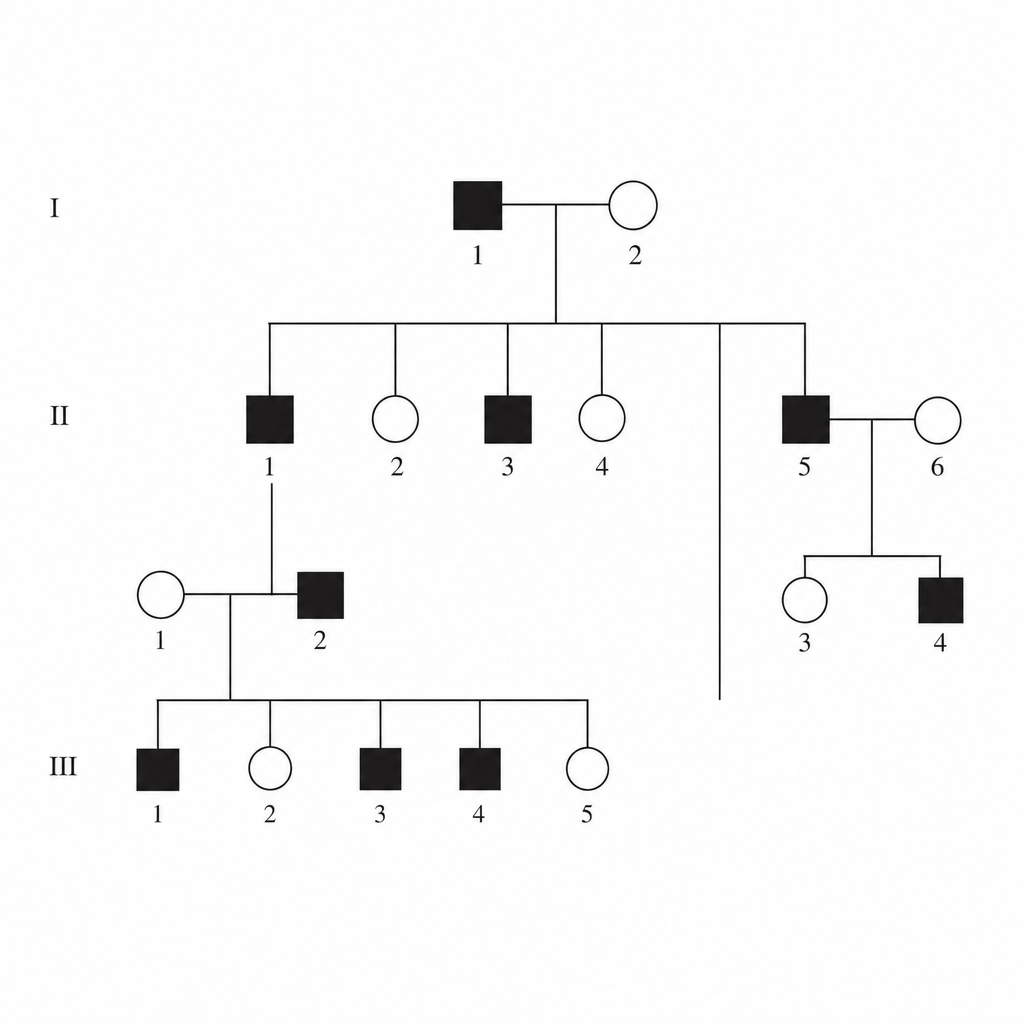
- A. Autosomal recessive
- B. X-linked recessive
- C. X-linked dominant
- D. Autosomal dominant (Correct Answer)
Explanation: ***Autosomal dominant*** - The trait is seen in **every generation** (vertical transmission), and affected parents (individuals 1 and 2) have an unaffected child (individual 7), which is a hallmark of dominant inheritance. - There is **male-to-male transmission** from the affected father (individual 4) to his son (individual 9), which rules out X-linked inheritance. *Autosomal recessive* - This is incorrect because two affected parents (1 and 2) have an unaffected offspring (7). In autosomal recessive inheritance, two affected parents (genotype **aa**) can only produce affected offspring. - The trait does not **skip generations**, which is a typical feature of recessive inheritance patterns. *X-linked recessive* - This is ruled out because an affected mother (2) has an unaffected son (7). In X-linked recessive traits, an affected mother (genotype **X<sup>a</sup>X<sup>a</sup>**) must pass the affected allele to all her sons, meaning all her sons would be affected. - Also, an unaffected couple (7 and 8) would need to have an affected child for this pattern to be considered, which is not the case here. *X-linked dominant* - The presence of **male-to-male transmission** (from father 4 to son 9) makes this mode of inheritance impossible. - In X-linked inheritance, a father passes his **Y chromosome** to his sons and his X chromosome to his daughters, so an affected father cannot have an affected son via this mechanism.
Internal Medicine
5 questionsWhat is the most common cause of Cushing's disease in a 60-year-old male?
A 50-year-old woman presented with difficulty in activities like climbing stairs, getting up from a chair, and combing hair. Violaceous erythema of the upper eyelids was noted. What is the most probable diagnosis?
Bell's palsy involves
Which of the following drugs reduces mortality in a patient with heart failure?
A 49-year-old male presents with recurrent episodes of watery diarrhoea, dehydration, hypokalemia, and achlorhydria. Which of the following neuroendocrine tumours can be responsible for these symptoms?
FMGE 2023 - Internal Medicine FMGE Practice Questions and MCQs
Question 181: What is the most common cause of Cushing's disease in a 60-year-old male?
- A. Small-cell lung cancer
- B. Adrenal tumor
- C. Pituitary microadenoma (Correct Answer)
- D. Ectopic ACTH syndrome
Explanation: ***Pituitary microadenoma*** - Cushing's **Disease** is specifically defined as hypercortisolism caused by an ACTH-secreting tumor of the pituitary gland, which is typically a **microadenoma** (<10 mm) [2]. - Pituitary adenomas are the most common cause of **endogenous** ACTH-dependent hypercortisolism (Cushing's Disease), regardless of the patient's age or sex [1]. *Small-cell lung cancer* - This is the most common cause of **ectopic ACTH syndrome**, which is a form of Cushing's **Syndrome**, not Cushing's Disease [1]. - Ectopic secretion generally leads to rapidly progressive, severe hypercortisolism and is often associated with hypokalemic metabolic alkalosis. *Adrenal tumor* - Adrenal tumors (adenomas or carcinomas) cause **ACTH-independent** Cushing's syndrome by directly overproducing cortisol [1]. - In this etiology, the pituitary gland is suppressed, resulting in very low or undetectable plasma **ACTH levels** [3]. *Ectopic ACTH syndrome* - While ectopic ACTH syndrome (often from bronchial carcinoids or small-cell lung cancer) is a significant cause of Cushing's **Syndrome** in elderly males, it is not the definition of Cushing's **Disease**. [1] - Ectopic sources produce ACTH unresponsive to **high-dose dexamethasone suppression** tests, unlike most cases of Cushing's Disease.
Question 182: A 50-year-old woman presented with difficulty in activities like climbing stairs, getting up from a chair, and combing hair. Violaceous erythema of the upper eyelids was noted. What is the most probable diagnosis?
- A. Inclusion body myositis
- B. Dermatomyositis (Correct Answer)
- C. Polymyositis
- D. Scleroderma
Explanation: ***Dermatomyositis***- The combination of **proximal muscle weakness** (difficulty climbing stairs, rising from a chair, combing hair) and the pathognomonic **Heliotrope sign** (violaceous erythema of the upper eyelids) is highly indicative of **Dermatomyositis** [1], [2].- Dermatomyositis is a type of idiopathic inflammatory **myopathy** that also features characteristic skin findings like **Gottron papules** (over MCPs, PIPs, and elbows) [1], [2].*Inclusion body myositis*- Primarily affects men older than 50 and often involves **distal muscle weakness** (e.g., finger flexors) in addition to proximal muscles, which is not described here [3].- Characterized by early loss of **deep tendon reflexes** and may show **rimmed vacuoles** on muscle biopsy, features distinct from this presentation [3].*Polymyositis*- Presents with similar **proximal muscle weakness** but **lacks the characteristic skin manifestations** like the Heliotrope sign or Gottron papules [1].- Diagnosis is supported by elevated muscle enzymes (CK) and inflammatory changes on muscle biopsy, but the absence of skin findings rules it out in favor of dermatomyositis.*Scleroderma*- Characterized by **skin thickening** and **fibrosis**, often involving the hands and face, and potentially internal organs (lung, GI tract).- Muscle weakness, if present (**Myositis overlap**), is usually less prominent than the distinctive **cutaneous and systemic features** of scleroderma.
Question 183: Bell's palsy involves
- A. Contralateral upper and lower halves of the face.
- B. Ipsilateral lower half of the face.
- C. Contralateral lower half of the face.
- D. Ipsilateral upper and lower halves of the face. (Correct Answer)
Explanation: ***Ipsilateral upper and lower halves of the face.*** - **Bell's palsy** is the most common cause of **idiopathic peripheral (Lower Motor Neuron - LMN)** facial nerve paralysis [1]. - A peripheral (LMN) lesion affects the **entire distribution** of the facial nerve on the affected side, resulting in paralysis of all muscles, including those controlling the forehead and eye closure. - Facial nerve palsies affect the **ipsilateral** side of the face relative to the site of peripheral nerve injury or brainstem nuclear lesion. *Contralateral upper and lower halves of the face.* - This presentation would imply a **bilateral upper and lower facial paralysis**, which is highly unusual for a single lesion like Bell's palsy. - Facial nerve palsies affect the **ipsilateral** side of the face, not contralateral. *Ipsilateral lower half of the face.* - Paralysis limited to the **ipsilateral lower half of the face** while sparing the upper face (forehead) is characteristic of a **Central (Upper Motor Neuron - UMN)** lesion (like a stroke) located in the contralateral cortex [1]. - This does not define Bell's palsy, which is a **peripheral (LMN)** lesion affecting the entire face. *Contralateral lower half of the face.* - This pattern, involving **paralysis of the lower face contralateral** to the lesion while sparing the forehead, is the classic presentation of a **Central (Upper Motor Neuron - UMN)** lesion [1]. - UMN lesions spare the upper face because the **facial nerve nucleus** receives bilateral cortical input for the muscles of the forehead.
Question 184: Which of the following drugs reduces mortality in a patient with heart failure?
- A. Prazosin
- B. Torsemide
- C. Furosemide
- D. Metoprolol (Correct Answer)
Explanation: ***Correct: Metoprolol*** - *Beta-blockers* like **Metoprolol succinate** (extended-release form) reduce mortality in patients with **HFrEF** (Heart Failure with reduced Ejection Fraction) by blocking the deleterious effects of chronic sympathetic nervous system activation on the myocardium [1]. - These drugs prevent ventricular remodeling, reduce **sudden cardiac death** by lowering heart rate and improving oxygen demand/supply balance, and are cornerstone therapies alongside **ACE inhibitors/ARBs/ARNI** [1]. *Incorrect: Furosemide* - Furosemide is a **loop diuretic** used primarily for **symptom relief** (reducing edema, dyspnea) by promoting diuresis and natriuresis to manage volume overload. - It does not modify the underlying disease progression or cardiac remodeling and, thus, has **no demonstrated mortality benefit** in heart failure trials. *Incorrect: Prazosin* - Prazosin is an **alpha-1 adrenergic blocker** used primarily as a vasodilator or for hypertension, but it has not shown benefit and may even increase adverse events in long-term heart failure management. - Unlike approved vasodilator therapies (like hydralazine/nitrate combination in certain populations), Prazosin is **not recommended** for chronic HF therapy due to lack of mortality data and potential for **orthostatic hypotension**. *Incorrect: Torsemide* - Torsemide is a **high-ceiling loop diuretic** similar to Furosemide, typically used to manage symptoms of congestion and fluid retention in heart failure patients. - While some studies suggest better bioavailability than Furosemide, it ultimately functions as a diuretic and **does not confer a mortality benefit** in heart failure.
Question 185: A 49-year-old male presents with recurrent episodes of watery diarrhoea, dehydration, hypokalemia, and achlorhydria. Which of the following neuroendocrine tumours can be responsible for these symptoms?
- A. Glucagonoma
- B. VIPoma (Correct Answer)
- C. Insulinoma
- D. Somatostatinoma
Explanation: A 49-year-old male presents with recurrent episodes of watery diarrhoea, dehydration, hypokalemia, and achlorhydria. Which of the following neuroendocrine tumours can be responsible for these symptoms? ***VIPoma***- The constellation of symptoms—watery diarrhoea, dehydration, hypokalemia, and achlorhydria—is known as **WDHA syndrome** (Watery Diarrhea, Hypokalemia, Achlorhydria), which is pathognomonic for a VIP-secreting tumour. [1] - **Vasoactive Intestinal Peptide (VIP)** acts as an intestinal secretagogue, leading to massive secretion of water and electrolytes, causing profound secretory diarrhea and subsequent life-threatening **hypokalemia** and dehydration. [1] *Insulinoma* - This tumour hypersecretes **insulin**, leading to severe symptoms of **hypoglycemia** (neuroglycopenic symptoms) which are typically worse in the fasting state. [2] - Insulinoma does not cause secretory diarrhea, hypokalemia, or achlorhydria. [2] *Somatostatinoma* - This tumor typically presents with the classic triad of **diabetes mellitus**, **gallstones (cholelithiasis)**, and **steatorrhea** (due to inhibition of pancreatic enzyme secretion). - While diarrhea can occur due to malabsorption, the overwhelming secretory diarrhea and achlorhydria defining this case are not characteristic. *Glucagonoma* - The primary clinical manifestations of glucagonoma include **necrolytic migratory erythema** (a distinctive skin rash), mild **diabetes mellitus**, and often **weight loss**. - It does not cause massive watery diarrhea leading to hypokalemia and achlorhydria.
Obstetrics and Gynecology
1 questionsA woman presents with complaints of greenish-frothy vaginal discharge for 1 month. On examination, vulvovaginal erythema is noticed. On saline microscopy, motile organisms are seen. What is the most likely diagnosis?
FMGE 2023 - Obstetrics and Gynecology FMGE Practice Questions and MCQs
Question 181: A woman presents with complaints of greenish-frothy vaginal discharge for 1 month. On examination, vulvovaginal erythema is noticed. On saline microscopy, motile organisms are seen. What is the most likely diagnosis?
- A. Chlamydial cervicitis
- B. Candidiasis
- C. Bacterial vaginosis
- D. Trichomoniasis (Correct Answer)
Explanation: ***Trichomoniasis***- The classic triad for this parasitic infection caused by **Trichomonas vaginalis** includes vulvovaginal erythema, dyspareunia, and a characteristic **greenish-frothy discharge**.- The diagnosis is confirmed by visualizing the **motile, flagellated protozoa** on saline wet mount microscopy, which directly matches the findings in the clinical presentation.*Bacterial vaginosis*- This condition, usually due to an overgrowth of **Gardnerella vaginalis**, typically presents with a thin, **gray discharge** and a strong **fishy odor**.- Saline microscopy characteristically reveals **clue cells** (vaginal epithelial cells covered in bacteria), not motile parasitic organisms.*Chlamydial cervicitis*- Infections with **Chlamydia trachomatis** primarily cause **cervicitis**, which is often asymptomatic or results in **mucopurulent discharge** from the cervix.- The diagnosis is typically made using highly sensitive **nucleic acid amplification tests (NAATs)**, and motile organisms are not seen on microscopy.*Candidiasis*- Vaginal candidiasis (yeast infection) typically causes intense pruritus (itching) and a **thick, white, cottage-cheese-like discharge**.- Microscopy shows **pseudohyphae** and **budding yeasts**, which are non-motile fungal elements, differentiating it from the motile organisms of Trichomoniasis.
Pediatrics
1 questionsA 5-year-old child presented with recurrent respiratory infections with thickened sputum. Chest X-ray showed bronchial wall thickening. He has been suffering from steatorrhea since birth. Which of the following is the first differential diagnosis?
FMGE 2023 - Pediatrics FMGE Practice Questions and MCQs
Question 181: A 5-year-old child presented with recurrent respiratory infections with thickened sputum. Chest X-ray showed bronchial wall thickening. He has been suffering from steatorrhea since birth. Which of the following is the first differential diagnosis?
- A. Hyaline membrane disease
- B. Alpha 1 anti-trypsin deficiency
- C. Malabsorption syndrome
- D. Cystic fibrosis (Correct Answer)
Explanation: ***Cystic fibrosis*** - This diagnosis is strongly supported by the triad of chronic **recurrent respiratory infections** (due to thick, retained sputum and subsequent bronchiectasis/bronchial wall thickening), and evidence of **pancreatic exocrine insufficiency** presenting as steatorrhea since birth. - It is an autosomal recessive disorder caused by mutations in the **CFTR gene**, leading to defective chloride transport and thick, sticky mucus formation in multiple organs. *Hyaline membrane disease* - Also known as **Respiratory Distress Syndrome (RDS)**, it is a condition primarily affecting **premature infants** due to deficiency of pulmonary surfactant. - It presents acutely within the first few hours of life and is not a cause of chronic, recurrent respiratory infections or steatorrhea in a 5-year-old child. *Alpha 1 anti-trypsin deficiency* - This hereditary condition typically presents with early-onset **panacinar emphysema** and/or liver disease (cirrhosis). - It is not associated with severe **pancreatic exocrine insufficiency** and steatorrhea in childhood, which is a hallmark feature of this patient's presentation. *Malabsorption syndrome* - While the patient exhibits findings consistent with **malabsorption** (steatorrhea), this is a general descriptive term and not a specific primary diagnosis for the entire clinical picture. - Cystic Fibrosis is the most specific primary diagnosis that explains both the **respiratory and gastrointestinal symptoms** (thick sputum, bronchial wall thickening, and steatorrhea).
Radiology
1 questionsA 30-year-old woman presented with complaints of bone pain and abdominal cramps. Her family says she has a history of abnormal behavior. The consultant doctor arrived at a provisional diagnosis based on the clinical features. Which of the following would be the best investigation to arrive at a definitive diagnosis?
FMGE 2023 - Radiology FMGE Practice Questions and MCQs
Question 181: A 30-year-old woman presented with complaints of bone pain and abdominal cramps. Her family says she has a history of abnormal behavior. The consultant doctor arrived at a provisional diagnosis based on the clinical features. Which of the following would be the best investigation to arrive at a definitive diagnosis?
- A. MRI
- B. Ultrasonogram
- C. Sestamibi scan (Correct Answer)
- D. CT scan
Explanation: ***Sestamibi scan*** - The clinical features (bone pain, abdominal cramps, abnormal behavior being "bones, groans, and psychic moans") strongly suggest **primary hyperparathyroidism** due to hypercalcemia, which requires definitive localization of the culprit adenoma. - The **Technetium-99m Sestamibi scan** is the best definitive investigation because it is a functional imaging study that specifically identifies hyperactive parathyroid tissue, showing increased, persistent uptake relative to the thyroid gland. *MRI* - MRI is primarily a **structural imaging** modality and is usually reserved for cases where initial localization studies (like Sestamibi and Ultrasound) are equivocal or to assess for **ectopic parathyroid tissue** located deep in the neck or mediastinum. - It lacks the high **functional specificity** of the Sestamibi scan required to definitively confirm that the identified mass is the hyperfunctioning parathyroid adenoma. *Ultrasonogram* - Ultrasound is often the **initial screening tool** for identifying parathyroid adenomas in the neck, being easily accessible and inexpensive, but it is **operator-dependent**. - It is not considered the single best definitive test because it often fails to localize small, posterior, or **ectopic adenomas** and provides only structural, not functional, information about the gland. *CT scan* - CT scans provide excellent **anatomical detail** and are helpful in complex cases or for locating mediastinal/ectopic glands, especially when planning highly focused surgery. - Like MRI, CT is a structural study that identifies masses but does not definitively prove the **hyperfunctionality** specific to parathyroid adenomas, making Sestamibi superior for definitive diagnosis.