A family pedigree chart is given below. Identify the mode of inheritance of this condition. 
Which of the following is not a microelement?
Which enzymes use molecular oxygen as a hydrogen acceptor to produce water?
A 34-year-old male whose staple diet primarily consisted of only maize presents with diarrhea, dementia, and photosensitive dermatitis in sun-exposed areas. Which vitamin is most likely deficient in this patient?
A patient who was in excruciating pain all over his body was taken to the hospital. In recent years, he has experienced these episodes frequently. When exercising vigorously, the pain begins. Anemia was detected on blood examination along with sickled RBCs as opposed to normal biconcave ones. It was determined that he had sickle cell anemia. What substitution takes place in sickle cell anemia?
FMGE 2023 - Biochemistry FMGE Practice Questions and MCQs
Question 11: A family pedigree chart is given below. Identify the mode of inheritance of this condition. 
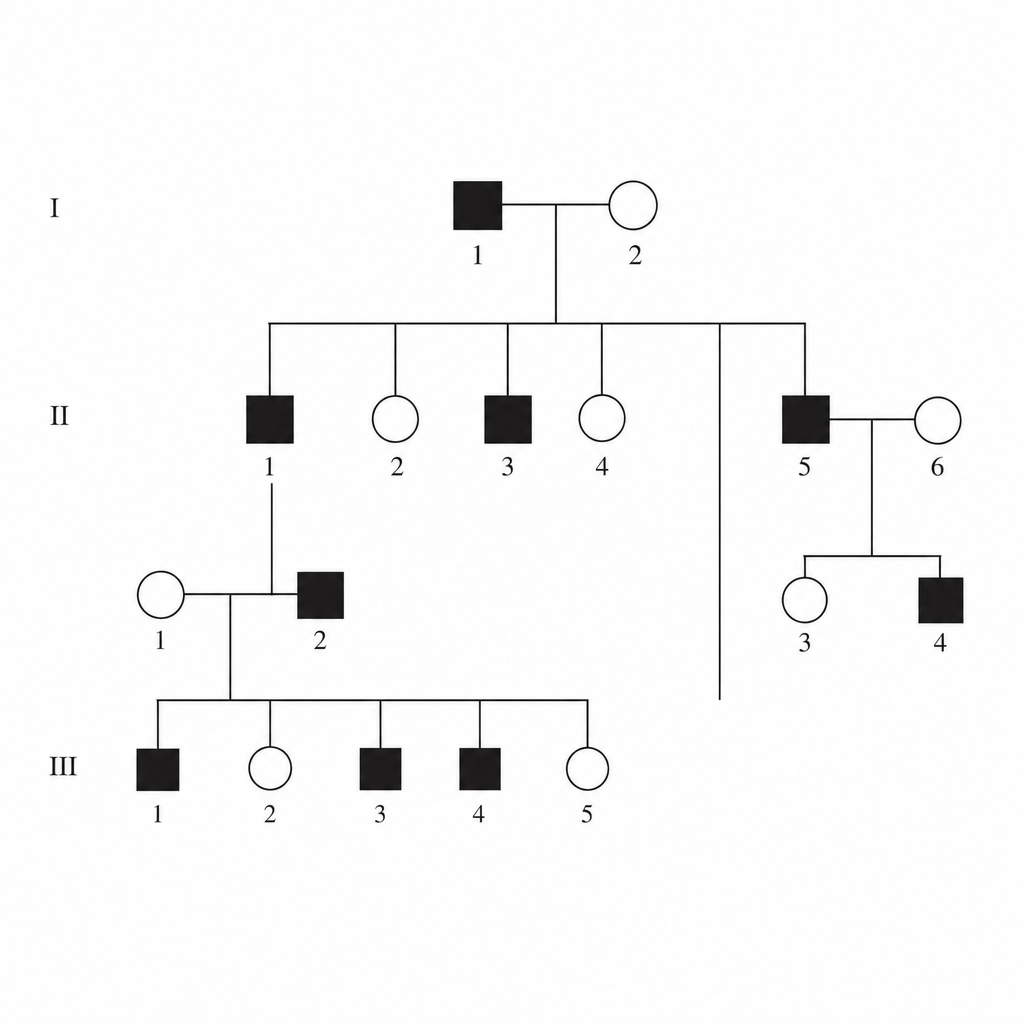
- A. Autosomal recessive
- B. X-linked recessive
- C. X-linked dominant
- D. Autosomal dominant (Correct Answer)
Explanation: ***Autosomal dominant*** - The trait is seen in **every generation** (vertical transmission), and affected parents (individuals 1 and 2) have an unaffected child (individual 7), which is a hallmark of dominant inheritance. - There is **male-to-male transmission** from the affected father (individual 4) to his son (individual 9), which rules out X-linked inheritance. *Autosomal recessive* - This is incorrect because two affected parents (1 and 2) have an unaffected offspring (7). In autosomal recessive inheritance, two affected parents (genotype **aa**) can only produce affected offspring. - The trait does not **skip generations**, which is a typical feature of recessive inheritance patterns. *X-linked recessive* - This is ruled out because an affected mother (2) has an unaffected son (7). In X-linked recessive traits, an affected mother (genotype **X<sup>a</sup>X<sup>a</sup>**) must pass the affected allele to all her sons, meaning all her sons would be affected. - Also, an unaffected couple (7 and 8) would need to have an affected child for this pattern to be considered, which is not the case here. *X-linked dominant* - The presence of **male-to-male transmission** (from father 4 to son 9) makes this mode of inheritance impossible. - In X-linked inheritance, a father passes his **Y chromosome** to his sons and his X chromosome to his daughters, so an affected father cannot have an affected son via this mechanism.
Question 12: Which of the following is not a microelement?
- A. Calcium (Correct Answer)
- B. Copper
- C. Selenium
- D. Zinc
Explanation: ***Calcium***- Calcium is classified as a **macroelement** (or major mineral) because the body requires it in large quantities, often exceeding 100 mg daily.- It is essential for **bone mineralization**, muscle contraction, and is the most abundant mineral in the human body.*Copper*- Copper is a **microelement** (or trace mineral) and is required in amounts less than 100 mg per day.- It functions as a cofactor for several antioxidant and electron transport enzymes, crucial for **iron metabolism**.*Zinc*- Zinc is a **microelement** vital for immune function, protein synthesis, and is required in trace daily amounts.- It is a necessary cofactor for the function of over 300 enzymes, playing a key role in **gene expression** and wound healing.*Selenium*- Selenium is a **microelement** known for its antioxidant properties and is required in minute quantities (micrograms) daily.- It is structurally central to **glutathione peroxidase**, an enzyme that protects cells from oxidative damage.
Question 13: Which enzymes use molecular oxygen as a hydrogen acceptor to produce water?
- A. Catalase
- B. Superoxide dismutase
- C. Cytochrome c oxidase (Correct Answer)
- D. Pyruvate dehydrogenase
Explanation: ***Cytochrome c oxidase*** - This enzyme (Complex IV of the ETC) is responsible for the final step of cellular respiration, where it accepts electrons from **Cytochrome c**. - It catalyzes the four-electron reduction of molecular oxygen (**O₂**) to two molecules of **water** (**H₂O**), utilizing O₂ as the terminal hydrogen/electron acceptor. *Catalase* - Catalase breaks down **hydrogen peroxide** (**H₂O₂**) into water and molecular oxygen, acting as a peroxidase and protecting cells from reactive oxygen species. - It facilitates the breakdown of an existing toxic product and does not use O₂ as a hydrogen acceptor in a reduction reaction. *Superoxide dismutase* - This enzyme converts the hazardous **superoxide radical** (**O₂⁻**) into molecular oxygen and hydrogen peroxide. - It is critical for antioxidant defense but is involved in dismutation reactions, not in using O₂ as the final acceptor to form water. *Pyruvate dehydrogenase* - The pyruvate dehydrogenase complex links glycolysis to the Krebs cycle by converting **pyruvate** to **acetyl-CoA** (oxidative decarboxylation). - Its electron acceptors are **NAD⁺** and **lipoic acid** (which accept hydrogens/electrons to form NADH and reduced lipoic acid), not molecular oxygen.
Question 14: A 34-year-old male whose staple diet primarily consisted of only maize presents with diarrhea, dementia, and photosensitive dermatitis in sun-exposed areas. Which vitamin is most likely deficient in this patient?
- A. Niacin (Correct Answer)
- B. Vitamin B6
- C. Ascorbic acid
- D. Biotin
Explanation: **Correct: Niacin** - The constellation of **dementia**, **diarrhea**, and **photosensitive dermatitis** (the 3 Ds) is the hallmark presentation of **Pellagra**. - A diet reliant on **maize** (corn) is a classic cause of Pellagra because maize is deficient in **tryptophan**, a vital precursor to Niacin (Vitamin B3). - Pellagra can progress to a fourth D (**Death**) if untreated. *Incorrect: Vitamin B6* - Deficiency typically manifests as **peripheral neuropathy**, **seborrheic dermatitis** (non-photosensitive), and microcytic anemia (**sideroblastic anemia**). - It is not associated with the severe chronic diarrhea or the characteristic sun-exposed rash seen in Pellagra. *Incorrect: Ascorbic acid* - Deficiency causes **Scurvy**, characterized by **bleeding gums**, **perifollicular hemorrhages** (petechiae), and **impaired wound healing**. - Neurological symptoms typical of dementia and pronounced gastrointestinal symptoms are not primary features of Scurvy. *Incorrect: Biotin* - Biotin (Vitamin B7) deficiency is rare, usually presenting with **alopecia**, non-specific dermatitis, and sometimes hypotonia or developmental delay. - It is differentiated by the absence of characteristic photosensitive rash and the severe central nervous system symptoms (dementia) that define this case.
Question 15: A patient who was in excruciating pain all over his body was taken to the hospital. In recent years, he has experienced these episodes frequently. When exercising vigorously, the pain begins. Anemia was detected on blood examination along with sickled RBCs as opposed to normal biconcave ones. It was determined that he had sickle cell anemia. What substitution takes place in sickle cell anemia?
- A. Substitution of glutamic acid by valine at the 6th position (Correct Answer)
- B. Substitution of valine by glutamic acid at the 5th position
- C. Substitution of glutamic acid by valine at the 5th position
- D. Substitution of valine by glutamic acid at the 6th position
Explanation: ***Substitution of glutamic acid by valine at the 6th position***- This is the defining molecular defect in **sickle cell anemia** (HbS), resulting from a point mutation (GAG $\rightarrow$ GTG) in the $\beta$-globin gene.- The replacement of the hydrophilic amino acid **glutamic acid** by the hydrophobic amino acid **valine** at the **6th position** facilitates the polymerization of **deoxy-HbS** under low oxygen tension, causing RBC sickling.*Substitution of valine by glutamic acid at the 6th position*- This change is the **opposite** of the mutation causing HbS; HbS involves the substitution of a hydrophilic residue (Glutamic acid) with a **hydrophobic** one (Valine).- This particular reverse substitution would not lead to the formation of the **deoxy-HbS polymers** responsible for the sickling phenomenon.*Substitution of valine by glutamic acid at the 5th position*- The amino acid at the 5th position of the $\beta$-globin chain is typically **proline**, and the crucial molecular abnormality in HbS involves the **6th position**, not the 5th.- The defining mutation involves Glutamic acid being replaced by Valine, not Valine being replaced by Glutamic acid.*Substitution of glutamic acid by valine at the 5th position*- While the amino acid change (Glutamic acid $\rightarrow$ Valine) is correct for the type of substitution, the characteristic mutation of **sickle cell anemia** occurs specifically at the **6th position**.- Substitutions at different positions (like the 5th) usually result in other, distinct hemoglobin variants.