Identify the structure marked in the image given below.
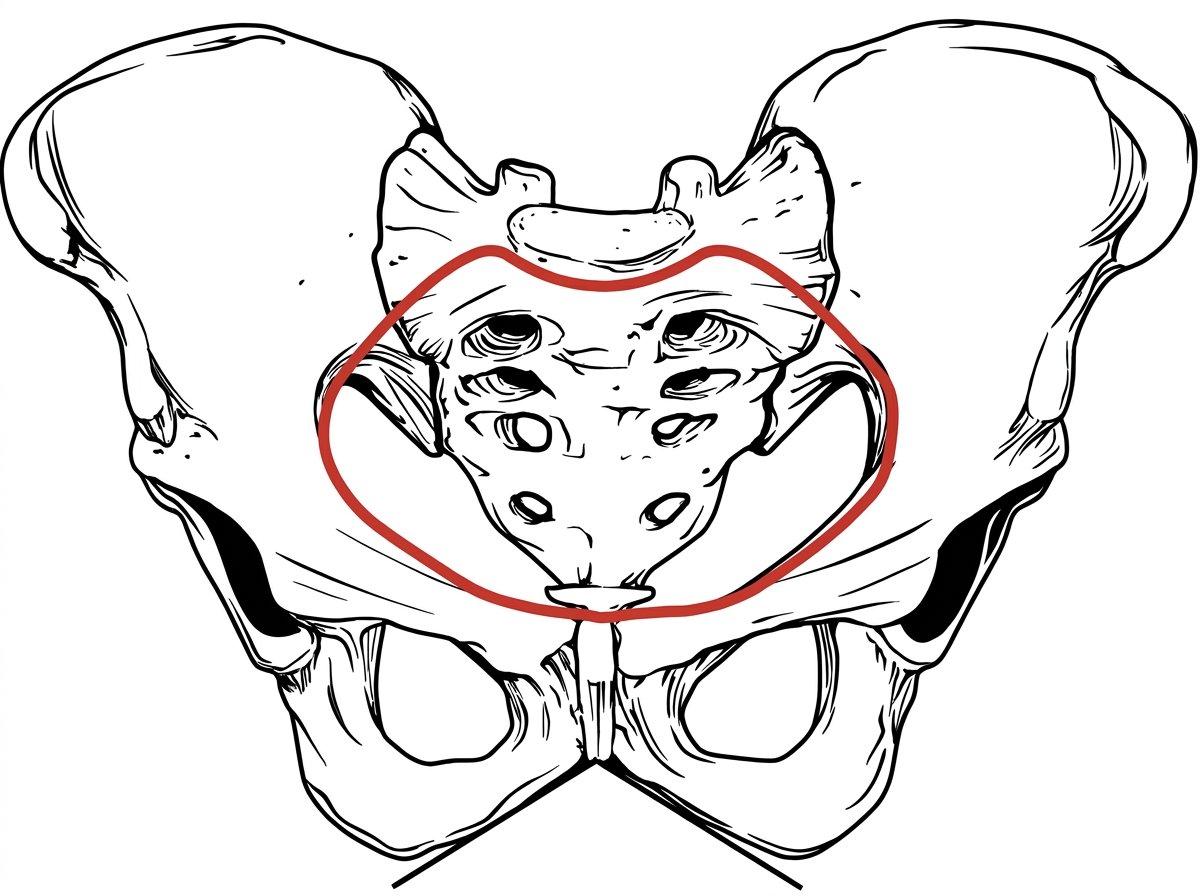
Identify the type of pelvis in the given image.
Which of the following structures passes through the foramen marked by the arrow? 
Identify the nerve indicated by the arrow in the image.
Which nerve can be injured when a fracture is sustained in the area marked with the red arrow in the image? 
The condition seen in the image results from failure of fusion of:
Identify the given histology slide:
Which of the following structures marked in the image contains the splenic artery?
While doing an endoscopy, constriction is felt at the oesophageal junction at 25 cm from the incisor. This is due to?
On palpation at the site marked by the red arrow on the image, a bony ridge is felt. What is the vertebral level of the marked arrow?
FMGE 2023 - Anatomy FMGE Practice Questions and MCQs
Question 11: Identify the structure marked in the image given below.
- A. Internal Capsule (Correct Answer)
- B. External capsule
- C. Putamen
- D. Caudate nucleus
Explanation: ***Internal Capsule***- The **internal capsule** is a V-shaped structure of densely packed white matter tracts situated deep within the cerebral hemispheres.- It contains crucial ascending and descending fibers, including the **corticospinal tract** (motor fibers) and **thalamocortical projections** (sensory fibers).*External capsule*- The **external capsule** is a thin sheet of white matter located *lateral* to the **lenticular nucleus** (putamen and globus pallidus).- It separates the **putamen** from the **claustrum**.*Caudate nucleus*- The **caudate nucleus** is a C-shaped component of the **basal ganglia**, typically situated medial to the internal capsule and forming the lateral wall of the anterior horn of the **lateral ventricle**.- Damage to this structure is often implicated in **Huntington's disease**.*Putamen*- The **putamen** is the larger, more lateral gray matter structure of the **lenticular nucleus**, located lateral to the internal and external capsules.- It is a core component of the **basal ganglia**, involved primarily in controlling learned motor movements.
Question 12: Identify the type of pelvis in the given image.
- A. Android pelvis
- B. Gynecoid pelvis (Correct Answer)
- C. Platypelloid pelvis
- D. Anthropoid pelvis
Explanation: ***Gynecoid pelvis***- The **Gynecoid pelvis** is considered the classic female pelvis, characterized by a **round** or slightly oval pelvic inlet and a well-curved sacrum.- This type is optimal for vaginal delivery, featuring straight side walls, a spacious midpelvis, and a **wide subpubic angle** (arch of 90 degrees or more).*Android pelvis*- The **Android pelvis** possesses a characteristic **heart-shaped** or triangular pelvic inlet because the sacrum is pushed forward, leading to converging side walls.- This shape is typically associated with the male structure and increases the likelihood of obstructed labor due to a **narrow subpubic arch**.*Anthropoid pelvis*- The **Anthropoid pelvis** has an oval shape where the **anteroposterior diameter** is significantly longer than the transverse diameter (long, narrow oval).- The fetal head often engages in the occipito-anterior or occipito-posterior position, which may increase the chance of difficulty with rotation to the transverse diameter.*Platypelloid pelvis*- The **Platypelloid pelvis** (or flat pelvis) is characterized by a severely flattened, transversely oval or **kidney-shaped** inlet, meaning the transverse diameter is much greater than the AP diameter.- It frequently prevents the fetal head from properly engaging or rotating, often leading to transverse arrest and necessity for **cesarean section**.
Question 13: Which of the following structures passes through the foramen marked by the arrow? 
- A. Oesophagus
- B. Sympathetic trunk
- C. Inferior vena cava
- D. Thoracic duct (Correct Answer)
Explanation: ***Thoracic duct*** - The arrow in the image points to the **aortic hiatus**, which is the most posterior of the three major openings in the diaphragm, located at the vertebral level of **T12**. - This hiatus provides passage for the **aorta**, the **thoracic duct**, and the **azygos vein** from the thorax into the abdomen. *Oesophagus* - The oesophagus passes through its own opening, the **oesophageal hiatus**, which is located more anteriorly and superiorly at the **T10** vertebral level within the muscular part of the diaphragm. - This opening is formed by the fibers of the **right crus** of the diaphragm and also transmits the **vagal trunks**. *Inferior vena cava* - The inferior vena cava traverses the diaphragm through the **caval opening**, the most anterior and superior opening, situated at the **T8** vertebral level. - This foramen is located within the **central tendon** of the diaphragm and also allows passage for branches of the **right phrenic nerve**. *Sympathetic trunk* - The sympathetic trunk does not pass through any of the major apertures but rather descends posterior to the diaphragm. - It typically passes behind the **medial arcuate ligament** or pierces the **crus of the diaphragm** to enter the abdomen.
Question 14: Identify the nerve indicated by the arrow in the image.
- A. Radial nerve
- B. Musculocutaneous nerve
- C. Median nerve
- D. Ulnar nerve (Correct Answer)
Explanation: ***Ulnar nerve*** - The arrow points to the area posterior to the **medial epicondyle** of the humerus, which is the location of the **cubital tunnel**. - The **ulnar nerve** passes superficially through this tunnel, making it susceptible to compression or injury, and is commonly known as the "funny bone". *Radial nerve* - The **radial nerve** travels down the posterior aspect of the humerus in the **radial groove** and then crosses the elbow joint anterior to the **lateral epicondyle**. - It is primarily responsible for innervating the **extensor muscles** of the forearm and hand. *Median nerve* - The **median nerve** descends through the **anterior compartment** of the arm and passes through the **cubital fossa**, which is anterior to the elbow joint. - It innervates most of the **flexor muscles** of the forearm and the **thenar muscles** of the hand. *Musculocutaneous nerve* - The **musculocutaneous nerve** is found in the **anterior compartment** of the arm, where it pierces the coracobrachialis muscle and runs between the biceps brachii and brachialis muscles. - It supplies the **flexor muscles** of the arm and provides sensory innervation to the **lateral forearm**.
Question 15: Which nerve can be injured when a fracture is sustained in the area marked with the red arrow in the image? 
- A. Ulnar nerve (Correct Answer)
- B. Radial nerve
- C. Musculocutaneous nerve
- D. Median nerve
Explanation: ***Ulnar nerve*** - The arrow points to the **medial epicondyle** of the humerus. The ulnar nerve runs in a groove on the posterior surface of the medial epicondyle, making it vulnerable to injury in this location. - A fracture of the medial epicondyle can cause direct trauma or entrapment of the ulnar nerve, leading to numbness and tingling in the fourth and fifth digits and weakness of the intrinsic hand muscles. *Radial nerve* - The radial nerve is most commonly injured in fractures of the **mid-shaft of the humerus**, where it travels in the **radial groove**. - Injury to the radial nerve typically results in **wrist drop**, characterized by the inability to extend the wrist and fingers. *Median nerve* - The median nerve is most at risk with **supracondylar fractures** of the humerus, as it passes anterior to the elbow joint. - This nerve is also famously associated with **carpal tunnel syndrome** when compressed at the wrist. *Musculocutaneous nerve* - The musculocutaneous nerve is located in the **anterior compartment** of the arm and is not in close proximity to the medial epicondyle. - Injury to this nerve, which is rare from fractures, results in weakness of elbow flexion (**biceps brachii** and **brachialis**) and sensory loss over the lateral forearm.
Question 16: The condition seen in the image results from failure of fusion of:
- A. Lateral nasal prominence and mandibular prominence
- B. Lateral nasal prominence and maxillary prominence
- C. Medial nasal prominence and maxillary prominence (Correct Answer)
- D. Medial nasal prominence and mandibular prominence
Explanation: ***Medial nasal prominence and maxillary prominence*** - The upper lip is formed embryologically by the fusion of the two **medial nasal prominences** (which form the central philtrum) and the two **maxillary prominences** (which form the lateral parts of the upper lip). - Failure of these prominences to fuse results in a **cleft lip** (cheiloschisis), as depicted in the image, which can be unilateral or bilateral. *Lateral nasal prominence and maxillary prominence* - The fusion of the **lateral nasal prominence** and the **maxillary prominence** forms the side of the face and the nasolacrimal duct. - Failure of these structures to fuse results in an **oblique facial cleft**, a rare condition extending from the upper lip to the eye. *Lateral nasal prominence and mandibular prominence* - These two prominences do not fuse during facial development. The **lateral nasal prominence** forms the alae (wings) of the nose. - The **mandibular prominence** forms the lower jaw and the lower lip, which is anatomically separate from the nasal structures. *Medial nasal prominence and mandibular prominence* - The **medial nasal prominence** contributes to the upper lip and nose, while the **mandibular prominence** forms the lower lip and jaw. - These structures are located superior and inferior to the developing mouth, respectively, and do not fuse with each other.
Question 17: Identify the given histology slide:
- A. Pancreas (Correct Answer)
- B. Lymph node
- C. Spleen
- D. Glomerulus
Explanation: ***Pancreas*** - The image displays a classic histological feature of the pancreas: a pale-staining cluster of endocrine cells, known as an **Islet of Langerhans**. - This islet is surrounded by more intensely stained, basophilic **acinar cells**, which constitute the exocrine component of the pancreas responsible for producing digestive enzymes. *Lymph node* - A lymph node has a distinct architecture with a **cortex** containing **lymphoid follicles** (often with germinal centers) and a **medulla**, which is not seen in this image. - The predominant cells would be lymphocytes, which appear as small, dark-staining cells, unlike the larger glandular cells shown here. *Glomerulus* - A glomerulus is a capillary tuft surrounded by **Bowman's capsule**, located within the renal cortex of the kidney. - The surrounding tissue would be composed of **renal tubules** (proximal and distal convoluted tubules), not the acinar cells seen in the slide. *Spleen* - The spleen is characterized by its division into **red pulp** (containing sinusoids and erythrocytes) and **white pulp** (lymphoid tissue surrounding a central artery). - The organized structure of islets and acini is distinct from the splenic architecture of lymphoid follicles and blood-filled sinuses.
Question 18: Which of the following structures marked in the image contains the splenic artery?
- A. 3
- B. 2
- C. 1
- D. 4 (Correct Answer)
Explanation: ***4*** - The pointer '4' indicates the **splenorenal ligament**, which contains the splenic artery and vein as they travel to the **splenic hilum**. - The **splenic artery** is a major branch of the celiac trunk and follows a tortuous course along the superior border of the pancreas before entering this ligament to reach the spleen. *2* - The pointer '2' indicates the **stomach**. - The splenic artery runs posterior to the stomach's lesser sac, but it is not contained within the stomach tissue itself. *1* - The pointer '1' indicates the **portal triad**, located within the **hepatoduodenal ligament**. - The portal triad consists of the **hepatic artery proper**, the **portal vein**, and the **common bile duct**, but not the splenic artery. *3* - The pointer '3' indicates the **spleen**, a lymphatic organ. - While the splenic artery's terminal branches ramify within the spleen, the main vessel is located within the splenorenal ligament (indicated by pointer 4) just before it enters the spleen.
Question 19: While doing an endoscopy, constriction is felt at the oesophageal junction at 25 cm from the incisor. This is due to?
- A. d. Diaphragmatic opening
- B. c. Right bronchus
- C. a. Inferior vena cava
- D. b. Arch of aorta (Correct Answer)
Explanation: ***b. Arch of aorta*** - The esophagus has **three normal anatomical constrictions** that are clinically important - At **25 cm from the incisors**, the esophagus is compressed by the **arch of aorta** crossing anteriorly, creating the **middle constriction** - This is the second of three constrictions and corresponds to the level of the **T4-T5 vertebrae** - These constrictions are sites where **foreign bodies may lodge** and where **strictures are more likely to develop** [1] *a. Inferior vena cava* - The IVC runs on the right side of the vertebral column and does **not cross anterior to the esophagus** - It does not cause any constriction of the esophagus *c. Right bronchus* - The **left main bronchus** (not right) crosses the esophagus anteriorly at approximately the same level as the aortic arch - The right bronchus does not come into contact with the esophagus *d. Diaphragmatic opening* - This causes the **third (lower) constriction** at approximately **40 cm from the incisors** - This is at the level of the **esophageal hiatus** in the diaphragm (T10 level) - Not at 25 cm as mentioned in the question
Question 20: On palpation at the site marked by the red arrow on the image, a bony ridge is felt. What is the vertebral level of the marked arrow?
- A. T4-T5 intervertebral disc (Correct Answer)
- B. T5-T6 intervertebral disc
- C. T3-T4 intervertebral disc
- D. T2-T3 intervertebral disc
Explanation: ***T4-T5 intervertebral disc*** - The arrow points to the **sternal angle** (Angle of Louis), which is the palpable transverse ridge at the junction of the **manubrium** and the **body of the sternum**. - This important anatomical landmark is located at the level of the **intervertebral disc** between the **T4 and T5** thoracic vertebrae and marks the site of articulation of the **second costal cartilage**. *T3-T4 intervertebral disc* - This vertebral level is superior to the sternal angle. - The **spine of the scapula** is a surface landmark that corresponds approximately to the level of the **T3** vertebra. *T2-T3 intervertebral disc* - This vertebral level is significantly superior to the location marked. - The **suprasternal notch** (jugular notch) of the manubrium corresponds to the level of the intervertebral disc between **T2 and T3**. *T5-T6 intervertebral disc* - This level is inferior to the sternal angle. - It would correspond to a point lower on the body of the sternum, rather than the manubriosternal junction.