Respiratory System Indian Medical PG Flashcards - Medical Study Cards
Master Respiratory System with OnCourse flashcards. These spaced repetition flashcards are designed for medical students preparing for NEET PG, USMLE Step 1, USMLE Step 2, MBBS exams, and other medical licensing examinations.
Respiratory System Flashcard Deck - 158 Cards
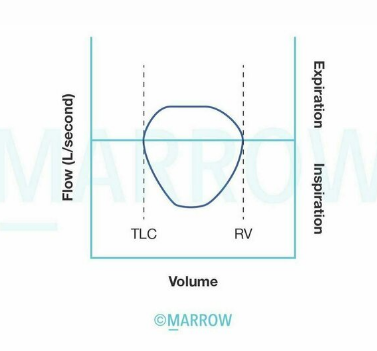
Flashcard 1: The graph given below shows _____ _____thoracic obstruction
Answer: variable
Flashcard 2: The graph given depicts the _____ effect
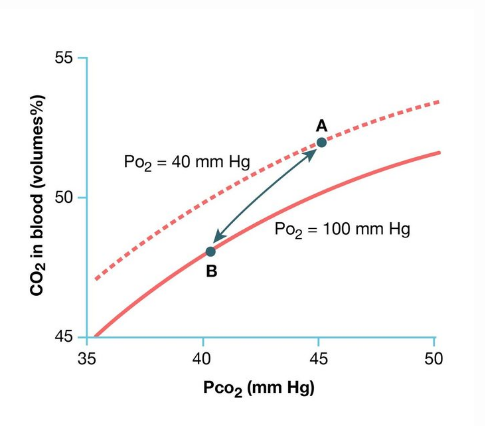
Answer: Haldane
Flashcard 3: The alveolar gas equation states that the alveolar Po2 (PAo2) equals:
_____
Answer:
Flashcard 4: According to Fick's law, the rate of diffusion of a gas (Vgas) is equal to:
_____
Answer:
Flashcard 5: What equation may be used to determine the physiologic dead space (VD)?
_____
Answer:
Flashcard 6: What type of upper airway obstruction is depicted by the following flow-volume loop?
_____
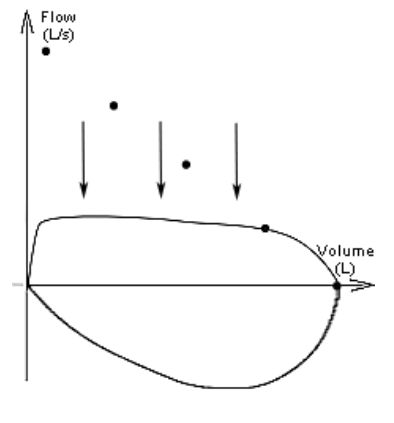
Answer: Variable intrathoracic obstruction
Flashcard 7: The _____ center is located in the upper pons and inhibits inspiration
Answer: pneumotaxic
Flashcard 8: _____ in Pco2 cause the O2-hemoglobin dissociation curve to shift to the right
Answer: Increases
Flashcard 9: In the _____, HCO3- enters the red blood cells in exchange for Cl-
Answer: lungs
Flashcard 10: _____ O2 binding to hemoglobin causes decreased affinity for CO2 (Haldane effect)
Answer: Increased
Flashcard 11: The two sources of the physiologic shunt are _____ blood flow and a small portion of coronary venous blood (drains into the left ventricle via the thebesian vein)
Answer: bronchial
Flashcard 12: In zone _____ of the lung, alveolar ventilation (V) is lowest
Answer: 1 (apex)
Flashcard 13: Breathing as an involuntary process is controlled by the _____ and pons of the brain stem
Answer: medulla
Flashcard 14: The respiratory quotient, if someone is on an exclusive _____ diet, is 0.81.
Answer: protein
Flashcard 15: The _____ lining the epithelium of the respiratory tract help clear mucus and debris from the lungs via the mucociliary escalator
Answer: cilia
Flashcard 16: The V/Q ratio at the apex of the lung is normally _____, indicating wasted ventilation
Answer: 3
Flashcard 17: When lung volume is _____ than FRC, there is a net collapsing force on the lung-chest wall system
Answer: greater
Flashcard 18: The immediate reflex response of J receptor stimulation is _____ followed by tachypnea, bradycardia, and hypotension (pulmonary chemoreflex)
Answer: apnea
Flashcard 19: In zone 3 of the lung, blood flow is driven by the difference between _____ and venous pressure
Answer: arteriolar
Flashcard 20: The lung diffusing capacity, DL, _____ in pulmonary fibrosis due to increased wall thickness (x)
Answer: decreases
Flashcard 21: Type _____ pneumocytes are responsible for synthesis of pulmonary surfactant
Answer: II
Flashcard 22: At _____, the inward pull of the lung is balanced by the outward pull of the chest
Answer: functional residual capacity
Flashcard 23: _____ may be caused by hypoxemia (hypoxia or hypoxemia)
Answer: Hypoxia
Flashcard 24: Central sleep apnea may be also caused by delayed detection / response to changes in _____ resulting in cyclic (cheyne-stokes) breathing
Answer: PaCO2
Flashcard 25: _____ in temperature cause the O2-hemoglobin dissociation curve to shift to the right
Answer: Increases
Flashcard 26: Elastic recoil is _____ proportional to compliance and directly proportional to elastance
Answer: inversely
Flashcard 27: In zone _____ of the lung, blood flow (Q) is highest
Answer: 3 (base)
Flashcard 28: The _____ center is located in the lower pons and stimulates inspiration
Answer: apneustic
Flashcard 29: The V/Q ratio is _____ in zone 3 (base) of the lung
Answer: lowest
Flashcard 30: Effects of Various Lesions and Brainstem Transections:Complete transection above pons with vagi _____ will lead to: Regular continued breating
Answer: intact
Flashcard 31: Surfactant decreases _____ in the lung, preventing collapse of alveolar air sacs after expiration
Answer: surface tension
Flashcard 32: Pathologic dead space is when part of the respiratory zone is _____, but not perfused (perfused, ventilated)
Answer: ventilated
Flashcard 33: In _____ lung disease, the flow volume loops shifts to the *left
Answer: obstructive
Flashcard 34: When lung volume is _____ than FRC, there is a net expanding force on the lung-chest wall system
Answer: less
Flashcard 35: During inspiration, main current of airflow in nasal cavity is through _____ part of nasal cavity in a parabolic curve
Answer: middle
Flashcard 36: To compensate for reduced lung compliance, obese patients have _____-shallow breathing
Answer: rapid
Flashcard 37: Type I glomus cells (carotid and aortic body) have O2-sensitive _____ channels, whose conductance is reduced in proportion to the degree of hypoxia.
Answer: K+
Flashcard 38: Peripheral chemoreceptors are stimulated by decreased _____ and pH
Answer: Po2
Flashcard 39: The _____ of a respiratory system pressure-volume curve represents lung compliance
Answer: slope
Flashcard 40: What are the causes of death in dry drowning?_____ and Laryngeal spasm
Answer: Vagal inhibiton
Flashcard 41: If there is a(n) _____ obstruction, the V/Q ratio = (dead space)*
Answer: blood flow
Flashcard 42: _____ intercostals help in inspiration whereas internal intercostals help in expiration.
Answer: External
Flashcard 43: Peripheral chemoreceptors respond PRIMARILY to decreases in _____ and pH
Answer: Pao2
Flashcard 44: During expiration, the slope of the pressure-volume loop _____ as the density of surfactant molecules rapidly increases
Answer: increases
Flashcard 45: Is respiration possible during the pseudoglandular period of lung development? _____
Answer: No
Flashcard 46: _____ is defined as a decrease of O2 delivery to tissues
Answer: Hypoxia
Flashcard 47: CO2 binding to hemoglobin favors the _____ form, thus reducing Hb affinity for O2
Answer: taut
Flashcard 48: Airway resistance is _____ proportional to the fourth power of the radius of the airway
Answer: inversely
Flashcard 49: During exercise or in diseases with increased airway resistance (e.g. asthma), _____ muscles and internal intercostal muscles may be used to aid expiration
Answer: abdominal
Flashcard 50: If a sharp object punctures the intrapleural space (_____), the intrapleural pressure becomes equal to atmospheric pressure
Answer: pneumothorax
Flashcard 51: Central chemoreceptors are stimulated by changes in _____ and Pco2 of the brain
Answer: pH
Flashcard 52: The V/Q mismatch seen in pulmonary embolism can result in _____, which causes hyper-ventilation with consequent respiratory alkalosis
Answer: hypoxemia
Flashcard 53: In the _____, H2CO3 in the red blood cell is reconverted to CO2 and H2O and expired
Answer: lungs
Flashcard 54: In _____-limited gas exchange, diffusion can be increased only if blood flow increases
Answer: perfusion
Flashcard 55: The volume of the _____ dead space plus the alveolar dead space comprises the 'physiologic dead space'
Answer: anatomic
Flashcard 56: In zone _____ of the lung, blood flow (Q) is lowest
Answer: 1 (apex)
Flashcard 57: Central chemoreceptors are especially sensitive to the _____ of the cerebrospinal fluid
Answer: pH
Flashcard 58: In the _____, hypoxia causes vaso-constriction
Answer: lungs
Flashcard 59: When using the alveolar gas equation, the respiratory quotient (R) is equal to the ratio of _____ / O2 consumed
Answer: CO2 produced
Flashcard 60: _____ in Pco2 cause the O2-hemoglobin dissociation curve to shift to the left
Answer: Decreases
Flashcard 61: TIMM increases in pregnancy:1. _____2. Inspiratory Capacity3. Minute ventilation4. Minute O2 uptake
Answer: Tidal Volume
Flashcard 62: Shifts of the O2-Hb dissociation curve to the _____ occurs when there is increased affinity of hemoglobin for O2
Answer: left
Flashcard 63: _____ lung diseases are characterized by a decreased FEV1/FVC ratio
Answer: Obstructive
Flashcard 64: During initial inspiration, liquid molecules are _____ together and intermolecular forces are high
Answer: close
Flashcard 65: _____ in pH cause the O2-hemoglobin dissociation curve to shift to the right
Answer: Decreases
Flashcard 66: Carboxyhemoglobinemia is associated with _____ SaO2, decreased O2 content, and normal PaO2
Answer: decreased*
Flashcard 67: In the _____, oxygenation of hemoglobin promotes H+ release from its buffering sites
Answer: lungs
Flashcard 68: Obesity hypoventilation syndrome is characterized by _____ Pao2 and increased Paco2 during sleep
Answer: decreased
Flashcard 69: _____ phenomenon explains formation of nasal polyp.
Answer: Bernoulli s
Flashcard 70: Asthmatic bronchoconstriction is mediated by _____ processes and parasympathetic (SNS or PNS?) tone
Answer: inflammatory
Flashcard 71: Cheyne-Stokes breathing is defined by respirations that oscillate between _____ and hyperpnea in response
Answer: apnea
Flashcard 72: The lung diffusing capacity, DL, _____ in emphysema due to decreased surface area (A)
Answer: decreases
Flashcard 73: The respiratory quotient, if someone is on an exclusive _____ diet, is 0.71.
Answer: fat
Flashcard 74: The dorsal respiratory group receives sensory input from peripheral chemoreceptors via the _____ and vagus (CN X) nerves
Answer: glossopharyngeal (CN IX)
Flashcard 75: Shifts of the O2-Hb dissociation curve to the _____ cause increased unloading of O2 at tissues
Answer: right
Flashcard 76: The partial pressure of O2 in arteriolar blood is slightly _____ than alveolar air due to the 'physiologic shunt''
Answer: lower
Flashcard 77: Functional residual capacity may be measured using _____ or body plethysmograph
Answer: helium dilution
Flashcard 78: Effects of Various Lesions and Brainstem Transections:Complete transection above pons with vagi _____ will lead to: Regular continued breating, but depth of respiration increases
Answer: cut
Flashcard 79: The smooth muscle of the conducting airways of the lung _____ in response to sympathetic activation of the 2 adrenergic receptors
Answer: relaxes
Flashcard 80: The V/Q ratio is _____ in zone 1 (apex) of the lung
Answer: highest
Flashcard 81: The _____ in red blood cells (from H2CO3) is transported into the plasma in exchange for Cl-
Answer: HCO3-
Flashcard 82: In zone 2 of the lung, blood flow is driven by the difference between _____ and alveolar pressure
Answer: arteriolar
Flashcard 83: The V/Q ratio at the base of the lung is normally _____, indicating wasted perfusion
Answer: 0.6
Flashcard 84: The gradient between PAo2 - PaO2 is known as the _____ and is normally 10 - 15 mmHg
Answer: A-a gradient
Flashcard 85: The total gas concentration in solution is the sum of the _____ gas plus bound gas plus chemically modified gas
Answer: dissolved
Flashcard 86: If CO2 production is constant, then the arterial and alveolar _____ is determined by alveolar ventilation
Answer: Pco2
Flashcard 87: Effects of Various Lesions and Brainstem Transections:Complete transection midway between pons and medulla with vagi _____ will lead to: irregular but rhythmic respiration
Answer: intact or cut
Flashcard 88: If there is a(n) _____ obstruction, the V/Q ratio = 0 (shunt)
Answer: airway
Flashcard 89: In zone _____ of the lung, alveolar ventilation (V) is highest
Answer: 3 (base)
Flashcard 90: SP-_____ & SP-C - are the key protein members of the monomolecular film of surfactant.
Answer: B
Flashcard 91: The _____ pressure across the lungs is calculated as alveolar pressure minus intrapleural pressure
Answer: transmural
Flashcard 92: Central chemoreceptors respond indirectly to increased _____ and directly to decreased pH
Answer: Pco2
Flashcard 93: The _____ respiratory group is primarily responsible for expiration and is not active during normal, quiet breathing
Answer: ventral
Flashcard 94: _____ dead space can be measured by the single-breath N2 curve (Fowler's method).
Answer: Anatomical
Flashcard 95: The oxygen-Hb dissociation curve is roughly flat when the Po2 is between _____ and 100 mmHg
Answer: 60
Flashcard 96: The _____ respiratory group is primarily responsible for inspiration and generates the basic rhythm for breathing
Answer: dorsal
Flashcard 97: Shifts of the O2-Hb dissociation curve to the _____ cause decreased unloading of O2 at tissues
Answer: left
Flashcard 98: _____ chemoreceptors are located in the carotid bodies and aortic bodies
Answer: Peripheral
Flashcard 99: The volume of the _____ zone of the lung comprises the "anatomic dead space"
Answer: conducting
Flashcard 100: _____ in temperature cause the O2-hemoglobin dissociation curve to shift to the left
Answer: Decreases
Flashcard 101: Hysteresis occurs due to the need to overcome _____ forces during lung inflation (inspiration)
Answer: surface tension
Flashcard 102: In _____ lung disease, the flow volume loops shifts to the right*
Answer: restrictive
Flashcard 103: O2 is carried in blood in two forms: _____ (2%) or bound to hemoglobin (98%)
Answer: dissolved
Flashcard 104: In a calorie depleted patient, excess calorie infusion may result in _____ retention and respiratory insufficiency
Answer: carbon dioxide
Flashcard 105: Water fall effect has been used to describe the blood flow in the _____ portion of lung.
Answer: middle
Flashcard 106: In abdominal compartment syndrome, peak inspiratory pressure _____, leading to hypoxia
Answer: increases
Flashcard 107: The most important stimulus controlling the level of resting ventilation is _____ of CSF
Answer: pH
Flashcard 108: In normal respiration, the vocal cords are in _____ position
Answer: slight abduction
Flashcard 109: _____ is the lung volume above Residual Volume at which airways in the lower, dependent parts of the lungs begin to close off because of the lesser transmural pressure in these areas.
Answer: Closing Volume
Flashcard 110: Total lung capacity depends on the _____ of the lung
Answer: compliance
Flashcard 111: Movement of mucus blanket of the nose is by _____.
Answer: ciliary action
Flashcard 112: Ventilation of sinuses takes place during _____
Answer: expiration
Flashcard 113: Absence of ventilatory effort, with the arterial CO2 tension at least 60 mm Hg or 20 mm Hg above the pretest level is a positive _____ test
Answer: apnea
Flashcard 114: In young adults, the closing volume is about _____% of the vital capacity (VC).
Answer: 10
Flashcard 115: _____ law states that, at a given temperature, the product of pressure times volume for a gas is constant.
Answer: Boyle s
Flashcard 116: The partial pressure of water vapor at a normal body temperature of 37C is _____ mm Hg.
Answer: 47
Flashcard 117: Closing volume _____creases steadily with age
Answer: in
Flashcard 118: Nicotine causes _____ of the terminal bronchioles of the lungs
Answer: constriction (dilation/constriction)
Flashcard 119: Latissimus dorsi is an accessory muscle of _____iration
Answer: exp
Flashcard 120: Can a standard pulse oximeter differentiate between oxyhemoglobin and carboxyhemoglobin?_____
Answer: No
Flashcard 121: Most potent stimulus for central chemoreceptor in CSF is _____ levels
Answer: H+
Flashcard 122: Smoking causes _____ to the sensitivity of the chemoreceptors.
Answer: no change (change/no change)
Flashcard 123: Type _____, also called as periop. respiratory failure, is because of lung atelectasis
Answer: III
Flashcard 124: Work done in quiet breathing is _____ kg-m/min
Answer: 0.5
Flashcard 125: Hering-Breuer reflexes are mediated by _____ adapting pulmonary stretch receptors and the impulses travel in the vagus nerve via large myelinated fibers.
Answer: slowly (rapidly/slowly)
Flashcard 126: HFNC _____ the nasopharyngeal dead space
Answer: decreases
Flashcard 127: Most potent stimulus for central chemoreceptor in blood is _____ levels
Answer: CO2
Flashcard 128: Both peripheral and central chemoreceptors contribute to increased ventilation that occurs as a result of decreased _____.
Answer: arterial blood pressure
Flashcard 129: The primary function of the larynx is _____
Answer: to protect the airway
Flashcard 130: The ventral respiratory group contributes to the extra respiratory drive (_____ mechanism)
Answer: overdrive
Flashcard 131: The rate of inspiration is controlled by the _____ center.
Answer: pneumotaxic
Flashcard 132: A deep breath _____ the secretion of surfactant by stretching the type II cells.
Answer: increases
Flashcard 133: Time taken by a red cell is about _____ seconds to traverse the pulmonary capillaries at rest
Answer: 0.75
Flashcard 134: Preoxygenation is the process of replacing _____ in the lungs with oxygen.
Answer: nitrogen
Flashcard 135: The normal value of physiological shunt is _____%
Answer: 2
Flashcard 136: The upper limit for the linear relationship between increase in % of CO2 in inspired air and respiratory minute volume is _____% of alveolar PCO2.
Answer: 6
Flashcard 137: Peripheral chemoreceptors are stimulated maximally by _____ levels
Answer: cyanide
Flashcard 138: Approximately _____ mL of water is lost in expired air every 24 hours
Answer: 400
Flashcard 139: If lung is allowed to undergo elastic recoil without the chest wall, the resultant volume of the lung would be _____.
Answer: minimum volume
Flashcard 140: The response of peripheral chemoreceptors to changes in Pco2 is _____ than that of central chemoreceptors
Answer: faster (slower/faster)
Flashcard 141: Complete sheet of mucus is cleared into the pharynx every _____ min.
Answer: 10 20
Flashcard 142: SP-_____ - carries out the regulation of the feedback uptake of surfactant by the type II alveolar epithelial cells that secrete it.
Answer: A
Flashcard 143: Most potent stimulus for respiration is _____
Answer: CO2
Flashcard 144: Nicotine paralyzes the _____ on the surfaces of the respiratory epithelial cells
Answer: cilia
Flashcard 145: Breathing in a bag technique relieves _____ in hyperventilation syndrome
Answer: hypocapnia
Flashcard 146: SP-_____ - carries out the organization of SP-B and SP-C into the surfactant layer.
Answer: D
Flashcard 147: _____ generates the rhythm for automated breathing.
Answer: Pre-Botzinger complex
Flashcard 148: Type _____ failure, also called as hypoxia with hypercapnea, is because of the inability to eliminate carbon dioxide effectively.
Answer: II
Flashcard 149: What is the cause of death in wet drowning?_____
Answer: Disruption of pulmonary surfactant
Flashcard 150: The normal value of DLco at rest is about _____ mL/min/mm Hg.
Answer: 25
Flashcard 151: Mucus blanket moves at a speed of _____ mm/min
Answer: 5 10
Flashcard 152: In case of hyaline membrane disease, FRC is _____ than Closing Volume.
Answer: smaller
Flashcard 153: Hyperinflation of the lungs causing strong and long-lasting inspiratory effort, is known as _____ reflex
Answer: Head's paradoxical
Flashcard 154: Complete transection below _____ causes cessation of spontaneous respiration irrespective of vagi status
Answer: medulla
Flashcard 155: Hering-Breuer reflex is not activated until the tidal volume increases to more than _____ times normal.
Answer: 3
Flashcard 156: Due to the presence of dead space in pulmonary embolism (V/Q = _____), the PO2 of the alveolus will be _____ that in the inspired air.
Answer: ; equal to
Flashcard 157: Due to the presence of dead space in pulmonary embolism (V/Q = _____), the PO2 of the alveolus will be _____ that in the inspired air.
Answer: ; equal to
Flashcard 158: Type _____ respiratory failure is caused by V/Q mismatch
Answer: I
Keywords: Respiratory System flashcards, medical flashcards, NEET PG preparation, USMLE Step 1 flashcards, Anki alternative, spaced repetition medical, OnCourse flashcards