Neurology Indian Medical PG Flashcards - Medical Study Cards
Master Neurology with OnCourse flashcards. These spaced repetition flashcards are designed for medical students preparing for NEET PG, USMLE Step 1, USMLE Step 2, MBBS exams, and other medical licensing examinations.
Neurology Flashcard Deck - 54 Cards
Flashcard 1: _____ is the typical interictal EEG finding seen in infantile epileptic spasm
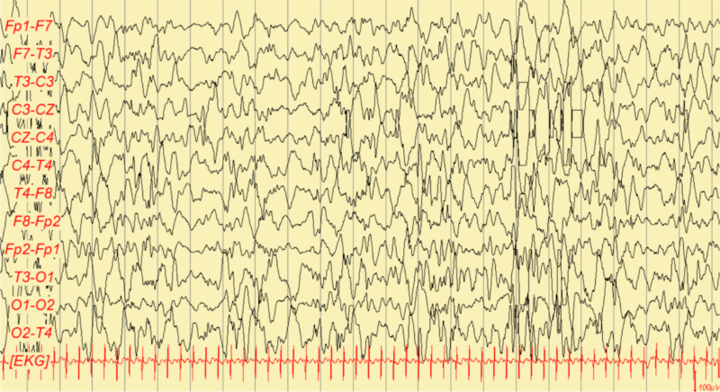
Answer: Hypsarrhythmia
Flashcard 2: Indications for lumbar puncture in a child presenting with a febrile seizure are as follows: No answer _____
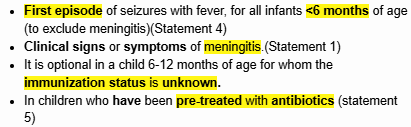
Answer: :)
Flashcard 3: _____ Malformation is associated with bulging fontanelles and macrocephaly.
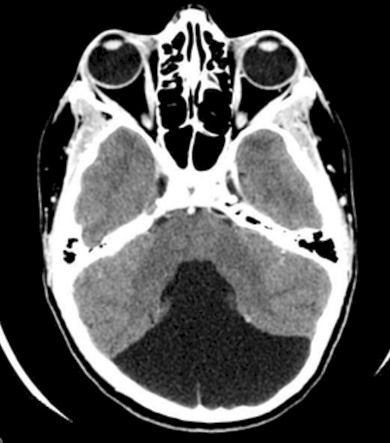
Answer: Dandy Walker
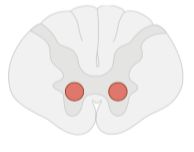
Flashcard 4: What congenital disorder can cause this spinal cord lesion?
_____
Answer: Werdnig-Hoffmann (Spinal Muscular Atrophy type 1) disease
Flashcard 5: Dandy-Walker malformation is associated with _____ and spina bifida
Answer: non-communicating hydrocephalus
Flashcard 6: SCIWORA is very common in _____ and injuries are most often in the cervical spine
Answer: children
Flashcard 7: _____ classically presents with pseudohypertrophy of calf muscles
Answer: Duchenne muscular dystrophy
Flashcard 8: The characteristics of _____ syndrome may be remembered with the mnemonic 'STURGE': S: Sporadic, port-wine StainT: Tram track calcifications (opposing gyri)U: UnilateralR: Retardation (intellectual disability)G: Glaucoma, GNAQ gene E: Epilepsy
Answer: Sturge-Weber
Flashcard 9: Congenital hydrocephalus often presents initially with macrocephaly, muscle _____tonicity and hyperreflexia, and a bulging fontanelle
Answer: hyper
Flashcard 10: Werdnig-Hoffmann disease presents as a "_____" with marked hypotonia and tongue fasciculations
Answer: floppy baby
Flashcard 11: Hallervorden-Spatz Disease is characterised by childhood onset _____ and gait disorder
Answer: dystonia
Flashcard 12: Erb palsy is commonly caused by:- _____ on neck during delivery (in infants) - trauma (in adults).
Answer: lateral traction
Flashcard 13: The late phase of kernicterus includes movement disorders (choreoathetosis, ballismus, tremor), defective _____ gaze, and sensorineural hearing loss.
Answer: upward
Flashcard 14: Klumpke palsy is commonly caused by _____ on the arm during breech delivery (in infants) or trauma, such as grabbing a tree branch while falling (in adults).
Answer: upward force
Flashcard 15: Hypomelanosis of Ito is associated with _____ and mental retardation.
Answer: epilepsy
Flashcard 16: Friedreich ataxia presents in _____ (age group) with kyphoscoliosis
Answer: childhood
Flashcard 17: The triad of _____, arrest of psychomotor development, and hypsarrhythmia is known as West syndrome
Answer: spasms
Flashcard 18: _____ syndrome often presents with verbal regression, intellectual disability, ataxia, and stereotyped hand-wringing
Answer: Rett
Flashcard 19: _____ due to fever in tonsillitis, is an indication for tonsillectomy.
Answer: Febrile seizures
Flashcard 20: _____cephaly is a feature of cerebral palsy because of insult to the developing brain.
Answer: Micro
Flashcard 21: PANDAS stands for? _____
Answer: Pediatric Autoimmune Neuropsychiatric Disorders Associated with Streptococcal infections.
Flashcard 22: _____ should be performed in the first episode of seizures with fever, for all infants age
Answer: Lumbar puncture
Flashcard 23: Do antipyretics reduce the risk of recurrent febrile seizures in a child?_____
Answer: No
Flashcard 24: _____ syndrome is characterised by salaam spells (sudden dropping of the head and flexion of arms)
Answer: West
Flashcard 25: What type of endemic cretinism is associated with squint and spastic diplegias?_____
Answer: Neurological
Flashcard 26: Abnormal respiration with periods of hyperventilation is a characteristic feature of _____ syndrome
Answer: Rett
Flashcard 27: _____ is a group of disorders, affecting movement or posture, due to non-progressive disturbances occurring in the developing fetal or infant brain
Answer: Cerebral palsy
Flashcard 28: Infantile epileptic spasm occurs as an age-specific seizure disorder, before the age of _____
Answer: one
Flashcard 29: Tuft of hair over the lumbosacral region in a newborn can be a presentation of occult spinal _____
Answer: dysraphism
Flashcard 30: Is early or late age of onset a risk factor for recurrent febrile seizures?_____
Answer: Early
Flashcard 31: Breath-holding spells are associated with _____tonia
Answer: hypo
Flashcard 32: _____ is the typical interictal EEG finding seen in infantile epileptic spasm
Answer: Hypsarrhythmia
Flashcard 33: What is the sex of an anencephalic baby seen commonly?_____
Answer: Female
Flashcard 34: What is the characteristic manifestation in childhood Moyamoya disease?_____
Answer: Ischemic findings
Flashcard 35: SCIWORA is seen in which age group?_____
Answer: children
Flashcard 36: If the febrile seizures are 3 or more in 6 months, or 4 or more seizures in 1 year, intermittent prophylaxis with oral _____ for 3 days during the fever episode is given
Answer: clobazam
Flashcard 37: Duration of fever _____ than 24 hr is a risk factor for recurrent febrile seizures
Answer: less
Flashcard 38: What is the most common cause of ventriculomegaly in newborns?_____
Answer: Aqueductal stenosis
Flashcard 39: The most common subtype of cerebral palsy is _____
Answer: spastic diplegia
Flashcard 40: _____ cerebral palsy is associated with hypotonia
Answer: Dystonic
Flashcard 41: Spheno-orbital encephalocoele, due to dysplasia of the greater wing of the sphenoid is commonly seen in _____
Answer: neurofibromatosis type 1 (inherited condition)
Flashcard 42: Landau Kleffner syndrome is a rare condition characterized by loss of _____ skills in a previously normal child
Answer: language
Flashcard 43: What is the typical age of presentation of Lennox-Gastaut syndrome?_____
Answer: 2 to 10 years
Flashcard 44: What is the age of presentation of West syndrome?_____
Answer: 2 to 12 months
Flashcard 45: What is the triad of Lennox-Gastaut syndrome?_____
Answer: Developmental delay, seizures and characteristic EEG findings
Flashcard 46: _____ (mirror movements) is involuntary paired movements of hands and arm seen in around 20% of children with Klippel-Feil syndrome
Answer: Synkinesis
Flashcard 47: Cerebral palsy is an _____ motor neuron disorder associated with rigidity/spasticity and scissoring gait
Answer: upper
Flashcard 48: _____ is the investigation of choice for diagnosis and quantification of seizures in neonates
Answer: Video-EEG
Flashcard 49: _____ Malformation is associated with bulging fontanelles and macrocephaly.
Answer: Dandy Walker
Flashcard 50: _____ myositis is the most common inflammatory myopathy in children.
Answer: Dermato
Flashcard 51: Wasting of the muscles of the posterior axillary fold in DMD is known as _____ sign
Answer: Valley
Flashcard 52: _____ is the drug of choice for a child with simple febrile seizures
Answer: Acetaminophen
Flashcard 53: _______ is the drug of choice for a child with simple febrile seizures
Answer: Acetaminophen
Flashcard 54: The drug of choice in the treatment of infantile spasms or West syndrome is _______
Answer: Adrenocorticotropic hormone (ACTH)
Keywords: Neurology flashcards, medical flashcards, NEET PG preparation, USMLE Step 1 flashcards, Anki alternative, spaced repetition medical, OnCourse flashcards