Orbital Diseases Indian Medical PG Flashcards - Medical Study Cards
Master Orbital Diseases with OnCourse flashcards. These spaced repetition flashcards are designed for medical students preparing for NEET PG, USMLE Step 1, USMLE Step 2, MBBS exams, and other medical licensing examinations.
Orbital Diseases Flashcard Deck - 47 Cards
Flashcard 1: The following image demonstrates _____
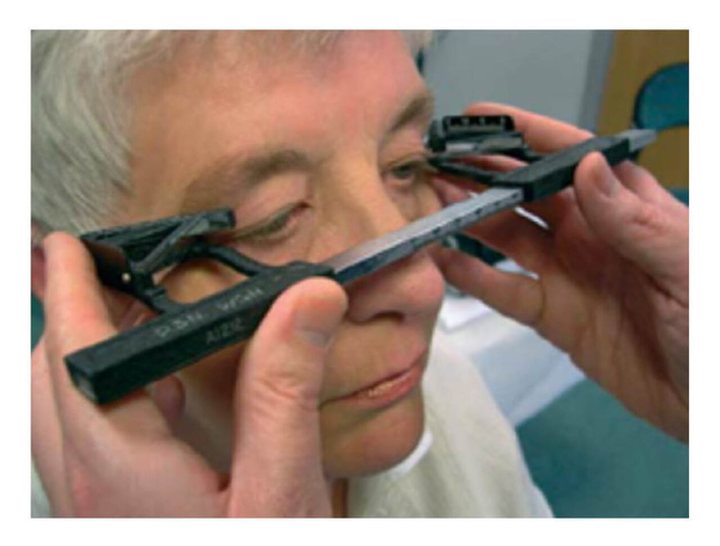
Answer: Hertel's exophthalmometer
Flashcard 2: The following image demonstrates _____
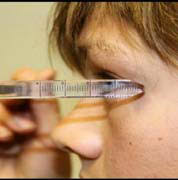
Answer: Luedde exophthalmometer
Flashcard 3: A ruptured dermoid of the eye will present as a pain_____, rapidly-growing proptosis
Answer: ful
Flashcard 4: Dacryoadenitis is the inflammation of the lacrimal _____ caused by infection such as mumps
Answer: gland
Flashcard 5: Proptosis following trauma can be seen in conditions such as: Caroticocavernous fistula, Retro-orbital hematoma, Superior _____ syndrome and Orbital apex syndrome
Answer: orbital fissure
Flashcard 6: _____ presents with unilateral proptosis with diplopia, conjunctival chemosis responsive to systemic corticosteroids.
Answer: Orbital pseudotumor
Flashcard 7: _____: measures protrusion of the apex of cornea from the outer orbital margin (with the eyes looking straight ahead).
Answer: Exophthalmometry
Flashcard 8: Surgical management for thyroid ophthalmopathy: Orbital _____, Extraocular muscle surgery and Eyelid surgery
Answer: decompression
Flashcard 9: Transmitted pulsations leading to pulsatile proptosis maybe seen in congenital _____ and neurofibromatosis
Answer: meningocele
Flashcard 10: Carotid cavernous fistula presents with the classic triad of:_____, Chemosis and Bruit
Answer: Pulsatile proptosis
Flashcard 11: Total ophthalmoplegia is seen in _____ syndrome and Cavernous sinus thrombosis
Answer: Orbital apex
Flashcard 12: _____ sign/Retraction of the upper lids caused by overaction of Muller s muscle, is the most common clinical feature of Grave's ophthalmopathy
Answer: Dalrymple s
Flashcard 13: An absolute protrusion of >_____ mm or a difference of >2 mm between the two eyes is labeled as proptosis.
Answer: 20
Flashcard 14: Eyeballs are pushed _____wards, forwards and laterally in mucocele
Answer: down
Flashcard 15: Non-surgical management for thyroid ophthalmopathy: Systemic _____, Radiotherapy and Guanethidine 5% eye drops
Answer: steroids
Flashcard 16: An orbital lymphangioma of the eye will present as a pain_____, rapidly-growing proptosis
Answer: ful
Flashcard 17: Pulsating vascular lesions, causing pulsatile proptosis include: _____ (most common), and saccular aneurysm of the ophthalmic artery
Answer: Caroticocavernous fistula
Flashcard 18: _____ layer is secreted by the lacrimal and accessory lacrimal glands
Answer: Aqueous
Flashcard 19: Only the _____ of the inferior rectus muscle is involved in thyroid myopathy; the tendon is characteristically spared.
Answer: belly
Flashcard 20: A retinoblastoma of the eye will present as a pain_____, rapidly-growing proptosis
Answer: ful
Flashcard 21: _____ syndrome refers to idiopathic, nonspecific, non granulomatous inflammation, involving the superior orbital fissure and/or orbital apex and/or cavernous sinus.
Answer: Tolosa Hunt
Flashcard 22: Most common cause of intermittent proptosis is _____
Answer: orbital varix
Flashcard 23: _____ is the most common lacrimal gland tumor.
Answer: Pleomorphic adenoma
Flashcard 24: The most common cause of unilateral proptosis in adults is _____
Answer: thyroid ophthalmopathy
Flashcard 25: Signs in Grave's ophthalmopathy:_____ Sign: Abnormal pigmentation of the upper lid
Answer: Jellinek's
Flashcard 26: Signs in Grave's ophthalmopathy:_____ Sign: Lower lid lag on upward gaze
Answer: Griffith
Flashcard 27: Signs in Grave's ophthalmopathy:_____ sign: Convergence weakness
Answer: Mobius
Flashcard 28: Signs in Grave's ophthalmopathy:_____ sign: Infrequent blinking
Answer: Stellwag's
Flashcard 29: Which mode of USG is used in ophthalmology and orbital biometry ?_____
Answer: A mode
Flashcard 30: Signs in Grave's ophthalmopathy:_____ sign: Retraction of the upper lids
Answer: Dalrymple's
Flashcard 31: Signs in Grave's ophthalmopathy:_____ sign: Lid lag, i.e., when the globe is moved downward, the upper lid lags behind
Answer: von Graefe's
Flashcard 32: In thyroid ophthalmopathy, forced duction test is _____
Answer: positive
Flashcard 33: The most common cause of bilateral proptosis in adults is _____.
Answer: thyroid ophthalmopathy
Flashcard 34: Complete Loss of vision is seen in _____, which is a cause of acute inflammatory proptosis
Answer: panophthalmitis
Flashcard 35: _____duction defect in thyroid ophthalmopathy is caused by fibrosis of the lateral rectus
Answer: Ad
Flashcard 36: Hazy cornea is seen in _____, which is a cause of acute inflammatory proptosis
Answer: panophthalmitis
Flashcard 37: Uveal effusion syndrome is a rare idiopathic, often _____ilateral, condition that most frequently affects middle-aged hypermetropic men
Answer: b
Flashcard 38: Most common cause of reducible proptosis is _____
Answer: orbital varix
Flashcard 39: _____ is a condition in which the eyeball appears to be proptosed, but there is no actual forward displacement.*causes?
Answer: Pseudoproptosis
Flashcard 40: Signs in Grave's ophthalmopathy:_____ sign: Difficulty in eversion of the upper lid
Answer: Gifford's
Flashcard 41: _____ is the most common malignant lacrimal gland tumor.
Answer: Adenoid cystic carcinoma
Flashcard 42: Lack of support of the lids by the globe may be due to an _____ deficit, leading to pseudoptosis
Answer: orbital volume
Flashcard 43: Irritation from increased pressure of the upper eyelid against the globe may cause _____ in Grave's ophthalmopathy
Answer: superior limbic keratoconjunctivitis
Flashcard 44: _____ is a mutilating surgery in which all the contents of the orbits along with the periorbita are removed.
Answer: Exenteration
Flashcard 45: Signs in Grave's ophthalmopathy:_____ sign: Fullness of the eyelids
Answer: Enroth's
Flashcard 46: Purulent inflammation of the soft tissues of the orbit is known as _____.
Answer: orbital cellulitis
Flashcard 47: Extra-orbital spread of the malignant melanoma necessitates _____
Answer: enucleation+ chemo+ immunotherapy
Keywords: Orbital Diseases flashcards, medical flashcards, NEET PG preparation, USMLE Step 1 flashcards, Anki alternative, spaced repetition medical, OnCourse flashcards