Pulmonology Indian Medical PG Flashcards - Medical Study Cards
Master Pulmonology with OnCourse flashcards. These spaced repetition flashcards are designed for medical students preparing for NEET PG, USMLE Step 1, USMLE Step 2, MBBS exams, and other medical licensing examinations.
Pulmonology Flashcard Deck - 73 Cards
Flashcard 1: What type of upper airway obstruction is depicted by the following flow-volume loop?
_____
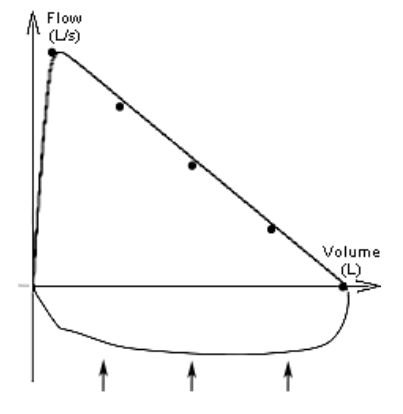
Answer: Variable extrathoracic obstruction
Flashcard 2: What type of upper airway obstruction is depicted by the following flow-volume loop?
_____
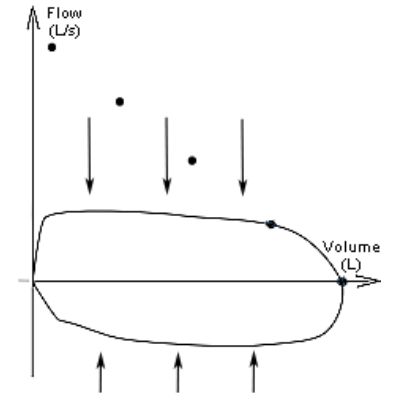
Answer: Fixed upper airway obstruction
Flashcard 3: Day symptoms lasting _____/week and night symptoms lasting d2nights/month with an FEV1 of >80% is classified as mild intermittent asthma according to severity
Answer: d2 days
Flashcard 4: Day symptoms lasting _____/week and night symptoms lasting >1 nights/week with an FEV1 of 60-80% is classified as moderate persistent asthma according to severity
Answer: daily
Flashcard 5: _____ lung disease may be caused by poor structural apparatus, such as scoliosis and morbid obesity
Answer: Restrictive
Flashcard 6: _____ pleural effusion occurs due to thoracic duct injury from trauma or malignancy
Answer: Lymphatic
Flashcard 7: Aspiration pneumonia is commonly seen in _____ and anesthetized patients
Answer: alcoholics
Flashcard 8: Allergic bronchopulmonary aspergillosis is usually seen in individuals with _____ or cystic fibrosis
Answer: asthma
Flashcard 9: At 18 hours after inhalation injury, bronchoscopy will typically show severe _____, congestion of bronchi, and soot deposition
Answer: edema
Flashcard 10: Blood tests of patients with Allergic Bronchopulmonary Aspergillosis will show _____creased IgE
Answer: in
Flashcard 11: Pulmonary infarction due to PE may present with _____ (RR) and tachycardia (HR)
Answer: tachypnea
Flashcard 12: Pneumonia due to Staphylococcus aureus is often complicated by _____ formation or empyema (pus in the pleural space)
Answer: abscess
Flashcard 13: _____ pleural effusion is caused by states of increased vascular permeability (e.g. malignancy, pneumonia, trauma, collagen vascular disease)
Answer: Exudative
Flashcard 14: _____ presents with hyper-resonance on the affected side
Answer: Pneumothorax
Flashcard 15: Asthma with impending respiratory failure will have rising PaCO2 in a silent patient with _____cardia and silent chest
Answer: brady
Flashcard 16: Pulmonary _____ due to PE occurs if a large- or medium-sized artery is obstructed in patients with pre-existing cardiopulmonary compromise
Answer: infarction
Flashcard 17: Secondary pulmonary hypertension due to Lung Disease may arise due to _____ of lung parenchyma (e.g. COPD / Interstitial lung disease) or hypoxic pulmonary vasoconstriction (e.g. obstructive sleep apnea, high altitude)
Answer: damage / inflammation
Flashcard 18: ARDS is a diagnosis of exclusion with the following criteria (ARDS)- Abnormal chest x-ray- Respiratory failure within _____ of insult- Decreased Pao2 / FIO2 ratio - Symptoms of respiratory failure are not due to HF/fluid overload
Answer: 1 week
Flashcard 19: Clinical features of pneumonia include productive cough with _____ or rusty-colored sputum (due to pus and blood, respectively)
Answer: yellow-green
Flashcard 20: Chronic bronchitis presents with _____ due to excessive mucus production and late-onset dyspnea
Answer: productive cough
Flashcard 21: Acute _____ is caused by diffuse alveolar damage with impairment of the alveolar-capillary interface
Answer: (aka Adult) respiratory distress syndrome (ARDS)
Flashcard 22: The arterial blood profile seen in compensated respiratory acidosis is: pH: _____[HCO3-]: increasedPCO2: increased
Answer: decreased
Flashcard 23: _____ often presents with prolonged expiration with pursed lips
Answer: Emphysema
Flashcard 24: Sarcoidosis is associated with _____ CD4+/CD8+ ratio in bronchoalveolar lavage fluid
Answer: elevated
Flashcard 25: Chronic bronchitis is associated with _____ Paco2 and decreased Pao2
Answer: increased
Flashcard 26: Day symptoms lasting _____/week and night symptoms lasting >2 nights/month with an FEV1 of {{c2 asthma according to severity
Answer: >2 days
Flashcard 27: Increased levels of IgE in _____ leads to eosinophilia, causing intense inflammation of airways and mucus plugs in terminal bronchioles. Repeated attacks may lead to bronchiectasis.
Answer: Allergic bronchopulmonary aspergillosis
Flashcard 28: One clinical feature of _____ is a productive cough with spiral-shaped mucus plugs, known as Curschmann spirals
Answer: asthma
Flashcard 29: _____ lung diseases are characterized by a FEV1/FVC ratio > 80%
Answer: Restrictive
Flashcard 30: _____ pleural effusion may be caused by increased hydrostatic pressure (e.g. HF)
Answer: Transudative
Flashcard 31: _____ occurs when mouth anaerobic bacteria enter the lungs
Answer: Aspiration pneumonia
Flashcard 32: Allergic bronchopulmonary aspergillosis can be treated with _____ to reduce IgE response.
Answer: corticosteroids
Flashcard 33: The causes of _____ syndrome may be remembered with "SPARTAS" S: SepsisP: Pancreatitis, PneumoniaA: AspirationR: uRemia T: TraumaA: Amniotic fluid embolismS: Shock
Answer: acute respiratory distress
Flashcard 34: Sarcoidosis is associated with _____ due to increased 1-hydroxylase activity in epithelioid histiocytes
Answer: hypercalcemia
Flashcard 35: Emphysema may be caused by excessive _____ or lack of 1-antitrypsin
Answer: inflammation/proteases
Flashcard 36: _____-capillary pulmonary hypertension also called as pulmonary arterial hypertension involves group I of WHO classification
Answer: Pre
Flashcard 37: Type _____, also called as acute hypoxemic respiratory failure, is because of alveolar flooding and subsequent intrapulmonary shunt physiology
Answer: I
Flashcard 38: A patient with _____ breathes at a higher lung volume and will thus have a barrel-shaped chest (increased anterior-posterior diameter)
Answer: emphysema
Flashcard 39: Allergic bronchopulmonary aspergillosis is an IgE-mediated type I hypersensitivity reaction that is most often seen in individuals suffering from _____ or cystic fibrosis.
Answer: asthma
Flashcard 40: _____ is a result of inhalation of the Aspergillus fumigatus fungus and presents with wheezing, fever and migratory pulmonary infiltrate
Answer: Allergic Bronchopulmonary Aspergillosis (ABPA)
Flashcard 41: Pneumonia may present with _____ breath sounds and dullness to percussion
Answer: decreased
Flashcard 42: Granulomas due to sarcoidosis most commonly involve the _____ lymph nodes and the lung, leading to restrictive lung disease
Answer: hilar
Flashcard 43: One complication associated with lung cancer is _____, which is classically seen with adenocarcinoma
Answer: pleural effusion
Flashcard 44: _____ is defined as a productive cough lasting > 3 months per year for > 2 years
Answer: Chronic bronchitis
Flashcard 45: Clinical diagnosis of asthma may be aided with _____ (PFTs) and methacholine challenge
Answer: spirometry
Flashcard 46: _____ pleural effusion may be caused by decreased oncotic pressure (e.g. nephrotic syndrome, cirrhosis)
Answer: Transudative
Flashcard 47: Day symptoms lasting continual/frequent and night symptoms lasting _____/week with an FEV1 of {{c2 asthma according to severity
Answer: 4-7 nights
Flashcard 48: Treatment of ARDS includes mechanical ventilation with _____ and most importantly low tidal volumes
Answer: positive end-expiratory pressure (PEEP)
Flashcard 49: OHS, causes _____ hypoxia and hypercapnia
Answer: chronic
Flashcard 50: The presence of pleural fluid cholesterol usually > _____mg/dl is suggestive of pseudochylothorax
Answer: 200
Flashcard 51: What is the pattern of bronchiectasis seen in Allergic bronchopulmonary Aspergillosis?_____
Answer: Central Bronchiectasis
Flashcard 52: What is the adequate SpO2 that a patient of COPD can be kept on using assisted respiratory techniques like the Venturi mask?_____
Answer: 85-92%
Flashcard 53: Acute onset tachypnea and hypotension, in a post-op CABG patient points to the diagnosis of acute _____ failure
Answer: respiratory
Flashcard 54: Is mediastinal shift always seen in pneumothorax?_____
Answer: No, unless its tension pneumothorax
Flashcard 55: What is the next line of mx in a patient of status asthamaticus who hasn't had a good response to initial bronchodialator and oral steroid rx?_____
Answer: IV MgSO4
Flashcard 56: What is the next step in managing a patient on standard oxygen therapy using bag and mask ventilation?_____
Answer: high flow nasal cannula/NIV
Flashcard 57: Patients of sarcoidosis will undergo spontaneous remission especially in stage _____
Answer: I
Flashcard 58: Bronchoscopy shows the typical 'cobblestone' appearance of the mucosa in _____
Answer: sarcoidosis
Flashcard 59: Which subtypes of idiopathic interstitial pneumonia are associated with upper respiratory tract infection?_____
Answer: Acute interstitial pneumonia (AIP)
Flashcard 60: What is the most common cause of acute exacerbation of COPD?_____
Answer: H. influenzae
Flashcard 61: What is the change in DLco in patients of PAH?_____
Answer: Decreased
Flashcard 62: The sinus most commonly involved in acute sinusitis is the _____
Answer: maxillary
Flashcard 63: A patient with low-risk PE will be treated with _____ alone
Answer: anticoagulation
Flashcard 64: Patient with a positive vasoreactivity test using inhaled NO, _____ are used as first line for management of PAH
Answer: CCBs
Flashcard 65: The graph given below shows _____ _____thoracic obstruction
Answer: variable::variable/fixed; intra::intra/extra
Flashcard 66: A young adult with _____ is most likely to have _____ emphysema.
Answer: spontaneous pneumothorax; paraseptal
Flashcard 67: Pulmonary embolism causes an _____udative pleural effusion
Answer: ex
Flashcard 68: Pneumonia due to Moraxella catarrhalis is likely to be associated with underlying _____ or smoking.
Answer: COPD
Flashcard 69: Pulmonary lymphangioleiomyomatosis (LAM) has a predilection for _____smoker, _____male patients.
Answer: non-; fe
Flashcard 70: Bronchiectasis in the back ground of cystic fibrosis predominantly shows _____ lobe involvement.
Answer: upper
Flashcard 71: CD4+/CD8+ ratio on BAL is found to be _____1 in case of Hypersensitivity Pneumonitis
Answer: <
Flashcard 72: _____ therapy will decrease mortality in chronic obstructive pulmonary disease (COPD).
Answer: Long-term oxygen
Flashcard 73: Surfactant replacement is _____ useful in the management of patients with ARDS.
Answer: not
Keywords: Pulmonology flashcards, medical flashcards, NEET PG preparation, USMLE Step 1 flashcards, Anki alternative, spaced repetition medical, OnCourse flashcards